Sold For $9,390
*Includes Buyers Premium
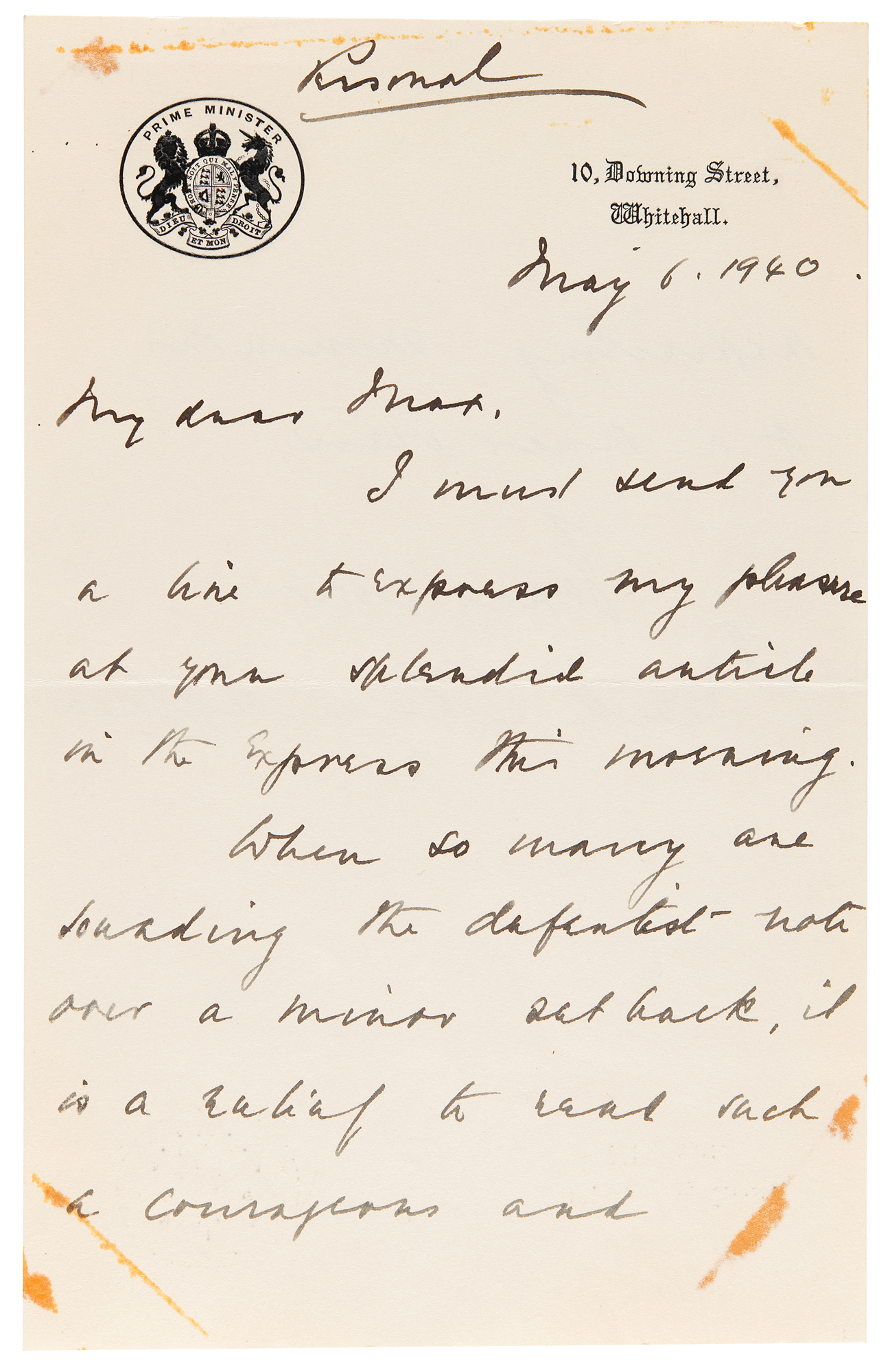
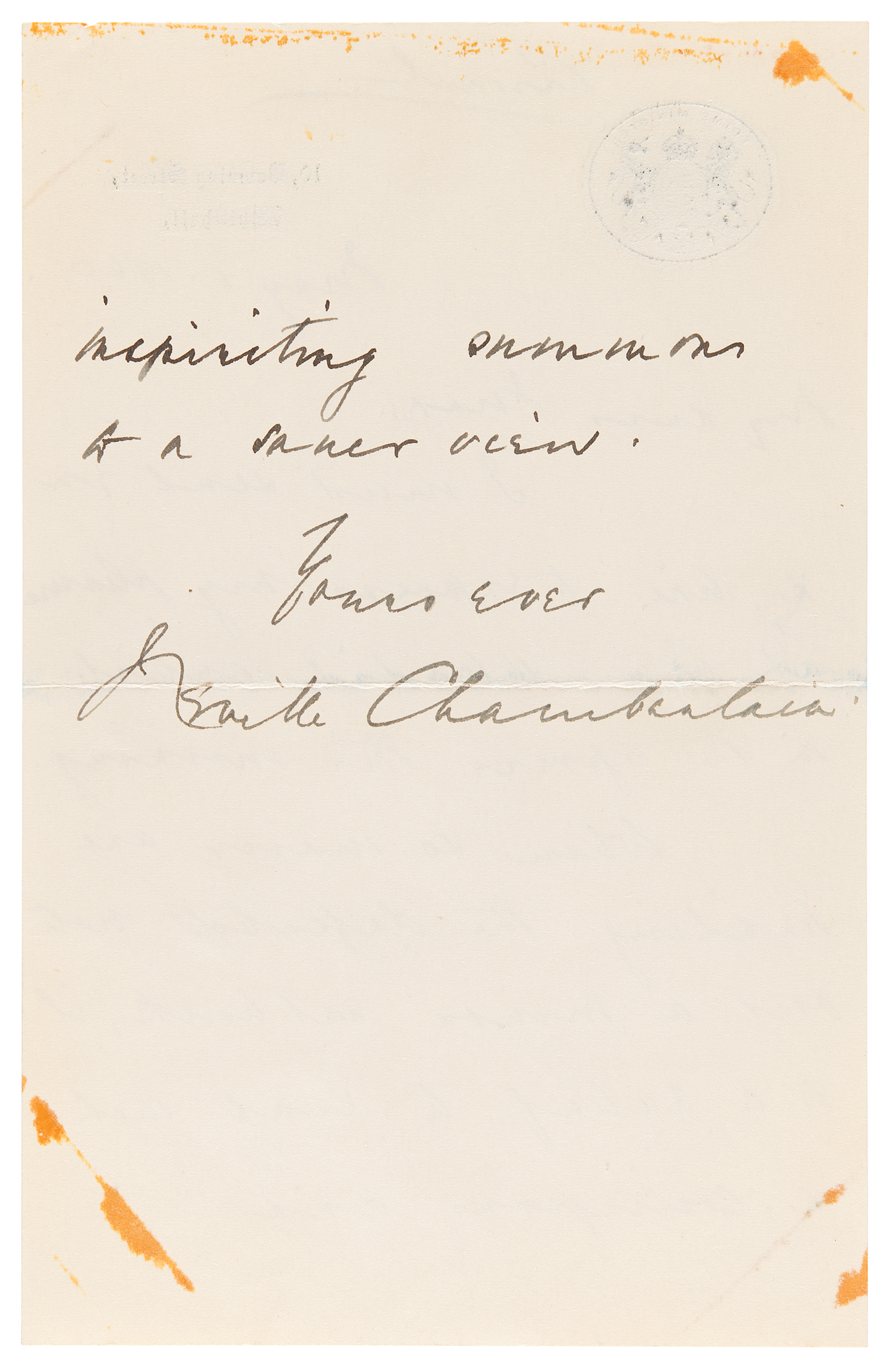
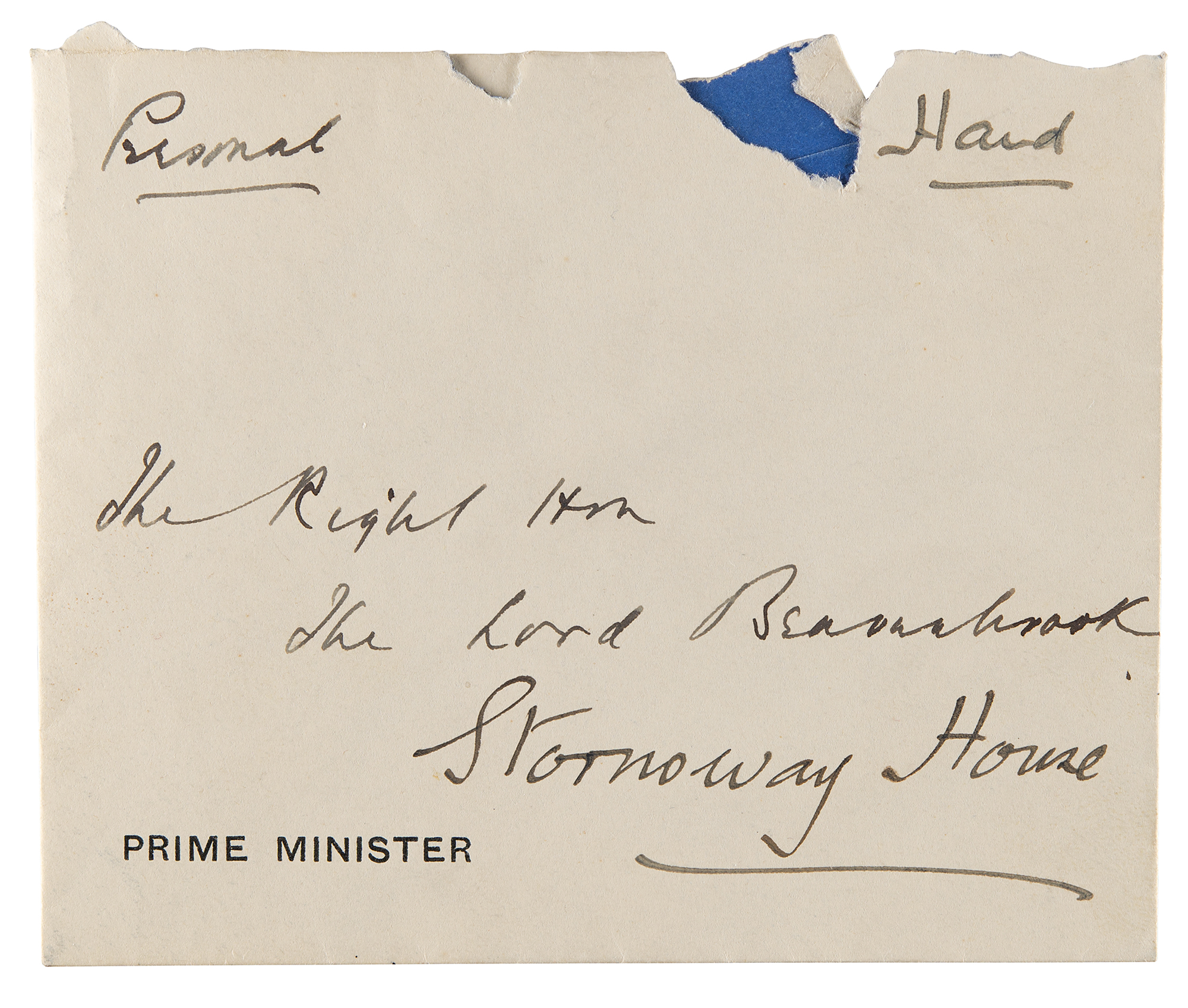
World War II–dated ALS, signed "Neville Chamberlain," one page both sides, 4.75 x 7.5, 10 Downing Street letterhead, May 6, 1940. Handwritten letter to influential British newspaper publisher Max Aitken, Lord Beaverbrook, marked "Personal," thanking him for publishing a supportive article amidst the Norway crisis. In full: "I must send you a line to express my pleasure at your splendid article in the Express this morning. When so many are sounding the defeatist note over a minor set back, it is a relief to read such a courageous inspiriting summons to a saner view." In very good to fine condition, with old mounting stains to the corners. Accompanied by the original mailing envelope, addressed in Chamberlain's own hand.
A month earlier, in April 1940, Germany launched Operation Weserübung, the invasion of Norway, aiming to secure iron ore shipments and seize strategic ports. Great Britain sent forces to aid the Norwegians, with much trumpeting about the might of British sea power, but the campaign ended in humiliating defeat. German forces, using swift amphibious assaults and paratroopers, seized key Norwegian cities before the Allies could mount an effective defense. Britain's attempts to counter the invasion, notably at Narvik, ended in retreat as German air superiority and logistical challenges overwhelmed the expedition, exposing serious weaknesses in British military coordination and planning.
Chamberlain's government was in crisis and public opinion began to turn. On May 6, Beaverbrook did his best to support Chamberlain, publishing an article, 'What is the Damage?,' in The Daily Express. He dismissed the Norwegian failure as a minor affair, damaging only to British prestige, urging his readers not to 'despair over accounts in this war of incompetence, of stupidity, of misunderstanding and even of wilful neglect. Such vices and weaknesses are inseparable from war.' He further outlined his reasons for confidence, including the defeat of U-boats, immense financial resources, the impregnable Maginot Line, and the misperception of domestic safety: 'We may hope, with some confidence, that London and other densely populated areas of Britain will not be bombed at all.' Chamberlain wrote at once to express his pleasure with Beaverbrook's work, reducing the Norwegian failure to a "minor setback."
Lord Beaverbrook's article could not stem the tide of opinion. The next day, May 7th, the House of Commons convened and began the 'Norway Debate,' discussing Allied efforts against Germany. The proceedings redirected to Chamberlain and his inefficacy as the nation’s wartime leader. At the end of the second day of debate, there was a division of the House for the members to hold a no-confidence motion. Chamberlain’s government won the vote but by a drastically reduced majority.
On May 9th and 10th, a desperate Chamberlain sought to form a coalition government with Labour and Liberal participation. The proposal was denied, but the opposition consented to the plan if a different Conservative was named prime minister. After Chamberlain’s first choice, Edward Wood, the Earl of Halifax, declined, the second candidate, Winston Churchill, emerged as the final choice. On the same day, Germany began its massive western offensive on Belgium, Luxembourg, the Netherlands, and France. Accordingly, Chamberlain went to Buckingham Palace to resign and advise the King to send for Churchill.
In a resignation broadcast that evening, Chamberlain told the nation: ‘For the hour has now come when we are to be put to the test, as the innocent people of Holland, Belgium, and France are being tested already. And you and I must rally behind our new leader, and with our united strength, and with unshakable courage fight, and work until this wild beast, which has sprung out of his lair upon us, has been finally disarmed and overthrown.’
Chamberlain's letter to Beaverbrook is discussed in several biographies and histories of World War II, including: Beaverbrook by Alan John Percivale Taylor (1972); Rudolf Hess and Germany's Reluctant War 1939-41 by Alfred Smith (2001); A History of the English-Speaking Peoples Since 1900 by Andrew Roberts (2010); and The Newspaper Axis: Six Press Barons Who Enabled Hitler by Kathryn S. Olmsted (2022).

This item is Pre-Certified by PSA/DNA
Buy a third-party letter of authenticity for
(inquire for price)
*This item has been pre-certified by a trusted third-party authentication service, and by placing a bid on this item, you agree to accept the opinion of this authentication service. If you wish to have an opinion rendered by a different authenticator of your choosing, you must do so prior to your placing of any bid. RR Auction is not responsible for differing opinions submitted 30 days after the date of the sale.
Third-party authentication service applies only to signatures and handwriting, and does not cover the addition of sketches, artwork, musical quotations, etc.

