The 30 Minute Rule begins November 19 at 7:00 PM EST. An Initial Bid Must Be Placed By November 19 at 6:00 PM EST To Participate After 6:00 PM EST
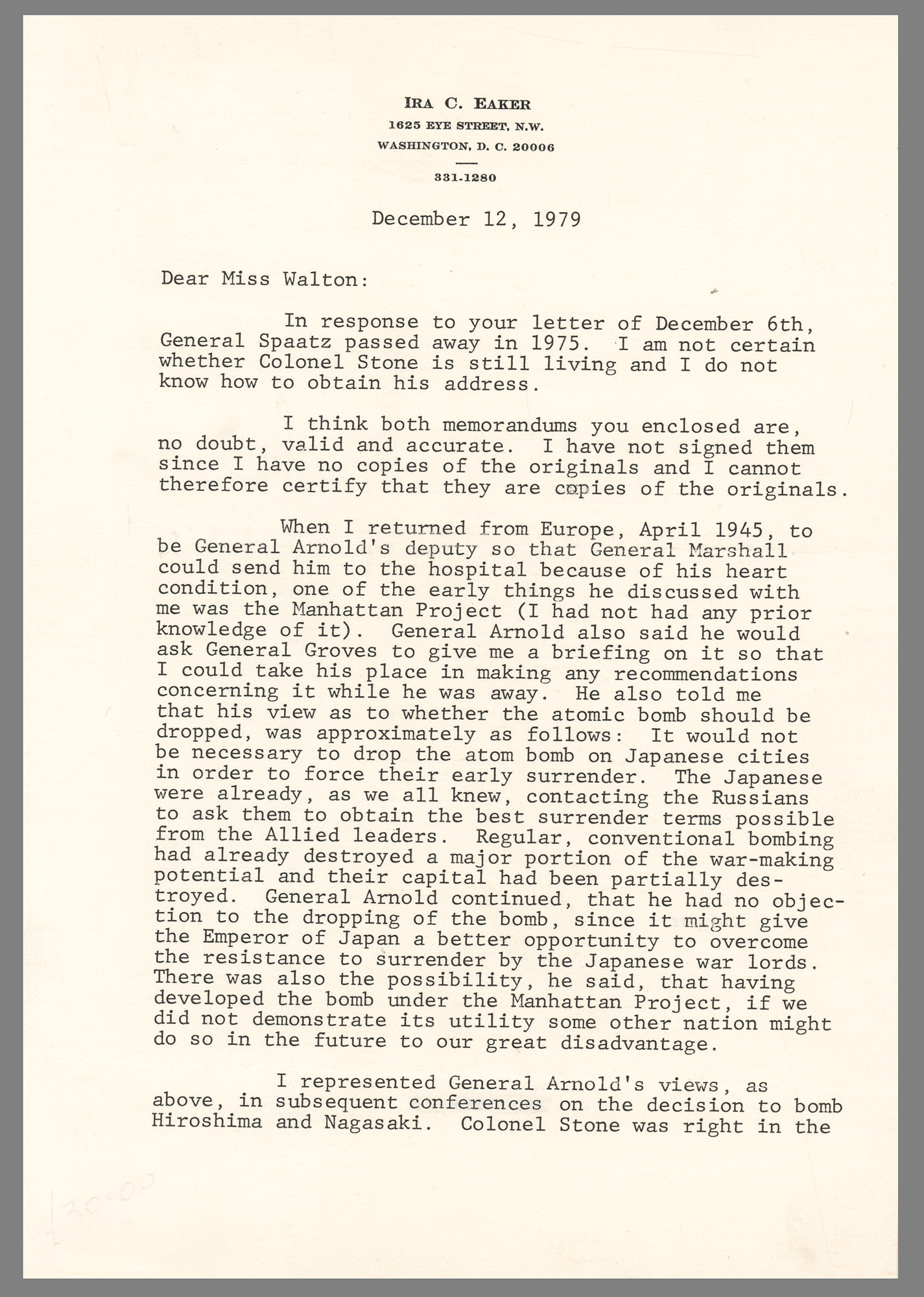
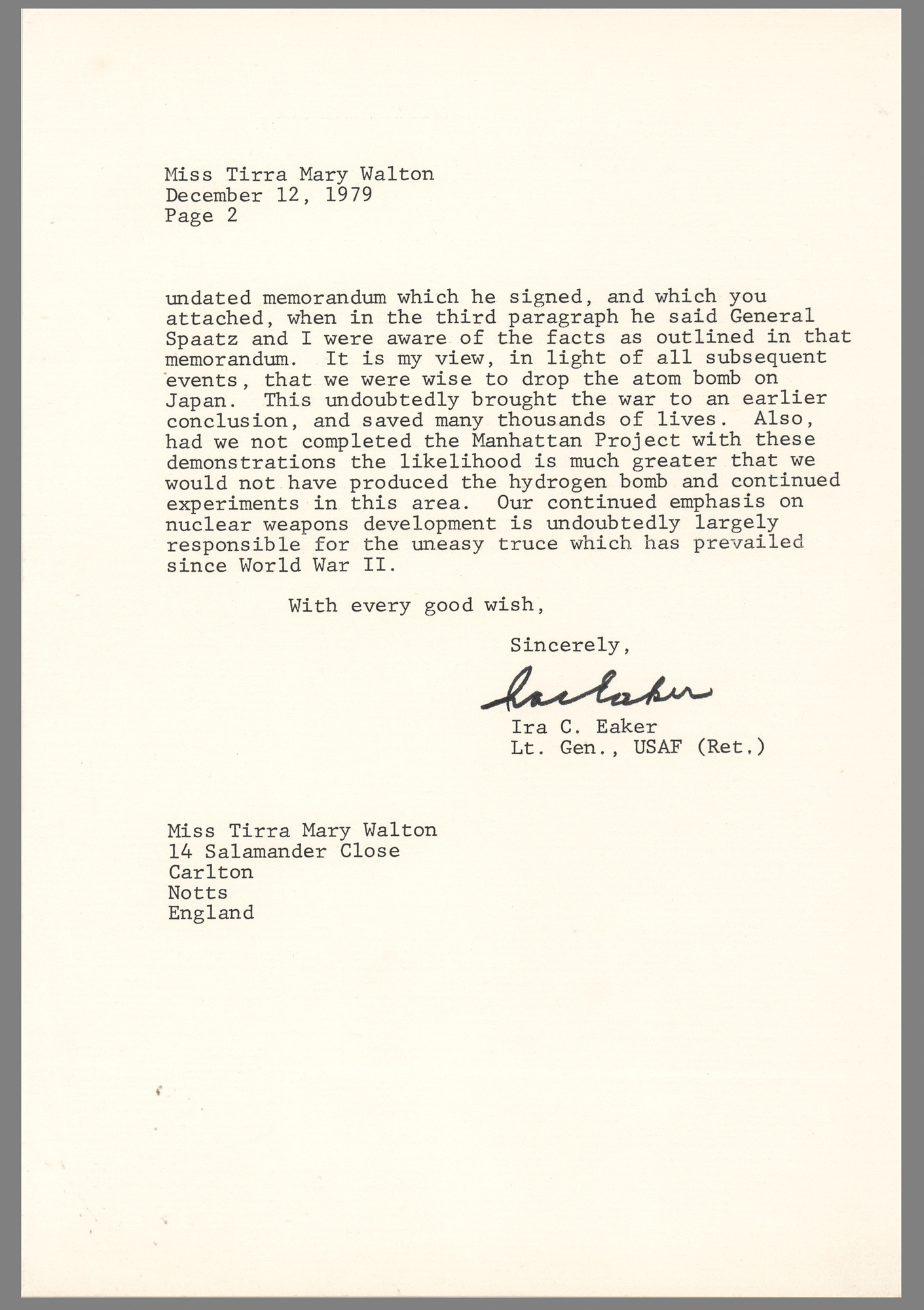
American Army Air Forces general (1896–1987) who organized and commanded the Eighth Air Force’s strategic bombing campaign during World War II. He later led the Mediterranean Allied Air Forces and served as deputy commander of the Army Air Forces. TLS, one page, 7.25 x 10.5, personal letterhead, December 12, 1979. Letter to Miss Tirra Mary Walton, in part: “When I returned from Europe, April 1945, to be General Arnold’s deputy so that General Marshall could send him to the hospital because of his heart condition, one of the early things he discussed with me was the Manhattan Project (I had not had any prior knowledge of it). General Arnold also said he would ask General Groves to give me a briefing on it so that I could take his place in making any recommendations concerning it while he was away. He also told me that his view as to whether the atomic bomb should be dropped, was approximately as follows: It would not be necessary to drop the atom bomb on Japanese cities in order to force their early surrender. The Japanese were already, as we all knew, contacting the Russians to ask them to obtain the best surrender terms possible from the Allied leaders. Regular, conventional bombing had already destroyed a major portion of the war-making potential and their capital had been partially destroyed. General Arnold continued, that he had no objection to the dropping of the bomb, since it might give the Emperor of Japan a better opportunity to overcome the resistance to surrender by the Japanese war lords. There was also the possibility, he said, that having developed the bomb under the Manhattan Project, if we did not demonstrate its utility some other nation might do so in the future to our great disadvantage.
I represented General Arnold’s views, as above, in subsequent conferences on the decision to bomb Hiroshima and Nagasaki. Colonel Stone was right in the undated memorandum which he signed, and which you attached, when in the third paragraph he said General Spaatz and I were aware of the facts as outlined in that memorandum. It is my view, in light of all subsequent events, that we were wise to drop the atom bomb on Japan. This undoubtedly brought the war to an earlier conclusion, and saved many thousands of lives. Also, had we not completed the Manhattan Project with these demonstrations the likelihood is much greater that we would not have produced the hydrogen bomb and continued experiments in this area. Our continued emphasis on nuclear weapons development is undoubtedly largely responsible for the uneasy truce which has prevailed since World War II.” In fine condition, with light creasing to the left side.
A pioneer of American air power, Ira C. Eaker flew the record-setting 'Question Mark' refueling endurance flight in 1929. In World War II he built and led the Eighth Air Force’s heavy-bomber campaign over Europe, flying on its first B-17 mission against Rouen in August 1942. He later commanded the Mediterranean Allied Air Forces. In April 1945 he returned to Washington as deputy commander of the Army Air Forces and chief of the Air Staff, serving under Gen. Henry H. 'Hap' Arnold, whose repeated heart attacks often kept him from his duties. In that role Eaker represented Arnold at the June 18, 1945, White House meeting where President Truman and his military chiefs reviewed plans for the invasion of Japan, and he took part in the deliberations that preceded the atomic missions against Hiroshima and Nagasaki that August. The “Colonel Stone” he mentions is presumably Col. John N. Stone, Arnold’s staff officer for atomic bomb matters. Eaker retired in 1947 as a lieutenant general, wrote widely on national defense, and was advanced to four-star rank by act of Congress in 1985. He died on August 6, 1987, the 42nd anniversary of the bombing of Hiroshima.

This item is Pre-Certified by PSA/DNA
Buy a third-party letter of authenticity for
(inquire for price)
*This item has been pre-certified by a trusted third-party authentication service, and by placing a bid on this item, you agree to accept the opinion of this authentication service. If you wish to have an opinion rendered by a different authenticator of your choosing, you must do so prior to your placing of any bid. RR Auction is not responsible for differing opinions submitted 30 days after the date of the sale.
Third-party authentication service applies only to signatures and handwriting, and does not cover the addition of sketches, artwork, musical quotations, etc.

