The 30 Minute Rule begins November 11 at 7:00 PM EST. An Initial Bid Must Be Placed By November 11 at 6:00 PM EST To Participate After 6:00 PM EST
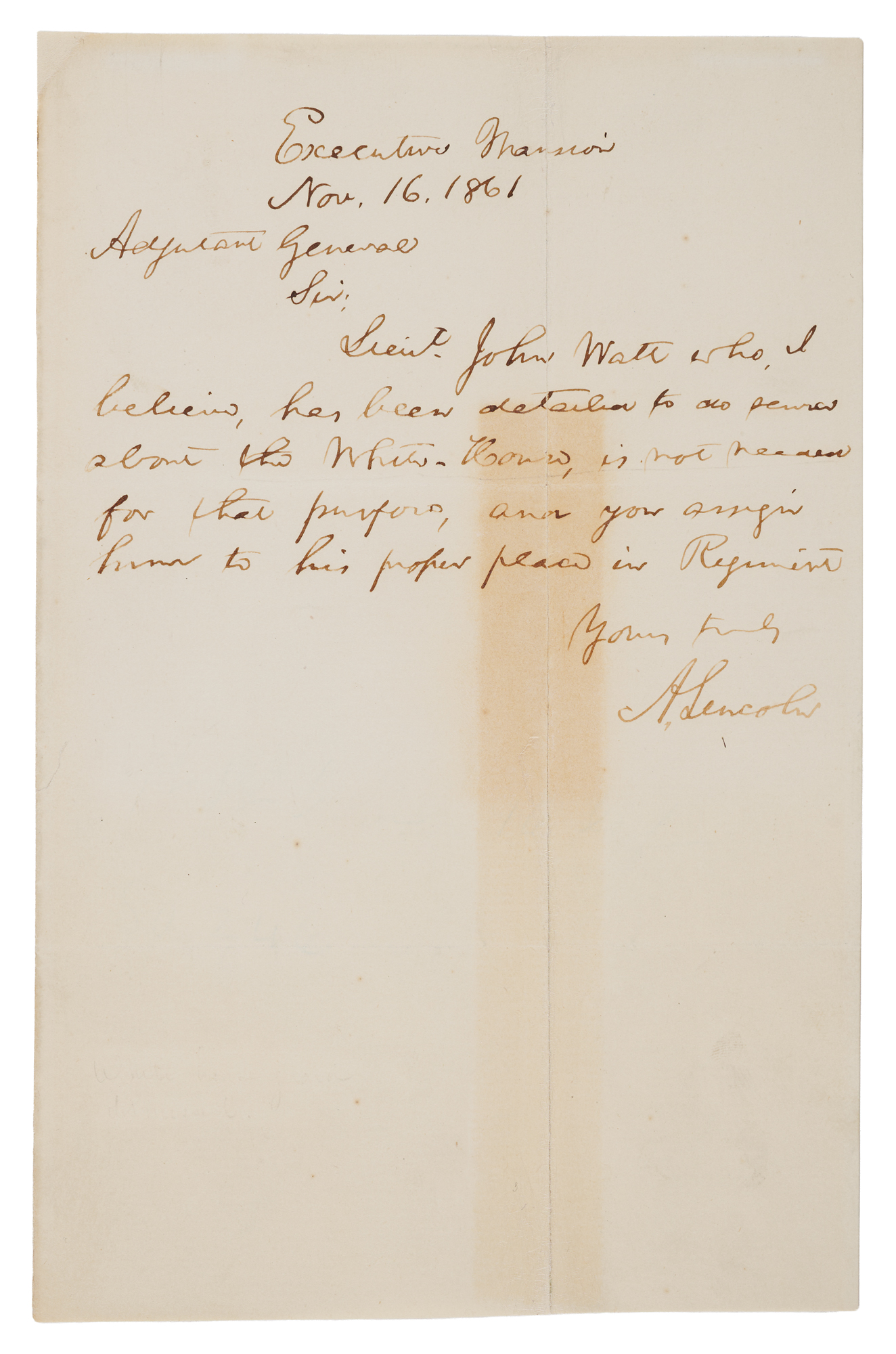
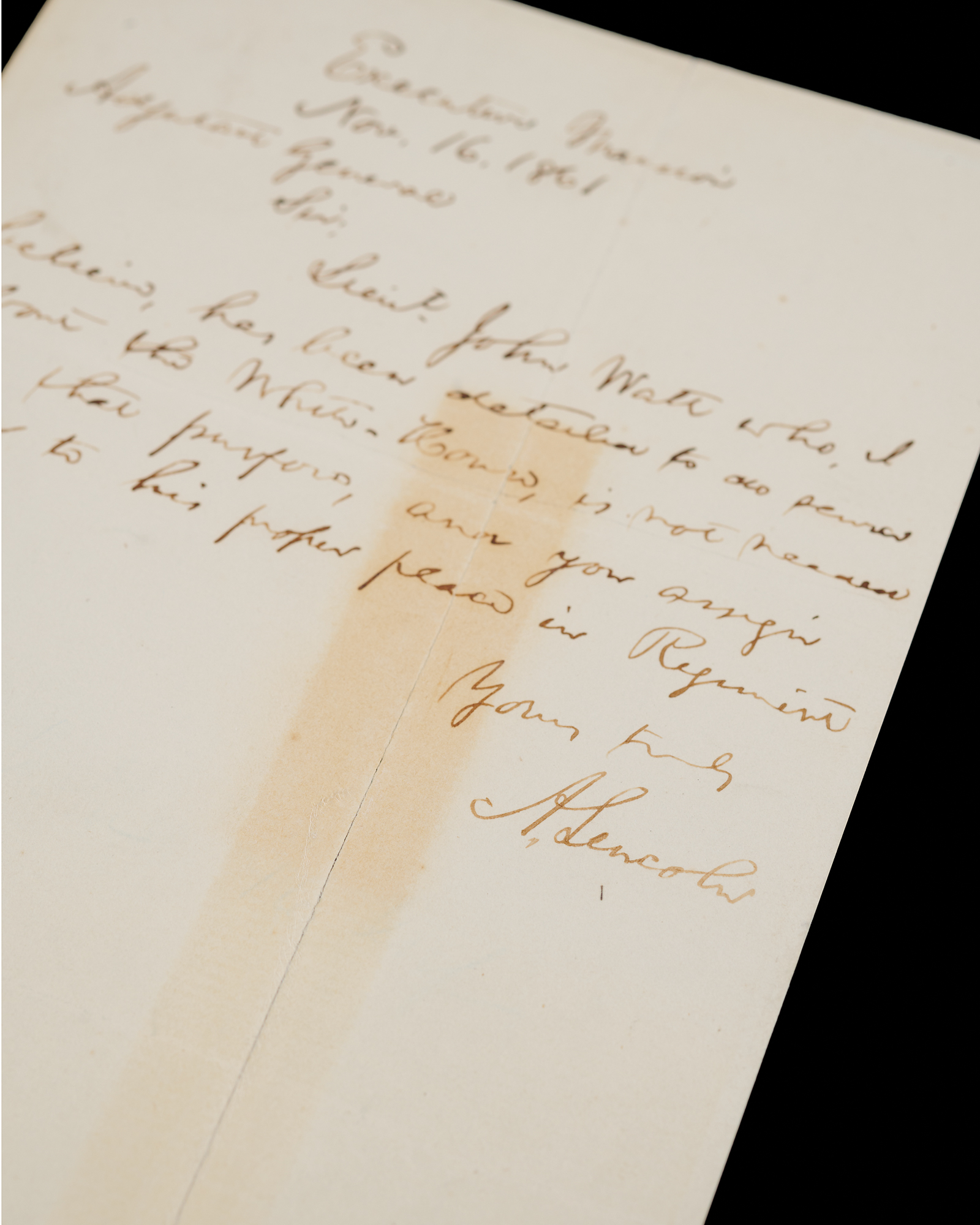
Civil War-dated ALS as president, signed “A. Lincoln,” one page, 5 x 7.75, November 16, 1861. Addressed from the “Executive Mansion,” a handwritten letter to the Adjutant General [Lorenzo Thomas], in full: “Lieut. John Watt who, I believe, has been detailed to do service about the White-House, is not needed for that purpose, and you assign him to his proper place in Regiment.” Old tape professionally removed leaving some staining along a repaired fold touching several words of text, in near fine condition.
John Watt, a White House gardener and groundskeeper, had won Mary Todd Lincoln’s confidence and her help securing a military appointment that allowed him to remain at the presidential residence. In September 1861, she defended him against accusations of dishonesty and thanked Secretary of War Simon Cameron for arranging his cavalry appointment and White House assignment. Watt also faced allegations of disloyalty investigated by Congressman John F. Potter’s committee, whose letter on September 12, 1861, forwarded to the President the testimony against Watt on disloyalty charges to the Union. This letter of reassignment was most likely in reference to the investigation. Despite Lincoln’s instruction, the reassignment did not take place. Portions of Lincoln’s first annual message appeared in the New York Herald before its December 3, 1861, delivery to Congress, prompting a separate House inquiry. According to journalist Ben Perley Poore’s later reminiscences, Watt testified that he had read the message in the Executive Mansion library and repeated portions from memory to Henry Wikoff. Herald correspondent S. P. Hanscom testified that Wikoff had told him earlier that the leaks came from Mary Todd Lincoln. Due to the implication of his wife, Abraham Lincoln became the first sitting president to testify before a committee of Congress. Lincoln testified in secret, and he said that only members of his cabinet had seen the address ahead of time, meaning nobody else, including Mary, could have leaked it. Watt remained in his post until February 1862, when his commission was revoked following the Potter investigation.
The name ‘White House’ appeared in nineteenth-century newspapers and periodicals, though ‘President’s House’ and ‘Executive Mansion’ were more common. In October 1901, Theodore Roosevelt directed that ‘White House’ replace ‘Executive Mansion’ in the headings and date lines of official papers requiring his signature. Lincoln’s use of both “Executive Mansion” and “White-House” in his own hand makes this letter especially desirable for collectors of presidential manuscripts and White House history.
This item is Pre-Certified by PSA/DNA
Buy a third-party letter of authenticity for
$500.00
*This item has been pre-certified by a trusted third-party authentication service, and by placing a bid on this item, you agree to accept the opinion of this authentication service. If you wish to have an opinion rendered by a different authenticator of your choosing, you must do so prior to your placing of any bid. RR Auction is not responsible for differing opinions submitted 30 days after the date of the sale.
Third-party authentication service applies only to signatures and handwriting, and does not cover the addition of sketches, artwork, musical quotations, etc.

