The 30 Minute Rule begins November 19 at 7:00 PM EST. An Initial Bid Must Be Placed By November 19 at 6:00 PM EST To Participate After 6:00 PM EST
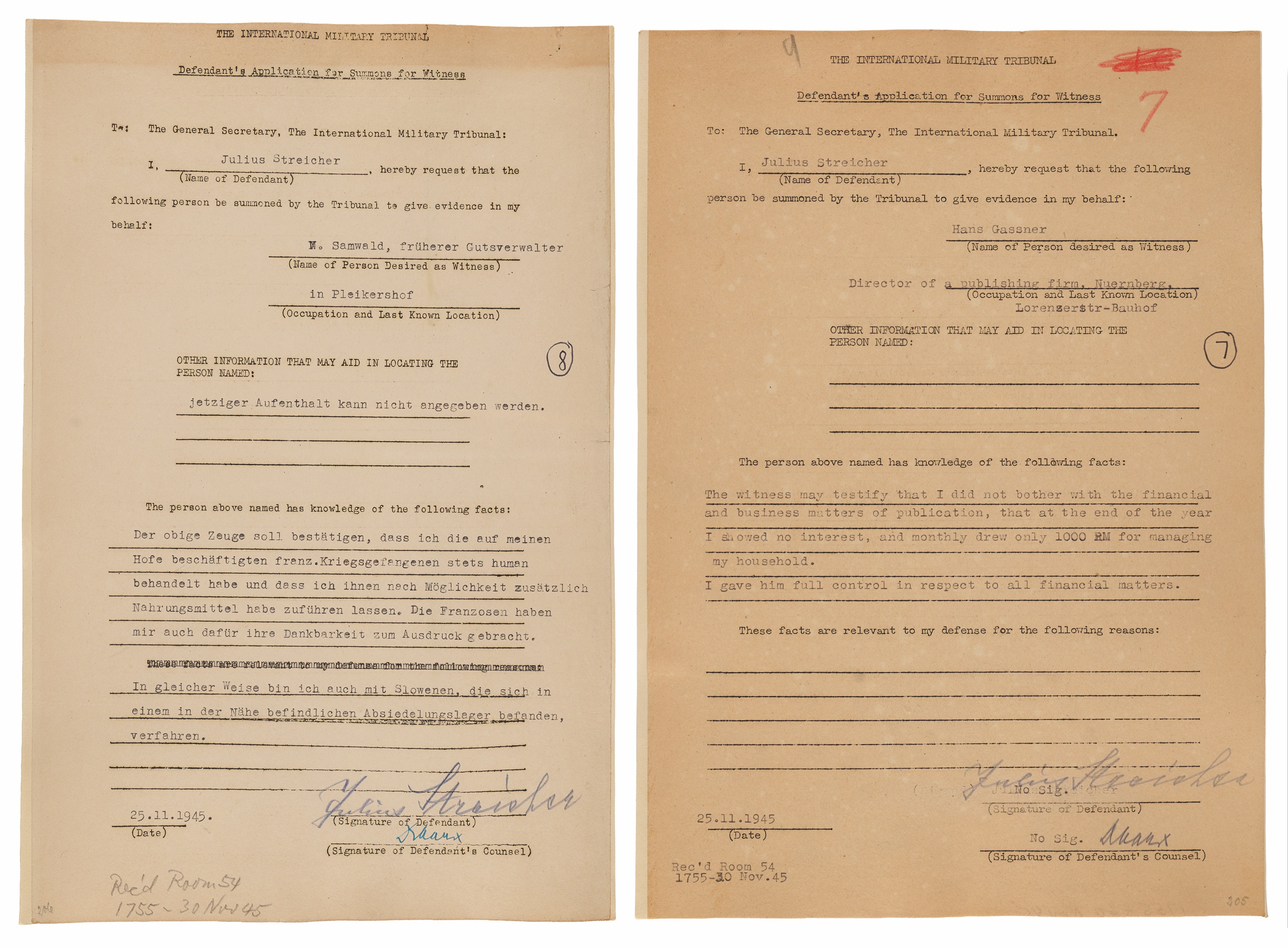
Two witness applications signed by Julius Streicher while preparing his Nuremberg defense, affixed back-to-back on a single cardstock sheet:
- Partly-printed DS, in English, one page, 8 x 12.25, November 25, 1945. Document headed, "The International Military Tribunal, Defendant's Application for Summons for Witness." Streicher and his defense lawyer request testimony from "Hans Gassner," explaining: "The witness may testify that I did not bother with the financial and business matters of publication, that at the end of the year I showed no interest, and monthly drew only 1000 RM for managing my household. I have him full control in respect to all financial matters." Signed at the conclusion in pencil by Julius Streicher, and countersigned by his defense attorney.
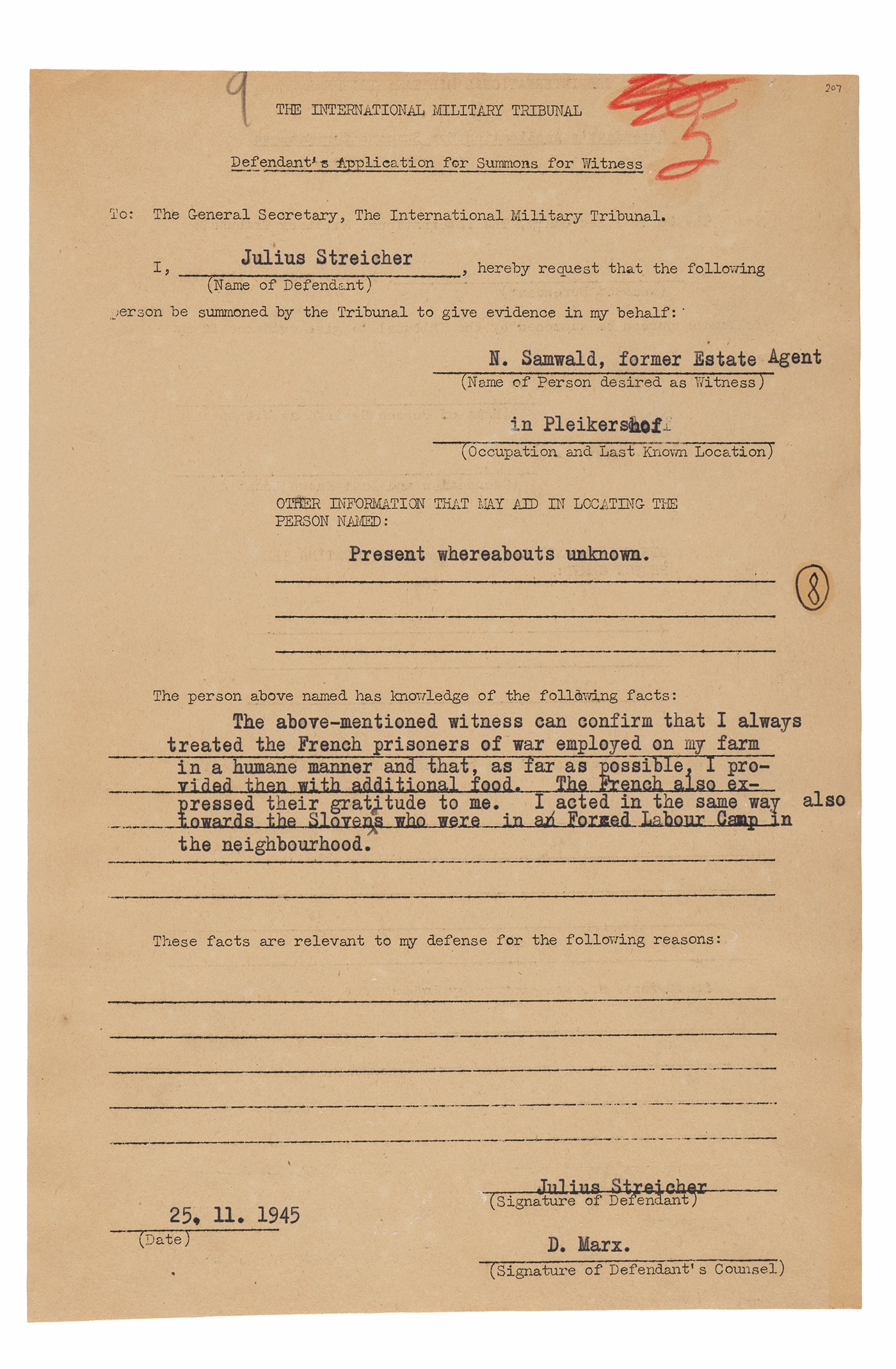
- Partly-printed DS, in German, one page, 7.75 x 12.25, November 25, 1945. Document headed, "The International Military Tribunal, Defendant's Application for Summons for Witness." Streicher and his defense lawyer request testimony from "N. Samwald, former Estate Agent," explaining (translated): "The above-mentioned witness can confirm that I always treated the French prisoners of war employed on my farm in a humane manner and that, as far as possible, I provided them with additional food. The French also expressed their gratitude to me. I acted in the same way also towards the Slovenes who were in a forced labor camp in the neighborhood." Signed at the conclusion in pencil by Julius Streicher, and countersigned by his defense attorney. Accompanied by a contemporary English translation.
Backed by lightweight cardstock and in fine condition, with a band of toning across the top of the second document.
Taken together, these two applications show Streicher attempting to construct a defense around personal character and financial detachment rather than confronting the central accusation against him. By calling former estate agent N. Samwald, he sought testimony that French prisoners of war and Slovene forced laborers on his farm had been treated humanely and even given extra food. Through publishing director Hans Gassner, meanwhile, Streicher aimed to portray himself as removed from the financial affairs of his publishing enterprise, claiming that he took only a fixed household allowance and left business matters entirely in Gassner's hands.
Neither line of testimony addressed the charge that proved decisive at Nuremberg: Streicher's sustained use of Der Stürmer to incite hatred, persecution, and ultimately extermination of the Jews. The juxtaposition is revealing—on one side an appeal to humane private conduct, on the other an effort to distance himself from the business operations of his newspaper, while its propagandistic role remained untouched. The Tribunal convicted Streicher of crimes against humanity for his campaign of antisemitic incitement, and he was executed on October 16, 1946.

This item is Pre-Certified by PSA/DNA
Buy a third-party letter of authenticity for
(inquire for price)
*This item has been pre-certified by a trusted third-party authentication service, and by placing a bid on this item, you agree to accept the opinion of this authentication service. If you wish to have an opinion rendered by a different authenticator of your choosing, you must do so prior to your placing of any bid. RR Auction is not responsible for differing opinions submitted 30 days after the date of the sale.
Third-party authentication service applies only to signatures and handwriting, and does not cover the addition of sketches, artwork, musical quotations, etc.

