The 30 Minute Rule begins November 19 at 7:00 PM EST. An Initial Bid Must Be Placed By November 19 at 6:00 PM EST To Participate After 6:00 PM EST
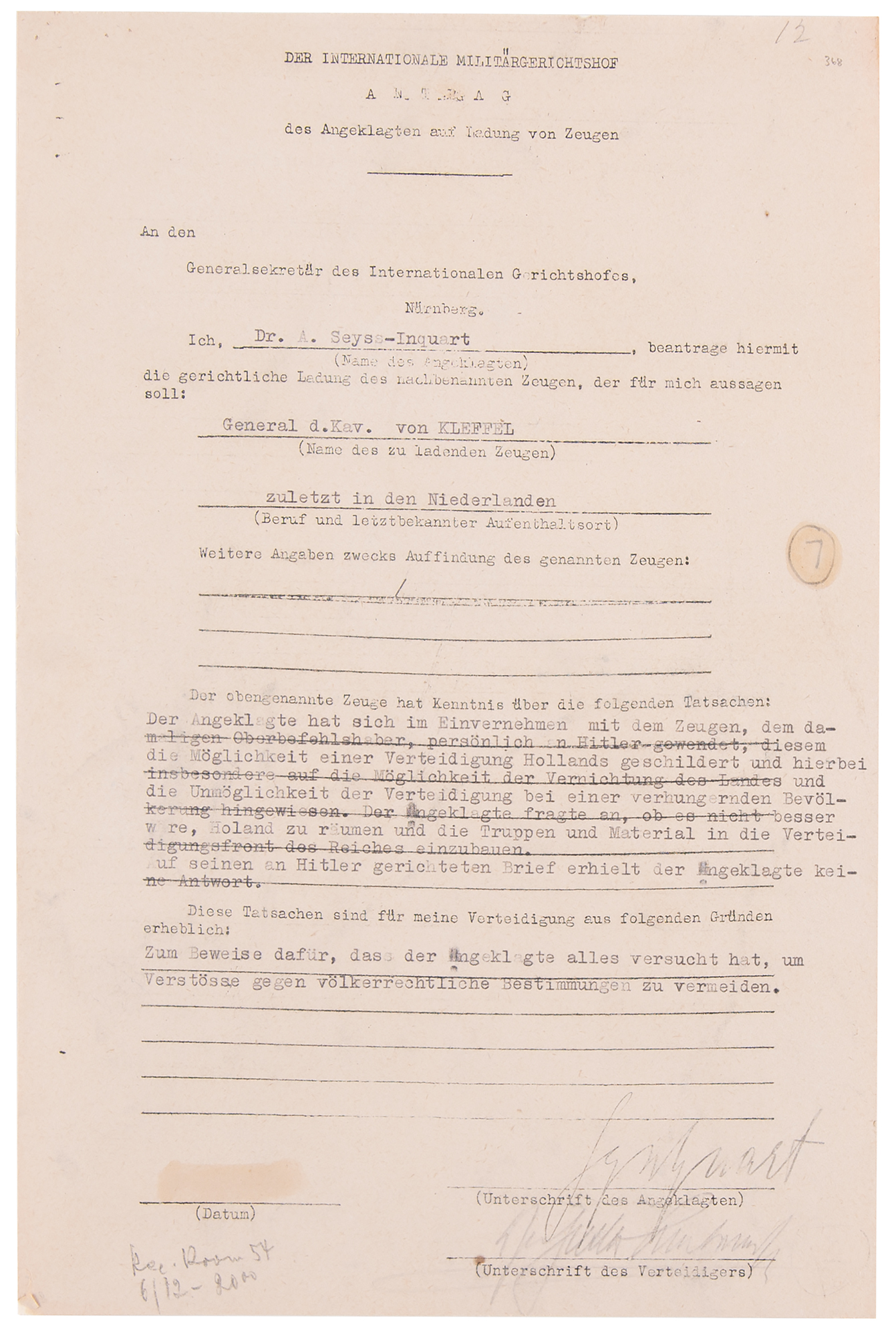
Partly-printed DS, in German, signed “Seyss-Inquart,” one page, 8 x 12.25, December 6, 1945. Document headed (translated), "The International Military Tribunal, Defendant's Application for Summons for Witness," made while preparing his defense for the Nuremberg trials. Seyss-Inquart and his defense lawyer request testimony from "General of the Cavalry von Kleffel," citing his knowledge of these facts: "The accused personally applied to Hitler, in cooperation with the witness who was Supreme Commander at that time; he has told Hitler about the possibilities to defend Holland and has especially emphasized the possibility of the destruction of the country and the impossibility of a defense, with a starving population. The accused inquired, if it would not be better to evacuate Holland and to incorporate the troops and the material into the defense front of the Reich. The accused received no reply to his letter which was directed to Hitler."
Seyss-Inquart states that this testimony will serve as "proof that the accused has tried everything to prevent violations against the provisions of international law." Signed at the conclusion in pencil by Seyss-Inquart, and countersigned by his defense counsel. Backed by archival paper and in fine condition, with professional cleaning to the paper. Accompanied by a contemporary English translation.
Seyss-Inquart sought the testimony of General of the Cavalry Rudolf von Kleffel, then a senior German commander in the Netherlands, to support his claim that he had tried to avert the destruction of Holland in the war’s final months. According to the application, Seyss-Inquart joined von Kleffel in warning Hitler that continued resistance could devastate the country and leave its already starving population in an impossible position; he proposed evacuating the Netherlands and transferring German troops and matériel to the Reich’s defensive line, but received no reply. He offered the episode as evidence that he had “tried everything to prevent violations against the provisions of international law.”
The argument formed part of Seyss-Inquart’s broader effort at Nuremberg to portray himself as a restrained administrator working within limits imposed from above. The Tribunal rejected that characterization, finding that he had exercised substantial authority in Austria and the occupied Netherlands and had willingly participated in policies involving deportation, forced labor, persecution, and repression. Seyss-Inquart was convicted on all four counts and executed by hanging on October 16, 1946.

This item is Pre-Certified by PSA/DNA
Buy a third-party letter of authenticity for
(inquire for price)
*This item has been pre-certified by a trusted third-party authentication service, and by placing a bid on this item, you agree to accept the opinion of this authentication service. If you wish to have an opinion rendered by a different authenticator of your choosing, you must do so prior to your placing of any bid. RR Auction is not responsible for differing opinions submitted 30 days after the date of the sale.
Third-party authentication service applies only to signatures and handwriting, and does not cover the addition of sketches, artwork, musical quotations, etc.

