The 30 Minute Rule begins November 19 at 7:00 PM EST. An Initial Bid Must Be Placed By November 19 at 6:00 PM EST To Participate After 6:00 PM EST
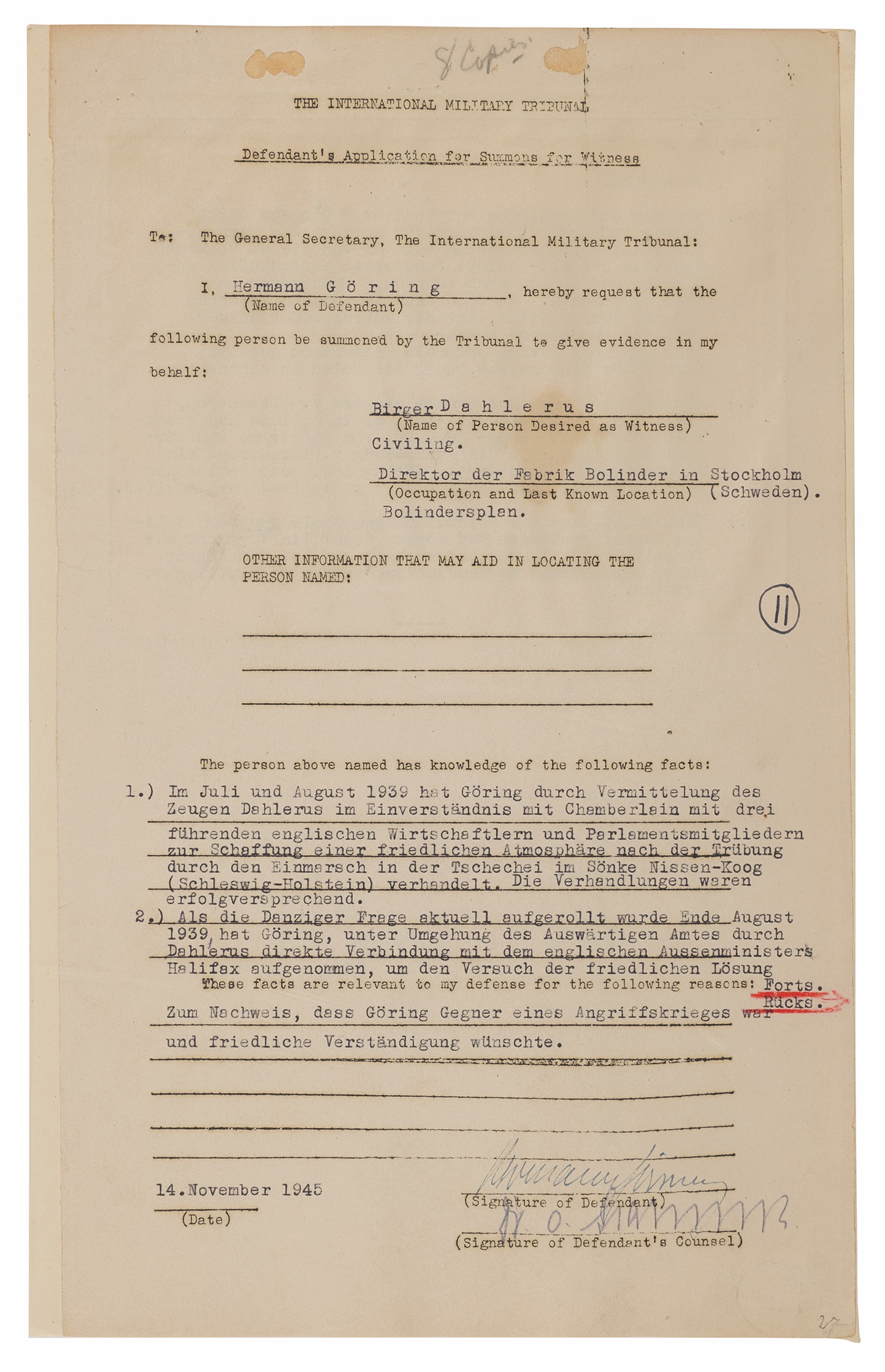
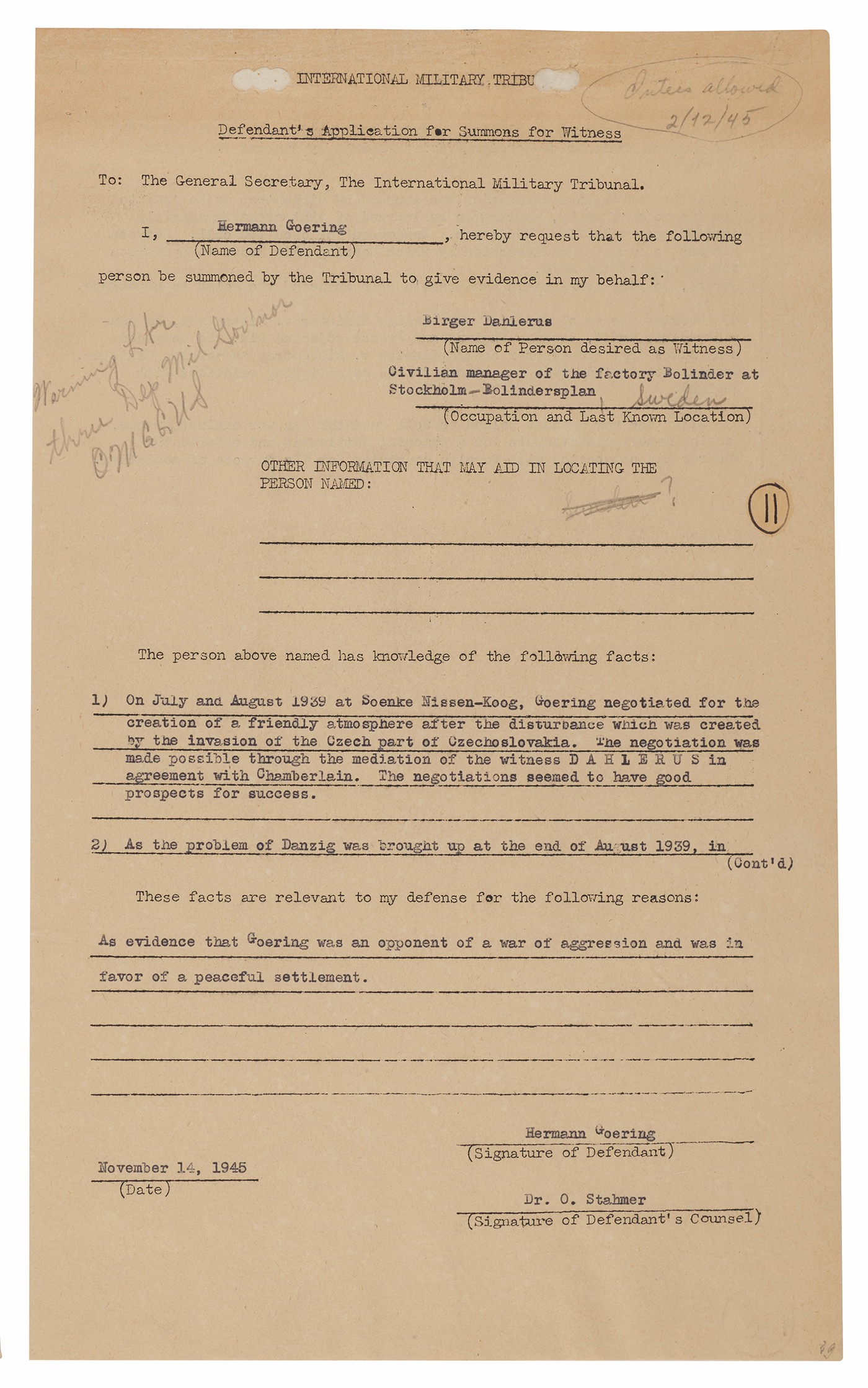
Partly-printed DS, in German, signed “Hermann Göring,” one page both sides, 7.75 x 12.75, November 14, 1945. Document headed, "The International Military Tribunal, Defendant's Application for Summons for Witness," made while preparing his defense for the Nuremberg trials. Göring and his defense lawyer request testimony from "Birger Dahlerus," a Swedish businessman and director of the Bolinder factory in Stockholm, citing his knowledge of five separate facts (translated):
"1) In July and August 1939 at Soenke Nissen-Koog, Goering negotiated for the creation of a friendly atmosphere after the disturbance which was created by the invasion of the Czech part of Czechoslovakia. The negotiation was made possible through the mediation of the witness Dahlerus in agreement with Chamberlain. The negotiations seemed to have good prospects for success.
2) As the problem of Danzig was brought up at the end of August 1939, in order to try a peaceful solution, Goering took up direct connection with the English Minister of Foreign Affairs Halifax by passing the German Foreign Office.
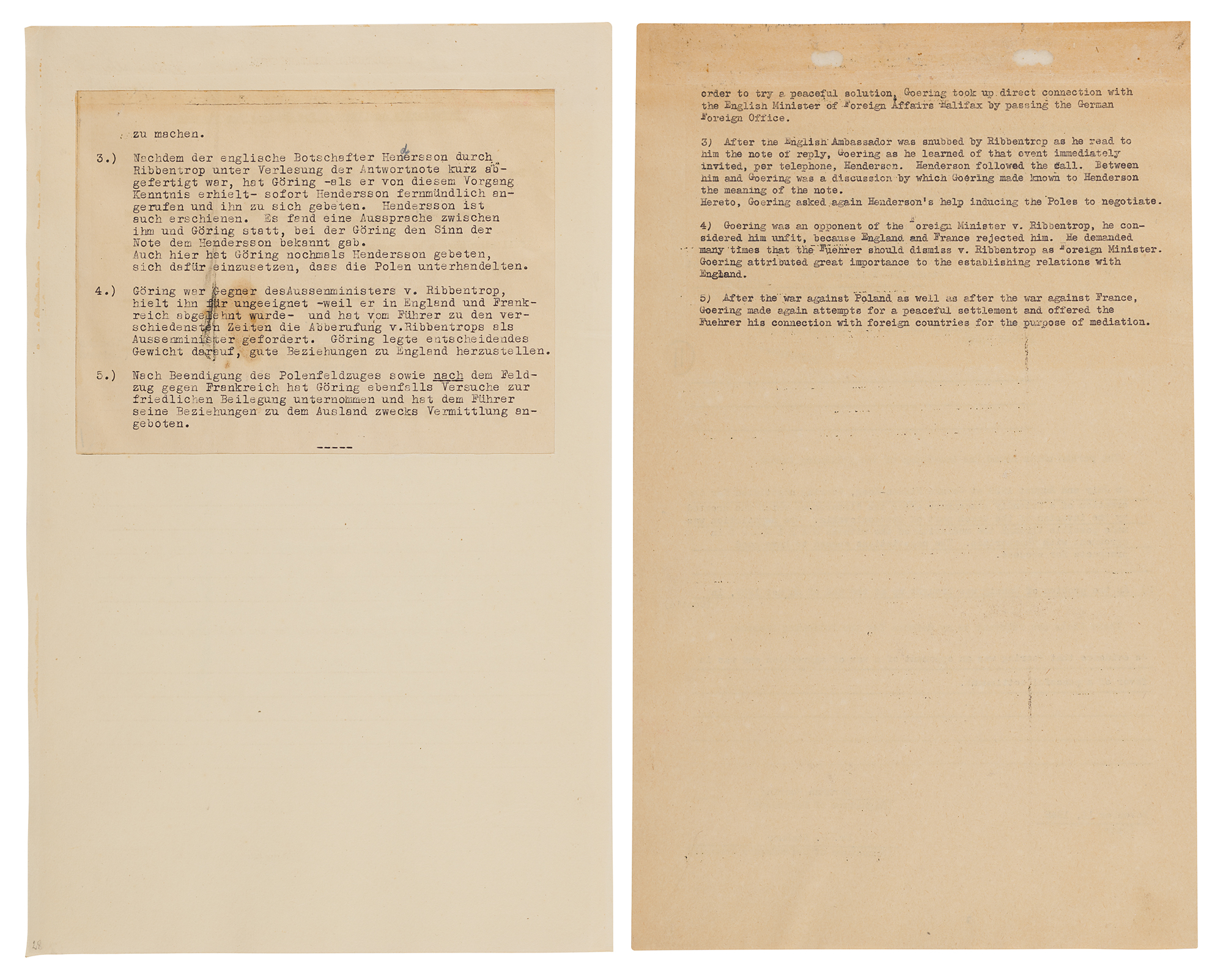
3) After the English ambassador was snubbed by Ribbentrop as he read to him the note of reply, Goering as he learned of that event immediately invited, per telephone, Henderson. Henderson followed the call. Between him and Goering was a discussion by which Goering made known to Henderson the meaning of the note. Hereto, Goering asked again Henderson's help inducing the Poles to negotiate.
4) Goering was an opponent of the Foreign Minister v. Ribbentrop, he considered him unfit, because England and France rejected him. He demanded many times that the Fuehrer should dismiss v. Ribbentrop as Foreign Minister. Goering attributed great importance to the establishing relations with England.
5) After the war against Poland as well as after the war against France, Goering made again attempts for a peaceful settlement and offered the Fuehrer his connection with foreign countries for the purpose of mediation." Backed by lightweight cardstock and in fine condition. Accompanied by a contemporary English translation.
Birger Dahlerus, a Swedish industrialist with close ties in both Britain and Germany, became an unofficial intermediary during the final frantic days before the outbreak of World War II, shuttling between Göring and senior British officials in an effort to avert hostilities. Göring cited those negotiations at Nuremberg as evidence that he had worked for a peaceful settlement, bypassing Ribbentrop to communicate with Lord Halifax and Sir Nevile Henderson and pressing for renewed talks over Danzig.
Dahlerus did testify at the trial in March 1946, initially called by Göring's own counsel, and confirmed many details of the backchannel diplomacy; under cross-examination, however, his testimony also exposed the limits of Göring's narrative, including that crucial German military intentions had been concealed from him while he was being used as an intermediary. Rather than establishing Göring as an opponent of aggressive war, Dahlerus's appearance illustrated how diplomatic overtures unfolded alongside preparations for the invasion of Poland, which began on September 1, 1939.
Ultimately, Dahlerus's testimony damaged rather than strengthened Göring's defense, undermining his attempt to portray himself as a consistent advocate for peace and exposing the deceptive character of the diplomacy surrounding the outbreak of war. Göring was convicted on all four counts before the International Military Tribunal and sentenced to death; he committed suicide by cyanide on October 15, 1946, hours before his scheduled execution.

This item is Pre-Certified by PSA/DNA
Buy a third-party letter of authenticity for
(inquire for price)
*This item has been pre-certified by a trusted third-party authentication service, and by placing a bid on this item, you agree to accept the opinion of this authentication service. If you wish to have an opinion rendered by a different authenticator of your choosing, you must do so prior to your placing of any bid. RR Auction is not responsible for differing opinions submitted 30 days after the date of the sale.
Third-party authentication service applies only to signatures and handwriting, and does not cover the addition of sketches, artwork, musical quotations, etc.

