The 30 Minute Rule begins November 11 at 7:00 PM EST. An Initial Bid Must Be Placed By November 11 at 6:00 PM EST To Participate After 6:00 PM EST
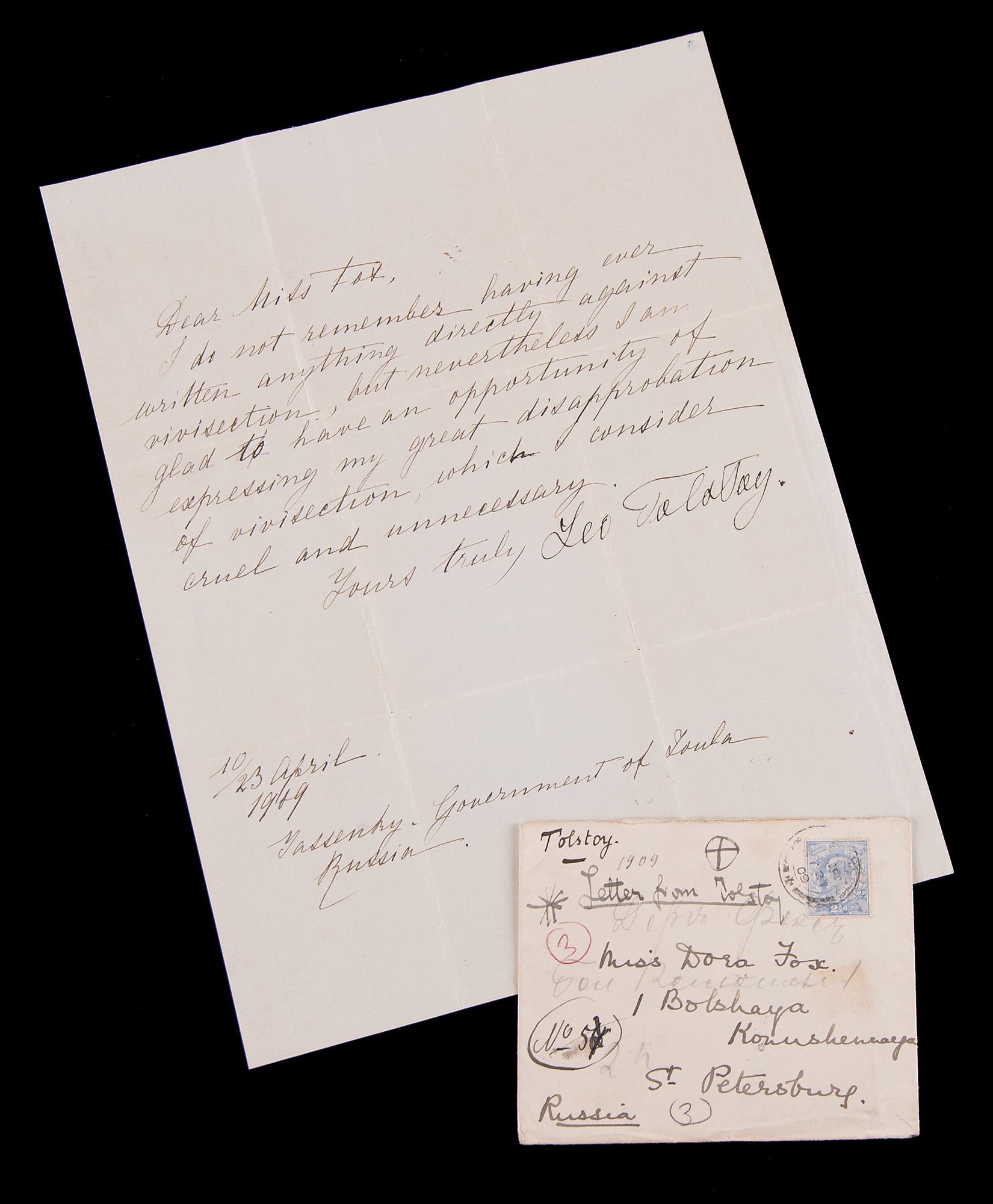
ALS, one page, 8.75 x 11.25, April 10/23, 1909. Handwritten letter to Dora Fox in St. Petersburg, in full: "I do not remember having ever written anything directly against vivisection, but nevertheless I am glad to have an opportunity of expressing my great disapprobation of vivisection, which I consider cruel and unnecessary." In fine condition. Accompanied by the original mailing envelope.
Tolstoy’s objection to vivisection was consistent with the ethical philosophy he developed during the later decades of his life, when he increasingly embraced vegetarianism, nonviolence, and compassion toward animals. His influential essay 'The First Step,' written as a preface to a Russian edition of Howard Williams’s The Ethics of Diet, argued that the killing of animals for food represented an unnecessary form of violence and became one of the best-known expressions of Tolstoy’s vegetarian convictions.
These beliefs formed part of a broader humanitarian outlook that also brought Tolstoy into direct conflict with institutions of imperial Russia. During the devastating famine of 1891–1892, he and his family became deeply involved in relief work, organizing soup kitchens and distributing food among suffering peasants. At the same time, Tolstoy publicly criticized the social and governmental conditions that had intensified the crisis, further establishing his reputation as one of Russia’s most prominent moral critics.
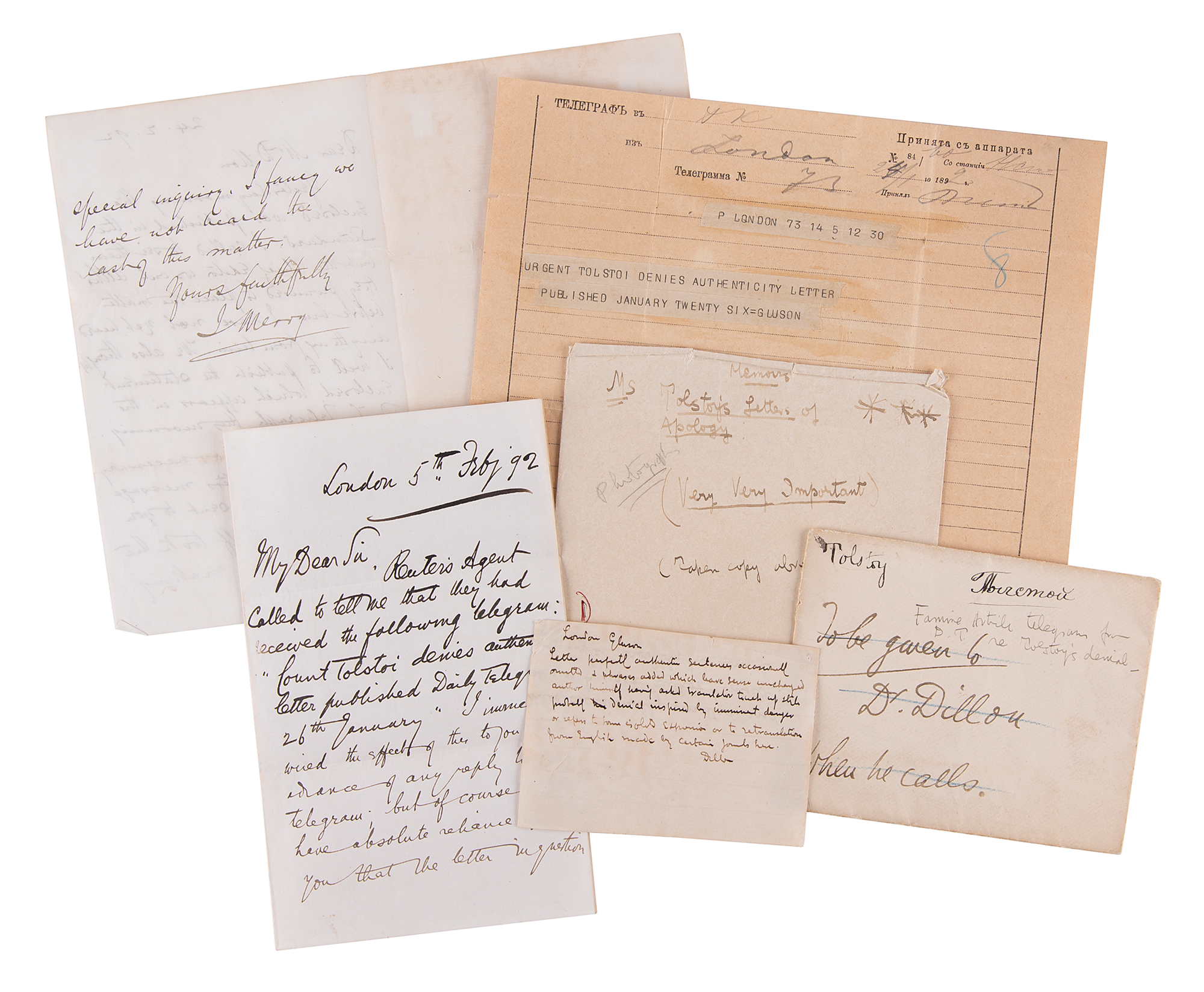
The Tolstoy letter is accompanied by an interesting archive association with a press controversy arising from Tolstoy’s essay on the famine. In January 1892, the London Daily Telegraph published an English version of his remarks that was subsequently retranslated and excerpted in the Russian press. The altered wording gave some readers the impression that Tolstoy had issued a more radical political denunciation than appeared in his original text, provoking considerable controversy.
Included with the Tolstoy letter are several documents connected with the dispute and with journalist Emile J. Dillon, the Daily Telegraph’s well-known correspondent on Russian affairs. One letter, dated London, February 5, 1892, reports that Reuters had received a telegram stating: “Count Tolstoi denies authenticity letter published in The Daily Telegraph 26th January,” and notes that the information was immediately wired to Dillon.
Also included is an autograph note signed by Dillon defending the authenticity of the published material and addressing the editorial changes made during translation. In part: “Letter perfectly authentic sentences occasionally omitted & phrases added which leave sense unchanged. Author himself having asked translator touch up style, probably denial inspired by imminent danger or refer to some…expression or retranslation made by certain journals here. Dillon.”
A further letter, dated February 24, 1892, likewise concerns the developing press dispute, referring to statements appearing in the Daily Standard and Daily Telegraph and efforts to clarify the matter publicly.
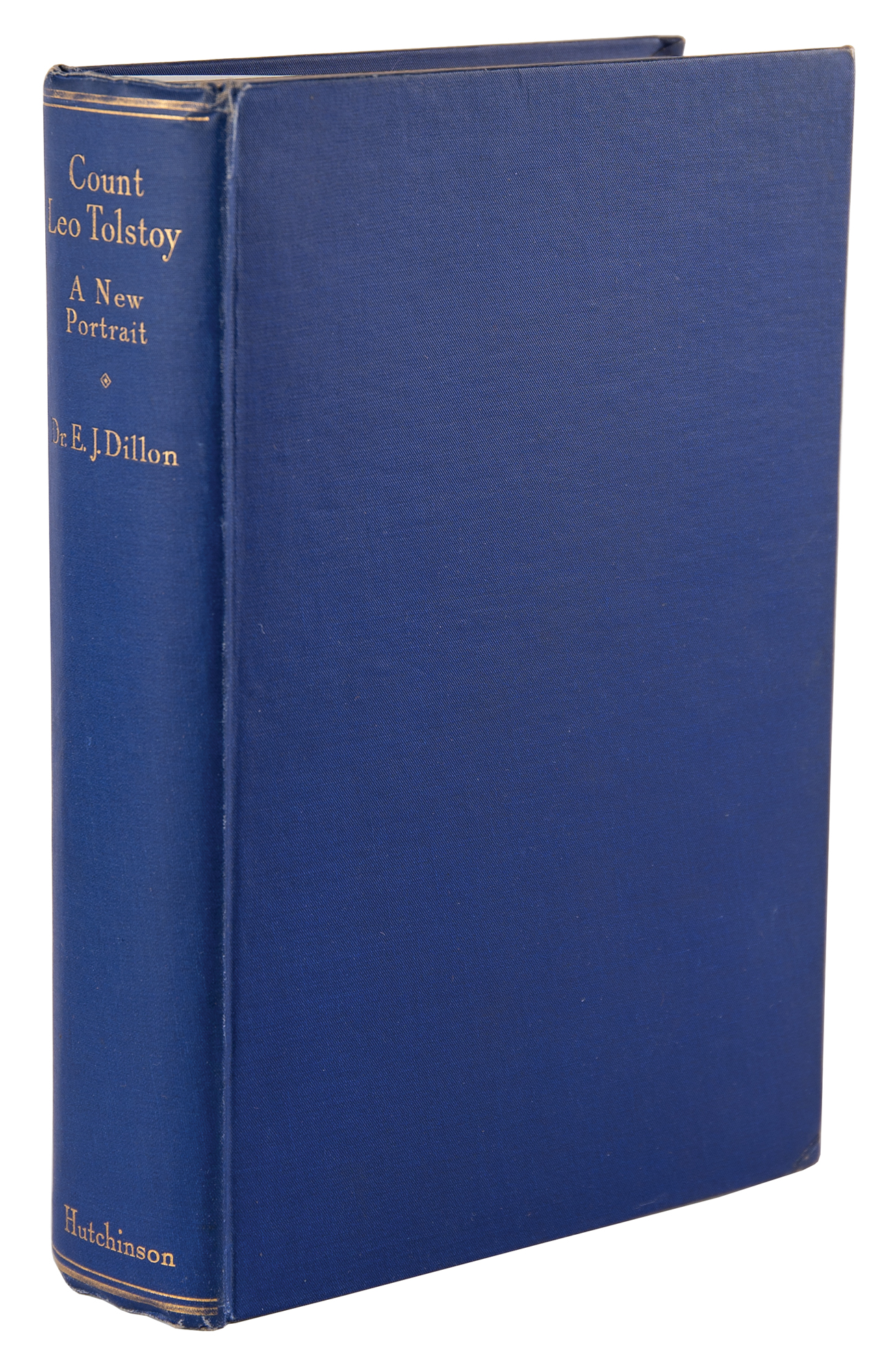
Dillon, a scholar and journalist with extensive knowledge of Russia and Eastern Europe, became a prominent foreign correspondent and commentator on international affairs, later reporting on events including the Russo-Japanese War, the Balkan conflicts, and the Dreyfus affair.
An unusually rich archive linking Tolstoy’s advocacy for humane treatment of animals with the wider moral and political concerns that defined his later life, while also documenting the international press controversy surrounding his response to the catastrophic Russian famine of 1891–1892.

This item is Pre-Certified by PSA/DNA
Buy a third-party letter of authenticity for
$150.00
*This item has been pre-certified by a trusted third-party authentication service, and by placing a bid on this item, you agree to accept the opinion of this authentication service. If you wish to have an opinion rendered by a different authenticator of your choosing, you must do so prior to your placing of any bid. RR Auction is not responsible for differing opinions submitted 30 days after the date of the sale.
Third-party authentication service applies only to signatures and handwriting, and does not cover the addition of sketches, artwork, musical quotations, etc.

