Sold For $16,444
*Includes Buyers Premium
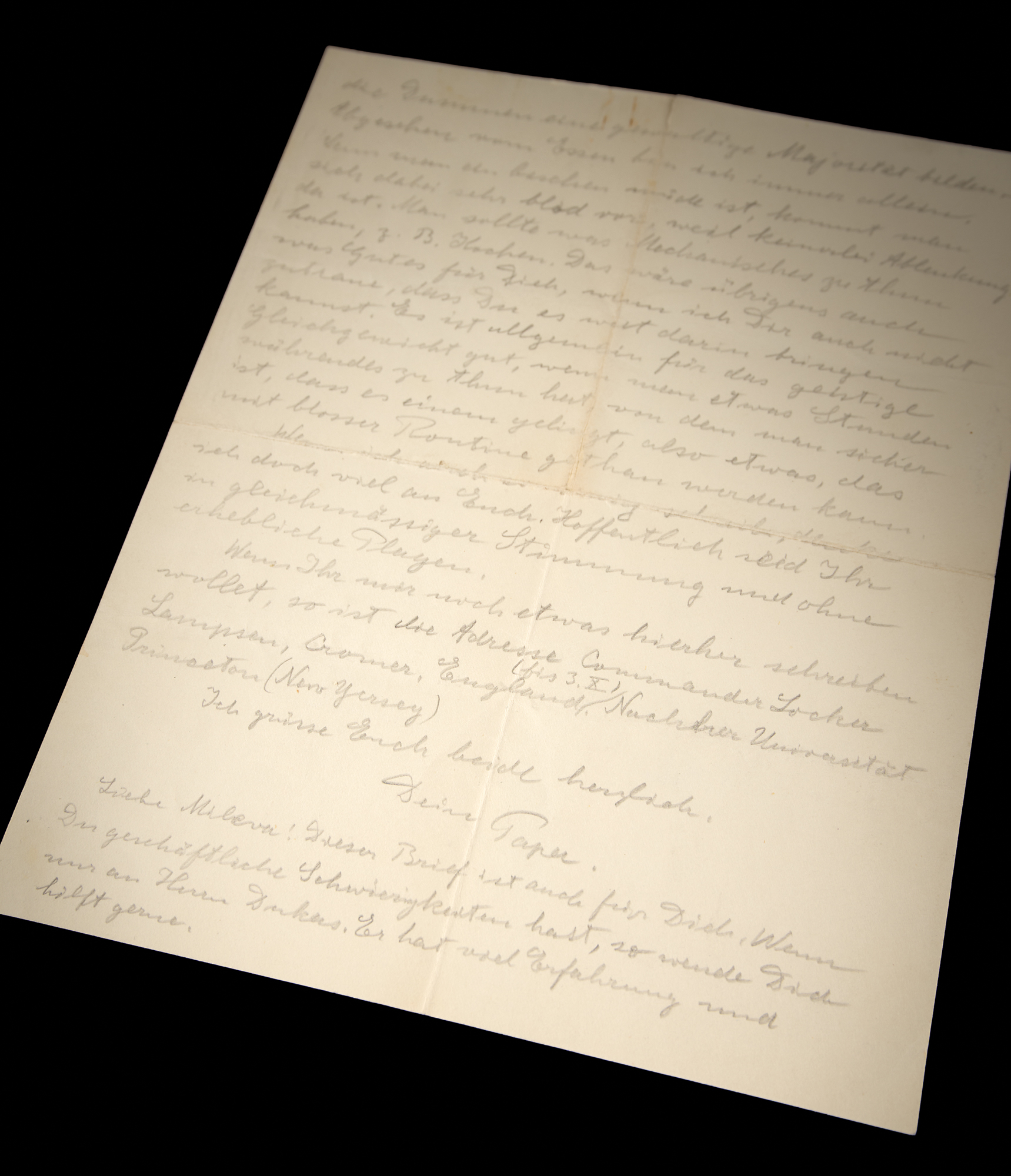
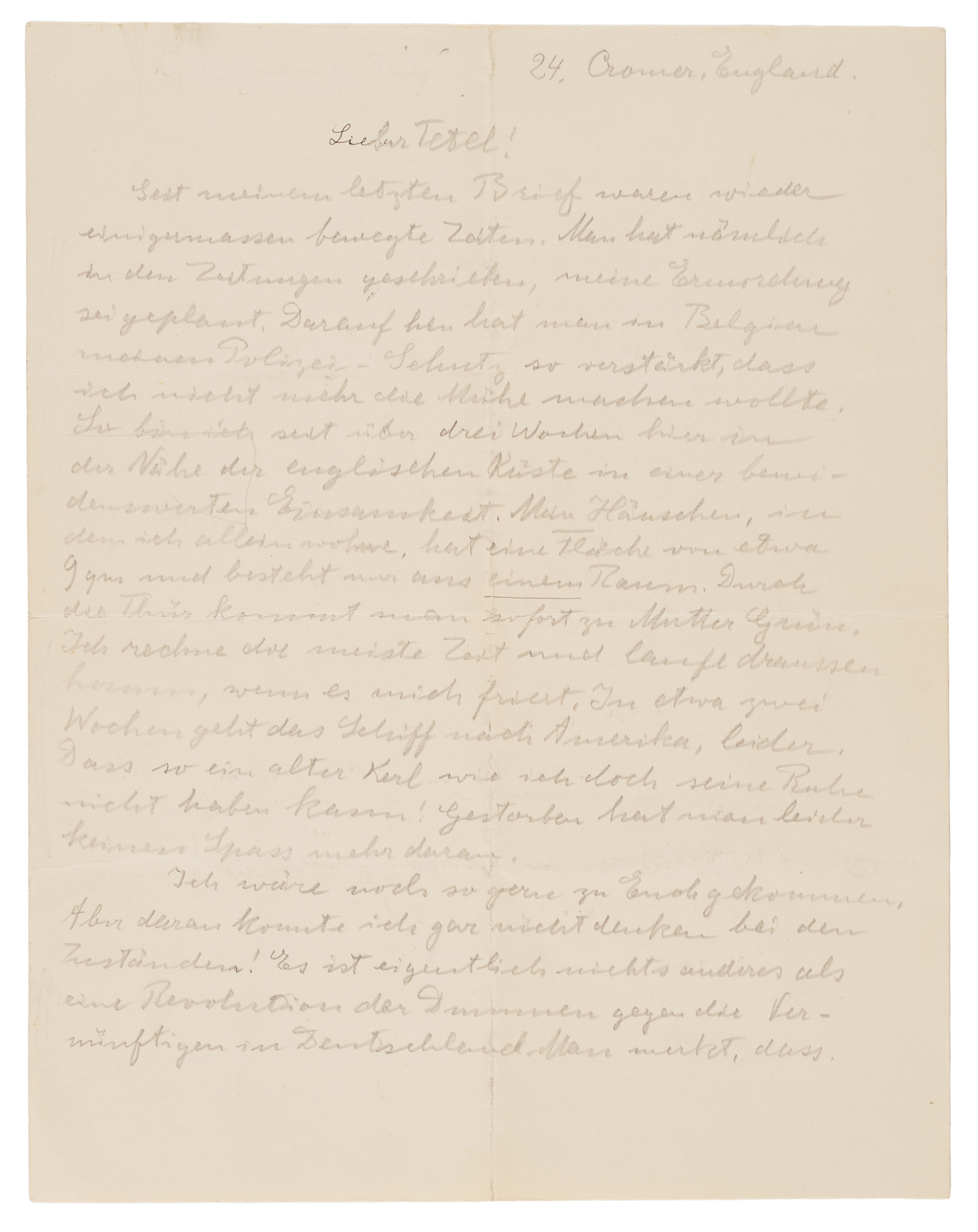
ALS in German, signed “Papa,” one page both sides, 7 x 9, circa September 23, 1933. Addressed from Cromer, England, a handwritten letter in pencil from Albert Einstein to his son Eduard Einstein, nicknamed “Tetel,” in full (translated): “Somewhat eventful times have once again occurred since my last letter. Specifically, it was written in the newspapers that there were plans for my assassination. This resulted in my police protection being increased to the point that I no longer wished to bother. That is why I have spent more than three weeks here by the English coast enjoying an enviable solitude. The cottage in which I live alone measures around 9 sqm and consists of only one room. When you step out the door, you are immediately greeted by Mother Nature. I spend most of my time doing mathematics and walk around outside when I'm cold. Unfortunately, the ship will be returning to America in around two weeks. An old chap like myself simply cannot have his peace and quiet! Unfortunately, dying takes the joy out of it.
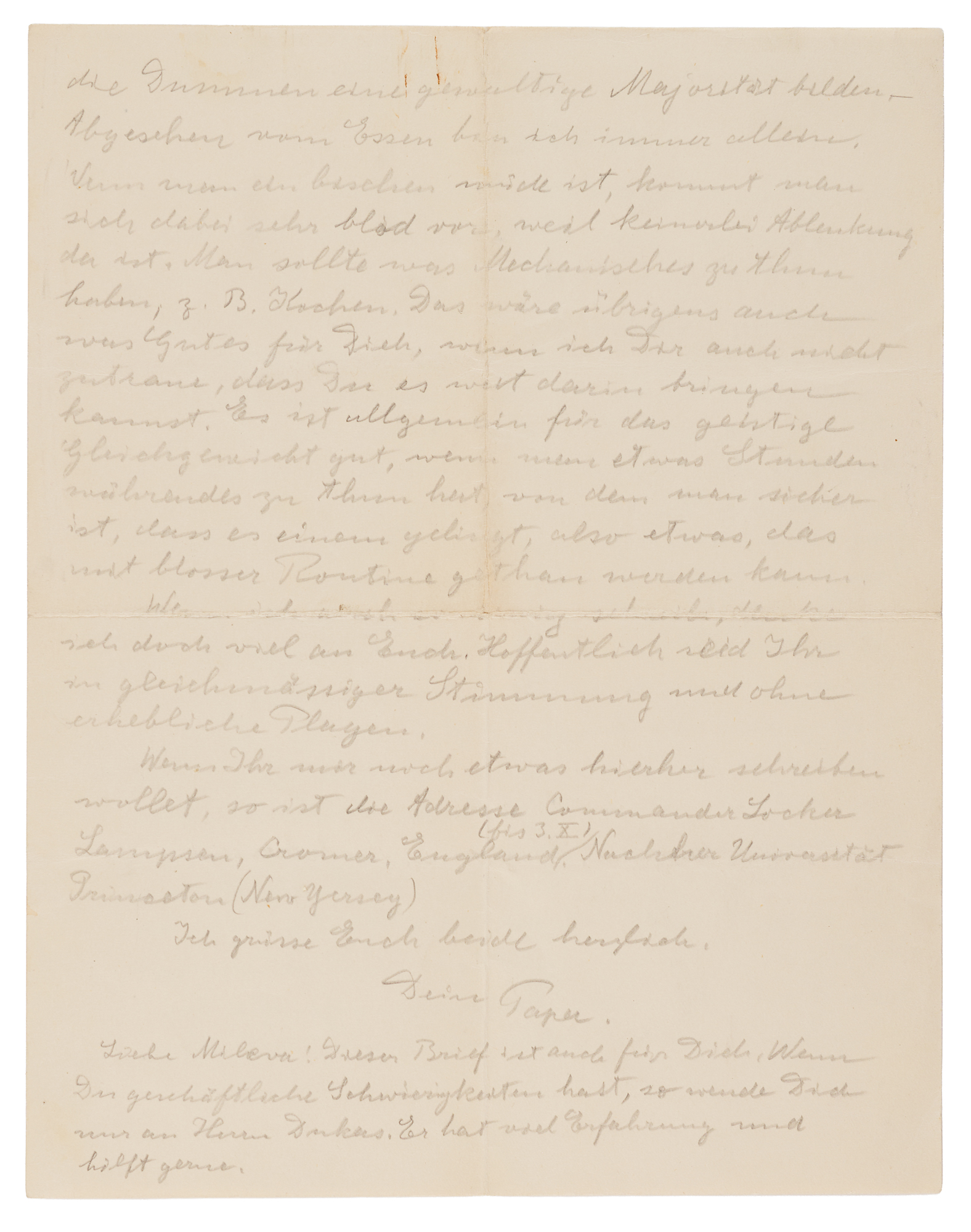
I would have loved to come and visit you. But it was something I couldn't even think about given the conditions! It is simply nothing more than the stupid revolting against the sensible in Germany. You see, the stupid constitute the vast majority — Food notwithstanding, I am always by myself. When you're tired, you feel very stupid because you have nothing to distract you. You should always have something mechanical to do, such as cooking. Incidentally, it would be something good for you too, even if I don't believe you will be able to make it very far. Generally, it is good for your mental balance if you have something you can do for hours where you can be sure you will achieve something even when simply doing it by routine.
Even though I write little, I still think about you a great deal. I hope you are in a steady mood with no significant irritations. Should you wish to write anything else to me, the address is Commander Locker Lampsen, Cromer, England, until 3. X. Subsequently, Princeton University (New Jersey). My warm greetings to you both.” Einstein adds a short postscript to Eduard's mother, his first wife, Mileva Marić: “Dear Mileva! This letter is for you as well. Should you run into any business-related difficulties, look no further than Mr Dukas. He is very experienced and will be happy to help.” In fine condition, with a short separation to the vertical fold, faint paperclip impressions, and two light horizontal bends.
Although undated, the letter can be placed to circa September 23, 1933, during Einstein’s stay at Roughton Heath near Cromer, Norfolk, where he lived under the protection of British MP and former naval officer Commander Oliver Locker-Lampson. The dating is supported by Einstein’s instructions that correspondence could reach him at Cromer until October 3rd and his statement that his ship would leave for America in around two weeks; on October 7th, he departed Southampton for the United States, where he would take up his position at the newly established Institute for Advanced Study in Princeton. Einstein had left Germany following Adolf Hitler’s rise to power and was living in Belgium before coming to England amid concerns for his safety. At Cromer, Locker-Lampson arranged for him to occupy a small wooden cottage at Roughton Heath under armed protection, circumstances reflected directly in Einstein’s account here of his isolation, mathematical work, and reports of plans for his assassination.
The letter’s recipient, Eduard Einstein, affectionately called Tetel, had hoped to pursue psychiatry and was an admirer of Sigmund Freud before being diagnosed with schizophrenia in 1930 at age twenty. Einstein’s advice here about maintaining mental balance through routine activity, together with his hope that Eduard was experiencing no significant irritations, was written against the background of his son’s illness. Mileva Marić, Einstein’s first wife and the recipient of the letter’s postscript, cared for Eduard until her death in 1948; he subsequently spent much of his remaining life at Zürich’s Burghölzli psychiatric clinic, where he died in 1965. Einstein’s departure for the United States shortly after writing this letter marked a lasting separation between father and son: the two never saw each other again.

This item is Pre-Certified by PSA/DNA
Buy a third-party letter of authenticity for
$150.00
*This item has been pre-certified by a trusted third-party authentication service, and by placing a bid on this item, you agree to accept the opinion of this authentication service. If you wish to have an opinion rendered by a different authenticator of your choosing, you must do so prior to your placing of any bid. RR Auction is not responsible for differing opinions submitted 30 days after the date of the sale.
Third-party authentication service applies only to signatures and handwriting, and does not cover the addition of sketches, artwork, musical quotations, etc.

