The 30 Minute Rule begins September 24 at 7:00 PM EDT. An Initial Bid Must Be Placed By September 24 at 6:00 PM EDT To Participate After 6:00 PM EDT
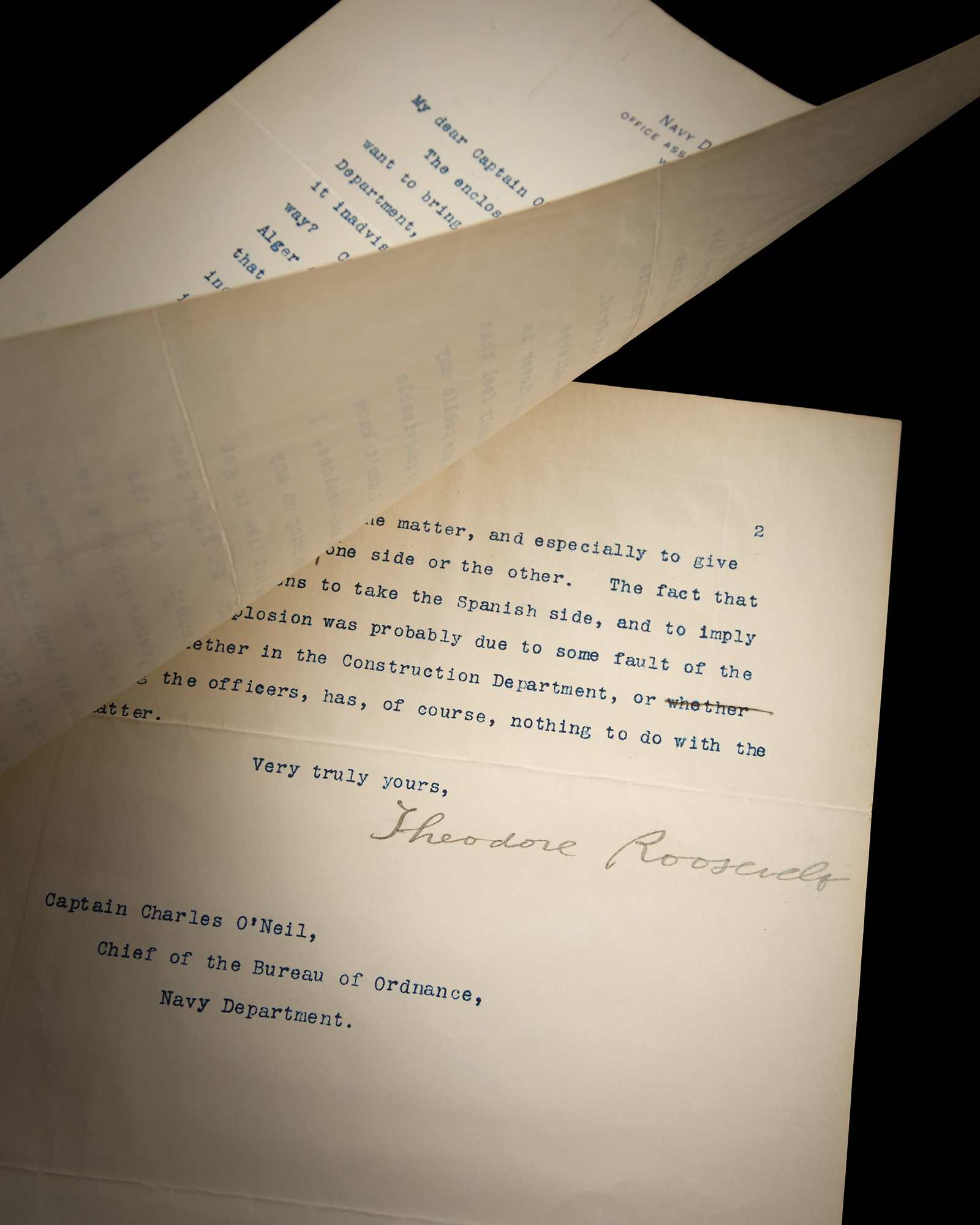
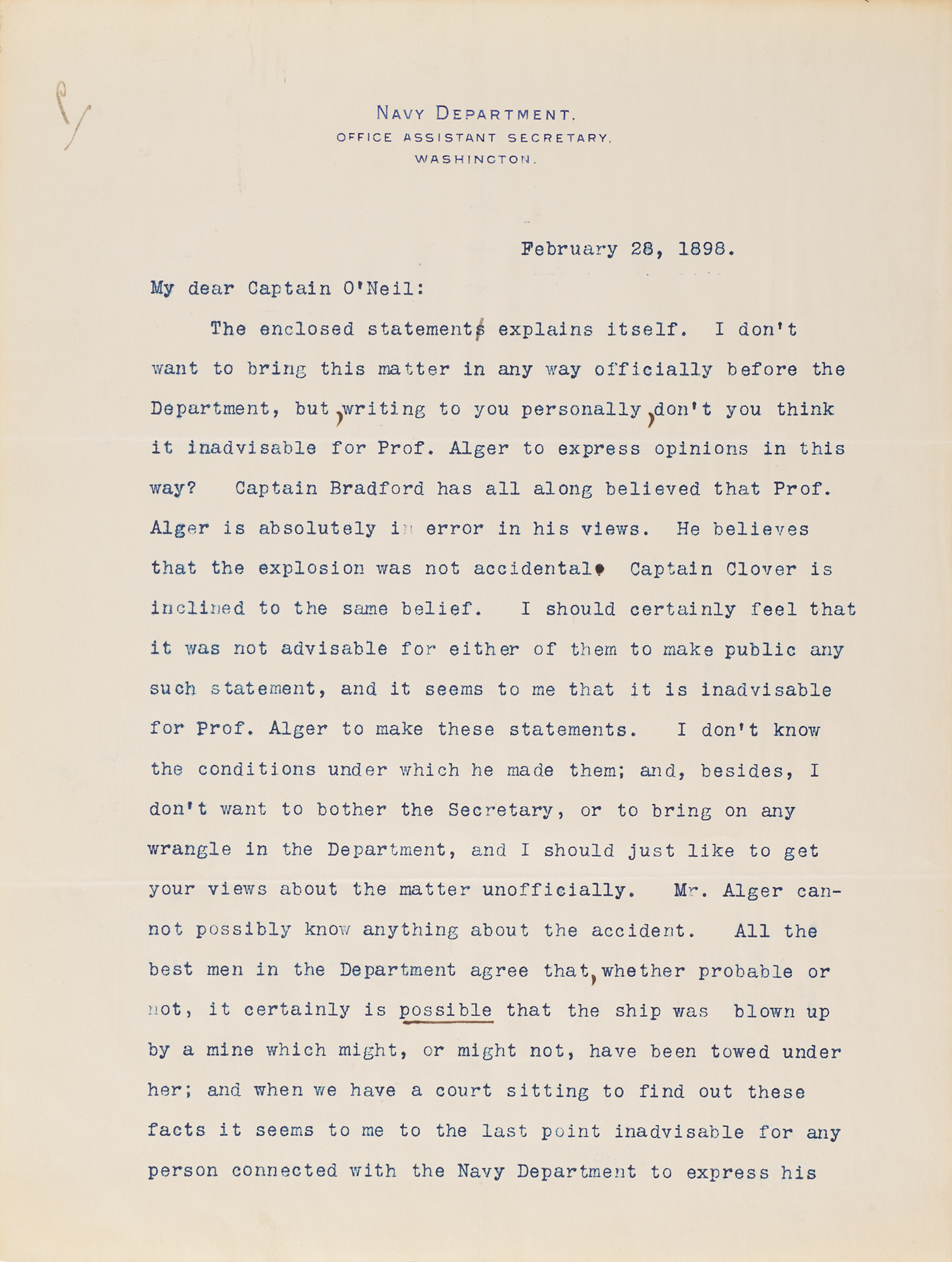
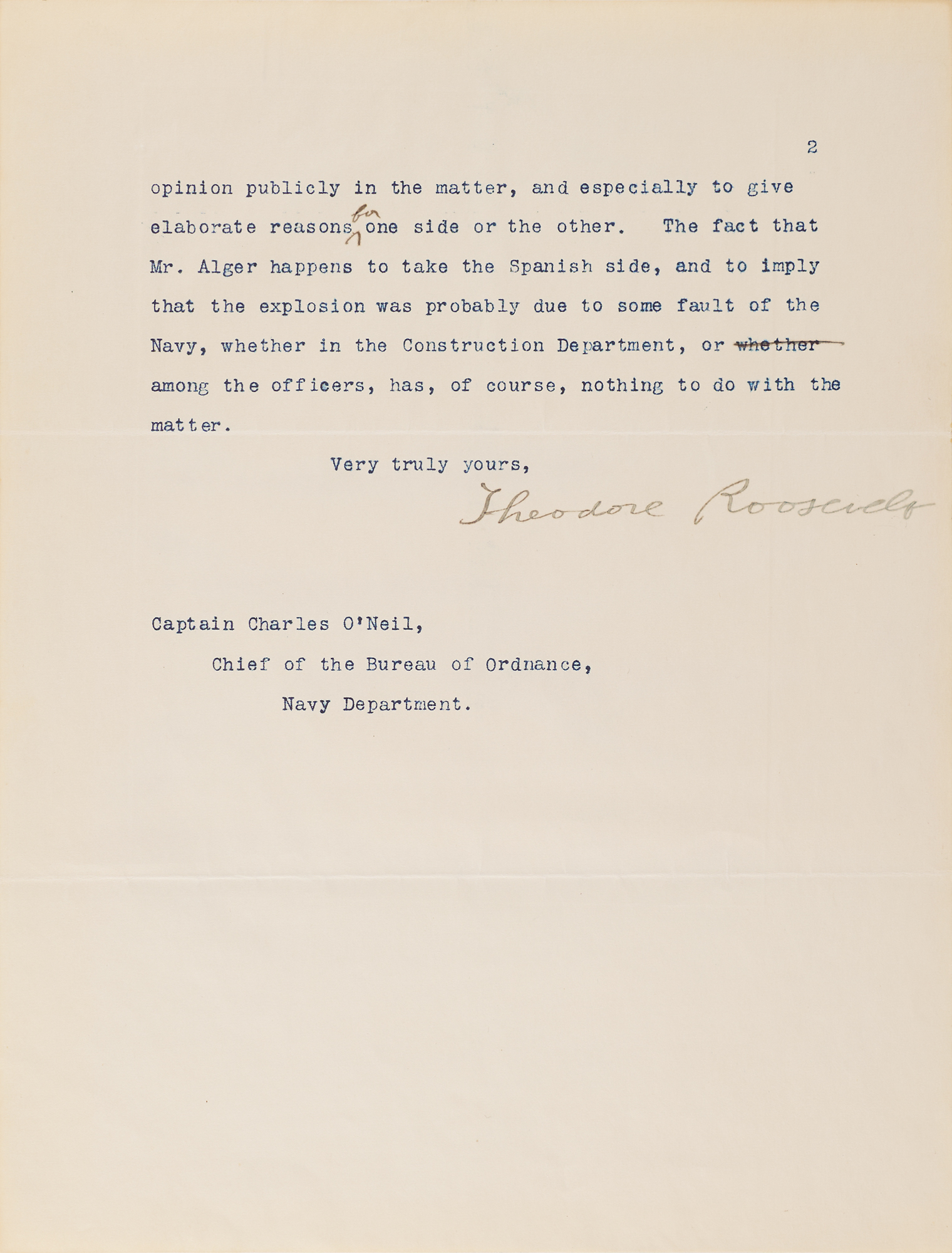
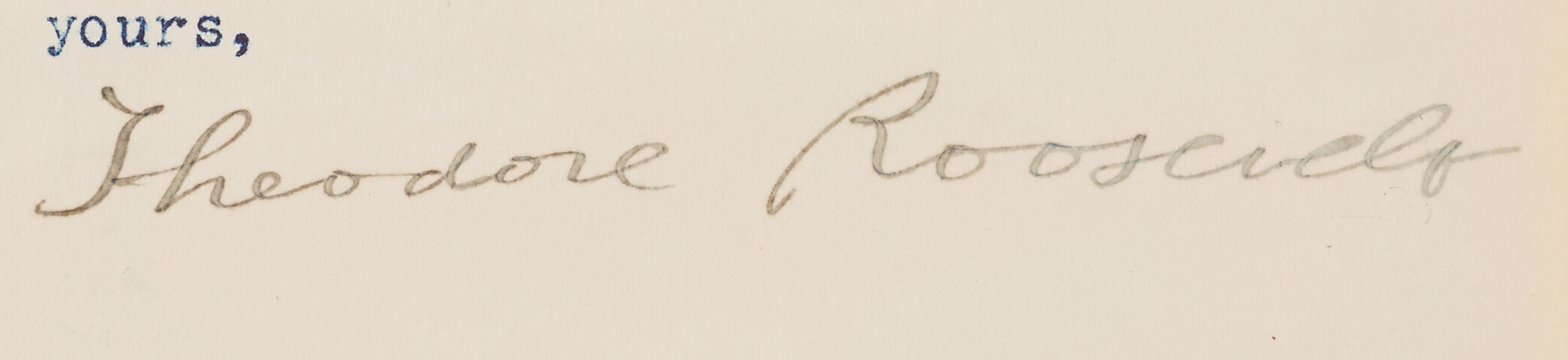
TLS, two pages, 8 x 10.5, Navy Department, Office Assistant Secretary letterhead, February 28, 1898. Letter to Captain Charles O'Neil, Chief of the Bureau of Ordnance, concerning the explosion of the USS Maine, written less than two weeks after the battleship's destruction in Havana Harbor: "The enclosed statement explains itself. I don't want to bring this matter in any way officially before the Department, but, writing to you personally, don't you think it inadvisable for Prof. Alger to express opinions in this way? Captain Bradford has all along believed that Prof. Alger is absolutely in error in his views. He believes that the explosion was not accidental. Captain Clover is inclined to the same belief. I should certainly feel that it was not advisable for either of them to make public any such statement, and it seems to me that it is inadvisable for Prof. Alger to make these statements. I don't know the conditions under which he made them; and, besides, I don't want to bother the Secretary, or to bring on any wrangle in the Department, and I should just like to get your views about the matter unofficially. Mr. Alger cannot possibly know anything about the accident. All the best men in the Department agree that, whether probable or not, it certainly is possible that the ship was blown up by a mine which might, or might not, have been towed under her; and when we have a court sitting to find out these facts it seems to me to the last point inadvisable for any person connected with the Navy Department to express his opinion publicly in the matter, and especially to give elaborate reasons for one side or the other. The fact that Mr. Alger happens to take the Spanish side, and to imply that the explosion was probably due to some fault of the Navy, whether in the Construction Department, or among the officers, has, of course, nothing to do with the matter." In fine condition, with light surface impressions. The original draft manuscript of Roosevelt's letter is held by the Library of Congress.
Provenance: Charles Hamilton, May 21, 1965.
Written just thirteen days after the destruction of the USS Maine in Havana Harbor, Roosevelt's letter offers a rare behind-the-scenes look at the Navy Department during one of the defining crises of the late nineteenth century. The battleship exploded on February 15, 1898, killing more than 260 American sailors and triggering an international incident that would soon propel the United States into the Spanish-American War. Although public opinion quickly placed responsibility on Spain, the cause of the explosion remained under official investigation, and senior Navy officials sharply disagreed over whether the disaster resulted from an external mine or an internal accident. As sensational newspaper coverage fueled anti-Spanish sentiment and popularized the rallying cry ‘Remember the Maine!,’ Roosevelt sought to prevent premature speculation from within the Navy Department itself.
As Assistant Secretary of the Navy, Roosevelt found himself at the center of those early deliberations. Writing privately to Captain Charles O'Neil, Chief of the Bureau of Ordnance, he expresses concern that Professor Philip R. Alger, a respected Naval Academy professor and ordnance expert, had publicly advanced his own theory before the Navy's Court of Inquiry could determine the facts. Roosevelt notes that two senior naval officers believed Alger's conclusions to be mistaken and emphasizes that "all the best men in the Department" agreed it remained entirely possible that the Maine had been destroyed by a mine. More importantly, Roosevelt insists that no one connected with the Navy Department should publicly speculate while the investigation remained underway, revealing his determination to maintain discipline and present a unified official position during one of the nation's most politically charged military crises.
Within weeks of writing this letter, the Navy's Court of Inquiry concluded that the Maine had been destroyed by an external mine, fueling public outrage and accelerating the march toward war. Congress declared war on Spain in April 1898, and Roosevelt resigned from the Navy Department the following month to organize the First U.S. Volunteer Cavalry, the famed Rough Riders, whose exploits in Cuba would launch his national political career.

This item is Pre-Certified by PSA/DNA
Buy a third-party letter of authenticity for
$100.00
*This item has been pre-certified by a trusted third-party authentication service, and by placing a bid on this item, you agree to accept the opinion of this authentication service. If you wish to have an opinion rendered by a different authenticator of your choosing, you must do so prior to your placing of any bid. RR Auction is not responsible for differing opinions submitted 30 days after the date of the sale.
Third-party authentication service applies only to signatures and handwriting, and does not cover the addition of sketches, artwork, musical quotations, etc.

