The 30 Minute Rule begins September 16 at 7:00 PM EDT. An Initial Bid Must Be Placed By September 16 at 6:00 PM EDT To Participate After 6:00 PM EDT
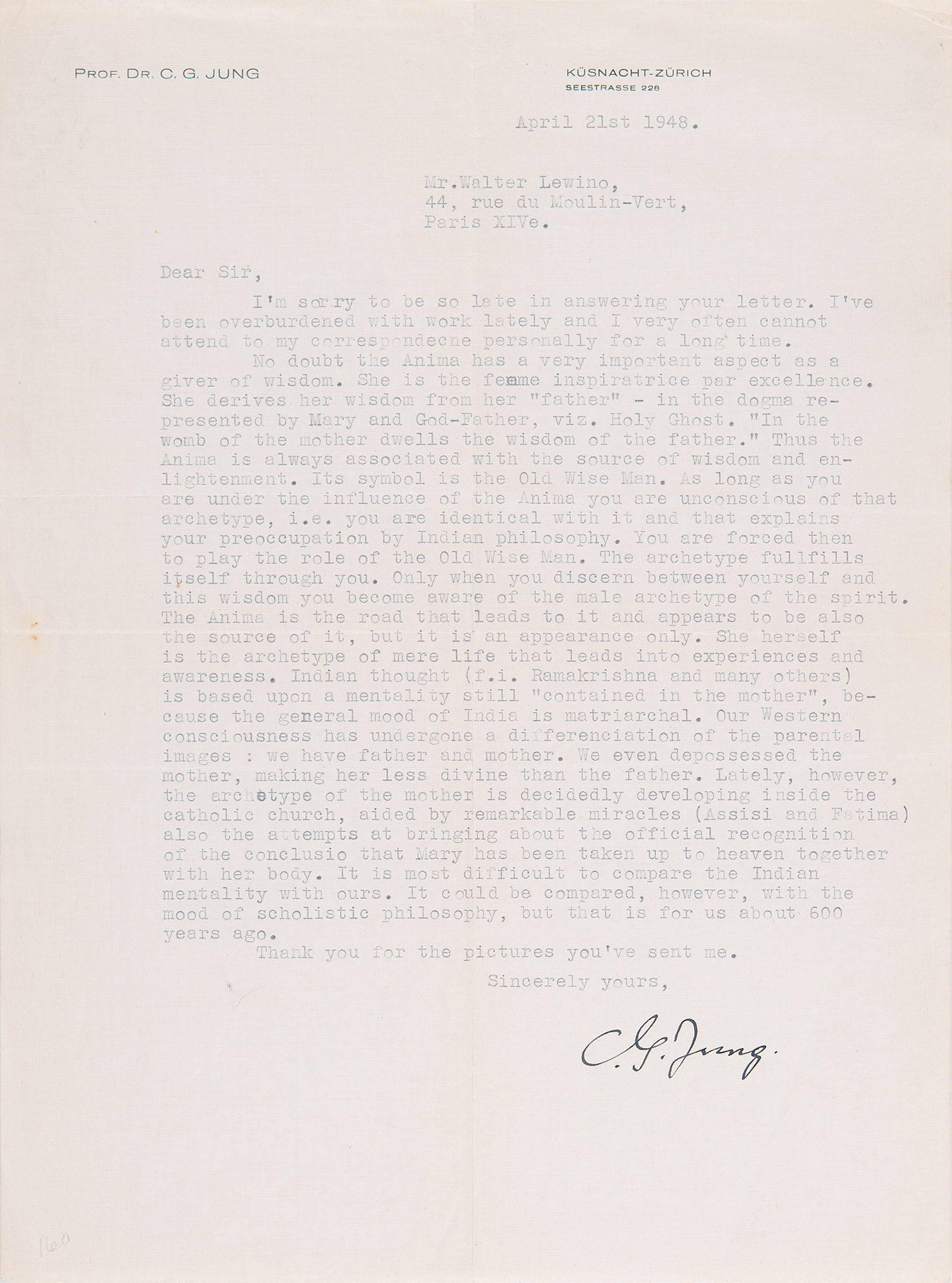
Influential psychologist (1875–1961) recognized as the founder of analytical psychology. TLS signed “C. G. Jung,” one page, 8.25 x 11.5, personal letterhead, April 21, 1948. Letter to Walter Lewino offering a detailed interpretation of the Anima—the feminine archetype in the male psyche—and its relationship to wisdom, spiritual authority, and Eastern philosophy. In part: "No doubt the Anima has a very important aspect as a giver of wisdom. She is the femme inspiratrice par excellence. She derives her wisdom from her 'father' in the dogma represented by Mary and God-Father, viz. Holy Ghost. 'In the womb of the mother dwells the wisdom of the father.' Thus the Anima is always associated with the source of wisdom and enlightenment. Its symbol is the Old Wise Man. As long as you are under the influence of the Anima you are unconscious of that archetype, i.e. you are identical with it and that explains your preoccupation by Indian philosophy. You are forced then to play the role of the Old Wise Man. The archetype fullfills itself through you. Only when you discern between yourself and this wisdom you become aware of the male archetype of the spirit.
The Anima is the road that leads to it and appears to be also the source of it, but it is an appearance only. She herself is the archetype of mere life that leads into experiences and awareness. Indian thought (f.i. Ramakrishna and many others) is based upon a mentality still 'contained in the mother,' because the general mood of India is matriarchal. Our Western consciousness has undergone a differenciation of the parental images: we have father and mother. We even depossessed the mother, making her less divine than the father. Lately, however, the archetype of the mother is decidedly developing inside the catholic church, aided by remarkable miracles (Assisi and Fatima) also the attempts at bringing about the official recognition of the conclusio that Mary has been taken up to heaven together with her body. It is most difficult to compare the Indian mentality with ours. It could be compared, however, with the mood of scholistic philosophy, but that is for us about 600 years ago." In fine condition.
A substantial and intellectually rich letter in which Jung applies several of the central concepts of analytical psychology—the Anima, the Wise Old Man, archetypal identification, and the differentiation of consciousness—to questions of religion and comparative philosophy. Written only two years before the Catholic Church formally proclaimed the dogma of the Assumption of Mary in 1950, the letter also reveals Jung’s close attention to contemporary religious developments and his belief that renewed veneration of Mary reflected the reemergence of the feminine archetype within Western Christianity.

This item is Pre-Certified by PSA/DNA
Buy a third-party letter of authenticity for
$100.00
*This item has been pre-certified by a trusted third-party authentication service, and by placing a bid on this item, you agree to accept the opinion of this authentication service. If you wish to have an opinion rendered by a different authenticator of your choosing, you must do so prior to your placing of any bid. RR Auction is not responsible for differing opinions submitted 30 days after the date of the sale.
Third-party authentication service applies only to signatures and handwriting, and does not cover the addition of sketches, artwork, musical quotations, etc.

