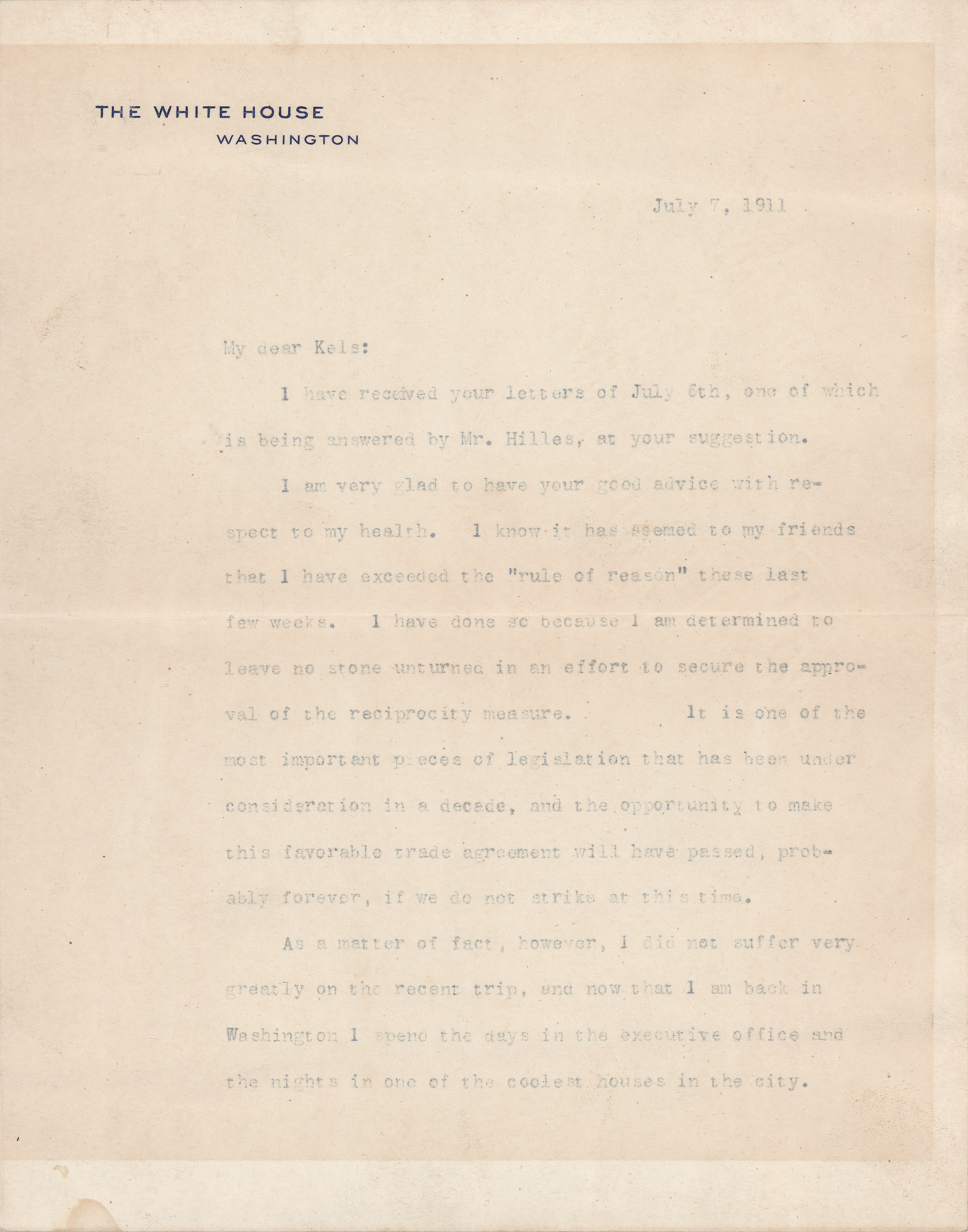
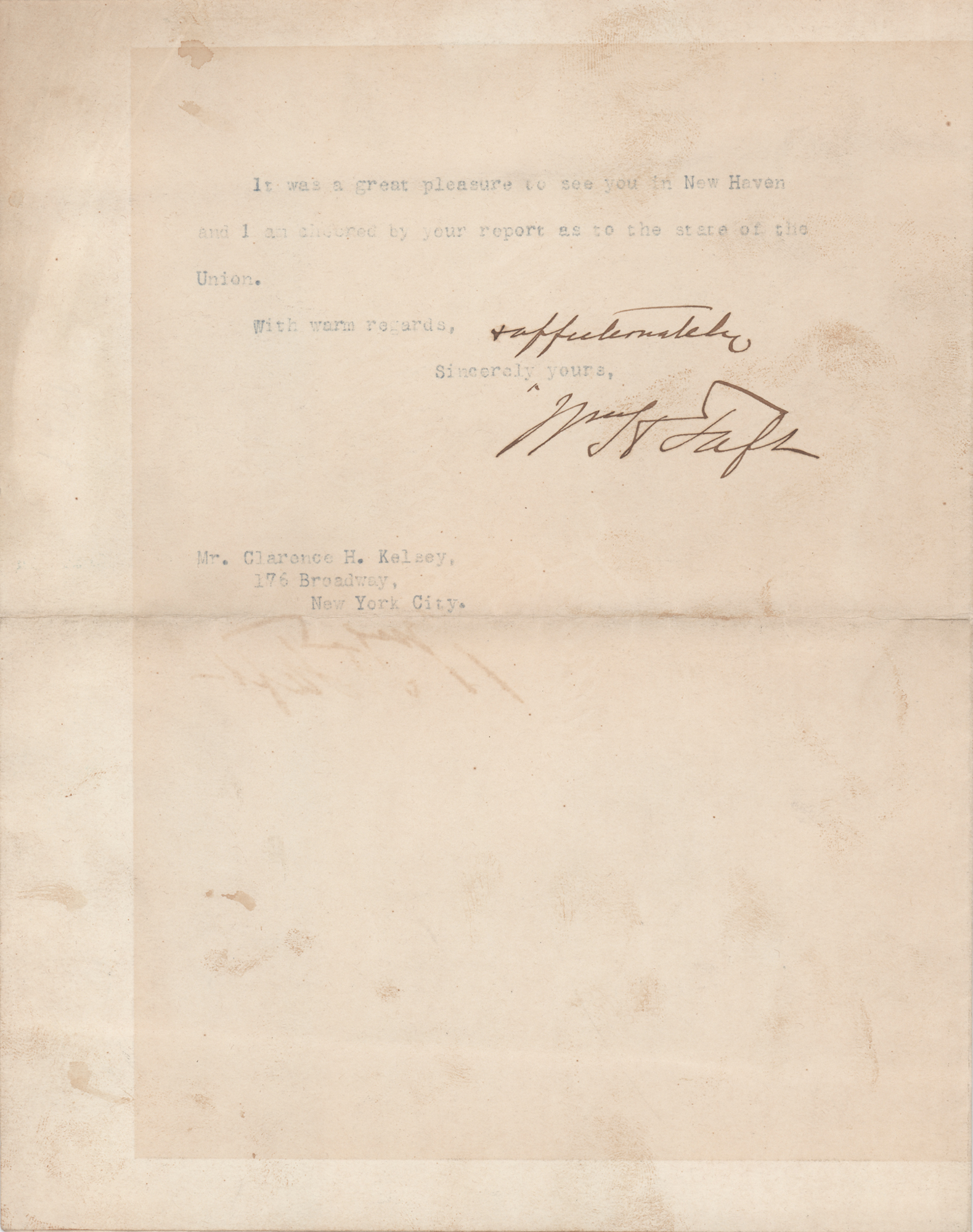
TLS as president signed “affectionately, Wm. H. Taft,” two pages on two adjoining sheets, 7 x 8.75, White House letterhead, July 7, 1911. Letter to Clarence H. Kelsey, in full: “I have received your letters of Jul. 6th, one of which is being answered by Mr. Hilles, at your suggestion. I am very glad to have your good advice with respect to my health. I know it has seemed to my friends that I have exceeded the ‘rule of reason’ these last few weeks. I have done so because I am determined to leave no stone unturned in an effort to secure the approval of the reciprocity measure. It is one of the most important pieces of legislation that has been under consideration in a decade, and the opportunity to make this favorable trade agreement will have passed, probably forever, if we do not strike at this time.
As a matter of fact, however, I did not suffer very greatly on the recent trip, and now that I am back in Washington I spend the days in the executive office and the nights in one of the coolest houses in the city. It was a great pleasure to see you in New Haven and I am cheered by your report as to the state of the Union.” In very good to fine condition, with light soiling and creasing, overall fading, and toning from prior display.
Written at a pivotal moment in the fight over the Canadian Reciprocity Agreement of 1911, this letter finds President William Howard Taft personally campaigning for what he regarded as one of the most important initiatives of his administration. The proposed agreement, negotiated with the government of Canadian Prime Minister Wilfrid Laurier, sought to reduce tariffs and expand trade between the United States and Canada. By the time of this letter, the measure had already passed the House of Representatives and was awaiting final action in the Senate. Emphasizing the stakes, Taft describes reciprocity as “one of the most important pieces of legislation that has been under consideration in a decade” and warns that the opportunity to secure the agreement might be lost “probably forever” if Congress failed to act. He also acknowledges concerns about his health, explaining that he had exceeded the “rule of reason” in his efforts to win approval of the measure. The Senate passed the reciprocity bill later that month, but the agreement ultimately collapsed when Canadian voters rejected the policy in the federal election of September 1911.
This item is Pre-Certified by PSA/DNA
Buy a third-party letter of authenticity for
$75.00
*This item has been pre-certified by a trusted third-party authentication service, and by placing a bid on this item, you agree to accept the opinion of this authentication service. If you wish to have an opinion rendered by a different authenticator of your choosing, you must do so prior to your placing of any bid. RR Auction is not responsible for differing opinions submitted 30 days after the date of the sale.
Third-party authentication service applies only to signatures and handwriting, and does not cover the addition of sketches, artwork, musical quotations, etc.

