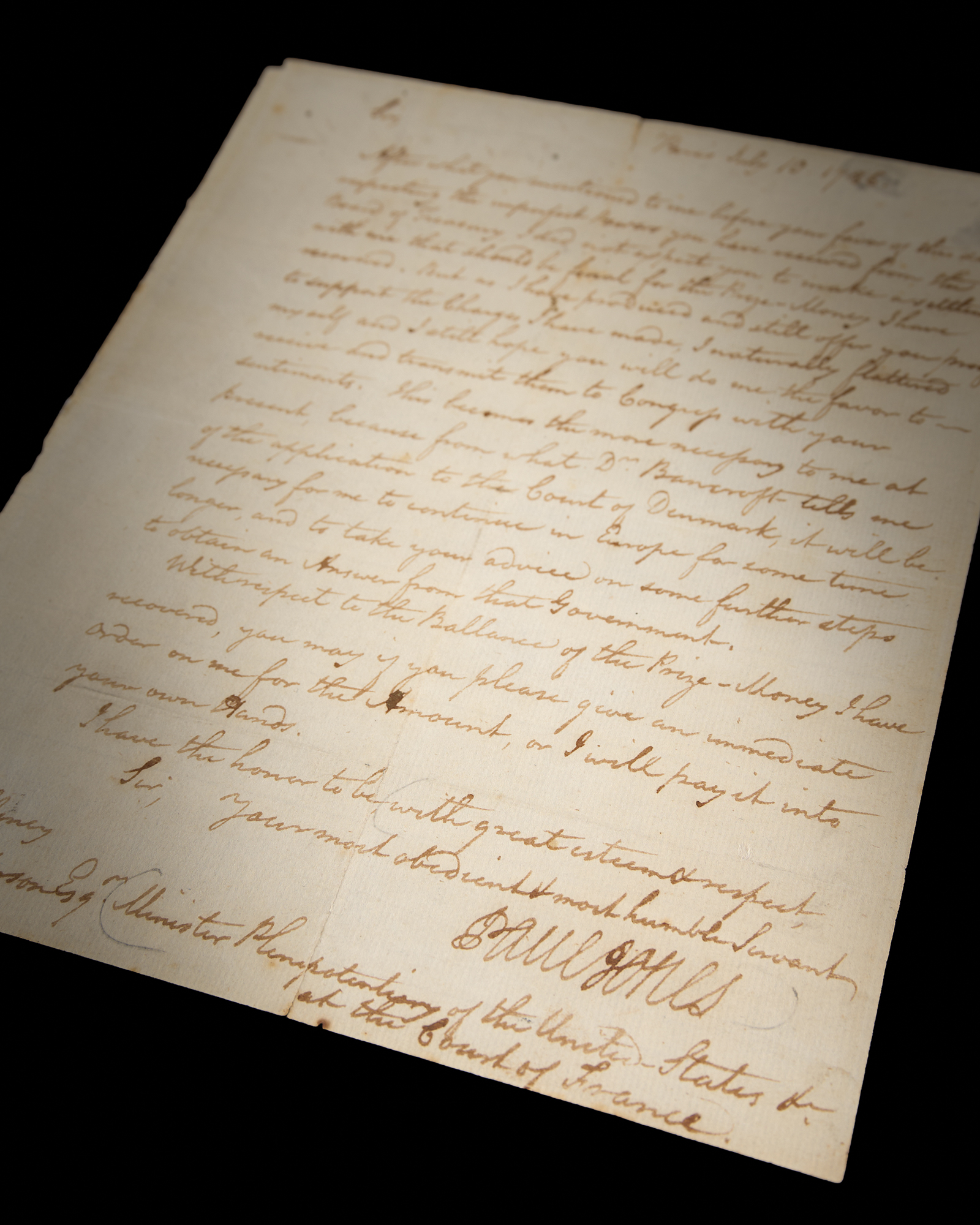
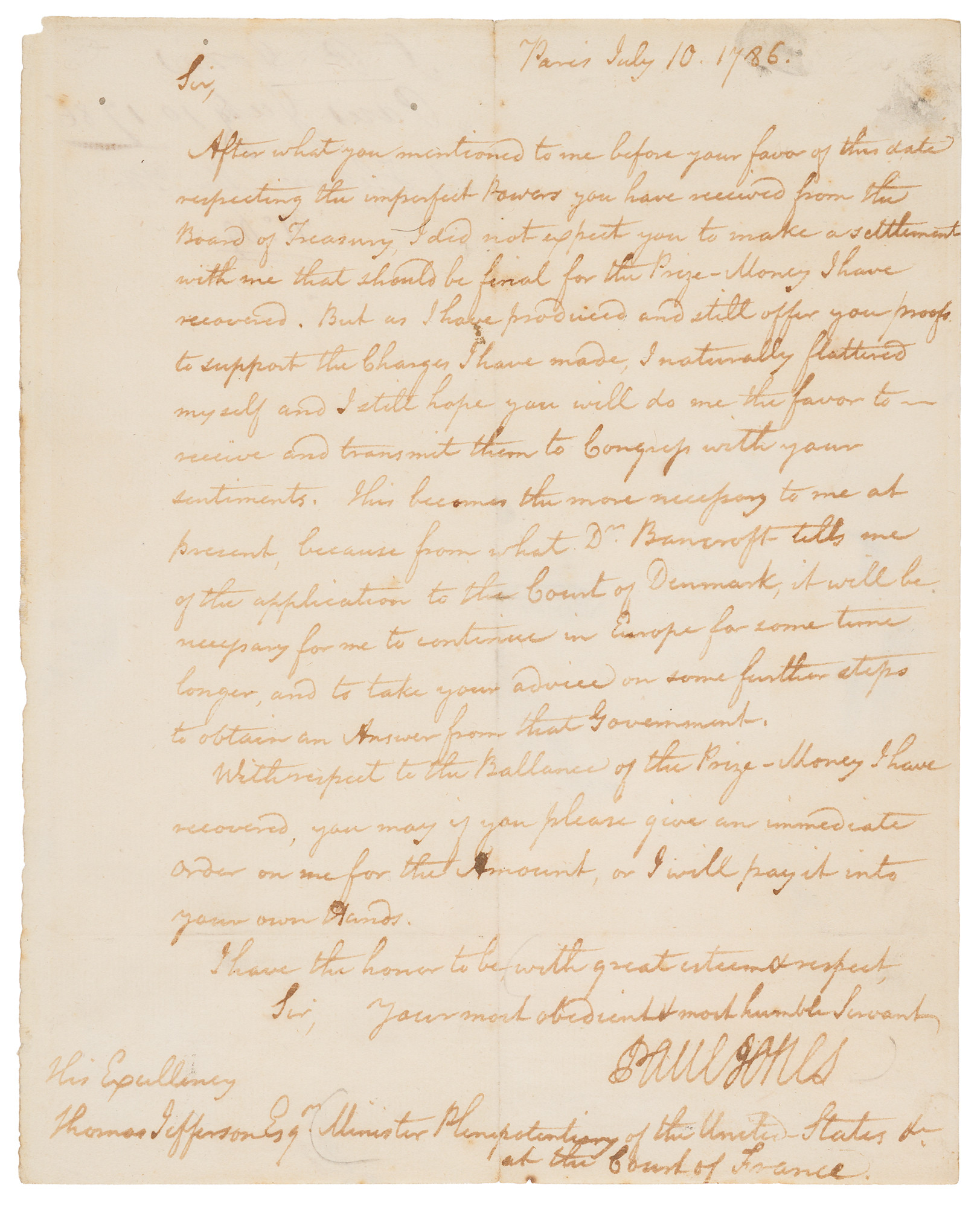
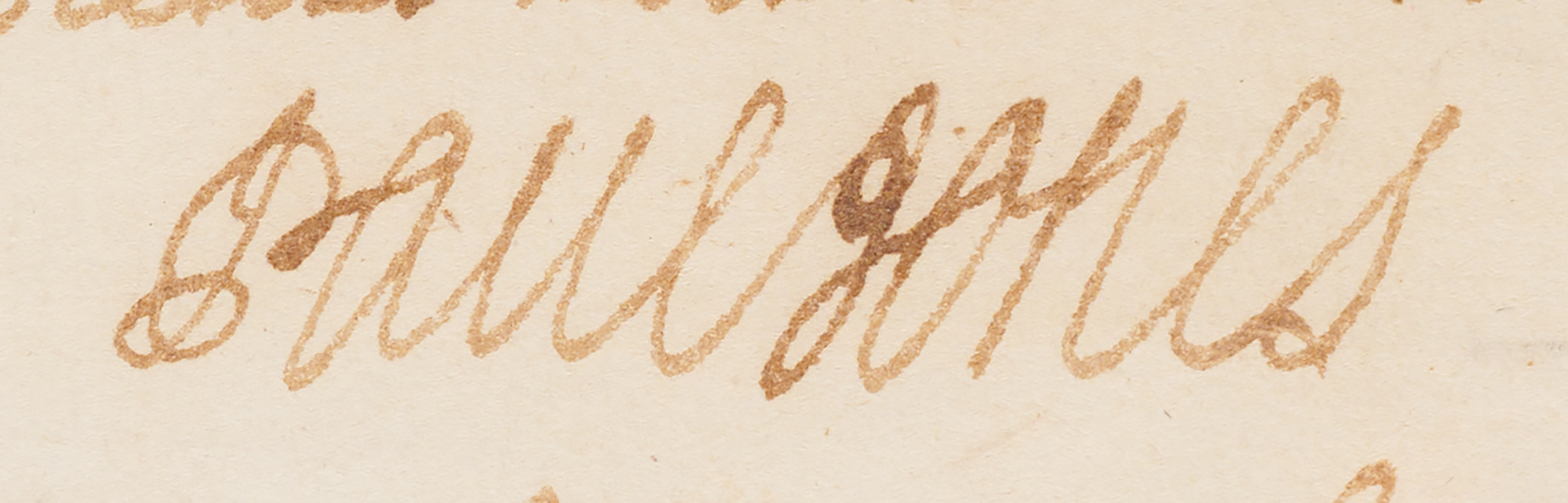
Important American naval commander (1747–1792) during the Revolutionary War, who earned acclaim for his raids against the British while aboard the Bonhomme Richard. ALS signed “Paul Jones,” one page, 7.25 x 9, July 10, 1786. Handwritten letter to "His Excellency Thomas Jefferson, Esq'r, Minister Plenipotentiary of the United States at the Court of France," detailing his ongoing efforts to secure prize money for the capture of several British ships during the Revolutionary War. In full: "After what you mentioned to me before your favor of this date respecting the imperfect powers you have received from the Board of Treasury, I did not expect you to make a settlement with me that should be final for the Prize-Money I have recovered. But as I have produced and still offer you proofs to support the charges I have made, I naturally flattered myself and I still hope you will do me the favor to receive and transmit them to Congress with your sentiments. This becomes the more necessary to me at present, because from what Dr. Bancroft tells me of the application to the Court of Denmark, it will be necessary for me to continue in Europe for some time longer, and to take your advice on some further steps to obtain an answer from that Government. With respect to the Ballance of the Prize-Money I have recovered, you may if you please give an immediate order on me for that amount, or I will pay it into your own hands." In fine condition.
The prize-money claim at the heart of this letter grew out of John Paul Jones’s famous 1779 North Sea cruise during the American Revolution, which culminated in the dramatic capture of HMS Serapis by the badly damaged Bonhomme Richard off Flamborough Head on September 23, 1779. That victory made Jones the young republic’s most celebrated naval hero, but the aftermath proved far less glorious: the proceeds from captured vessels became tangled in the overlapping authority of Congress, French officials, American diplomats, and private agents. By 1786, Jones was still in Europe trying to recover money he believed due to himself and his crew, and Thomas Jefferson—then U.S. minister in Paris—was one of the few American representatives positioned to help transmit claims to Congress and press them diplomatically.
Jones’s reference to Dr. Bancroft and the “Court of Denmark” points to the long-running dispute over the Alliance prizes, British vessels captured in 1779 and taken into Bergen, Norway, then under Danish rule, where they were returned to Britain rather than condemned for the Americans’ benefit. Edward Bancroft had been enlisted to assist with the Danish claim, and correspondence among Jones, Jefferson, and John Adams shows the matter being shifted between London and Paris depending on where Danish representatives could be reached.
This historic letter captures Jones in the weary postwar role of claimant and negotiator, pressing the new nation to honor the financial obligations attached to its naval victories as Jefferson attempted to navigate the uncertain machinery of American diplomacy under the Confederation government.

This item is Pre-Certified by PSA/DNA
Buy a third-party letter of authenticity for
(inquire for price)
*This item has been pre-certified by a trusted third-party authentication service, and by placing a bid on this item, you agree to accept the opinion of this authentication service. If you wish to have an opinion rendered by a different authenticator of your choosing, you must do so prior to your placing of any bid. RR Auction is not responsible for differing opinions submitted 30 days after the date of the sale.
Third-party authentication service applies only to signatures and handwriting, and does not cover the addition of sketches, artwork, musical quotations, etc.

