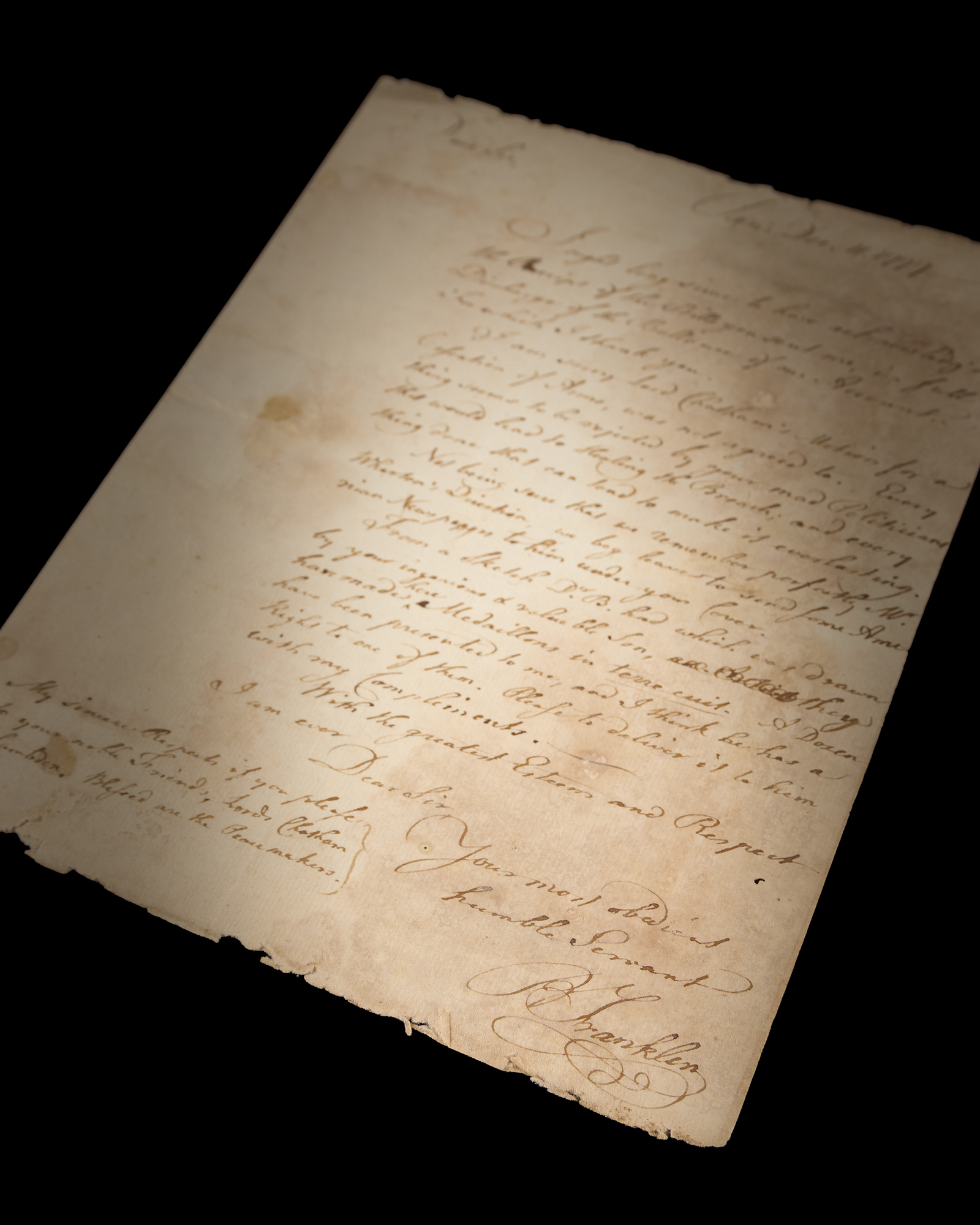
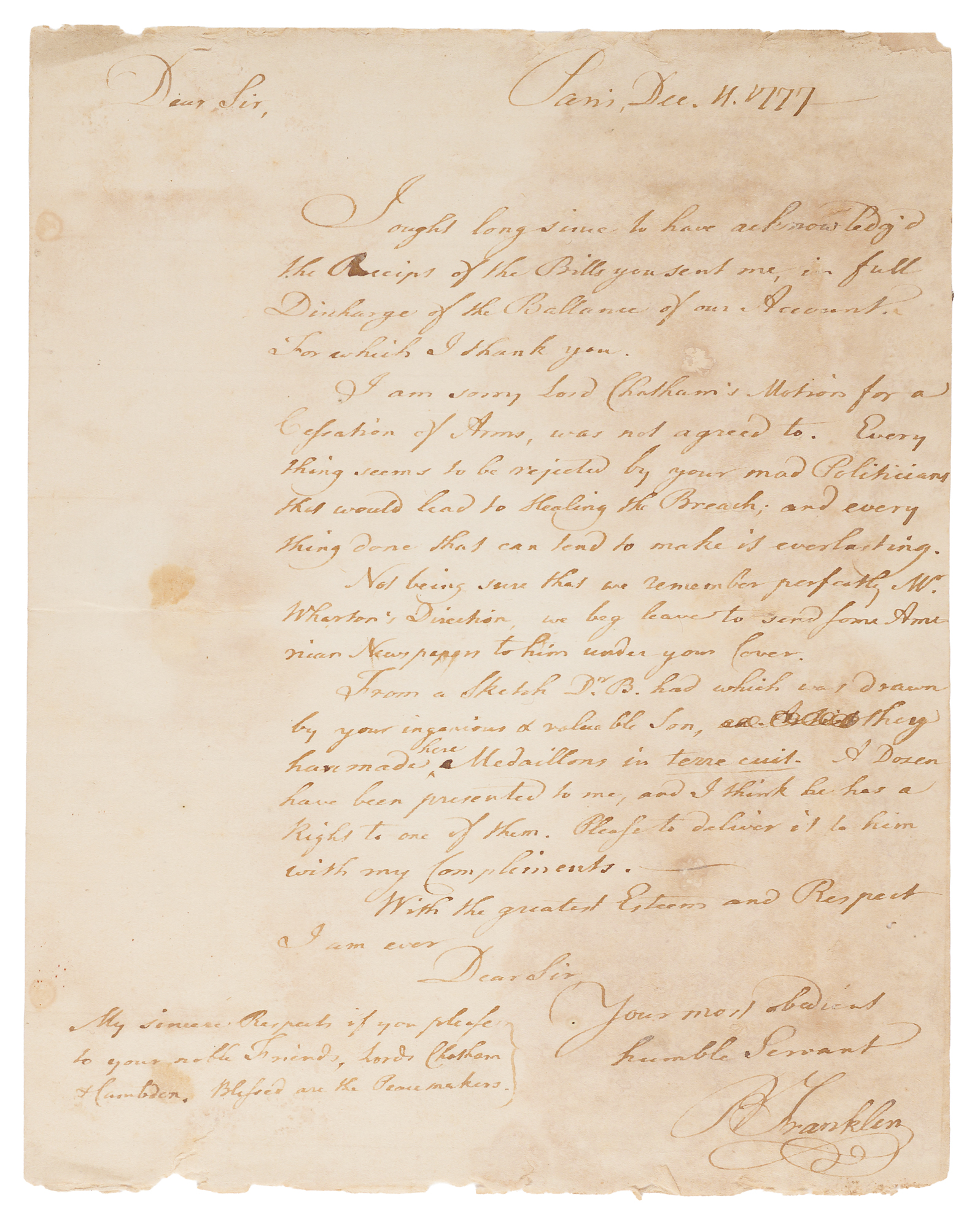
Revolutionary War–dated ALS signed “B. Franklin,” one page, 7.25 x 9.25, December 11, 1777. Handwritten letter to Thomas Walpole, bemoaning the failure of Lord Chatham's efforts to find a basis of conciliation with the American colonies and to bring an end to the Revolutionary War. In full: "I ought long since to have acknowledg'd the Receipt of the Bills you sent me, in full Discharge of the Balance of our Account. For which I thank you. I am sorry Lord Chatham's Motion for a Cessation of Arms, was not agreed to. Every thing seems to be rejected by your mad Politicians that would lead to Healing the Breach; and every thing done that can tend to make it everlasting. Not being sure that we remember perfectly Mr. Wharton's Direction, we beg leave to send some American Newspapers to him under your Cover.
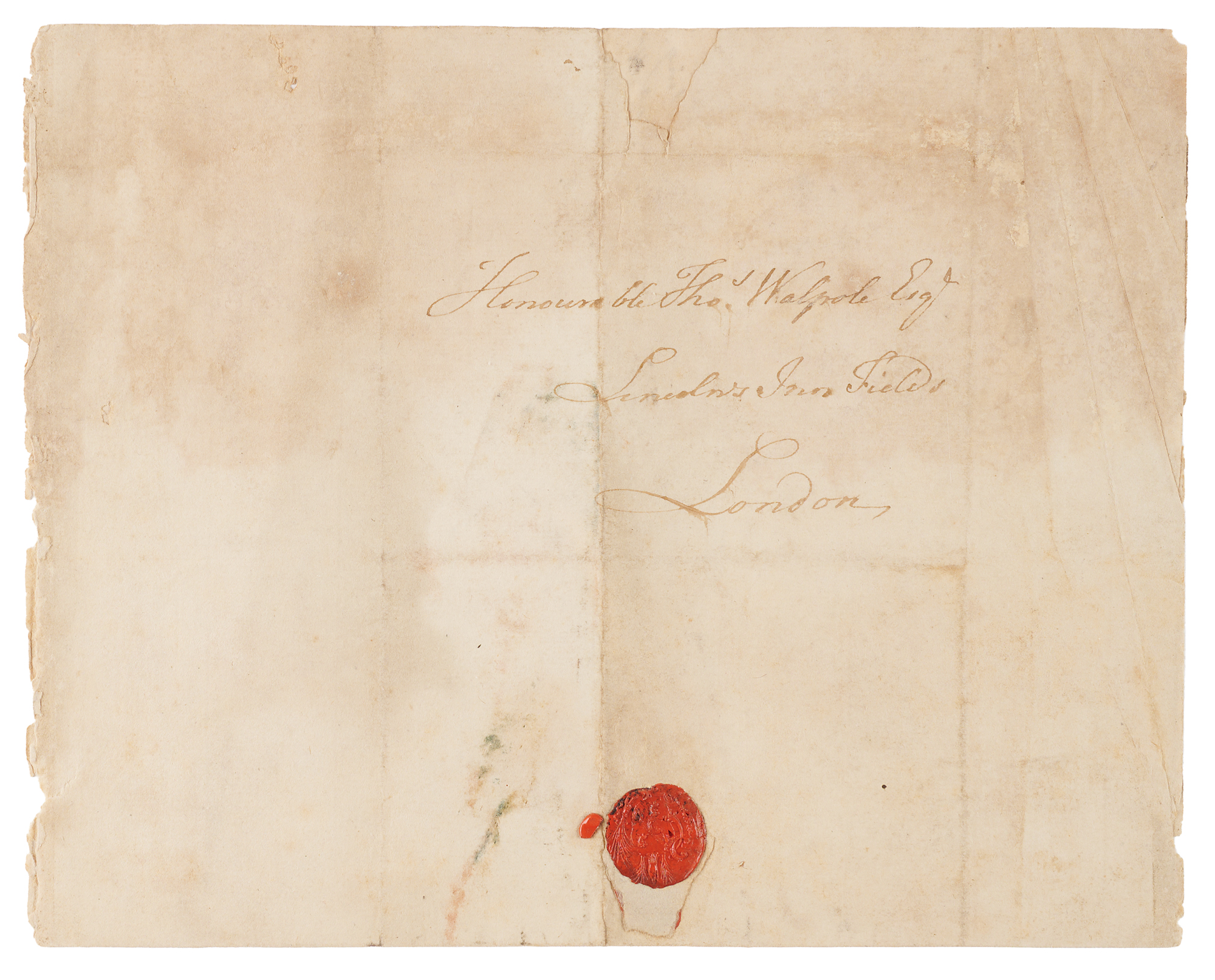
From a Sketch Dr. B. had which was drawn by your ingenious and valuable Son, they have made here Medallions in terre cuit [terra-cotta]. A Dozen have been presented to me, and I think he has a Right to one of them. Please to deliver it to him with my Compliments." He adds a postscript at the lower left: "My sincere Respects if you please to your noble Friends, Lords Chatham and Cambden. Blessed are the Peacemakers." Addressed on the integral leaf in Franklin's own hand, which carries a fine red-wax impression of Franklin's seal. In very good to fine condition, with soiling and staining, not affecting readability.
Franklin wrote this letter from Paris, where he was serving as an American commissioner seeking French support for the Revolutionary cause. Composed just weeks after Lord Chatham’s November 20, 1777 speech in the House of Lords urging conciliation with the colonies, the letter captures Franklin’s frustration that British leaders had rejected another possible path toward peace. His postscript to “Lords Chatham and Cambden,” both sympathetic to the American position, culminates in the biblical phrase “Blessed are the Peacemakers,” underscoring Franklin’s hope for reconciliation even as the war deepened.
The recipient, Thomas Walpole (1727–1803), was the son of Horatio, 1st Baron Walpole, and a relative of the writer and wit Horace Walpole. A prominent London lawyer, he had worked closely with Franklin on the Grand Ohio Company, which sought to acquire and develop a large tract of land west of present-day Virginia.
The letter’s reference to “Medallions in terre cuit” offers a remarkable additional point of interest: Franklin is here acknowledging the creation of one of the most famous and widely circulated portraits of himself—the 1777 terra-cotta medallion by Jean-Baptiste Nini. The “ingenious and valuable Son” was Thomas Walpole the Younger, then about twenty-two years old, whose profile drawing of Franklin served as the source image for the medallion; “Dr. B.” was Edward Bancroft, Franklin’s secretary in Paris, who had carried the sketch into Franklin’s French circle. The medallions were produced at Nini’s workshop at the Château de Chaumont-sur-Loire, the estate of Jacques-Donatien Le Ray de Chaumont, Franklin’s important pro-American host and patron.
The finished medallion, inscribed “B. FRANKLIN / AMERICAIN / NINI / F 1777,” became one of the defining images of Franklin in France: the fur-capped American sage, instantly recognizable and politically useful in a Parisian society fascinated by the American cause. This portrayal resonated with the French public, leading to widespread production of the medallion in various sizes and materials. Franklin humorously noted in a letter to his daughter that his likeness had become as familiar as that of the moon, with numerous reproductions adorning items like snuffbox lids and rings. Nini's medallion not only commemorated Franklin's presence in France but also symbolized the burgeoning Franco-American alliance during the Revolutionary era.
Published in The Papers of Benjamin Franklin, vol. 25, October 1, 1777, through February 28, 1778, ed. William B. Willcox. New Haven and London: Yale University Press, 1986, pp. 272–273; Nini's medallion is reproduced on the jackets of the Yale edition.

This item is Pre-Certified by PSA/DNA
Buy a third-party letter of authenticity for
$200.00
*This item has been pre-certified by a trusted third-party authentication service, and by placing a bid on this item, you agree to accept the opinion of this authentication service. If you wish to have an opinion rendered by a different authenticator of your choosing, you must do so prior to your placing of any bid. RR Auction is not responsible for differing opinions submitted 30 days after the date of the sale.
Third-party authentication service applies only to signatures and handwriting, and does not cover the addition of sketches, artwork, musical quotations, etc.

