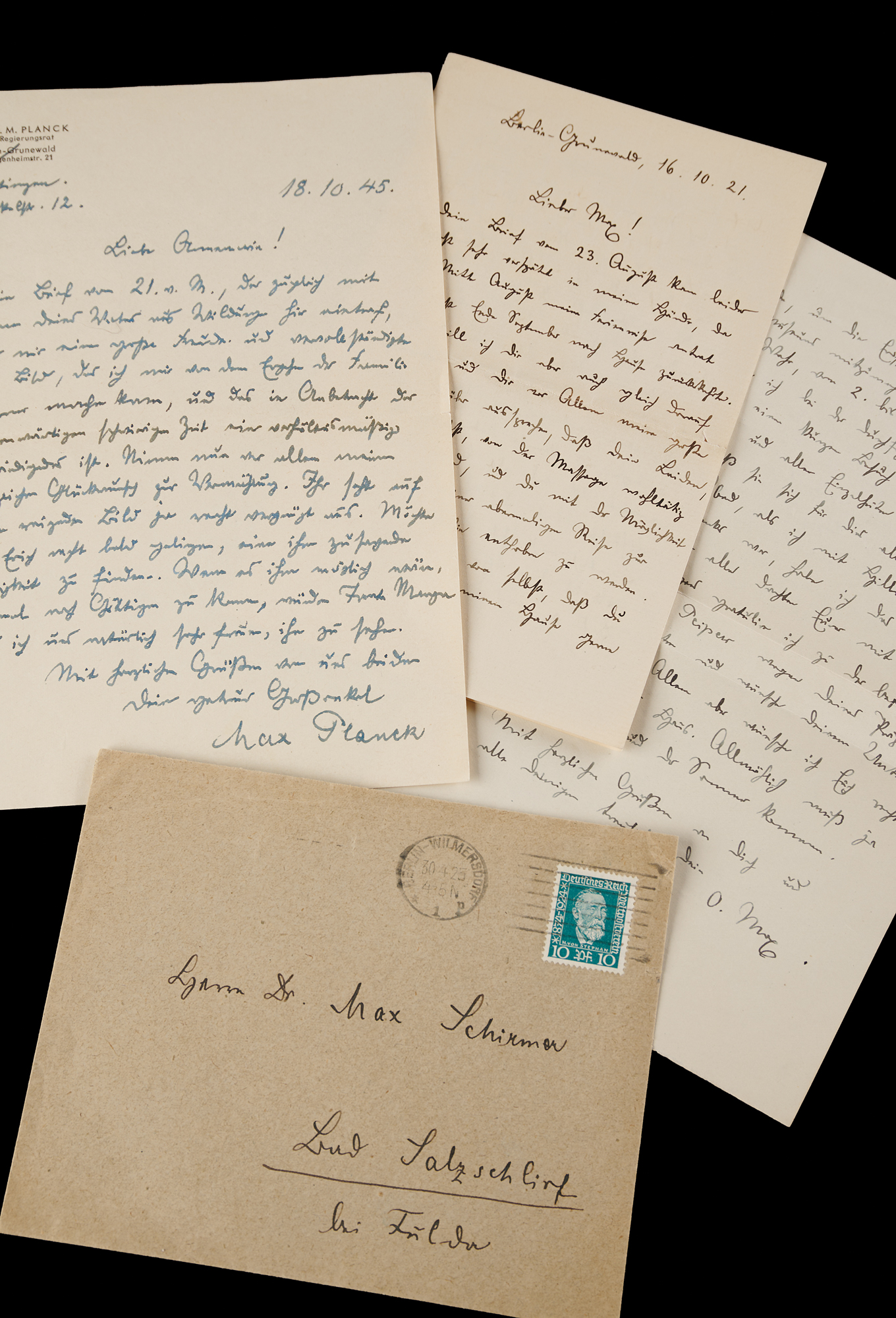
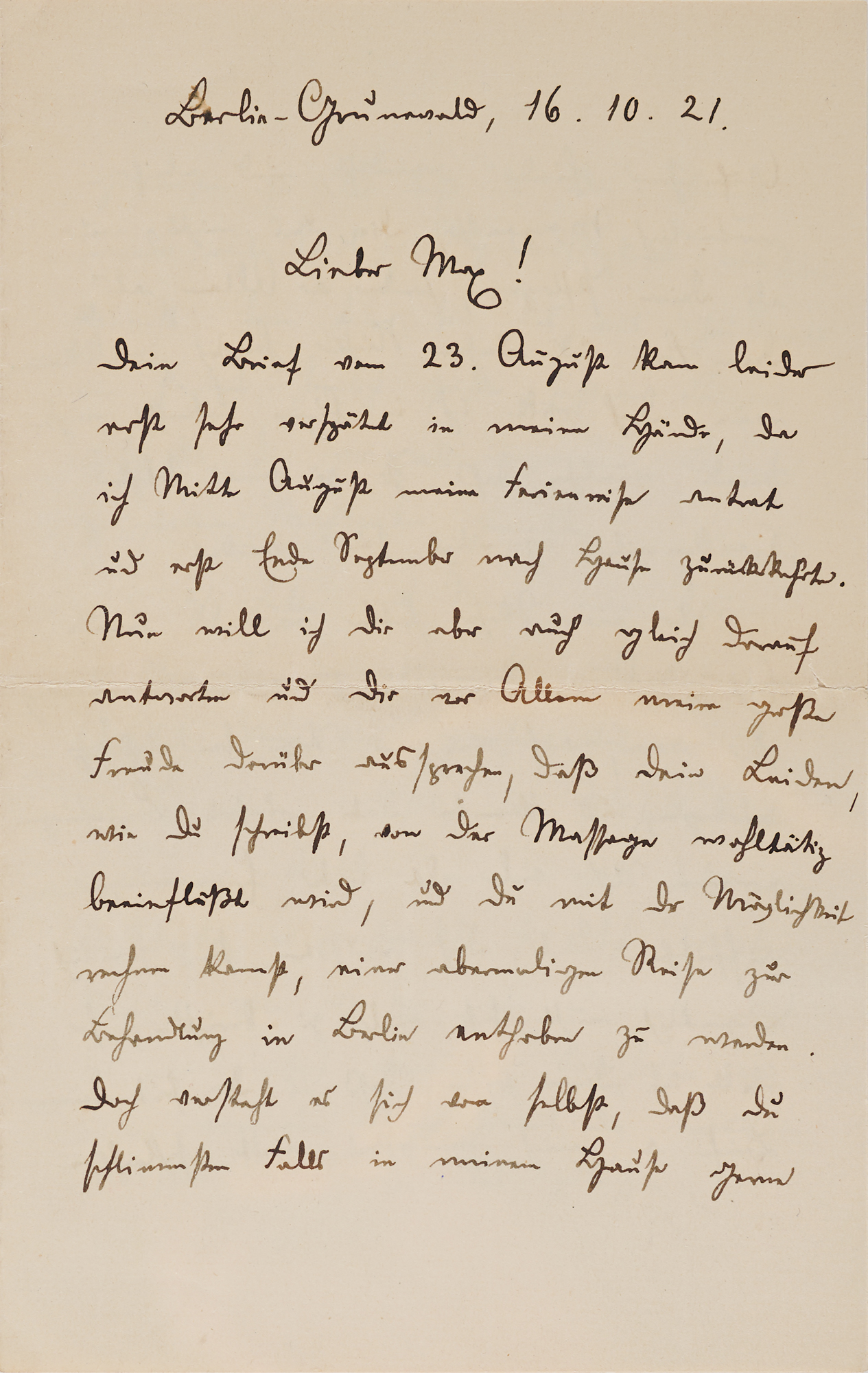
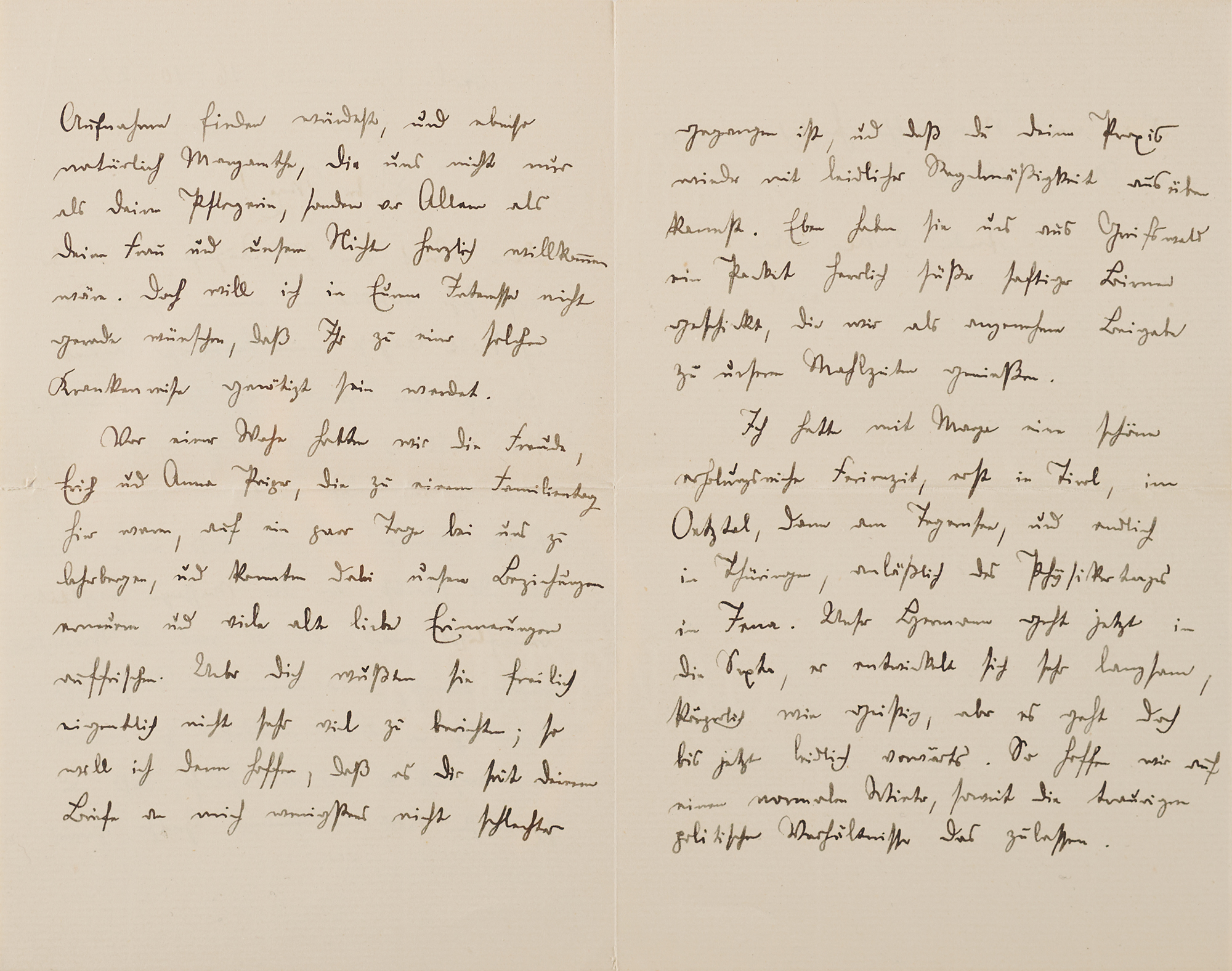
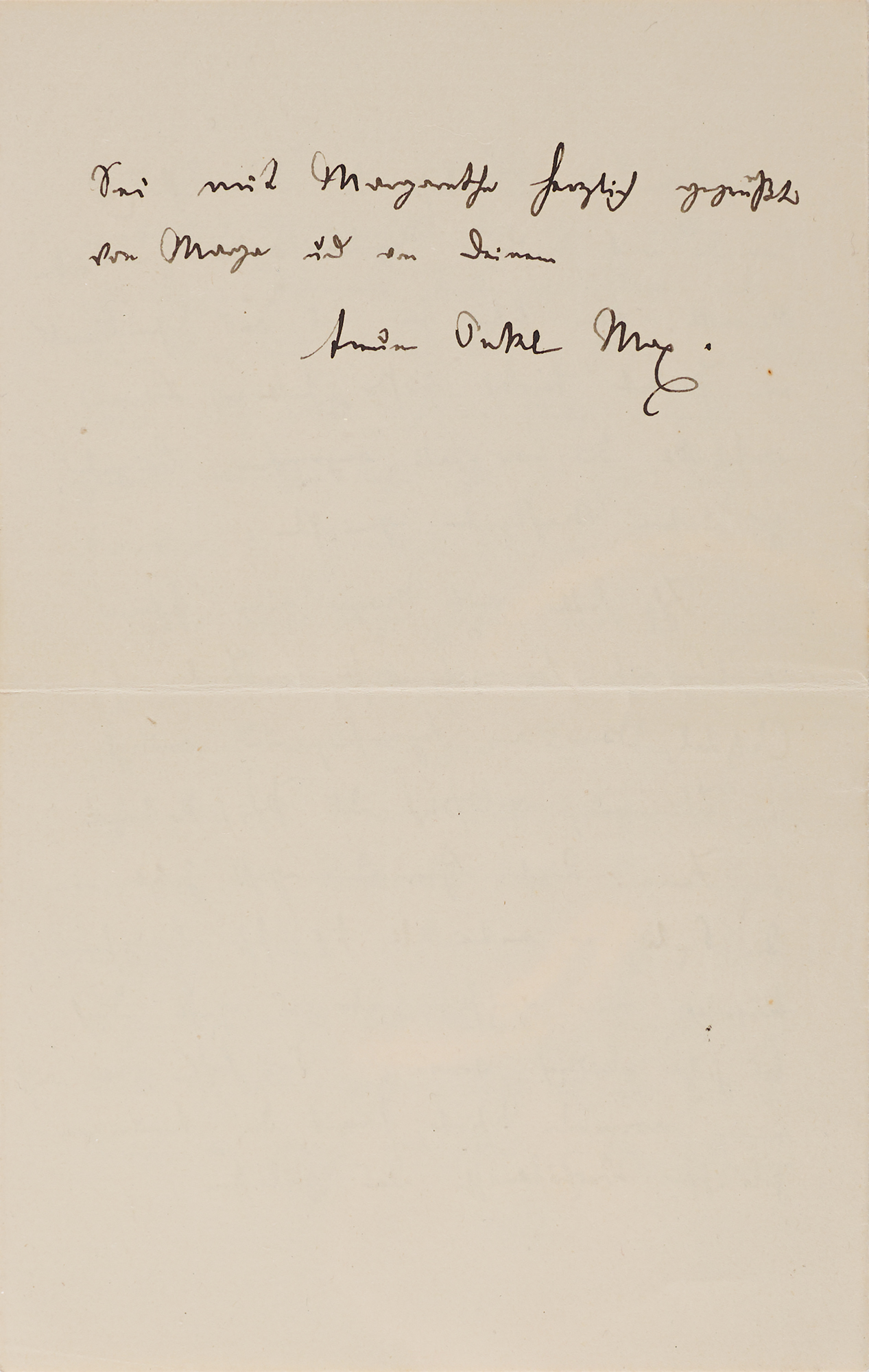
Nobel Prize-winning German physicist (1858-1947) who pioneered the understanding of quantum theory. Collection of three ALSs in German from Max Planck, dated 1921, 1925, and 1945, two of which are addressed to his nephew, Dr. Max Schirmer, and the third to his grandniece, Annemarie. The two handwritten letters to Schirmer, 4.5 x 7 and 5.5 x 8.75, were sent from Berlin-Grunewald, and signed “Onkel Max” and “O[nkel]. Max.” The earlier letter, four pages on two adjoining sheets, October 16, 1921, reads, in part (translated): “Your letter of August 23 unfortunately reached me very late, as I left on my vacation in mid-August and did not return home until the end of September. I want to reply to you at once, however, and above all express my great joy that your ailments, as you write, are being completely improved by the massage, and that you may rest with the prospect of being spared another trip to Berlin for treatment…A week ago we had the pleasure of hosting Erich and Anna Priger, who were here for a family gathering, for several days, and in doing so we were able to renew our ties and revive many fond old memories…Marga and I had a pleasant and restful holiday, first in Tyrol, in the Ötztal, then at Lake Tegernsee, and finally in Thuringia, on the occasion of the physicists’ meeting in Jena. Our Hermann is now in the Sexta (school level); he is developing very slowly, both physically and mentally, but things are at least progressing somewhat. Thus we hope for a normal winter, insofar as the sad political conditions allow it.”
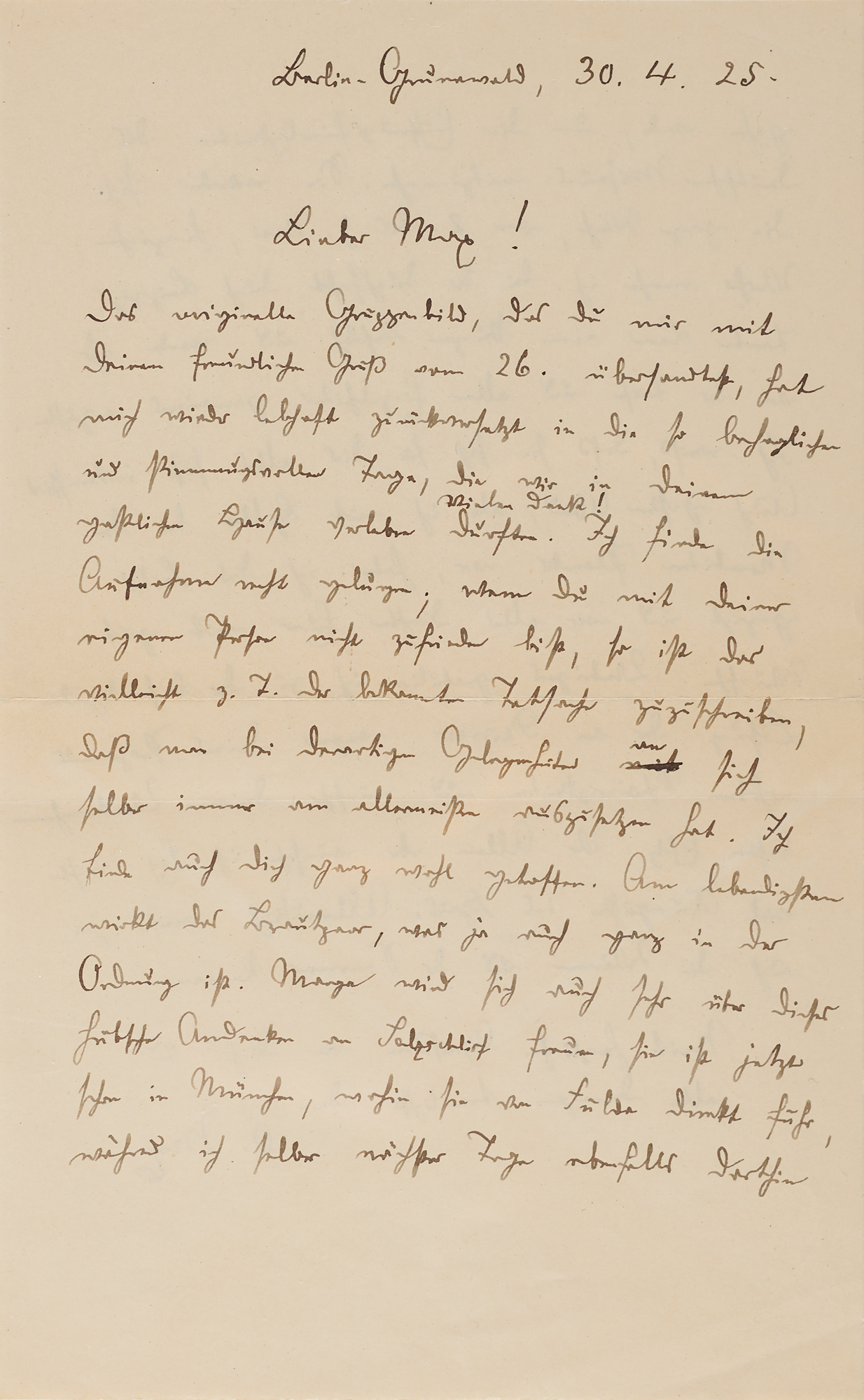
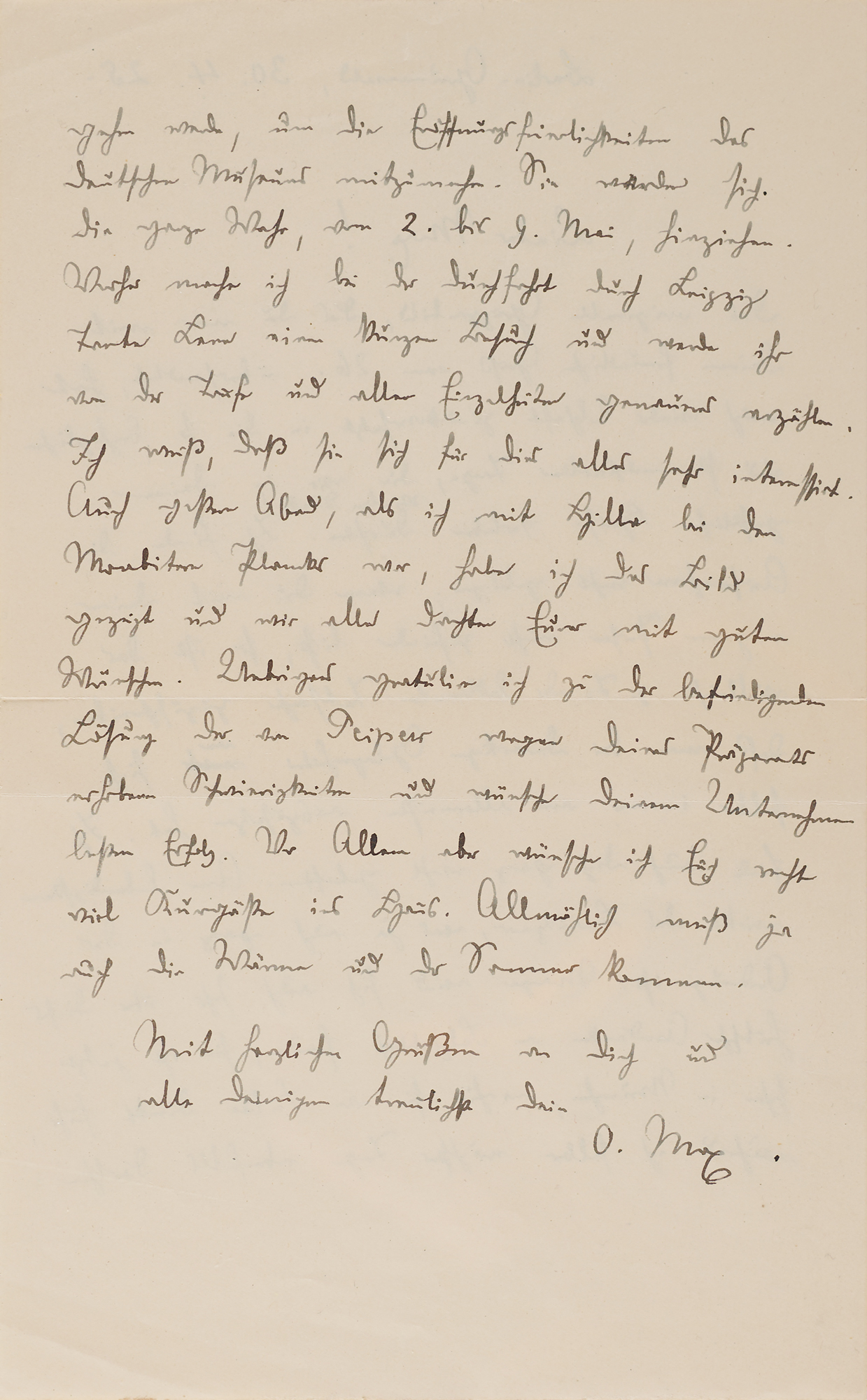
The second letter, one page both sides, April 30, 1925, in part: “The original group photograph that you sent me with your kind greetings on the 26th vividly transported me back to the comfortable and atmospheric days we were able to spend in your hospitable home. Many thanks! I find the picture quite successful; if you are not satisfied with your own appearance, this may perhaps partly be attributed to the well-known fact that on such occasions one is always most critical of oneself. I think you too are very well captured. The bridal couple appears the most lively, which is entirely as it should be. Marga will also be very pleased with this charming keepsake from…She is already in Munich, where she traveled directly from Fulda, while I myself will also be going there in the next few days to attend the opening celebrations of the Deutsches Museum…Before that, I will make a brief visit to Aunt…while passing through Leipzig and will tell her in more detail about the christening and all the particulars. I know that she is very interested in all this.”
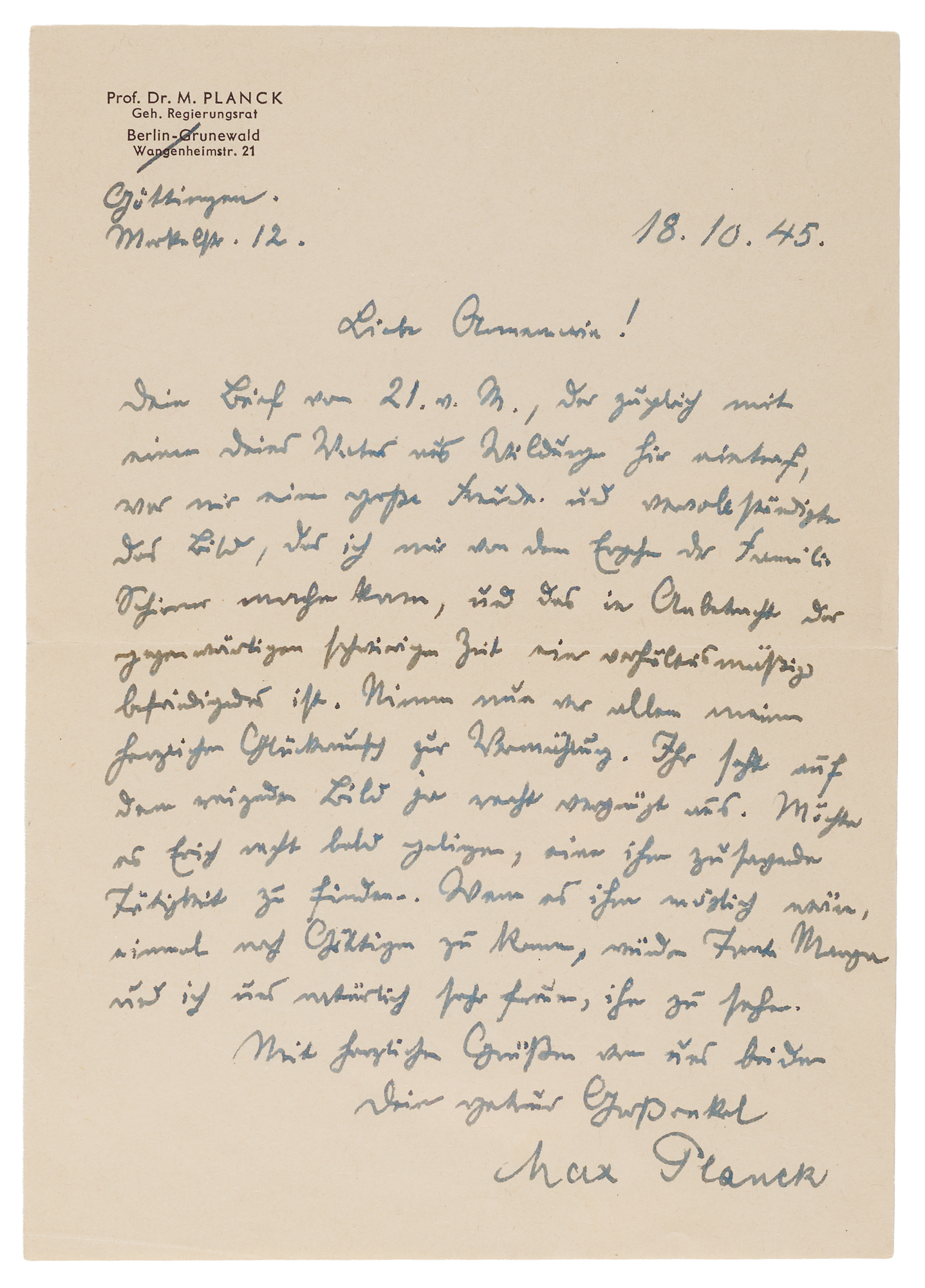
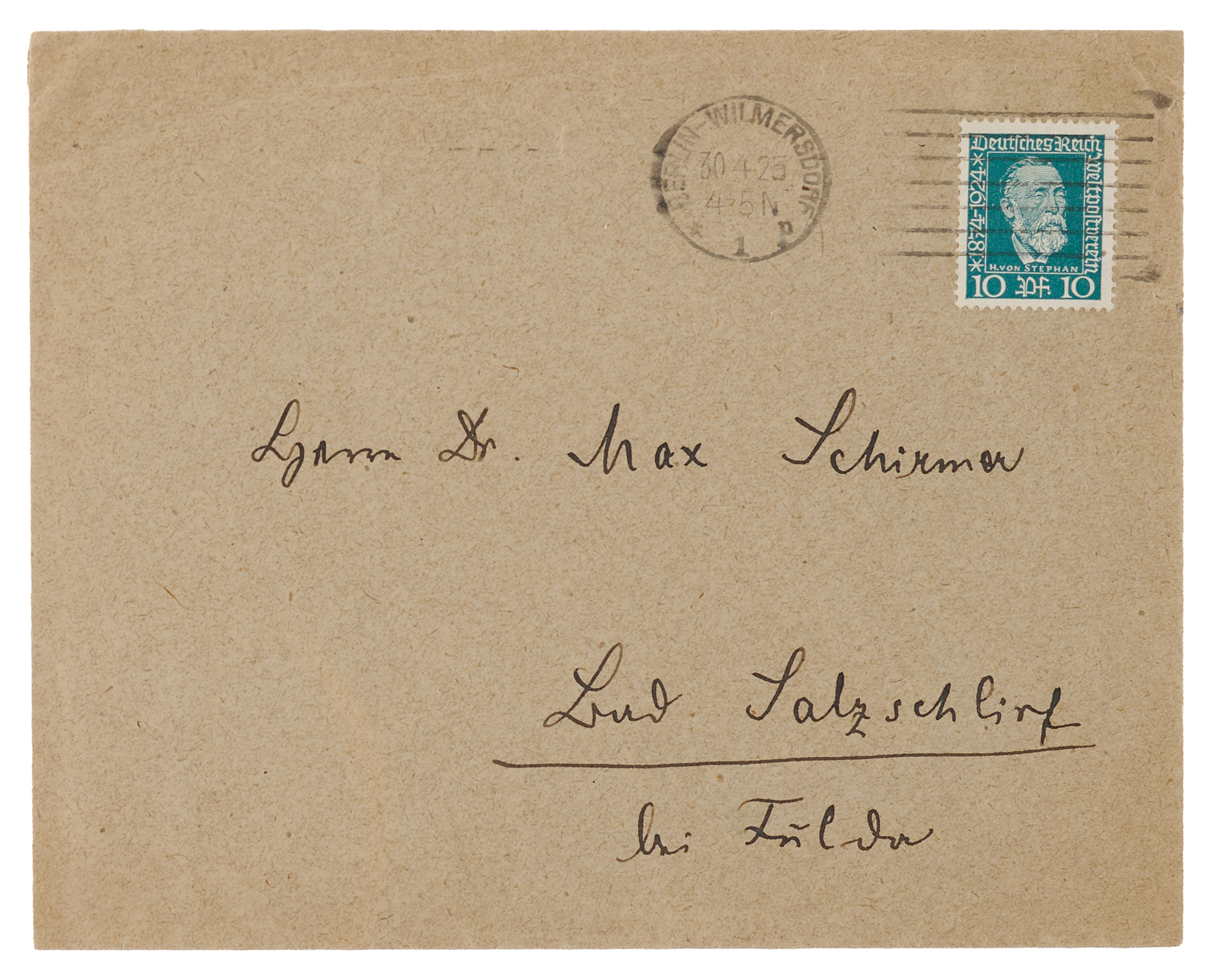
The third ALS, signed “Max Planck,” one page, 6 x 8.25, personal letterhead, October 18, 1945, is untranslated and sent to his grandniece. In it, Planck thanks her for her letter, sends his congratulations on her marriage, and expresses the hope of seeing her husband, who is apparently unemployed, in Göttingen soon. In overall very fine condition. Accompanied by an original mailing envelope addressed in Planck's own hand, postmarked at Berlin-Wilmersdorf on April 30, 1925.
Max Planck’s personal correspondence offers a revealing glimpse into the private life of a figure more often defined by his scientific achievements. Writing in 1921 to his nephew and signing warmly as “Onkel Max,” Planck reflects on health, travel, and recent family visits, situating himself in the routines of domestic life during a period of uncertainty in postwar Germany. Particularly notable is his candid remark about his young son Hermann, then in school: “he is developing very slowly, both physically and mentally…Thus we hope for a normal winter, insofar as the sad political conditions allow it.”
Seen in context, the letter falls within a period already marked by personal loss. Planck’s first wife had died in 1909, and within the following decade, he lost three of his children: his son Karl in the First World War, and his daughters Grete and Emma in 1917 and 1919. By the early 1920s, only Erwin and Hermann remained. The reference to Hermann’s development thus carries added weight in light of the family’s reduced circumstances. That sense of loss would deepen further in later years: his son Erwin was executed by the Nazis in 1945 for his involvement in the plot against Hitler, and Hermann would be the only child to outlive him, and then only briefly. Taken together, the group reflects Planck’s sustained engagement with his family across decades shaped by success and personal loss.

This item is Pre-Certified by PSA/DNA
Buy a third-party letter of authenticity for
(inquire for price)
*This item has been pre-certified by a trusted third-party authentication service, and by placing a bid on this item, you agree to accept the opinion of this authentication service. If you wish to have an opinion rendered by a different authenticator of your choosing, you must do so prior to your placing of any bid. RR Auction is not responsible for differing opinions submitted 30 days after the date of the sale.
Third-party authentication service applies only to signatures and handwriting, and does not cover the addition of sketches, artwork, musical quotations, etc.

