The 30 Minute Rule begins May 13 at 7:00 PM EDT. An Initial Bid Must Be Placed By May 13 at 6:00 PM EDT To Participate After 6:00 PM EDT
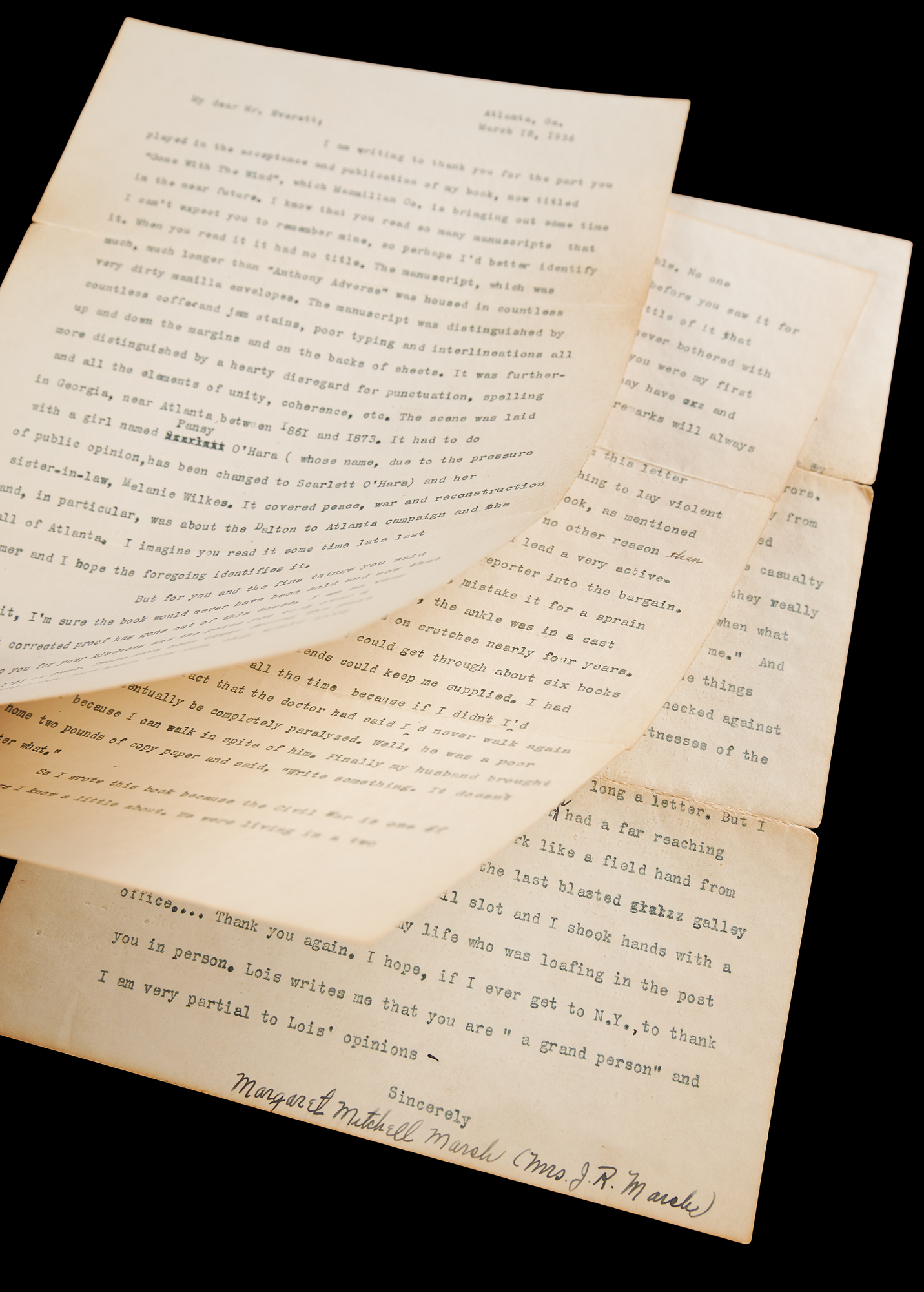
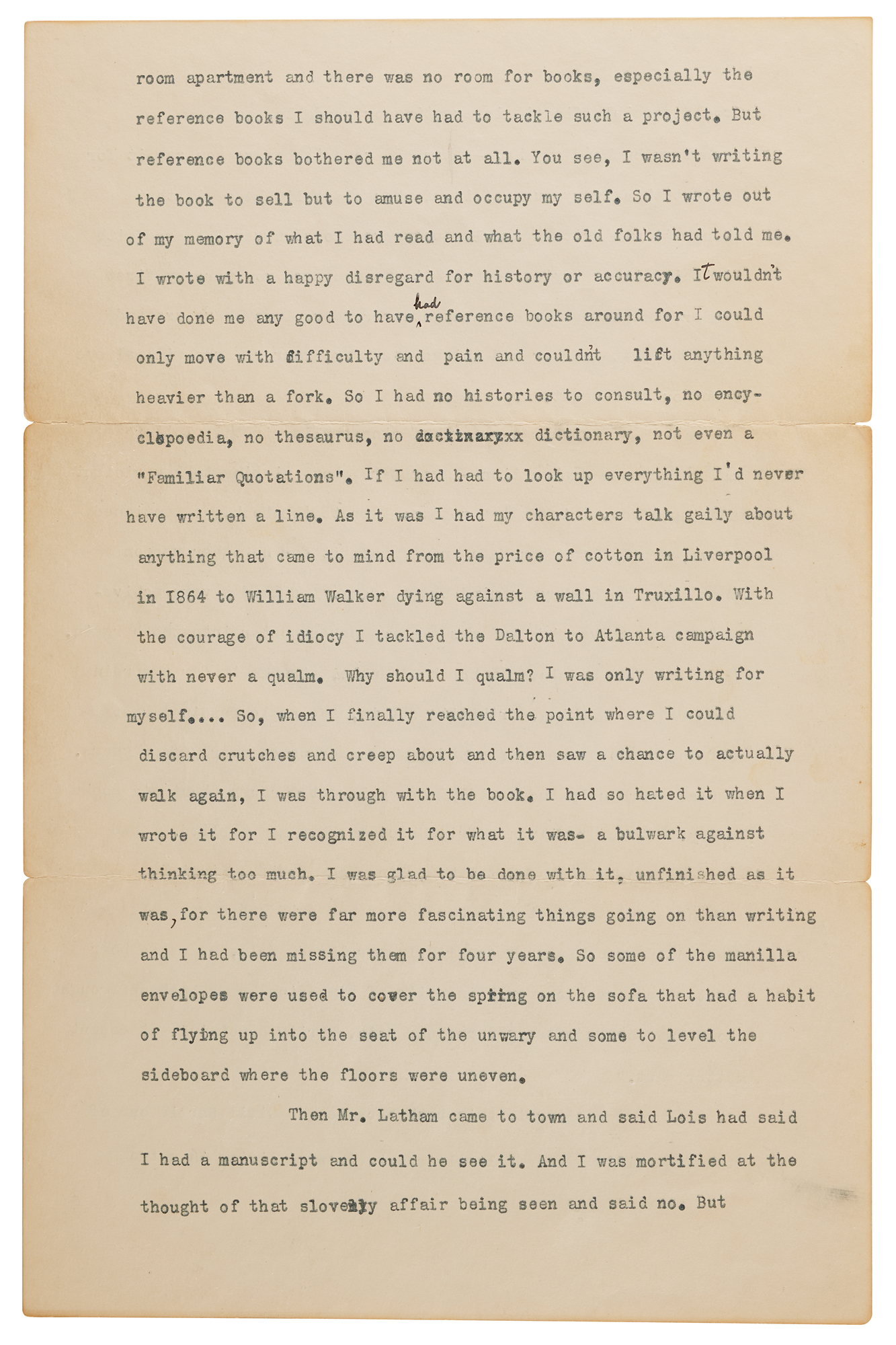
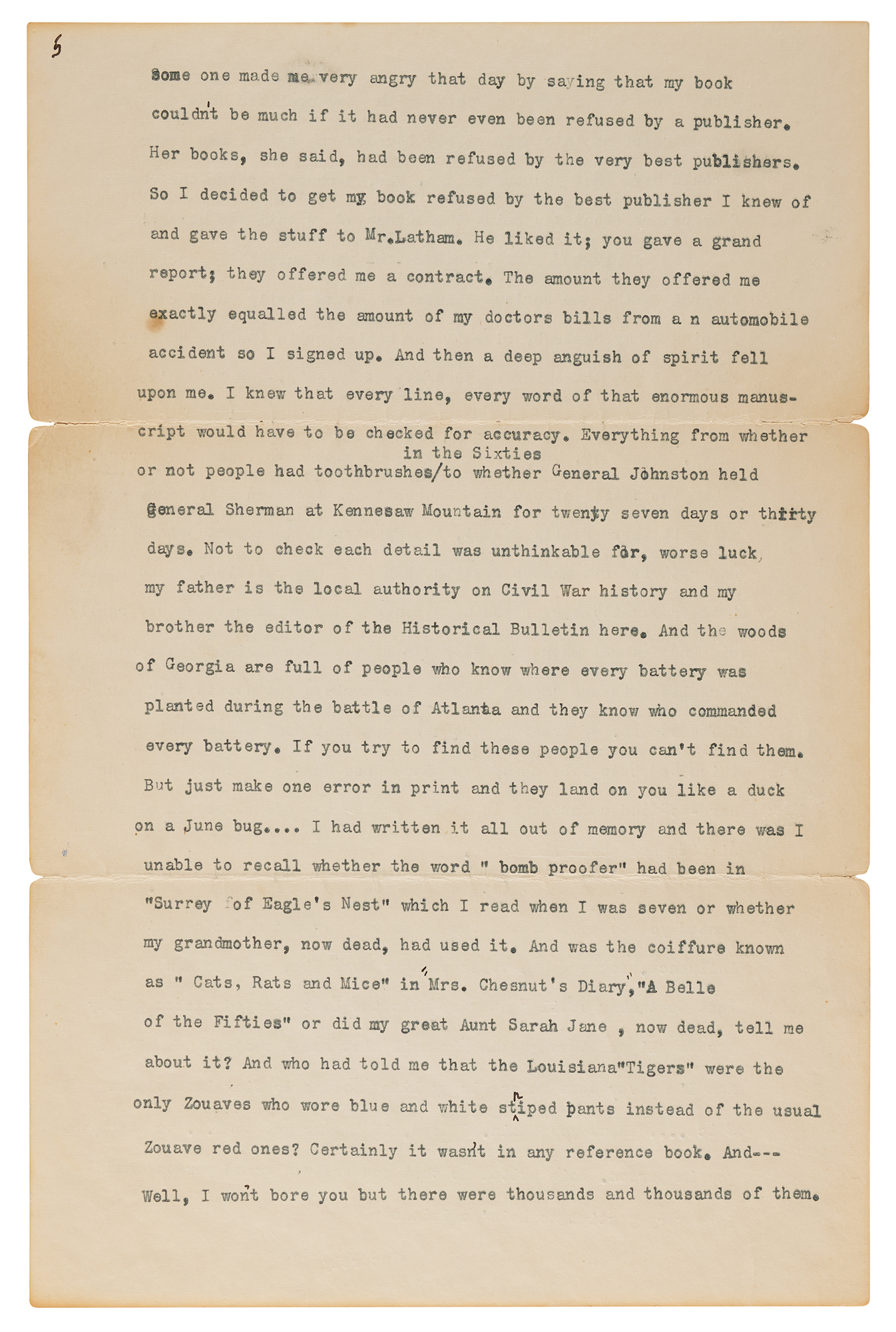
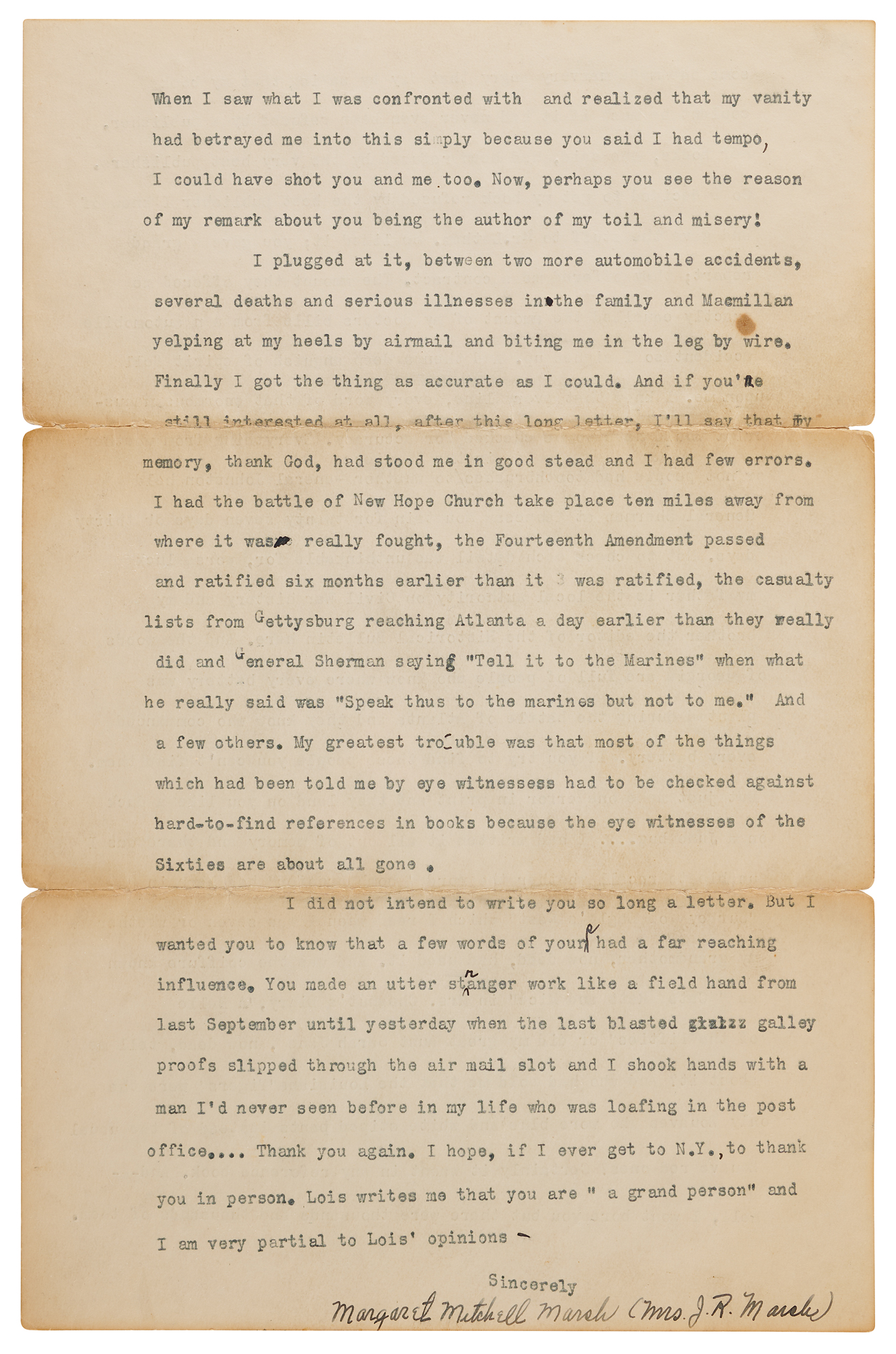
Amazing TLS signed “Margaret Mitchell Marsh (Mrs. J. R. Marsh),” three pages both sides, 7 x 11, March 18, 1936. Letter to Dr. Charles Warren Everett concerning Gone with the Wind, written three months before the novel's publication. Dr. Everett, a professor at Columbia College, had worked as a reader for the publisher Macmillan and reviewed Mitchell's manuscript with enthusiasm, leading to the signing of the contract with the publishing house. He encouraged Mitchell to delve deeper into her research on the Civil War and to revise her novel considerably.
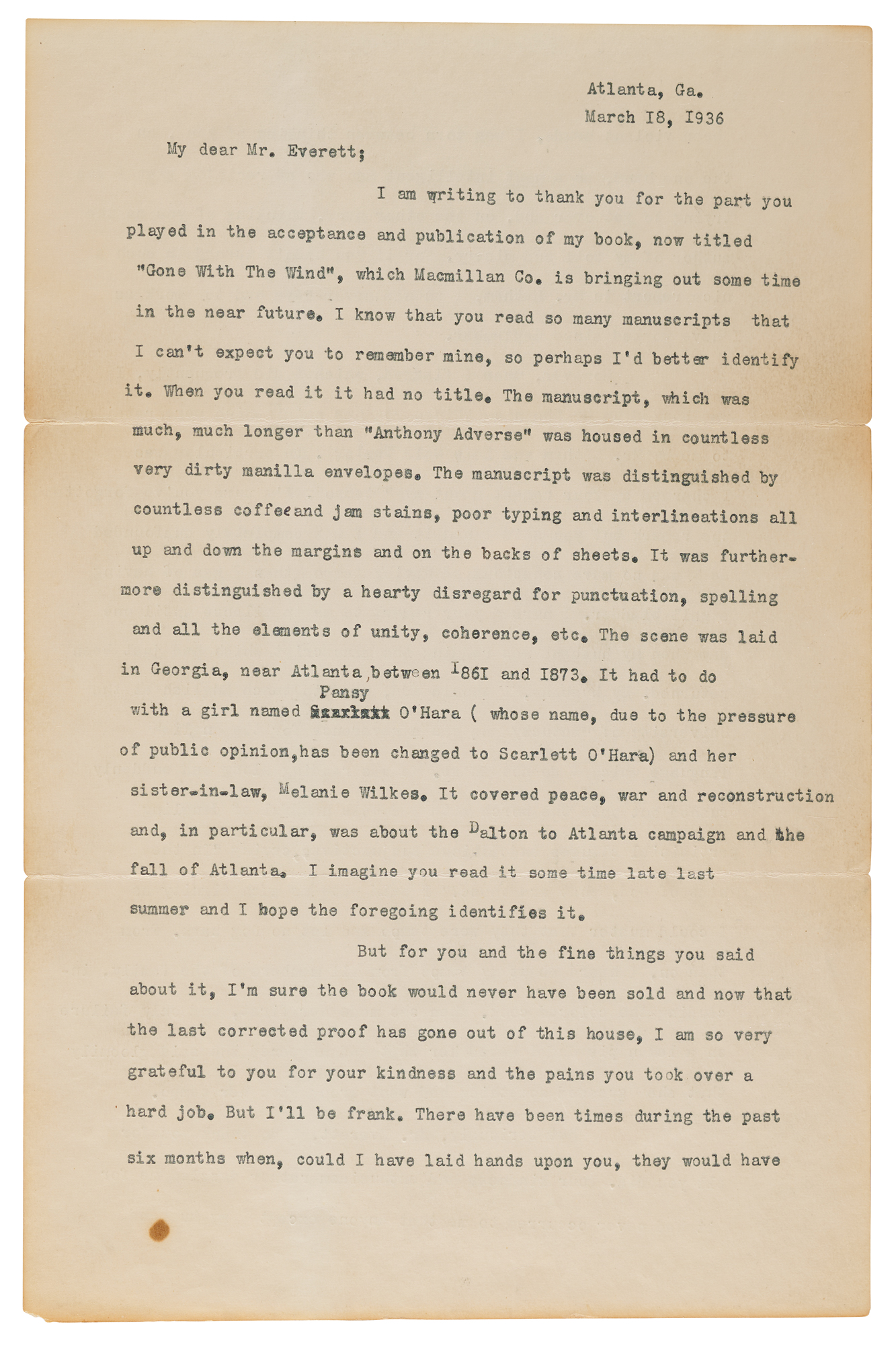
In full: "I am writing to thank you for the part you played in the acceptance and publication of my book, now titled 'Gone With The Wind,' which Macmillan Co. is bringing out some time in the near future. I know that you read so many manuscripts that I can't expect you to remember mine, so perhaps I'd better identify it. When you read it it had no title. The manuscript, which was much, much longer than 'Anthony Adverse' was housed in countless very dirty manilla envelopes. The manuscript was distinguished by countless coffee and jam stains, poor typing and interlineations all up and down the margins and on the backs of sheets. It was furthermore distinguished by a hearty disregard for punctuation, spelling and all the elements of unity, coherence, etc. The scene was laid in Georgia, near Atlanta, between 1861 and 1873. It had to do with a girl named Pansy O'Hara (whose name, due to the pressure of public opinion, has been changed to Scarlett O'Hara) and her sister-in-law, Melanie Wilkes. It covered peace, war and reconstruction and, in particular, was about the Dalton to Atlanta campaign and the fall of Atlanta. I imagine you read it some time late last summer and I hope the foregoing identifies it.
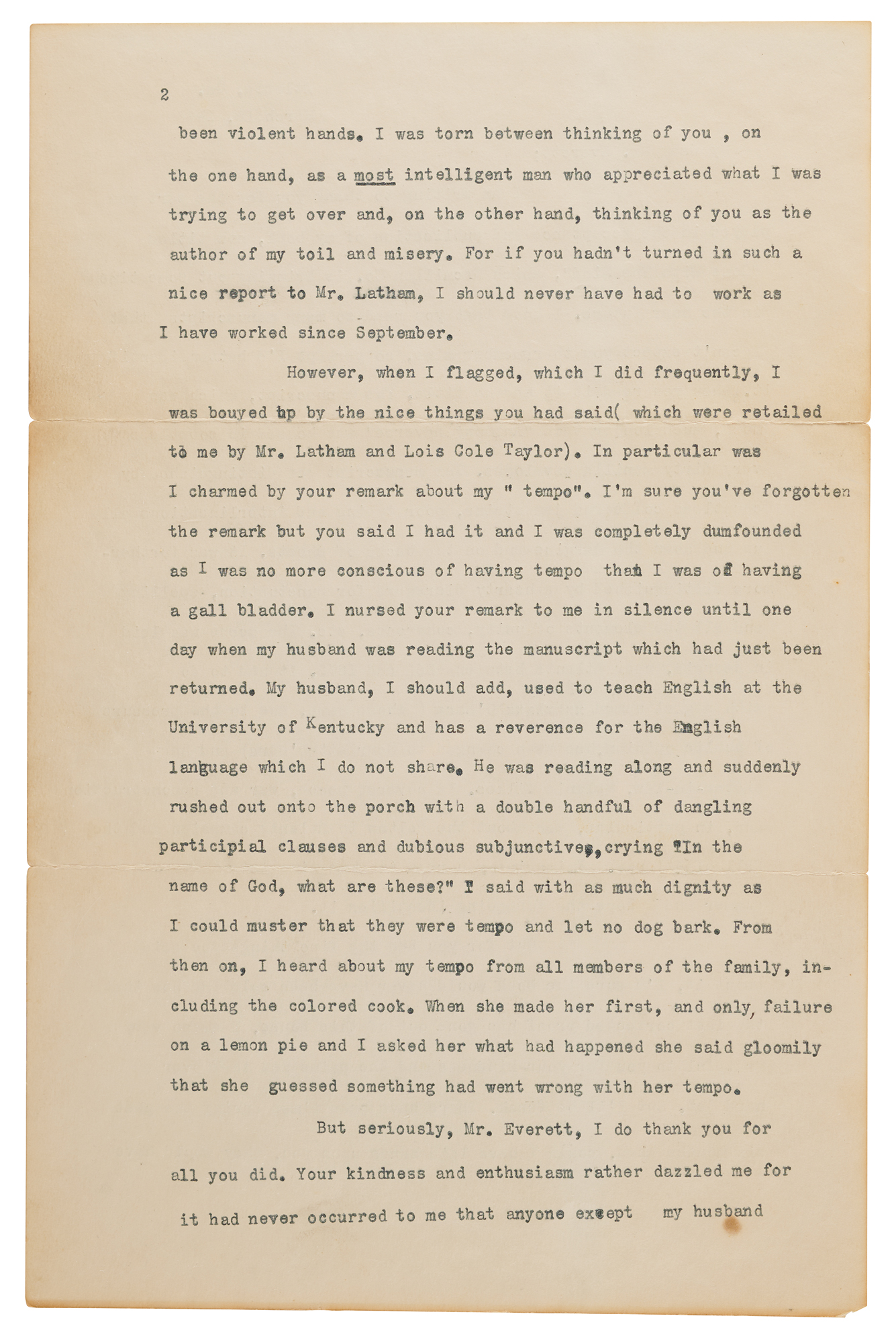
But for you and the fine things you said about it, I'm sure the book would never have been sold and now that the last corrected proof has gone out of this house, I am so very grateful to you for your kindness and the pains you took over a hard job. But I'll be frank. There have been times during the past six months when, could I have laid hands upon you, they would have been violent hands. I was torn between thinking of you, on the one hand, as a most intelligent man who appreciated what I was trying to get over and, on the other hand, thinking of you as the author of my toil and misery. For if you hadn't turned in such a nice report to Mr. Latham, I should never have had to work as I have worked since September.
However, when I flagged, which I did frequently, I was bouyed up by the nice things you had said (which were retailed to me by Mr. Latham and Lois Cole Taylor). In particular was I charmed by your remark about my 'tempo.' I'm sure you've forgotten the remark but you said I had it and I was completely dumfounded as I was no more conscious of having tempo than I was of having a gall bladder. I nursed your remark to me in silence until one day when my husband was reading the manuscript which had just been returned. My husband, I should add, used to teach English at the University of Kentucky and has a reverence for the English language which I do not share. He was reading along and suddenly rushed out onto the porch with a double handful of dangling participial clauses and dubious subjunctives, crying 'In the name of God, what are these?' I said with as much dignity as I could muster that they were tempo and let no dog bark. From then on, I heard about my tempo from all members of the family, including the colored cook. When she made her first, and only, failure on a lemon pie and I asked her what had happened she said gloomily that she guessed something had went wrong with her tempo.
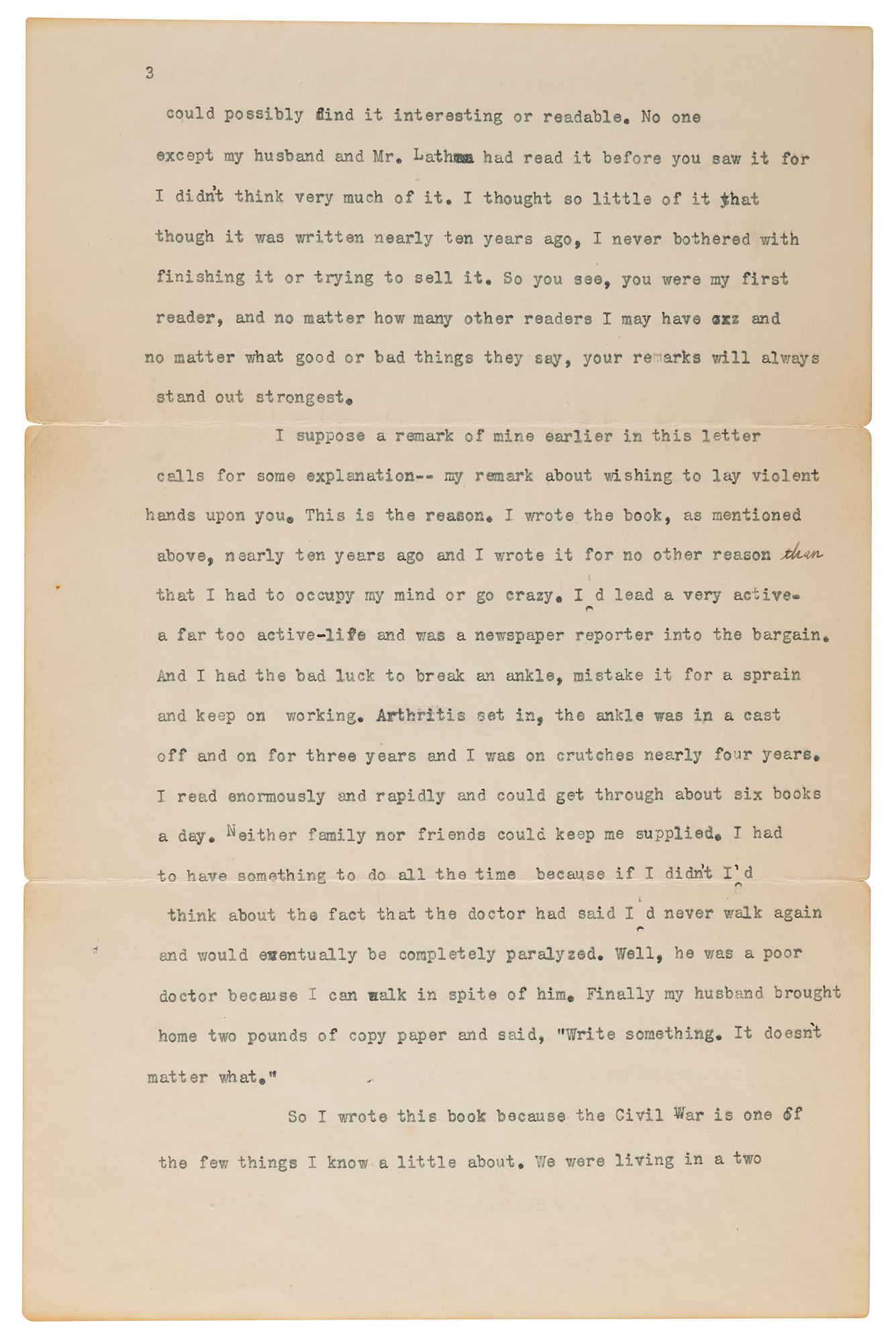
But seriously, Mr. Everett, I do thank you for all you did. Your kindness and enthusiasm rather dazzled me for it had never occurred to me that anyone except my husband could possibly find it interesting or readable. No one except my husband and Mr. Latham had read it before you saw it for I didn't think very much of it. I thought so little of it that though it was written nearly ten years ago, I never bothered with finishing it or trying to sell it. So you see, you were my first reader, and no matter how many other readers I may have and no matter what good or bad things they say, your remarks will always stand out strongest.
I suppose a remark of mine earlier in this letter calls for some explanation—my remark about wishing to lay violent hands upon you. This is the reason. I wrote the book, as mentioned above, nearly ten years ago and I wrote it for no other reason thin that I had to occupy my mind or go crazy. I'd lead a very active—a far too active—life and was a newspaper reporter into the bargain. And I had the bad luck to break an ankle, mistake it for a sprain and keep on working. Arthritis set in, the ankle was in a cast off and on for three years and I was on crutches nearly four years. I read enormously and rapidly and could get through about six books a day. Neither family nor friends could keep me supplied. I had to have something to do all the time because if I didn't I'd think about the fact that the doctor had said I'd never walk again and would eventually be completely paralyzed. Well, he was a poor doctor because I can walk in spite of him. Finally my husband brought home two pounds of copy paper and said, 'Write something. It doesn't matter what.'
So I wrote this book because the Civil War is one of the few things I know a little about. We were living in a two room apartment and there was no room for books, especially the reference books I should have had to tackle such a project. But reference books bothered me not at all. You see, I wasn't writing the book to sell but to amuse and occupy my self. So I wrote out of my memory of what I had read and what the old folks had told me.
I wrote with a happy disregard for history or accuracy. It wouldn't have done me any good to have had reference books around for I could only move with difficulty and pain and couldn't lift anything heavier than a fork. So I had no histories to consult, no encyclopoedia, no thesaurus, no dictionary, not even a 'Familiar Quotations.' If I had had to look up everything I'd never have written a line. As it was I had my characters talk gaily about anything that came to mind from the price of cotton in Liverpool in 1864 to William Walker dying against a wall in Truxillo. With the courage of idiocy I tackled the Dalton to Atlanta campaign with never a qualm. Why should I qualm? I was only writing for myself…. So, when I finally reached the point where I could discard crutches and creep about and then saw a chance to actually walk again, I was through with the book. I had so hated it when I wrote it for I recognized it for what it was a bulwark against thinking too much. I was glad to be done with it, unfinished as it was, for there were far more fascinating things going on than writing and I had been missing them for four years. So some of the manilla envelopes were used to cover the spring on the sofa that had a habit of flying up into the seat of the unwary and some to level the sideboard where the floors were uneven.
Then Mr. Latham came to town and said Lois had said I had a manuscript and could he see it. And I was mortified at the thought of that slovenly affair being seen and said no. But some one made me very angry that day by saying that my book couldn't be much if it had never even been refused by a publisher. Her books, she said, had been refused by the very best publishers. So I decided to get my book refused by the best publisher I knew of and gave the stuff to Mr. Latham. He liked it; you gave a grand report; they offered me a contract. The amount they offered me exactly equalled the amount of my doctors bills from an automobile accident so I signed up. And then a deep anguish of spirit fell upon me. I knew that every line, every word of that enormous manuscript would have to be checked for accuracy. Everything from whether or not people in the Sixties had toothbrushes to whether General Johnston held General Sherman at Kennesaw Mountain for twenty seven days or thirty days. Not to check each detail was unthinkable for, worse luck, my father is the local authority on Civil War history and my brother the editor of the Historical Bulletin here. And the woods of Georgia are full of people who know where every battery was planted during the battle of Atlanta and they know who commanded every battery. If you try to find these people you can't find them. But just make one error in print and they land on you like a duck on a June bug…. I had written it all out of memory and there was I unable to recall whether the word 'bomb proofer' had been in 'Surrey of Engle's Nest' which I read when I was seven or whether my grandmother, now dead, had used it. And was the coiffure known as 'Cats, Rats and Mice' in 'Mrs. Chesnut's Diary,' 'A Belle of the Fifties' or did my great Aunt Sarah Jane, now dead, tell me about it? And who had told me that the Louisiana 'Tigers' were the only Zouaves who wore blue and white striped pants instead of the usual Zouave red ones? Certainly it wasn't in any reference book. And—Well, I won't bore you but there were thousands and thousands of them.
When I saw what I was confronted with and realized that my vanity had betrayed me into this simply because you said I had tempo, I could have shot you and me too. Now, perhaps you see the reason of my remark about you being the author of my toil and misery!
I plugged at it, between two more automobile accidents, several deaths and serious illnesses in the family and Macmillan yelping at my heels by airmail and biting me in the leg by wire. Finally I got the thing as accurate as I could. And if you're still interested at all, after this long letter, I'll say that my memory, thank God, had stood me in good stead and I had few errors. I had the battle of New Hope Church take place ten miles away from where it was really fought, the Fourteenth Amendment passed and ratified six months earlier than it was ratified, the casualty lists from Gettysburg reaching Atlanta a day earlier than they really did and General Sherman saying 'Tell it to the Marines' when what he really said was 'Speak thus to the marines but not to me.' And a few others. My greatest trouble was that most of the things which had been told me by eye witnesses had to be checked against hard-to-find references in books because the eye witnesses of the Sixties are about all gone.
I did not intend to write you so long a letter. But I wanted you to know that a few words of yours had a far reaching influence. You made an utter stranger work like a field hand from last September until yesterday when the last blasted galley proofs slipped through the air mail slot and I shook hands with a man I'd never seen before in my life who was loafing in the post office…. Thank you again. I hope, if I ever get to N.Y., to thank you in person. Lois writes me that you are 'a grand person' and I am very partial to Lois' opinions." In very good to fine condition, with light soiling to the final page, and minor splitting to the ends of the mailing folds.
Written just three months before the publication of Gone with the Wind, this candid and highly engaging letter offers remarkable insight into Margaret Mitchell’s creative process and the unlikely path of her now-iconic novel to print. Addressed to Dr. Charles Warren Everett—whose early, enthusiastic reading helped secure the book’s publication—it reveals Mitchell’s humility and humor, while detailing the years of revision and historical verification that followed her manuscript’s rediscovery. Rich with personal anecdotes and self-deprecating wit, the letter captures a pivotal moment on the eve of literary history, when Mitchell’s deeply personal project was poised to become a cultural phenomenon.
Upon its release in June 1936, Gone With the Wind swiftly captured the hearts and imaginations of readers, garnering widespread acclaim for its sweeping narrative and vivid characters. Margaret Mitchell's depiction of the antebellum South amidst the turmoil of the Civil War resonated deeply with audiences, propelling the novel to unparalleled success. Critics hailed Mitchell's storytelling prowess and her ability to evoke a sense of place and time with remarkable detail. It became an instant bestseller, selling over 1,000,000 copies within the first six months of its publication.

This item is Pre-Certified by PSA/DNA
Buy a third-party letter of authenticity for
$150.00
*This item has been pre-certified by a trusted third-party authentication service, and by placing a bid on this item, you agree to accept the opinion of this authentication service. If you wish to have an opinion rendered by a different authenticator of your choosing, you must do so prior to your placing of any bid. RR Auction is not responsible for differing opinions submitted 30 days after the date of the sale.

