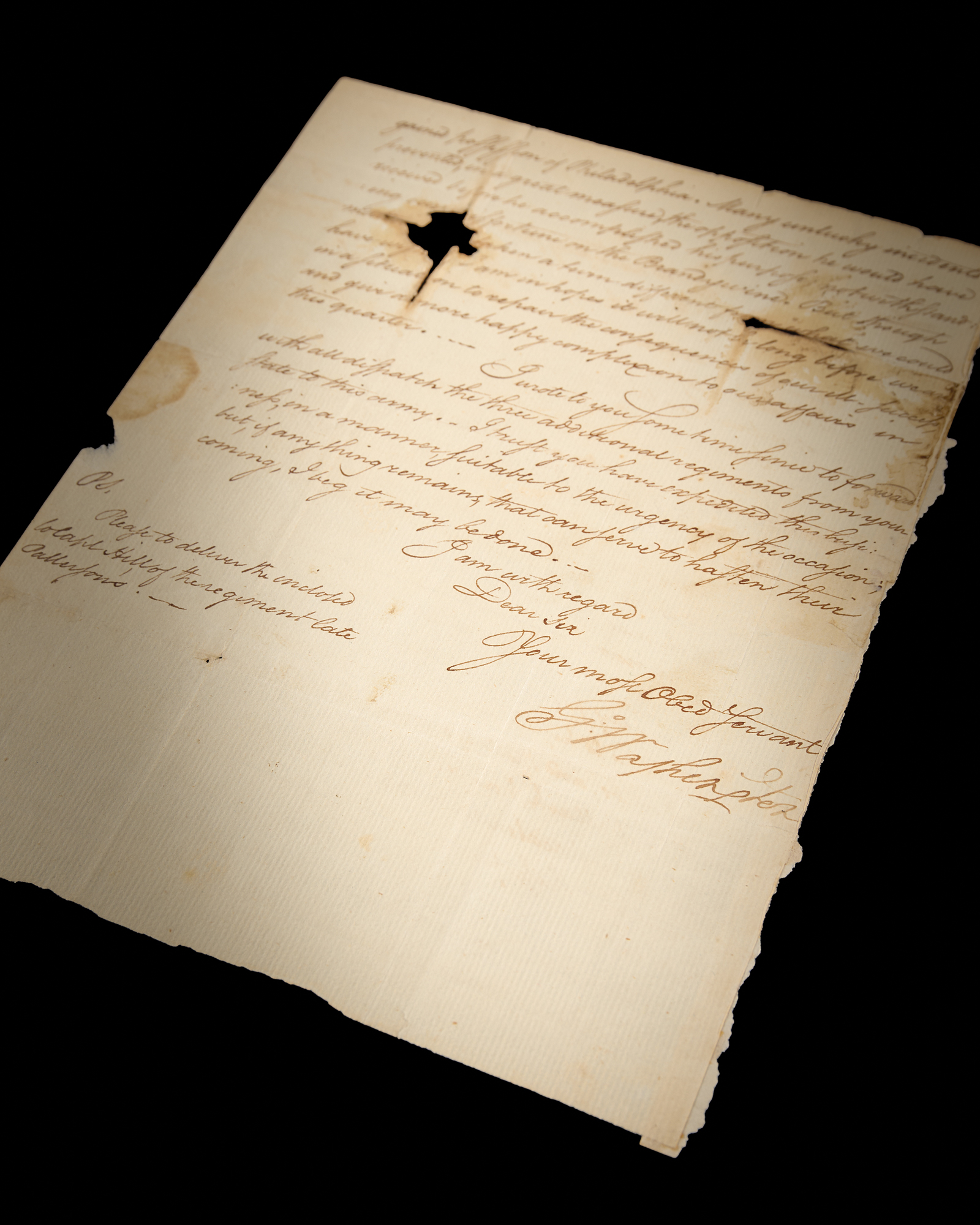
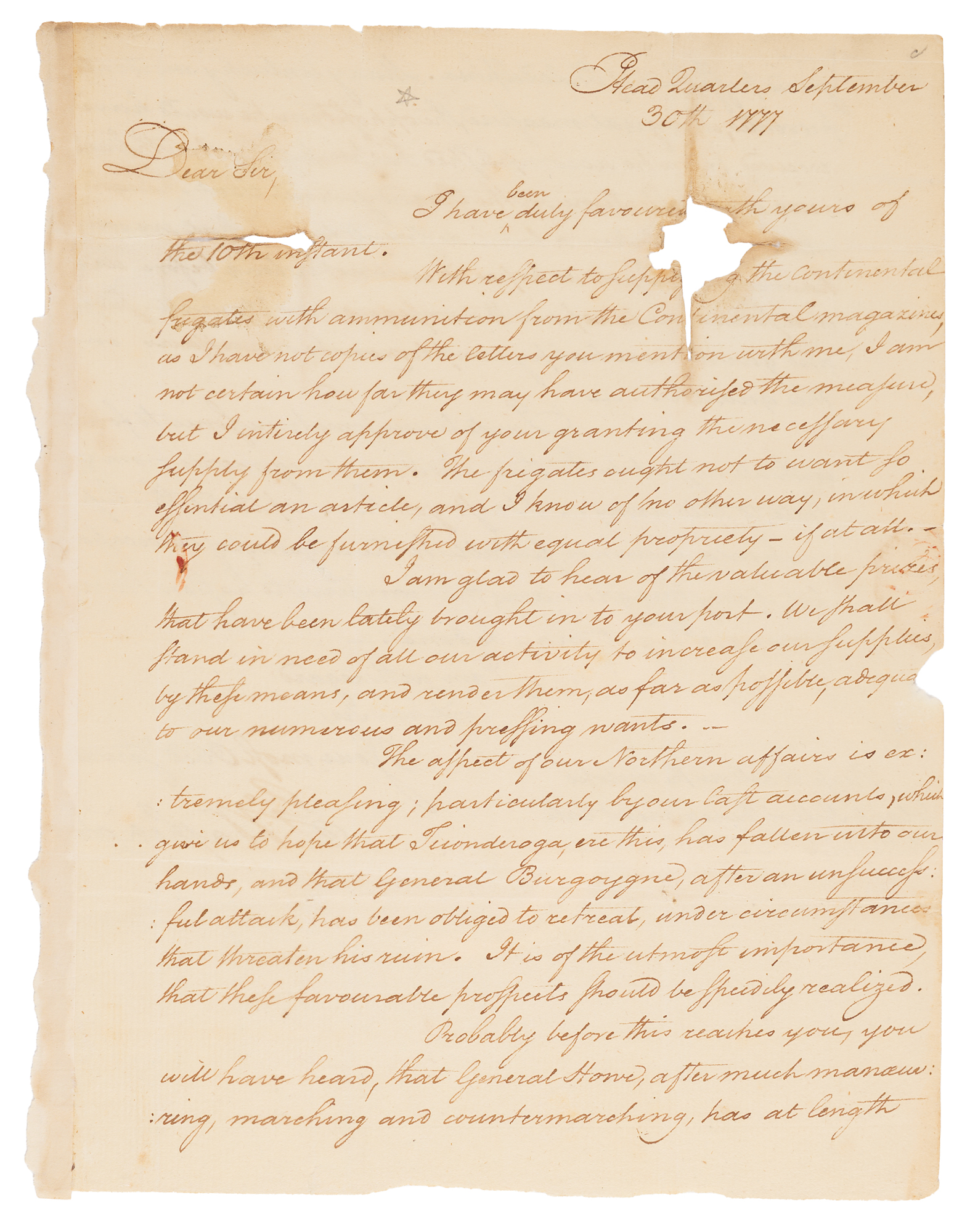
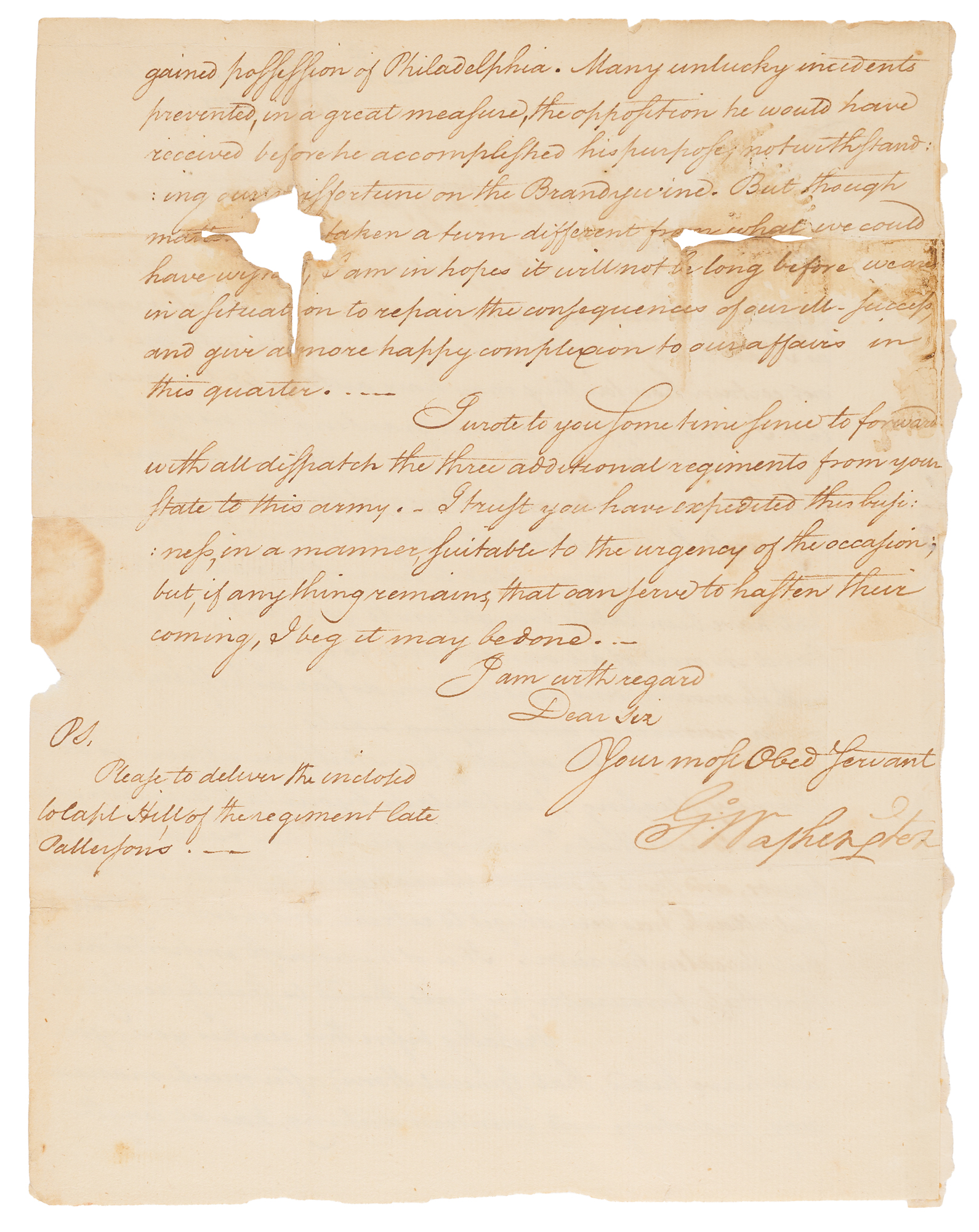
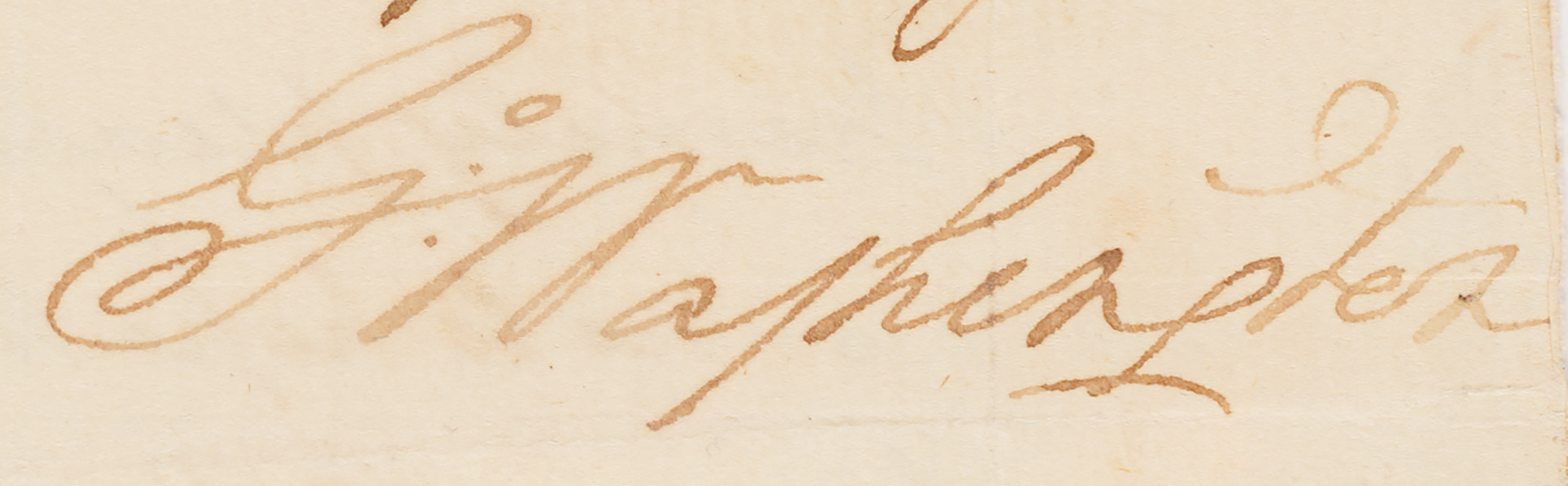
Revolutionary War-dated LS signed by George Washington, "Go: Washington," and penned in the hand of his trusted aide-de-camp, Alexander Hamilton, one page both sides, 7.5 x 9.75, September 30, 1777. Addressed from Washington's "Headquarters" near the Skippack Road encampment in Pennsylvania, northwest of Philadelphia and west of Germantown, the letter was sent to Major General William Heath during the critical Philadelphia campaign of 1777. Written only days before the Battle of Germantown, it concerns Continental military supplies, British movements, Burgoyne's failing northern campaign, and troop mobilization. In full:
"I have been duly favoured with yours of the 10th inst. With respect to supplying the Continental frigates with ammunition from the Continental magazines, as I have not copies of the letters you mention with me, I am not certain how far they may have authorized the measure, but I entirely approve of your granting the necessary supply from them. The frigates ought not to want so essential an article and I know of no other way in which they could be furnished with equal propriety – if at all.
I am glad to hear of the valuable prizes that have been lately brought into your port. We shall stand in need of all our activity to increase our supplies by these means, and render them, as far as possible, adequate to our numerous and pressing wants.
The aspect of our Northern affairs is extremely pleasing; particularly by our last accounts, which give us to hope that Ticonderoga, ere this, has fallen into our hands, and that General Burgoyne, after an unsuccessful attack, has been obliged to retreat, under circumstances that threaten his ruin. It is of the utmost importance, that these favourable prospects should be speedily realized.
Probably before this reaches you, you will have heard, that General Howe, after much maneuvering, marching and countermarching, has at length gained possession of Philadelphia. Many unlucky incidents prevented, in a great measure, the opposition he would have received before he accomplished his purpose notwithstanding our misfortune on the Brandywine. But though matters [have] taken a turn different from what we could have wished, I am in hopes it will not be long before we are in a situation to repair the consequences of our ill-success and give a more happy complexion to our affairs in this quarter.
I wrote to you some time since to forward with all dispatch the three additional regiments from your state to this army. I trust you have expedited this business, in a manner, suitable to the urgency of the occasion, but if anything remains, that can serve to hasten their coming, I beg it may be done." A postscript reads: "Please to deliver the inclosed to Capt. Hill of the regiment late Patterson's." In very good to fine condition, with two areas of paper loss affecting approximately five to eight words of text, all either partially legible on the manuscript or reconstructable from context; Washington's bold signature is completely unaffected
The letter was published in The Writings of George Washington (Vol. VI), on pages 286–287, where it is identified as having been addressed to Major General William Heath, and also appears in The Papers of Alexander Hamilton (Vol. I), edited by Harold C. Syrett, and in The Papers of George Washington, Revolutionary War Series, Vol. XI. Significantly, the Hamilton Papers entry describes the manuscript as ‘LS, in writing of H,’ confirming that the letter was penned in Hamilton’s hand not merely through modern manuscript analysis but through the editorial attribution of Hamilton’s own collected papers. Although Heath is not named in the surviving manuscript itself, the identification is supported by Washington’s references within the text to letters received from the recipient concerning Continental naval supply matters.
Written during one of the most consequential phases of the Revolutionary War, the letter captures Washington confronting simultaneous crises in both the northern and middle colonies during the autumn campaign of 1777. Penned entirely in the hand of Alexander Hamilton, then just 22 years old and serving as one of Washington’s aides-de-camp, having joined headquarters only six months earlier, the letter was composed at a moment when General John Burgoyne’s Saratoga campaign was deteriorating in the north following the costly engagement at Freeman’s Farm. Washington’s hope that “Ticonderoga, ere this, has fallen into our hands” reflects the incomplete and overly optimistic intelligence reaching headquarters in real time; the fort, which American forces had abandoned to Burgoyne in July, had not in fact been retaken. His further remark that Burgoyne had been “obliged to retreat, under circumstances that threaten his ruin” proved far closer to the mark, anticipating the British disaster that would culminate at Saratoga on October 17th, a victory that directly prompted France to enter the war as an American ally and fundamentally altered the course of the Revolution.
Heath himself occupied an important place within the military developments discussed in the letter. Serving as Washington’s trusted commander of the Eastern Department from Boston, he coordinated military affairs throughout New England during the Saratoga campaign and, beginning in November 1777, assumed custody of the Convention Army, the roughly 5,000 British and German troops captured after Burgoyne’s defeat.
Washington's passing reference to the “valuable prizes that have been lately brought into your port” carries more weight than its brevity suggests. By the autumn of 1777, the Continental Navy remained a modest force, wholly incapable of challenging British naval supremacy on the open ocean, but American privateers and naval vessels operating along the Atlantic seaboard were capturing British merchant ships and bringing their cargoes into port as prizes, an increasingly important supplementary source of military goods and provisions at a moment when the official supply system was faltering. Washington's acknowledgment that “we shall stand in need of all our activity to increase our supplies by these means” illustrates the increasing importance of captured British material in offsetting the army’s mounting shortages, a dependence that would only deepen as the Continental Army approached the severe supply crisis of Valley Forge two months later.
When Washington referred to “our misfortune on the Brandywine,” he was describing the largest single-day battle of the Revolutionary War, some 30,000 combatants engaged across the Pennsylvania countryside in eleven hours of fighting, a defeat that cost the Continental Army roughly a tenth of its strength in a single day. Yet even while acknowledging the setback, Washington expressed confidence that the army would soon “repair the consequences of our ill-success and give a more happy complexion to our affairs in this quarter.” The letter was written from Washington’s Skippack headquarters, where preparations were already underway for the surprise assault on the British at Germantown, launched four days later on October 4, 1777. Though the attack ended in defeat, its boldness impressed observers in Europe and, together with the American victory at Saratoga, helped persuade France to enter the war as America’s ally. French foreign minister Vergennes remarked upon Washington’s willingness to attack a victorious enemy with an army ‘raised within the year,’ declaring that it ‘promises everything.’ Few documents place the commander-in-chief so directly within the campaign that transformed the course of the Revolution.
Equally significant are Washington's references to Continental naval logistics, captured British prizes, ammunition shortages, and urgent requests for reinforcements, all reflecting the mounting strains on Continental resources that would become increasingly severe just two months later when Washington's army entered Valley Forge for the brutal winter encampment of 1777–1778. Letters combining such substantial military, political, naval, and strategic content from this pivotal moment of the Revolution are seldom encountered, particularly those additionally distinguished by Hamilton's wartime authorship and Washington's signature.

This item is Pre-Certified by PSA/DNA
Buy a third-party letter of authenticity for
$500.00
*This item has been pre-certified by a trusted third-party authentication service, and by placing a bid on this item, you agree to accept the opinion of this authentication service. If you wish to have an opinion rendered by a different authenticator of your choosing, you must do so prior to your placing of any bid. RR Auction is not responsible for differing opinions submitted 30 days after the date of the sale.
Third-party authentication service applies only to signatures and handwriting, and does not cover the addition of sketches, artwork, musical quotations, etc.

