The 30 Minute Rule begins July 8 at 7:00 PM EDT. An Initial Bid Must Be Placed By July 8 at 6:00 PM EDT To Participate After 6:00 PM EDT
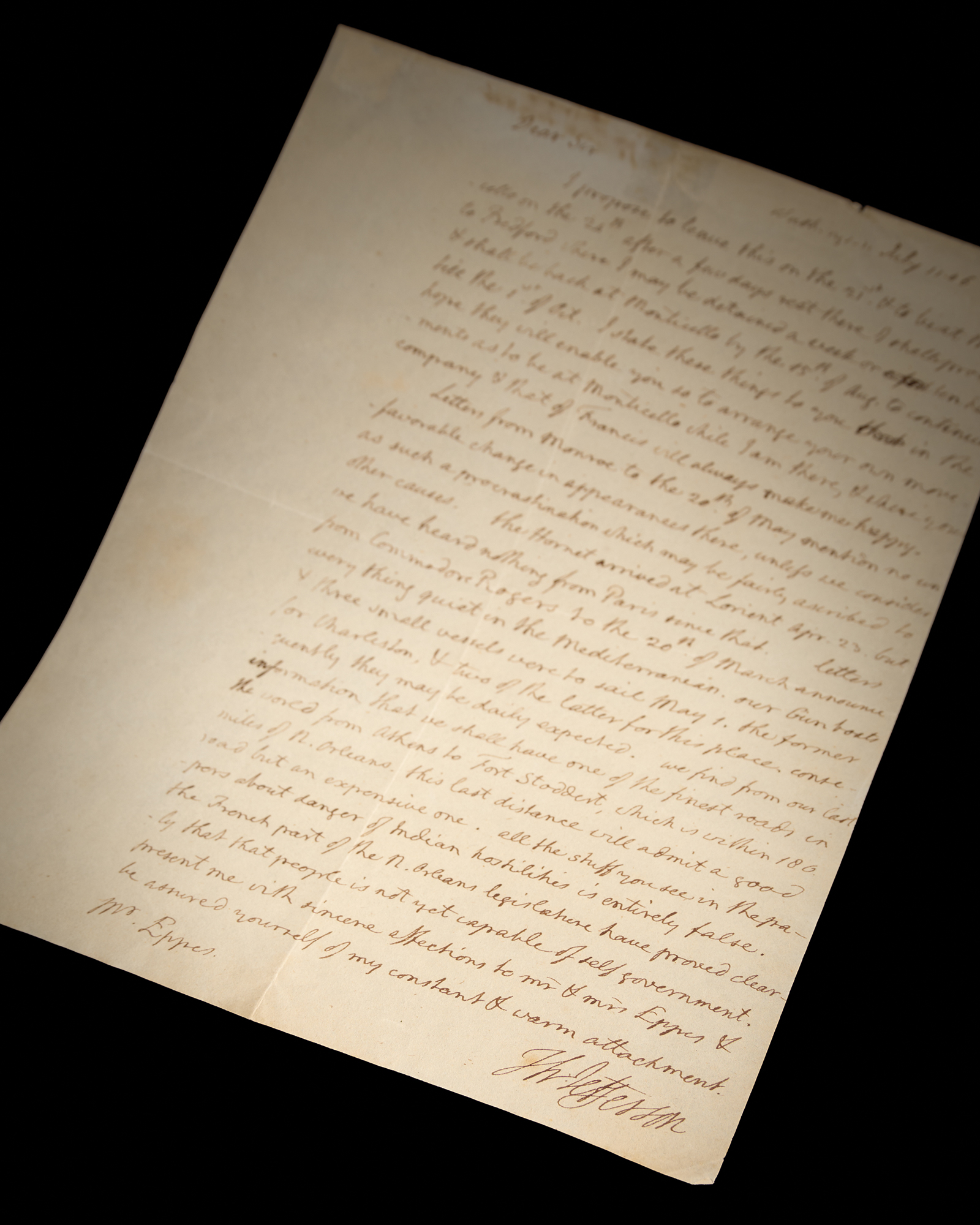
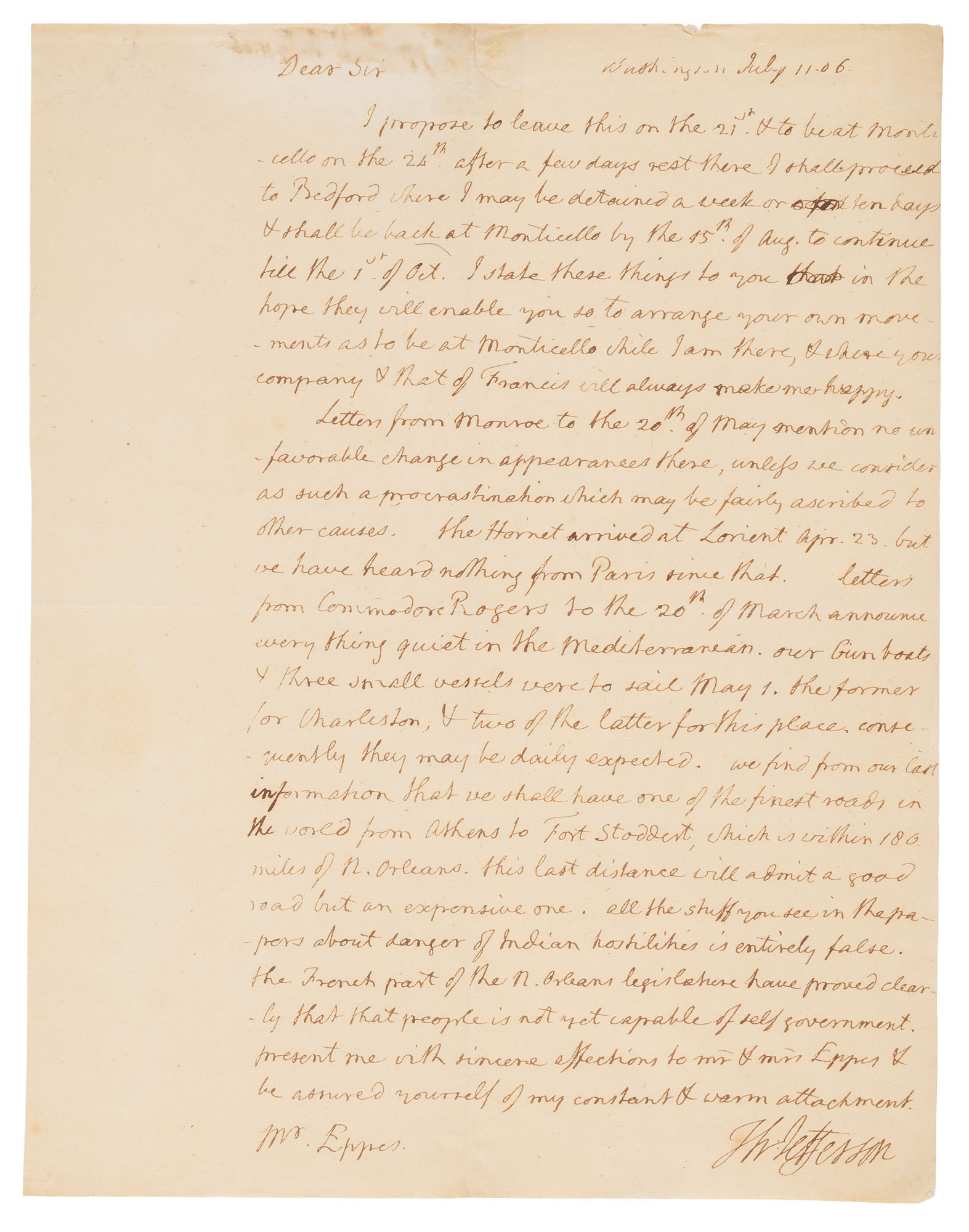
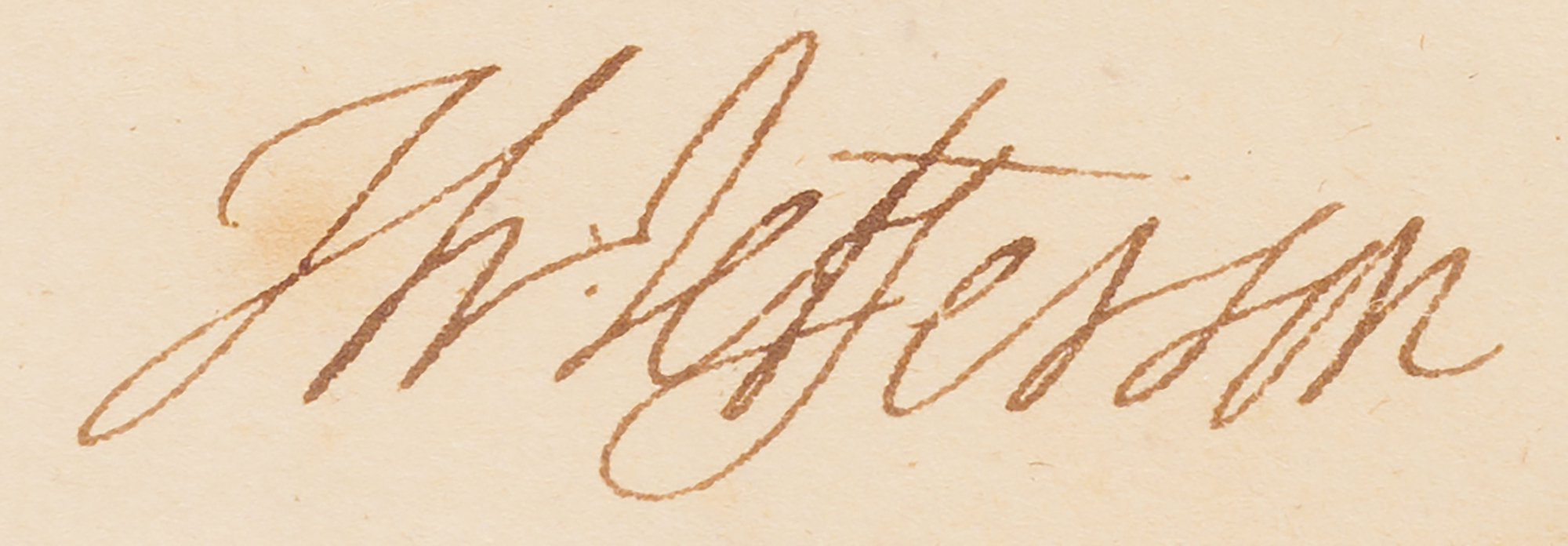
ALS as president signed “Th: Jefferson,” one page, 7.75 x 9.75, July 11, 1806. Addressed from Washington, a handwritten letter to his son-in-law, Congressman John Wayles Eppes, discussing travel plans, diplomacy abroad, naval affairs in the Mediterranean, internal improvements in the Southwest, and political conditions in the Territory of Orleans. In full: “I propose to leave this on the 21st & to be at Monticello on the 24th after a few days rest there I shall proceed to Bedford where I may be detained a week or ten days & shall be back at Monticello by the 15th of Aug. to continue till the 1st of Oct. I state these things to you in the hope they will enable you so to arrange your own movements as to be at Monticello while I am there, & where your company & that of Francis will always make me happy.
Letters from Monroe to the 20th of May mention no unfavorable change in appearances there, unless we consider as such a procrastination which may be fairly ascribed to other causes. The Hornet arrived at L’Orient Apr. 23. but we have heard nothing from Paris since that. Letters from Commodore Rogers to the 20th of March announce every thing quiet in the Mediterranean. Our gunboats & three small vessels were to sail May 1. The former for Charleston, & two of the latter for this place, consequently they may be daily expected. We find from our last information that we shall have one of the finest roads in the world from Athens to Fort Stoddert, which is within 180 miles of N. Orleans. This last distance will admit a good road but an expensive one. All the stuff you see in the papers about danger of Indian hostilities is entirely false. The French part of the N. Orleans legislature have proved clearly that that people is not yet capable of self government. Present me with sincere affections to Mr & Mrs Eppes & be assured yourself of my constant & warm attachment.” In fine condition, with a small repaired edge tear, and a slight area of staining, in the salutation area.
The referenced “Commodore Rogers” is Commodore John Rodgers (1772–1838), commander of the United States squadron in the Mediterranean during the peace-enforcement phase that followed the First Barbary War. Jefferson's report that Rodgers found “every thing quiet in the Mediterranean,” together with news of the arrival of the Hornet at Lorient, concerns the continued deployment of American naval forces overseas in the aftermath of the 1805 Treaty of Tripoli, when the United States maintained a squadron abroad to protect its commercial interests and uphold the newly secured peace with the Barbary States.
Written during Jefferson’s second presidential term, the letter offers a wide-ranging and personal survey of American political and diplomatic affairs in 1806. Jefferson writes to John Wayles Eppes, Virginia congressman and widower of Jefferson’s daughter Maria, arranging family visits to Monticello and Bedford while also discussing international developments involving James Monroe in Europe, American naval deployments in the Mediterranean, and road construction and western communications in the Southwest. His reference to "one of the finest roads in the world from Athens to Fort Stoddert" describes the Federal Road, one of the major infrastructure projects of his presidency, which would become the primary route opening the Old Southwest to American settlement following the Louisiana Purchase.
Jefferson also comments directly on political conditions in the Territory of Orleans, dismissing newspaper reports of impending Native American hostilities as “entirely false” while sharply criticizing the “French part of the N. Orleans legislature,” whom he declares “not yet capable of self government.” The remarks reflect Jefferson’s confidence in continued American expansion into the Southwest alongside his frustration with resistance to American political authority in the newly acquired former French and Spanish territory. They also illustrate the broader tensions confronting his administration as it attempted to impose American political institutions upon a culturally and legally distinct population only a few years after the Louisiana Purchase.

This item is Pre-Certified by PSA/DNA
Buy a third-party letter of authenticity for
$250.00
*This item has been pre-certified by a trusted third-party authentication service, and by placing a bid on this item, you agree to accept the opinion of this authentication service. If you wish to have an opinion rendered by a different authenticator of your choosing, you must do so prior to your placing of any bid. RR Auction is not responsible for differing opinions submitted 30 days after the date of the sale.
Third-party authentication service applies only to signatures and handwriting, and does not cover the addition of sketches, artwork, musical quotations, etc.

