
The 30 Minute Rule begins May 21 at 7:00 PM EDT. An Initial Bid Must Be Placed By May 21 at 6:00 PM EDT To Participate After 6:00 PM EDT
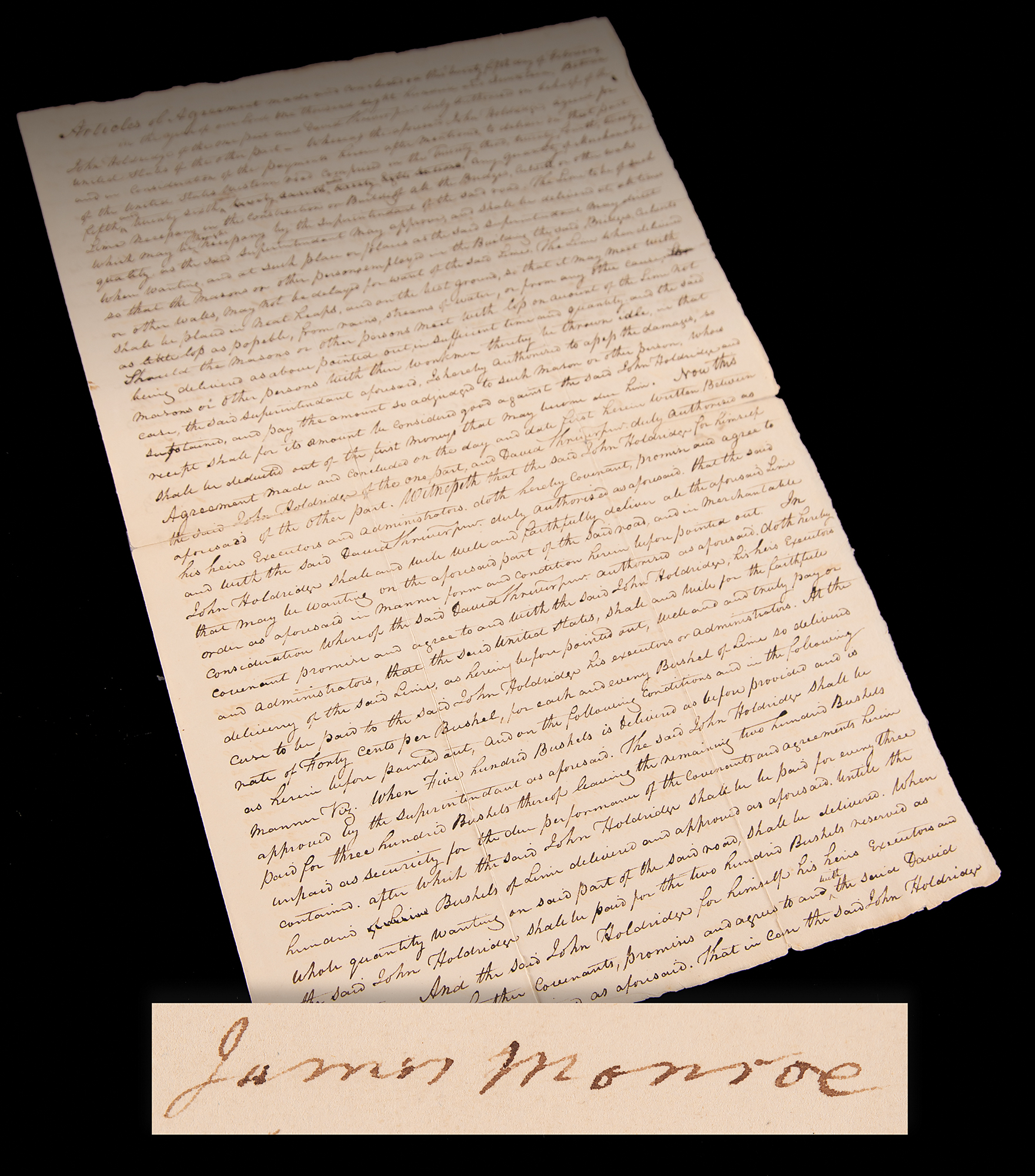
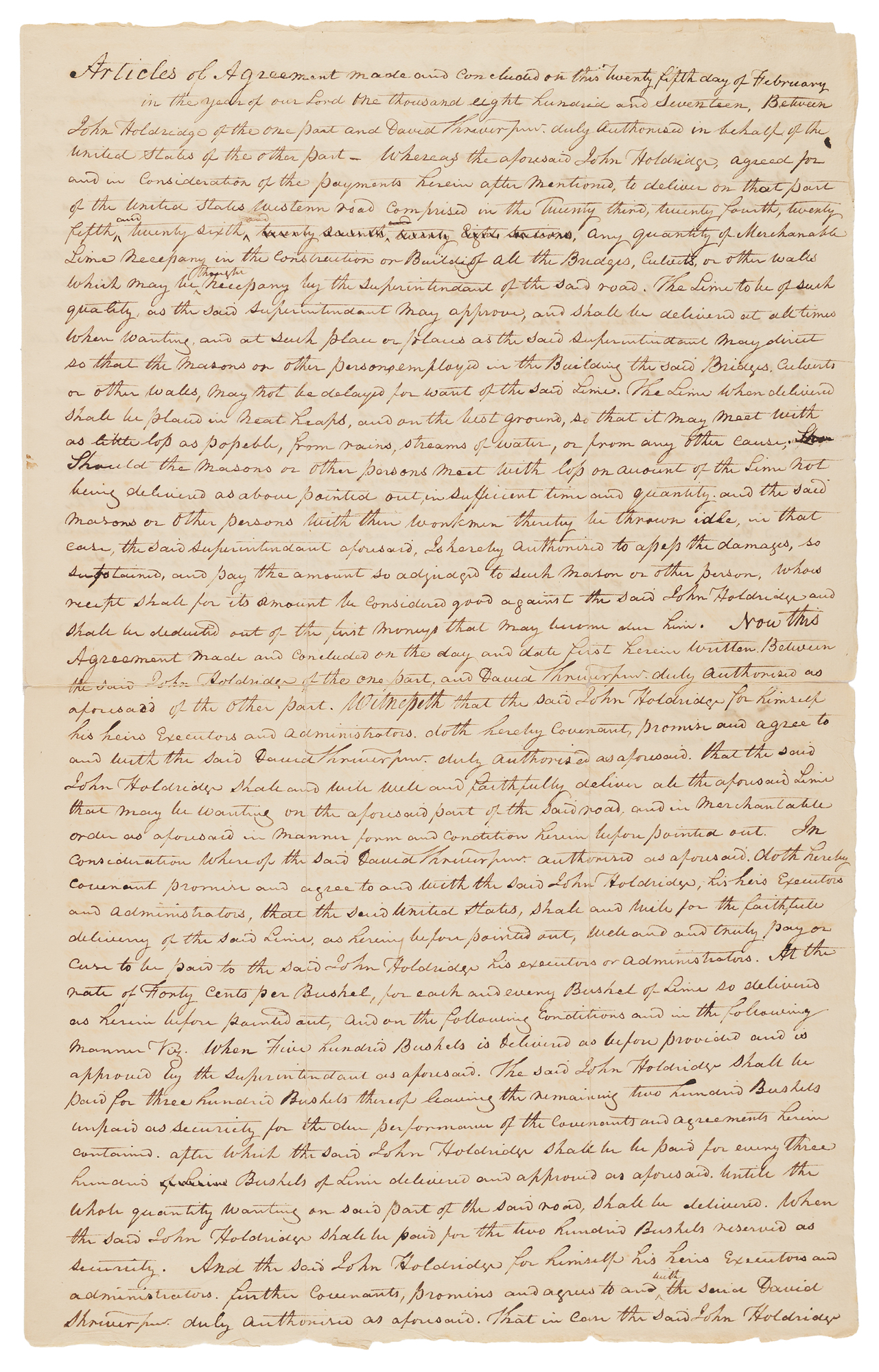
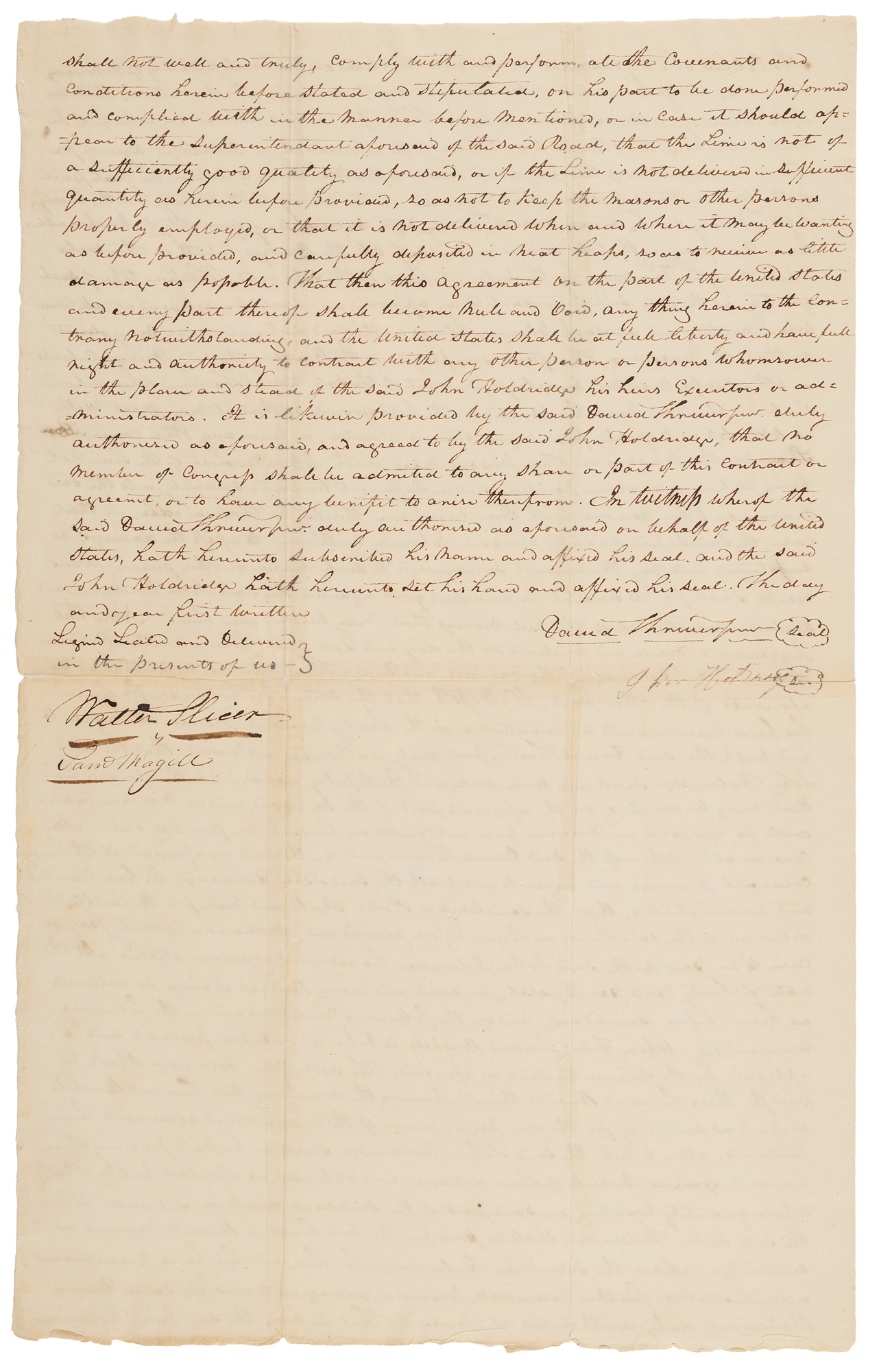
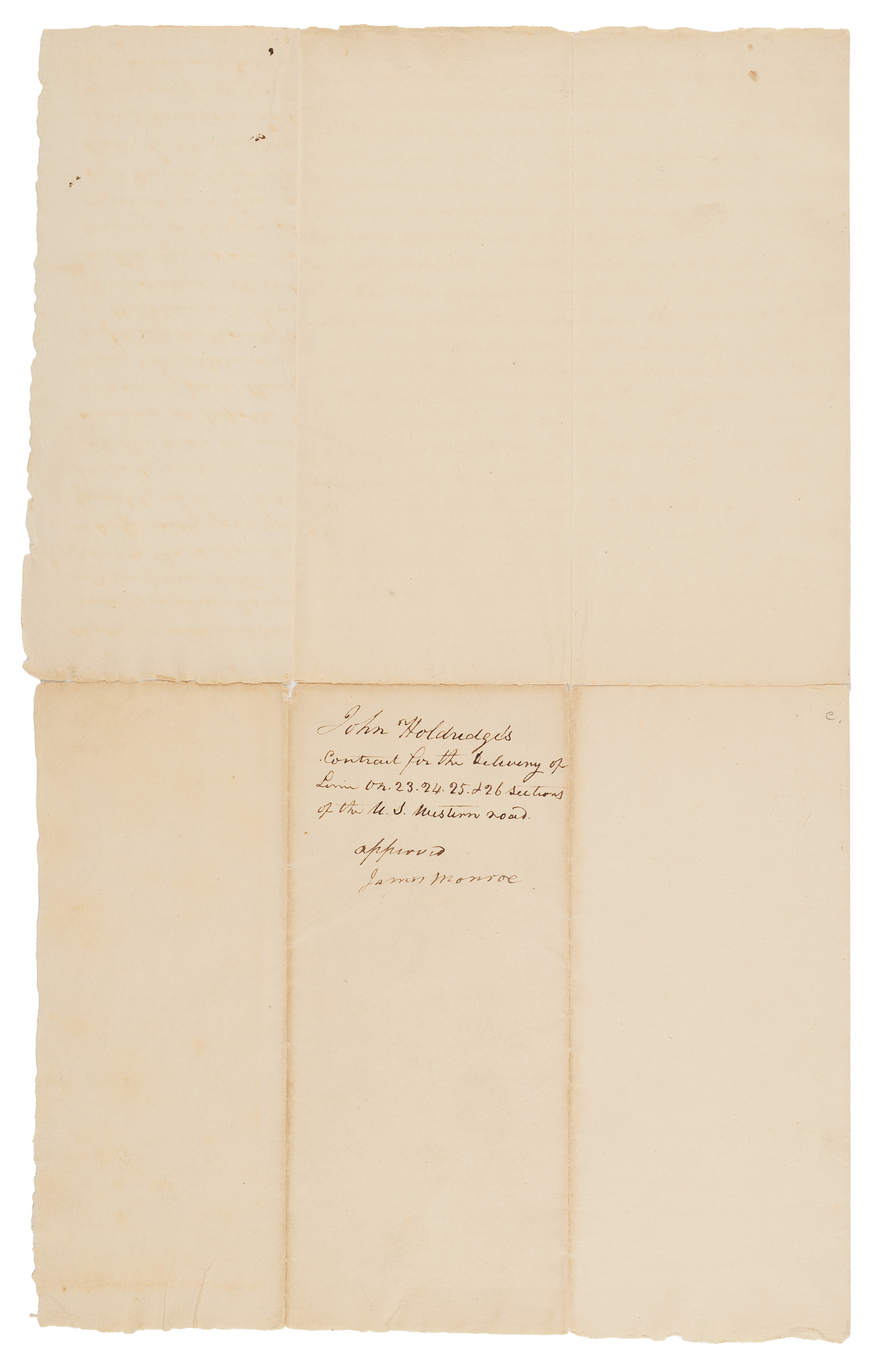
Endorsement signature as Secretary of State and President-Elect, “Approved, James Monroe,” penned on the reverse of a manuscript document related to the continued construction of America’s first road into the West, the Cumberland Road. The document, one page, both sides, 11.25 x 18, dated February 25, 1817, served as the original contract for the purchase of lime used to produce mortar for the road’s masonry. It reads, in part: “Between John Holdridge of the one part and David Shriver, Jr., duly authorized in behalf of the United States of the other part…The said John Holdridge agreed for and in consideration of the payments hereinafter mentioned to deliver on that part of the United States Western Road comprised in the 23rd, 24th, 25th, and 26th sections, any quantity of merchantable lime necessary in the construction or building of bridges, culverts, or other works which may be thought necessary by the Superintendent.” The U.S. agreed to pay Holdridge forty cents per bushel of lime, so long as it was of sufficient quality. The document is signed by both Shriver and Holdridge, and signing as witnesses are Walter Slicer, a partner in the firm building the Youghiogheny Bridge (thus perhaps indicating that the lime was to be used for the bridge), and Samuel Magill, who established the first newspaper in Cumberland and was later its mayor. Signed on the reverse with his approval signature by James Monroe, still serving in his capacity as Secretary of State. In very good to fine condition, with nearly complete separation along the hinge, and to the fragile folds of the second page.
The Cumberland Road (also known as the National Road) was America’s first federally funded interstate highway and was considered a wonder of the world upon its construction. It was authorized on March 29, 1806, by President Thomas Jefferson, who believed that the poor roads of the day hindered American expansion and that a trans-Appalachian route was essential to encourage western settlement and unify the young nation.
Construction began in May 1811 at Cumberland on the Potomac River, at “a stone at the corner of lot No. 1, near the confluence of Will’s Creek and the north branch of the Potomac River.” The road crossed the Allegheny Mountains and southwestern Pennsylvania, reaching Wheeling, Virginia (now West Virginia), on the Ohio River in 1818—marking the beginning of its widespread use. In the decades that followed, the road became a vital artery of westward expansion, carrying travelers, stagecoaches, and freight between the eastern seaboard and the frontier. Massive Conestoga wagons transported produce eastward and returned with staples such as coffee and sugar for western settlements. Construction ultimately continued through Ohio and Indiana, halting at Vandalia, Illinois, in 1839.
David Shriver, an expert in turnpike management, was appointed Superintendent of the Cumberland Road by Secretary of the Treasury Albert Gallatin. He oversaw all aspects of construction, including the selection, hiring, and supervision of contractors. While he had authority to execute contracts for materials and services, final approval rested with the President. Shriver also reported regularly to Congress on the road’s progress and expenses and estimated the funding required for future sections. He quickly earned a reputation as a strict and exacting supervisor, withholding payment from contractors whose work or materials failed to meet his standards. The first phase of the project—from Cumberland to Wheeling—extended an unprecedented 123 miles and presented major engineering challenges, including the bridge over the Youghiogheny River, whose 80-foot span was the largest stone arch in America at the time.
By 1817, completion of this initial phase was in sight, with only the sections west of the Youghiogheny River and the bridge itself remaining unfinished. These sections were numbered beginning at 23. The principal materials used in construction were stone, lime, and timber, with lime essential for producing the mortar that bound the masonry. In early 1817, Shriver informed Congress that approximately $1,500 would be required to procure the necessary lime for this portion of the work. He secured a contractor capable of supplying high-quality lime at a fair price and executed an agreement for its delivery—the contractor being John Holdridge.
The Western Americana auction of Jochen Zeitz.

This item is Pre-Certified by PSA/DNA
Buy a third-party letter of authenticity for
$125.00
*This item has been pre-certified by a trusted third-party authentication service, and by placing a bid on this item, you agree to accept the opinion of this authentication service. If you wish to have an opinion rendered by a different authenticator of your choosing, you must do so prior to your placing of any bid. RR Auction is not responsible for differing opinions submitted 30 days after the date of the sale.

