
The 30 Minute Rule begins May 21 at 7:00 PM EDT. An Initial Bid Must Be Placed By May 21 at 6:00 PM EDT To Participate After 6:00 PM EDT
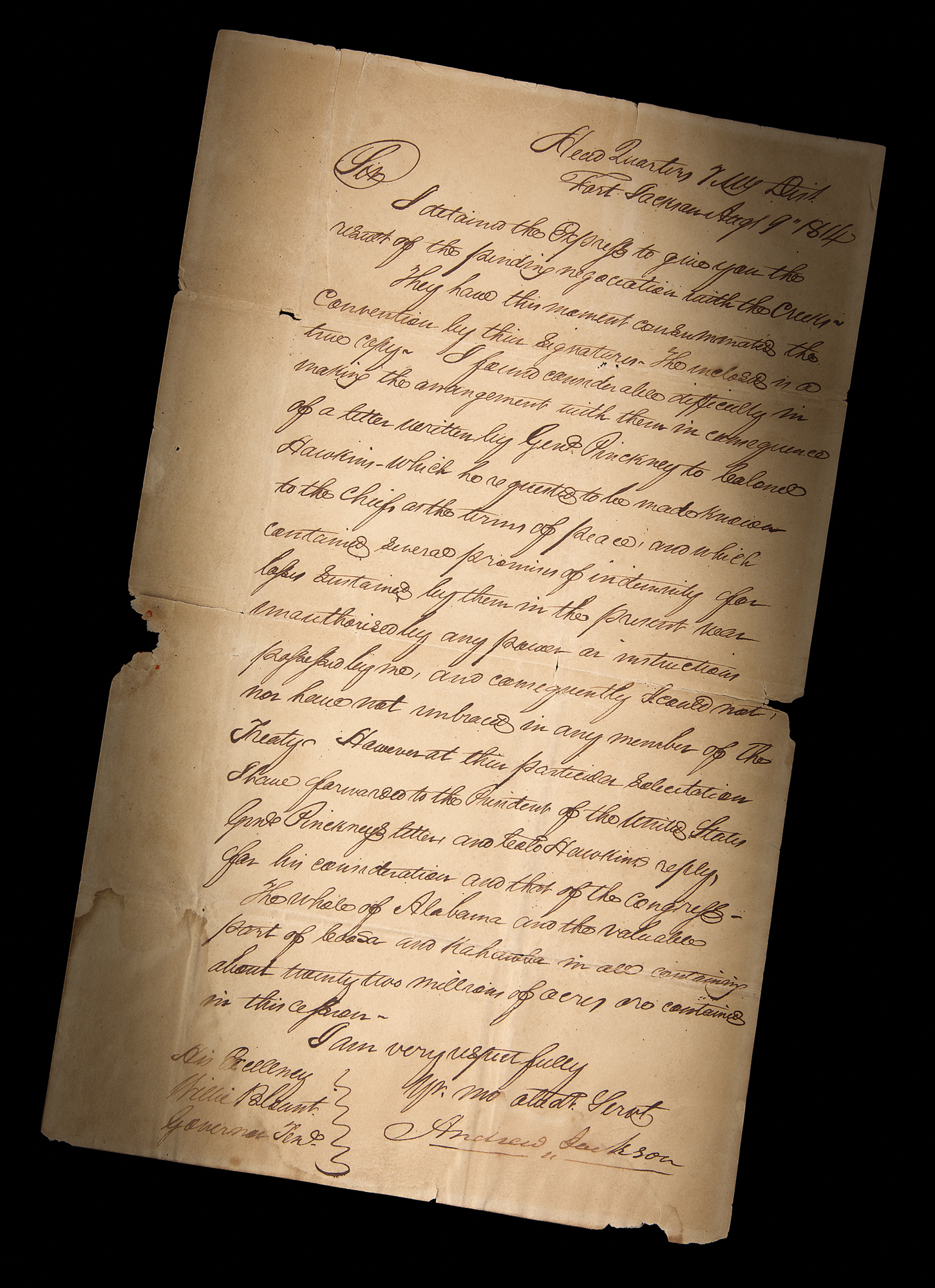
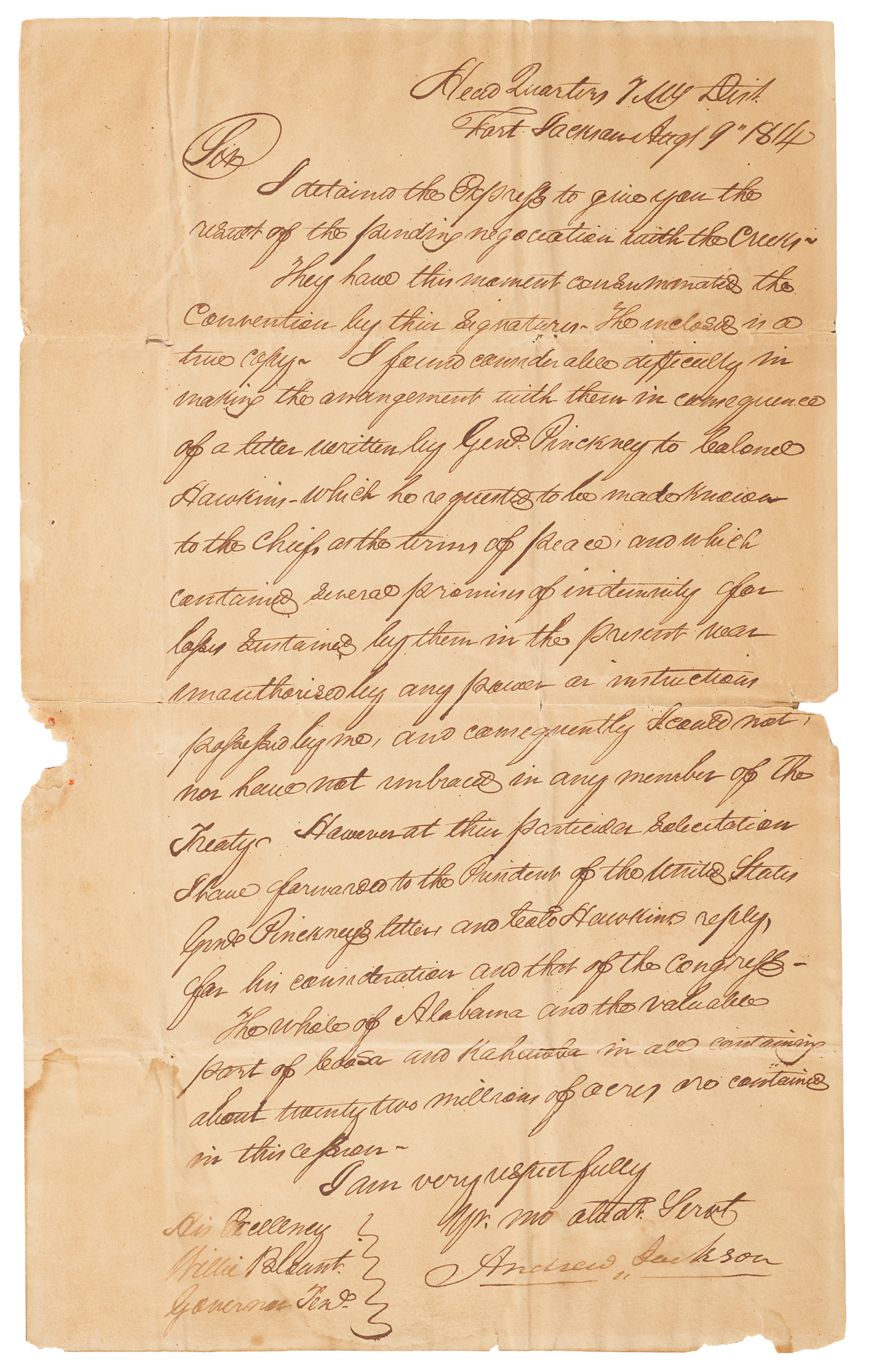
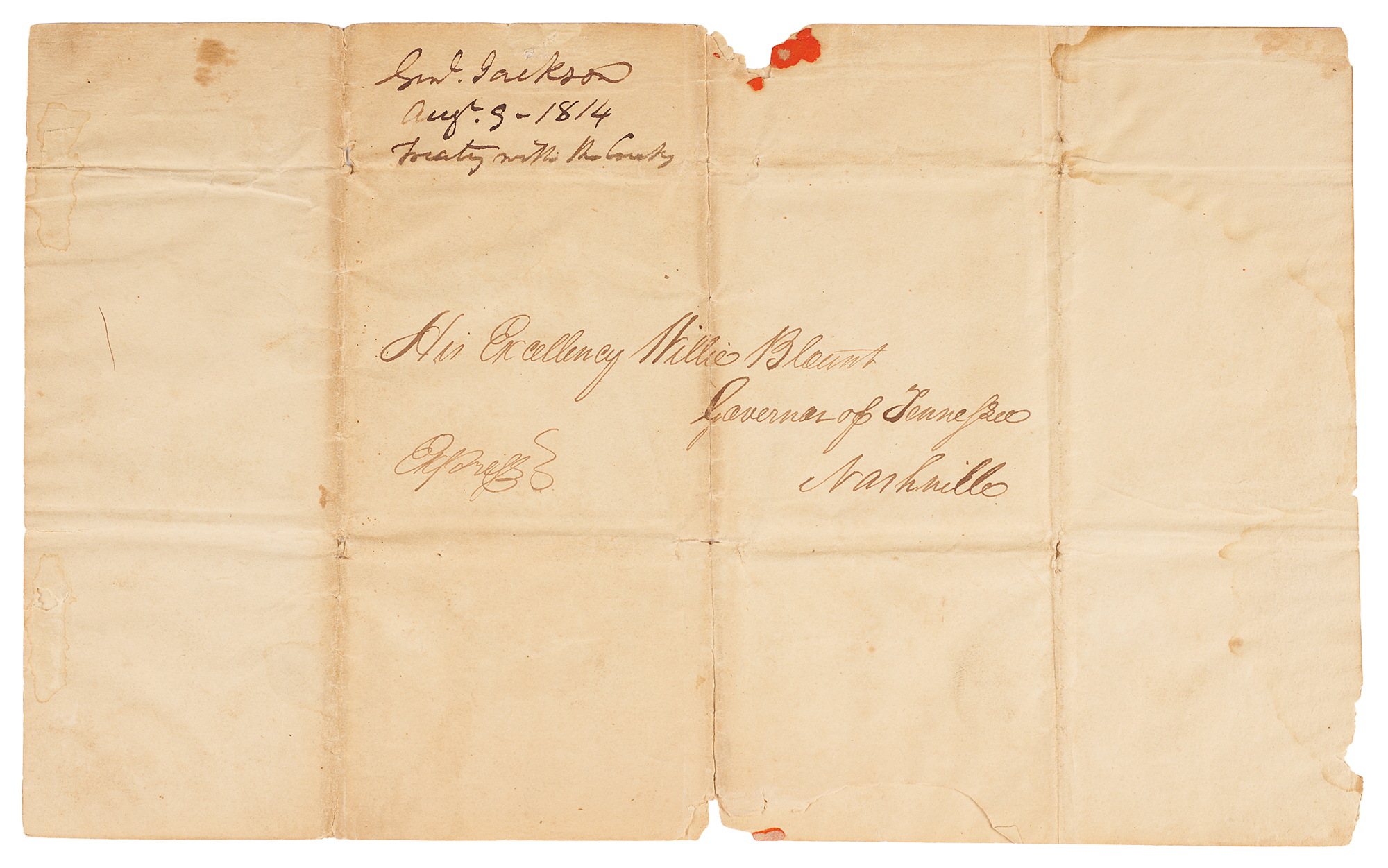
Significant LS, one page, 7.75 x 12.75, August 9, 1814. Addressed from “Head Quarters” at Fort Jackson, a letter sent to Tennessee Governor Willie Blount by Andrew Jackson as Major General, commander of the 7th Military District. The letter finds Jackson announcing the acquisition of the Creek land that encompasses much of Alabama and southern Georgia, and criticizing General Thomas Pinckney and Indian Agent Benjamin Hawkins for making his efforts more difficult. In full: “I detained the Express to give you the result of the pending negotiation with the Creeks. They have this moment consummated the Convention by their signatures. The enclosed is a true copy [not present]. I found considerable difficulty in making the arrangements with them in consequence of a letter written by Genl. Pinckney to Colonel Hawkins, which he requested to be made known to the Chiefs as the terms of peace, and which contained several promises of indemnity for losses sustained by them in the present war unauthorized by any power as instructions possessed by me, and consequently I could not, nor have not, embraced in any member of the Treaty. However at their particular solicitation I have forwarded to the President of the United States Genl. Pinckney’s letters and Colonel Hawkins reply, for his consideration and that of the Congress. The whole of Alabama and the valuable parts of Coosa and Kahawha in all containing about twenty two millions of acres are contained in this cession.” In very good condition, with light dampstaining, areas of paper loss, and splitting to the fragile hinge and folds.
In 1812, a faction within the Creek Nation known as the Red Sticks pushed to restore traditional ways and resist outside influence. Aligning themselves with the British during the War of 1812, they also came into violent conflict with other Creeks who were more open to working with American settlers. Tensions escalated dramatically on August 30, 1813, when the Red Sticks attacked Fort Mims in present-day Alabama, killing more than 400 people. Additional attacks followed, spreading fear across the southeastern frontier and prompting urgent calls for U.S. military intervention.
In response, Secretary of War John Armstrong authorized action, and Tennessee Governor Willie Blount mobilized militia forces under Andrew Jackson. Reinforced by the 39th U.S. Infantry and allied Native groups organized by Indian Agent Benjamin Hawkins, Jackson built a force of roughly 5,000 men. After weeks of preparation, he advanced into Creek territory, ultimately confronting the Red Sticks at the Battle of Horseshoe Bend on March 27, 1814. The battle ended in a decisive and brutal victory for Jackson, effectively crushing Red Stick resistance and marking a turning point in the conflict.
Although initial peace negotiations offered relatively moderate terms, Jackson and his supporters rejected them as too lenient. Elevated to Major General, Jackson took control of the negotiations and imposed far harsher conditions. The resulting Treaty of Fort Jackson, signed on August 9, 1814 — signed earlier the same day that Jackson wrote this letter — forced the Creek Nation to cede 23 million acres of land, much of it belonging even to tribes allied with the United States. Jackson lost not a minute before sending his superior, Governor Blount, his official report on the treaty’s signing and terms. Despite later challenges from the Creeks and the British, Jackson ensured the treaty remained in force, securing a vast territorial gain and freeing him to lead American forces south to confront the British at the Battle of New Orleans.
The Western Americana auction of Jochen Zeitz.

This item is Pre-Certified by PSA/DNA
Buy a third-party letter of authenticity for
$150.00
*This item has been pre-certified by a trusted third-party authentication service, and by placing a bid on this item, you agree to accept the opinion of this authentication service. If you wish to have an opinion rendered by a different authenticator of your choosing, you must do so prior to your placing of any bid. RR Auction is not responsible for differing opinions submitted 30 days after the date of the sale.

