The 30 Minute Rule begins May 21 at 7:00 PM EDT. An Initial Bid Must Be Placed By May 21 at 6:00 PM EDT To Participate After 6:00 PM EDT
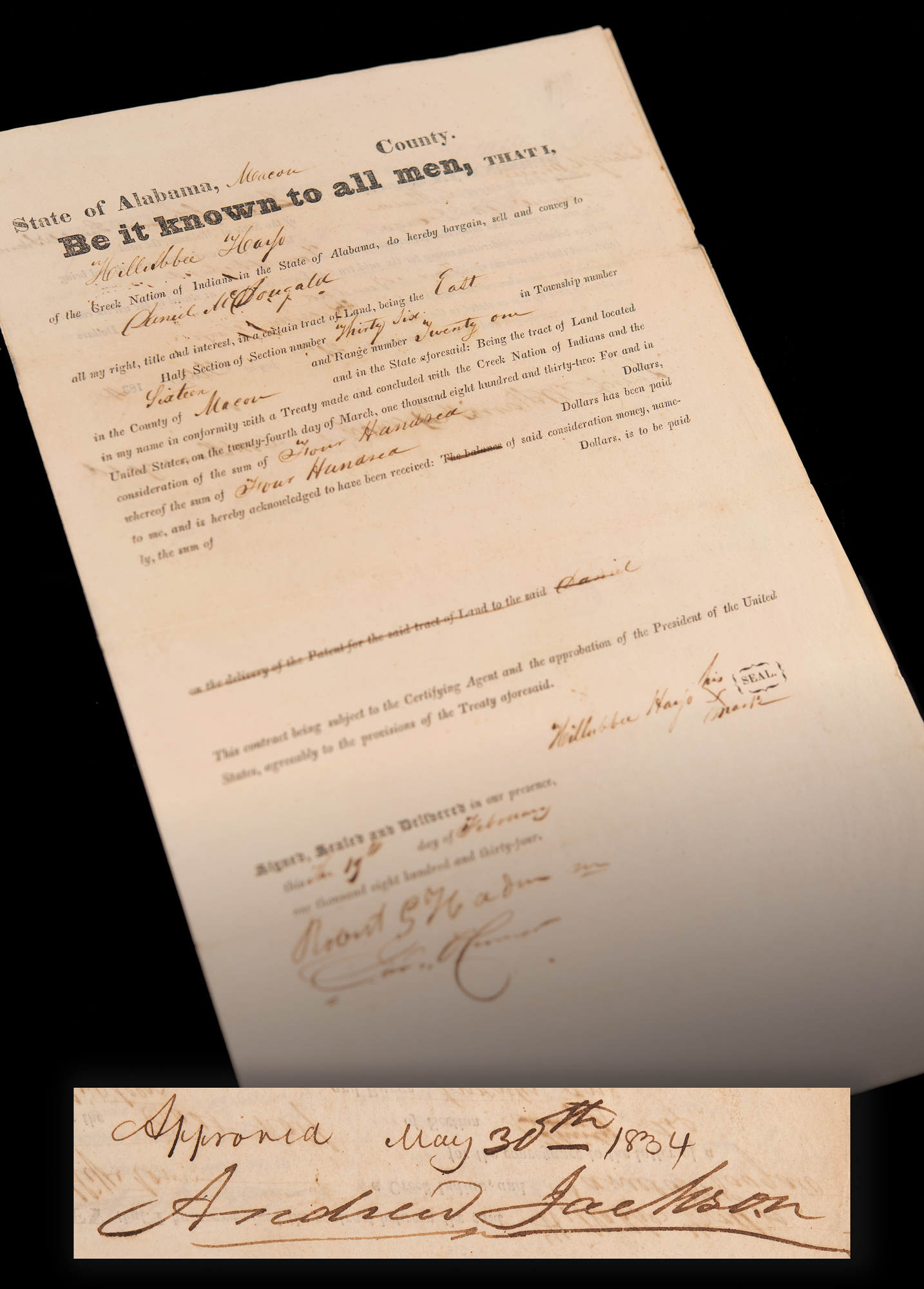
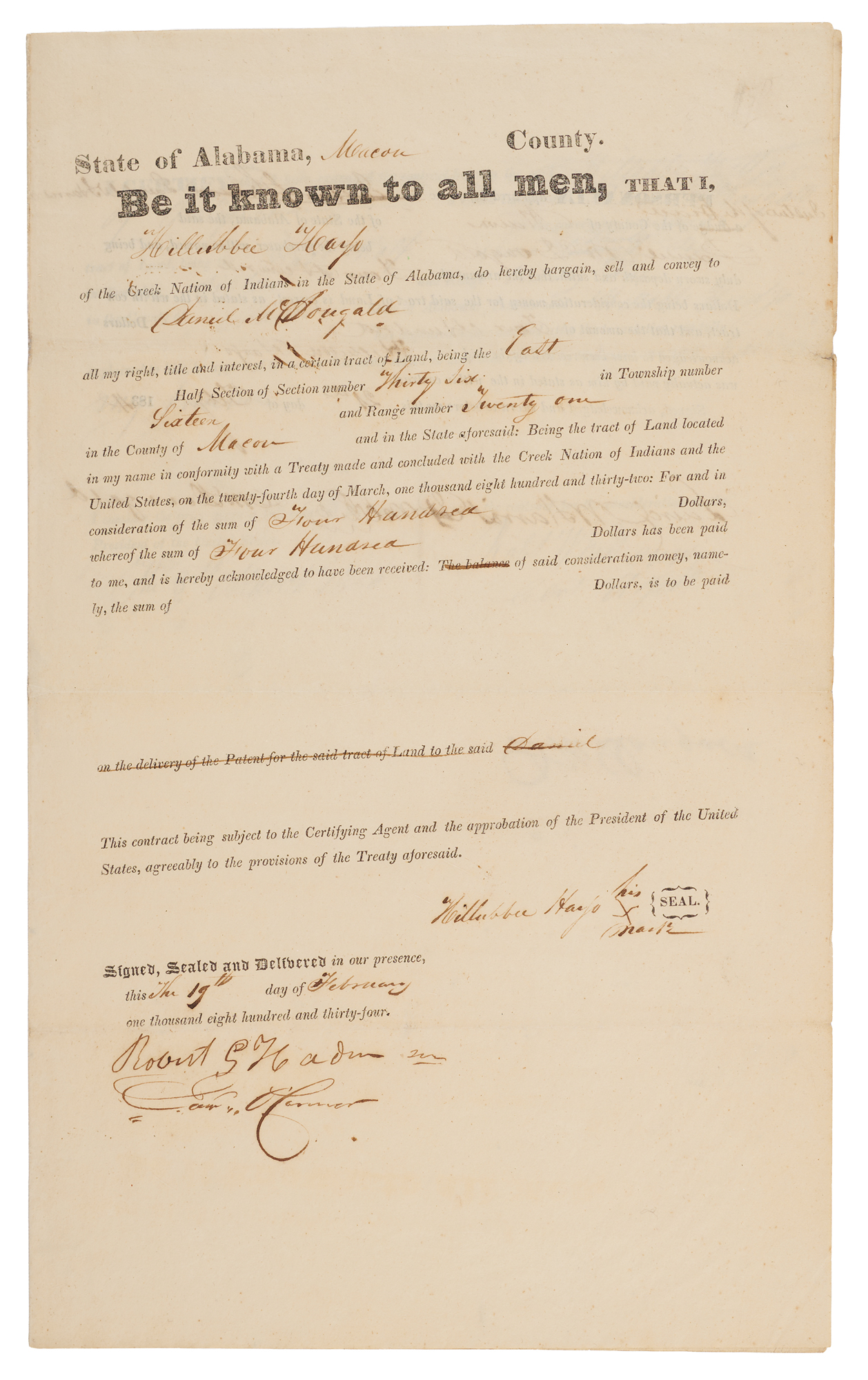
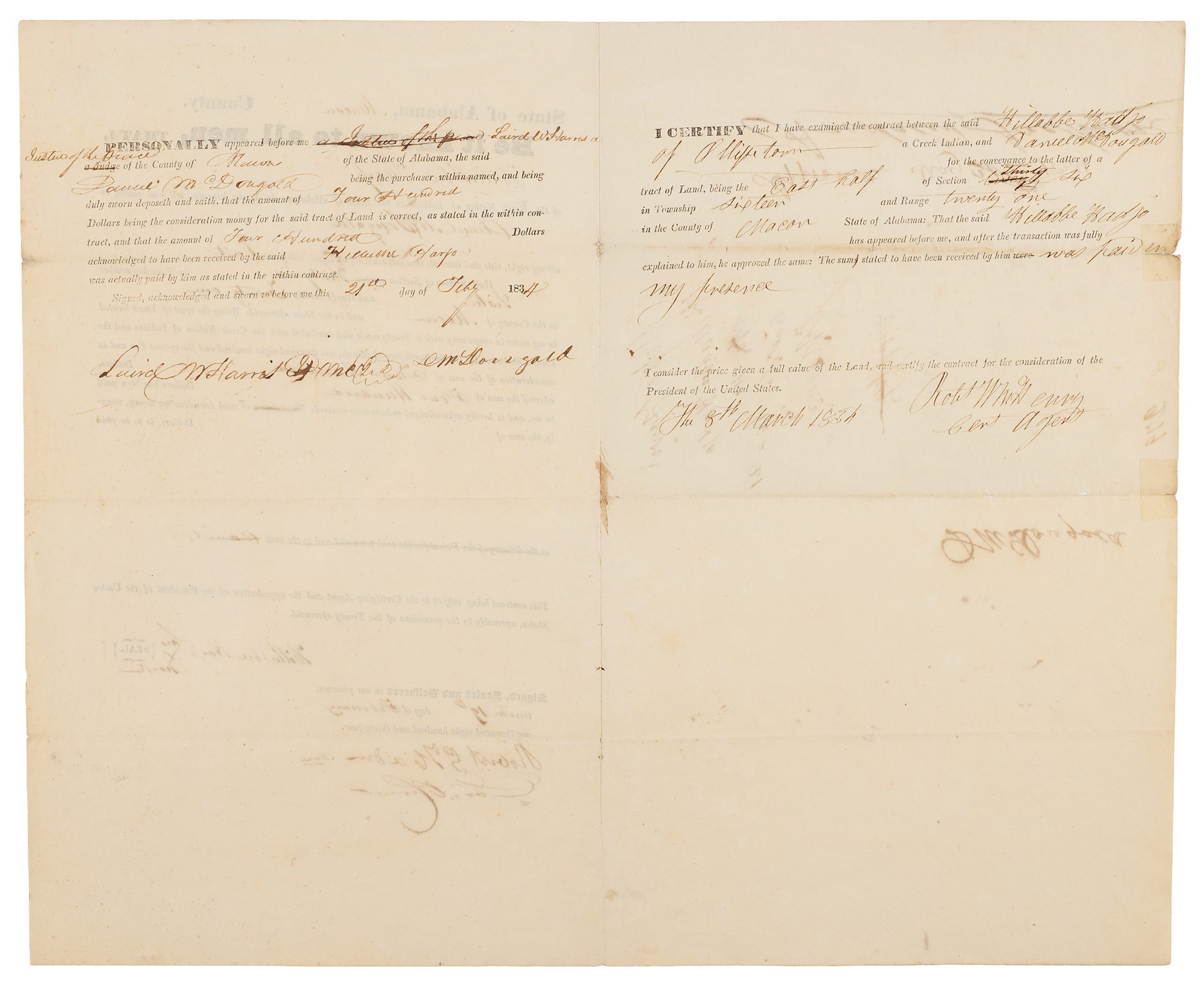
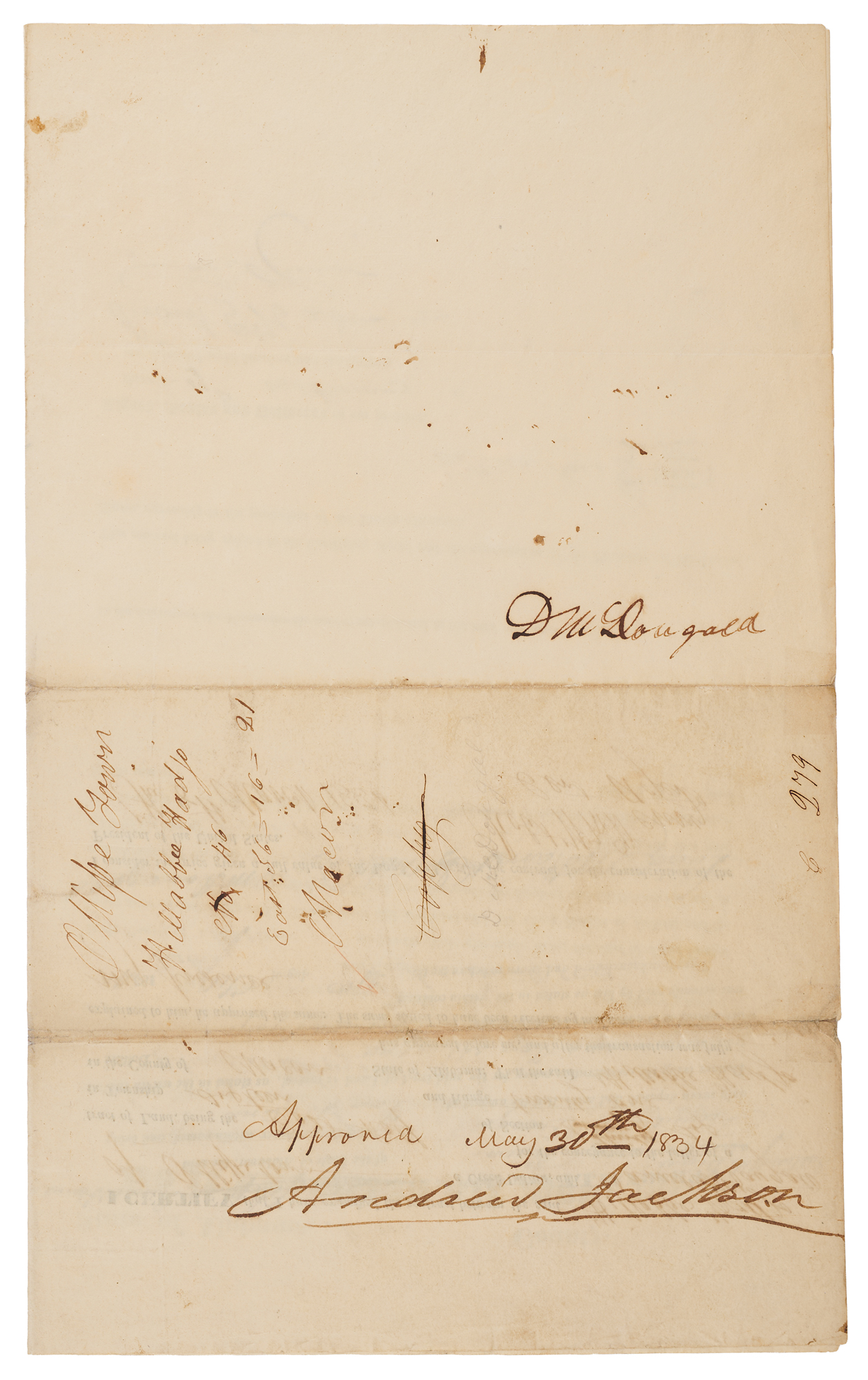
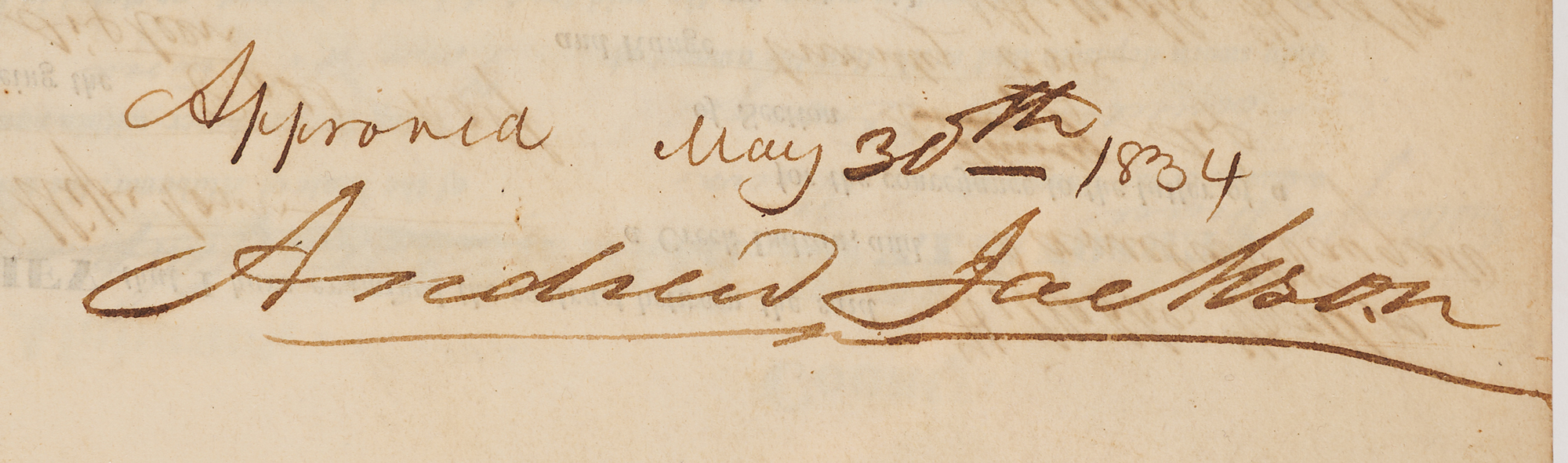
Endorsement signature as president, “Approved May 30th 1834, Andrew Jackson,” penned on the reverse of a partly printed document from the “State of Alabama, Macon County,” three pages on two adjoining sheets, 8 x 13, February 19, 1834, comprised of a land sale contract between seller Hillabee Harjo, “of the Creek Nation of Indians in the State of Alabama,” and buyer Daniel McDougald, with the former agreeing to sell his land for $400. McDougald and a certifying agent signing on the second and third pages, respectively.
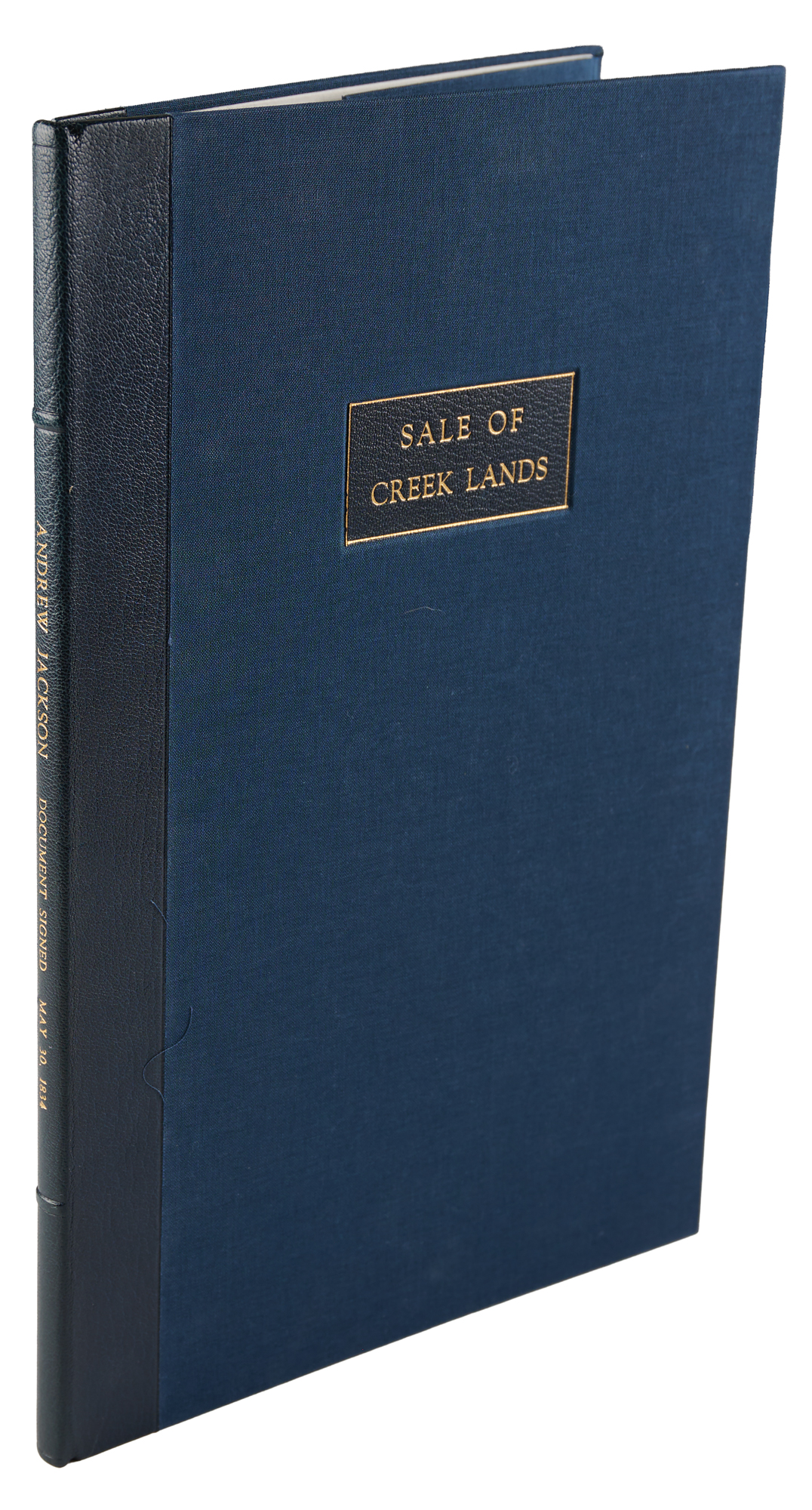
The document describes the land as “being the East Half Section of Section number Thirty Six in Township number Sixteen and Range number Twenty one in the County of Macon, and in the State aforesaid: Being the tract of Land located…in conformity with a Treaty made and concluded with the Creek Nation of Indians and the United States, on the twenty-fourth day of March, one thousand eight hundred and thirty-two.” Signed with an “X” mark by Harjo at the bottom of the first page, which bears the line: “This contract being subject to the Certifying Agent and the approbation of the President of the United States, agreeably to the provisions of the Treaty aforesaid.” As such, President Jackson endorses the sale with his large approval signature on the reverse of the second integral page. In fine condition. Accompanied by a custom presentation folder.
On March 24, 1832, the Creek Nation and the United States government signed the Treaty of Cusseta, requiring the Creek to relinquish all claims to land east of the Mississippi River. While the majority of the Creek people were ultimately displaced, some were permitted to remain through individual land allotments under federal protection. Those who stayed in Alabama later became the Poarch Band of Creek Indians, now residing on 230 acres—the only federally recognized reservation in the state.
This treaty was part of the broader Indian removal policy initiated under President Andrew Jackson following the Indian Removal Act of 1830. This legislation authorized the federal government to negotiate treaties forcing Native American tribes east of the Mississippi to exchange their lands for territory in the West. Although framed as voluntary, removal was often carried out under coercion and harsh conditions, culminating in what became known as the Trail of Tears.
Prior to 1830, the Cherokee, Chickasaw, Choctaw, Creek, and Seminole—often referred to as the Five Civilized Tribes—lived as autonomous nations in the southeastern United States. Many had begun adopting aspects of European-American culture, and some believed coexistence was possible. However, increasing pressure from settlers and government officials—motivated largely by the desire for land and resources—led to policies aimed at complete removal.
The Treaty of Cusseta included a notable provision: rather than immediately removing all Creek people, it allowed individuals to claim parcels of their ancestral land. Specifically, ninety principal chiefs were each granted one section of land, while heads of Creek families could claim half sections. These tracts were reserved for five years, during which they could be sold. Crucially, any sale required direct approval from the President of the United States—a rare stipulation, as most land grants of the period were authorized at a lower administrative level. This requirement makes surviving presidentially signed documents associated with the treaty particularly scarce and historically significant.
Despite these protections, the system was widely abused. Land speculators quickly took advantage of Creek landholders, often acquiring land through fraud or coercion. One such figure, McDougald, is documented in 'Alleged Frauds on Creek Indians' as having participated in numerous illicit transactions—admitting to taking land in 170 deals while paying for only 40. Many Creek individuals, including those with the family name Harjo, recorded in the 1833 census of eligible landholders, likely received little or no compensation for their land.
As a result of these exploitative practices, many Creek people were left impoverished. By 1835, desperation led some to raid nearby settlements for food. In response, the U.S. government escalated its actions, and in 1836, the Secretary of War ordered the forced removal of the Creek as a ‘military necessity.’ By 1837, approximately 15,000 Creek people had been forcibly relocated to the West.
The Western Americana auction of Jochen Zeitz.

This item is Pre-Certified by PSA/DNA
Buy a third-party letter of authenticity for
$150.00
*This item has been pre-certified by a trusted third-party authentication service, and by placing a bid on this item, you agree to accept the opinion of this authentication service. If you wish to have an opinion rendered by a different authenticator of your choosing, you must do so prior to your placing of any bid. RR Auction is not responsible for differing opinions submitted 30 days after the date of the sale.

