The 30 Minute Rule begins May 21 at 7:00 PM EDT. An Initial Bid Must Be Placed By May 21 at 6:00 PM EDT To Participate After 6:00 PM EDT
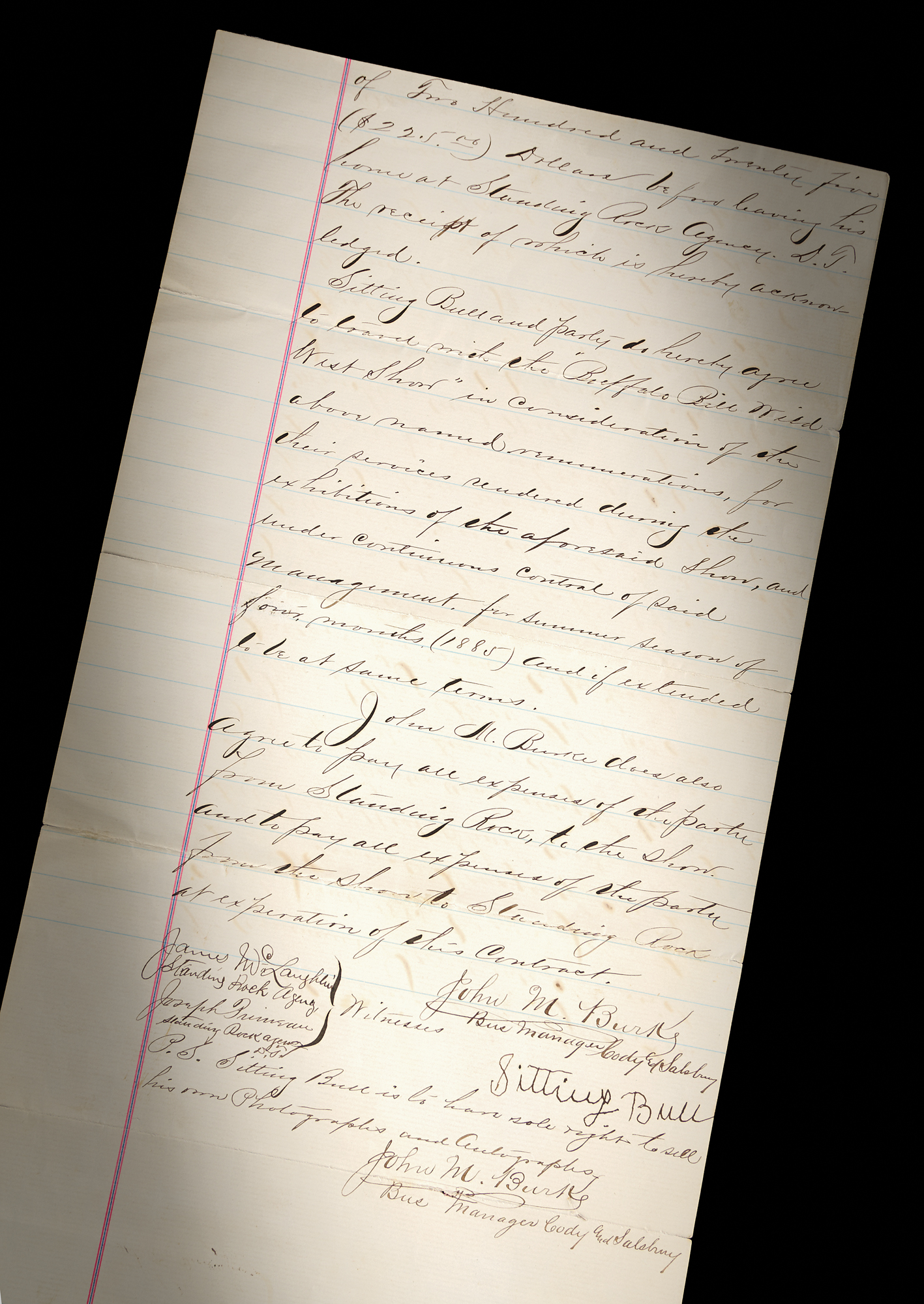
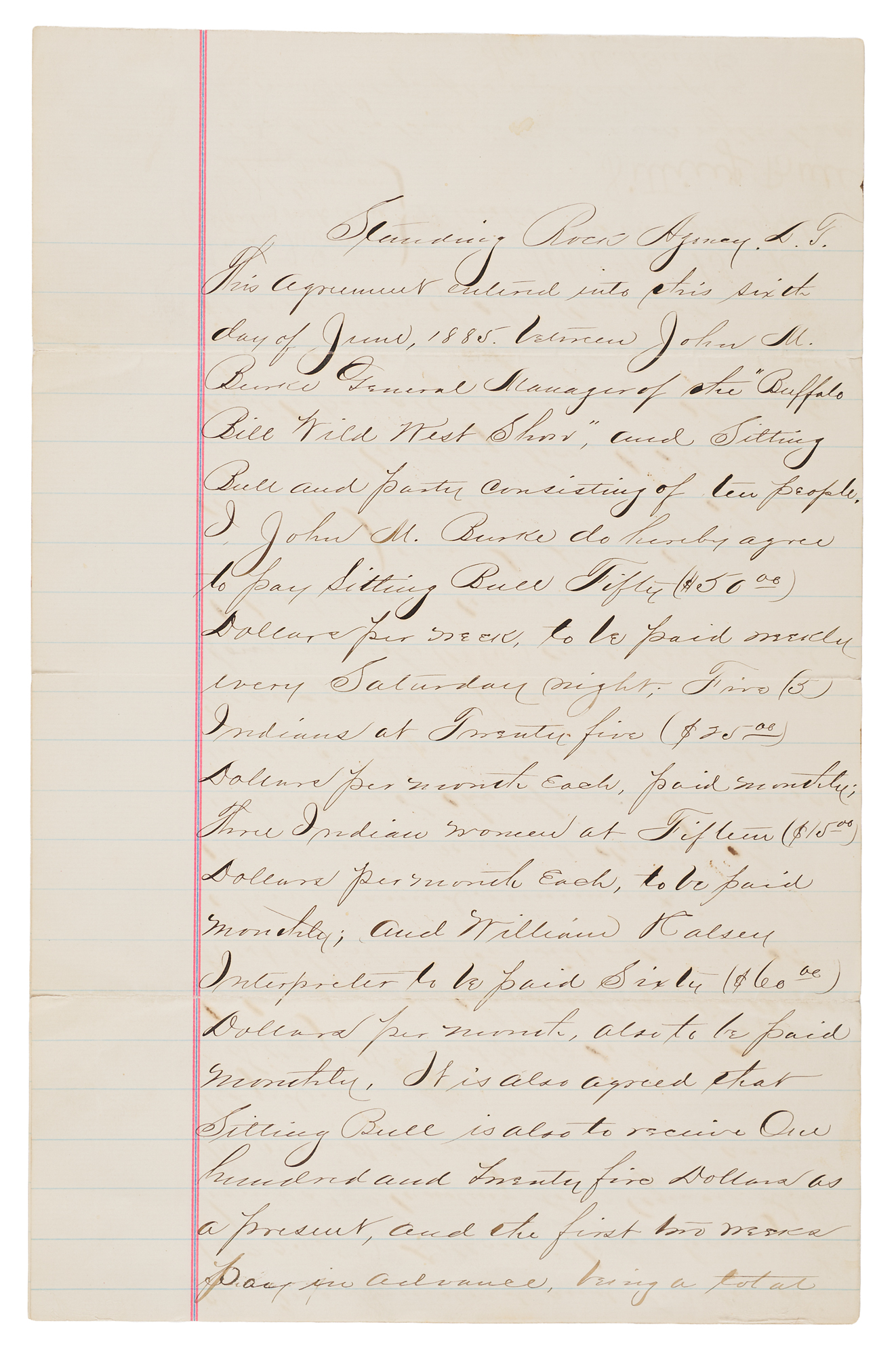
Historic manuscript DS, signed "Sitting Bull," one page both sides, 8 x 12.5, June 6, 1885. Contract concluded at the "Standing Rock Agency, D.T.," for his appearance in the "Buffalo Bill Wild West Show." In part: "This agreement entered into this sixth day of June, 1885, between John M. Burke General Manager of the 'Buffalo Bill Wild West Show,' and Sitting Bull and party consisting of ten people, I, John M. Burke do hereby agree to pay Sitting Bull Fifty ($50.00) Dollars per week, to be paid weekly every Saturday night; Five (5) Indians at Twenty five ($25.00) Dollars per month each…three Indian women at Fifteen ($15.00) Dollars per month each…and William Halsey Interpreter to be paid Sixty ($60.00) Dollars per month…It is also agreed that Sitting Bull is also to receive One hundred and Twenty five Dollars as a present, and the first two weeks pay in advance, being a total of Two hundred and Twenty five ($225.00) Dollars before leaving his home at Standing Rock Agency, D.T.
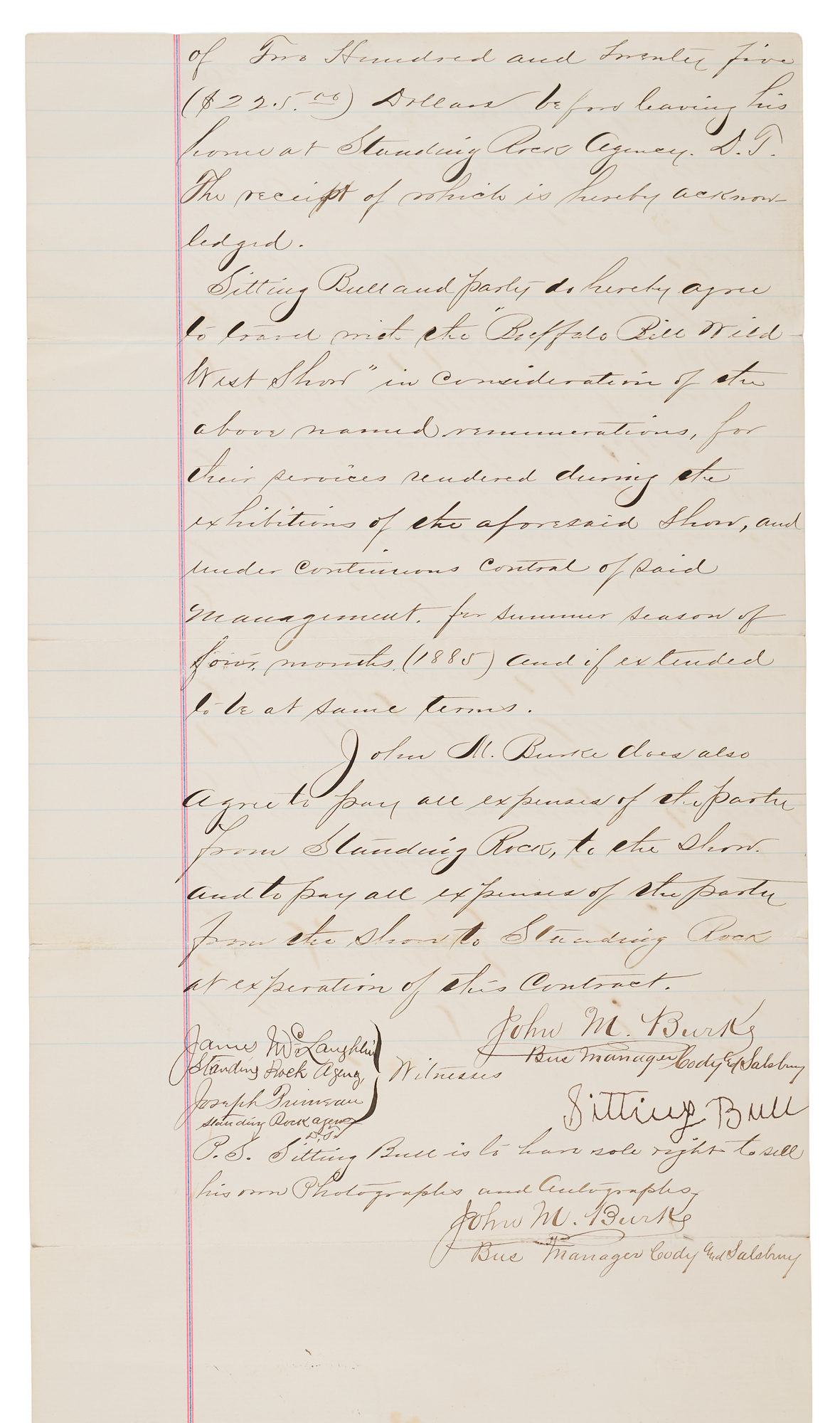
Sitting Bull and party do hereby agree to travel with the 'Buffalo Bill Wild West Show' in consideration of the above named remunerations, for their services rendered during the exhibitions of the aforesaid Show, and under continuous control of said management, for summer season of four months (1885) and if extended to be at same terms."
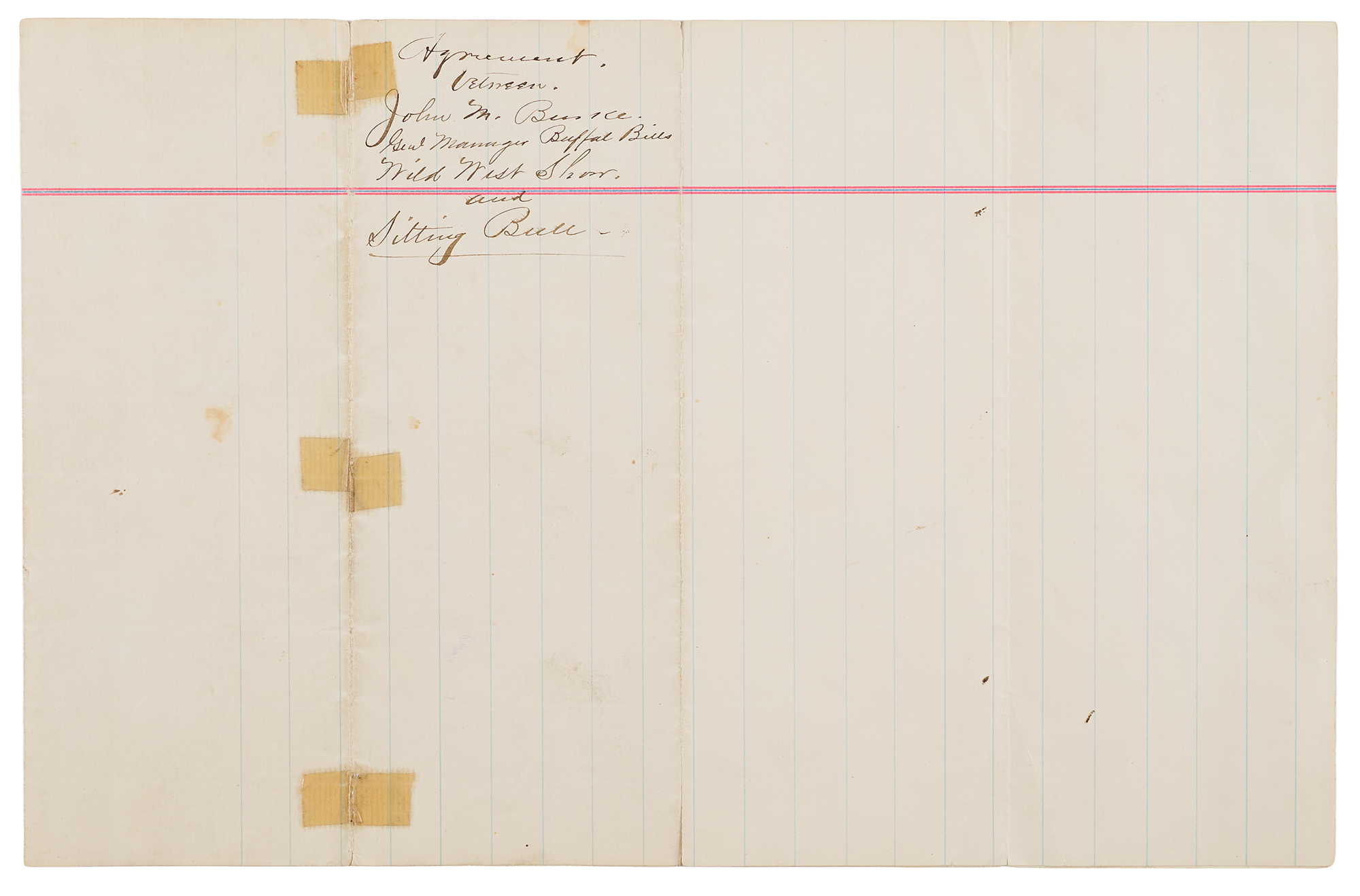
Signed at the conclusion in ink by Sitting Bull and John M. Burke, and countersigned by Indian agent James McLaughlin and interpreter Joseph Primeau as witnesses. Burke signs again at the bottom, attesting that "Sitting Bull is to have sole right to sell his own Photographs and Autographs." In fine condition, with three small old tape repairs to the blank bottom of the attached docketing sheet.
Sitting Bull (c. 1831–1890), the famed Hunkpapa Lakota leader, was one of the most prominent and complex Native American figures of the 19th century. Widely associated with the Lakota victory over Custer at Little Bighorn in 1876, he became both feared and admired as a symbol of Native resistance. After leading his people into exile in Canada, he returned to the United States in 1881 under threat of starvation and spent two years as a prisoner of war. By 1883 he had settled at Standing Rock Agency, where he lived under the authority of Indian agent James McLaughlin, who viewed him with suspicion despite recognizing his influence. Contrary to McLaughlin’s belief that he was an agitator, Sitting Bull was deeply interested in the future of his people and open to engaging with American society.
In 1885, Sitting Bull agreed to join Buffalo Bill Cody’s Wild West show, seeing it as an opportunity to observe white American culture and advocate for his people. Negotiated by John M. Burke, the agreement made him the highest-paid performer in the show and included provisions such as advance payment, travel expenses, and the exclusive right to sell his own autographs and photographs—an arrangement that proved highly profitable. During his time with the show, Sitting Bull was presented respectfully as a renowned leader rather than a caricature, and he used his platform to address audiences about the needs of the Lakota, though translations of his speeches were not always accurate. He also famously met Annie Oakley, whom he admired and symbolically adopted as 'Watanya Cicila, or 'Little Sure Shot.'
Sitting Bull traveled with the Wild West for four months, appearing across the Northeast and Canada and even visiting the White House, where he presented President Cleveland with a written appeal on behalf of his people. A contemporary reporter observed that 'He had no wish for blood in his heart… He recognized the inevitable supremacy of the white man, but hoped that the red man had enough self-respect and the white man enough honesty left to make the end of the controversy a peaceful one.' His relationship with Buffalo Bill was described as one of mutual trust and respect. Though he returned to Standing Rock with positive impressions of the experience, he was prevented from continuing with the show by McLaughlin's opposition.
Five years later in 1890, amid rising fears surrounding the Ghost Dance movement, it was James McLaughlin who ordered Sitting Bull’s arrest at Standing Rock. The attempt, carried out by Indian Agency police, ended in a violent struggle during which Sitting Bull was shot and killed. His death heightened tensions across the region and contributed directly to the chain of events that culminated in the tragic massacre at Wounded Knee two weeks later.
The survival of this 1885 contract stands as a powerful and exceptionally rare document of these significant cultural intersections. While Sitting Bull is known to have signed hundreds of autographs during his time with Buffalo Bill’s Wild West—capitalizing on the very right secured in this agreement—he famously never signed a treaty with the United States government, a reflection of his steadfast resistance to federal authority. As such, documents bearing his signature in a formal context are of the utmost rarity—no other contract signed by Sitting Bull is known to exist. An extraordinary piece that bridges his legacy as both a defiant leader of his people and a participant in the spectacle of the American frontier.
The Western Americana auction of Jochen Zeitz.

This item is Pre-Certified by PSA/DNA
Buy a third-party letter of authenticity for
$175.00
*This item has been pre-certified by a trusted third-party authentication service, and by placing a bid on this item, you agree to accept the opinion of this authentication service. If you wish to have an opinion rendered by a different authenticator of your choosing, you must do so prior to your placing of any bid. RR Auction is not responsible for differing opinions submitted 30 days after the date of the sale.

