The 30 Minute Rule begins May 21 at 7:00 PM EDT. An Initial Bid Must Be Placed By May 21 at 6:00 PM EDT To Participate After 6:00 PM EDT
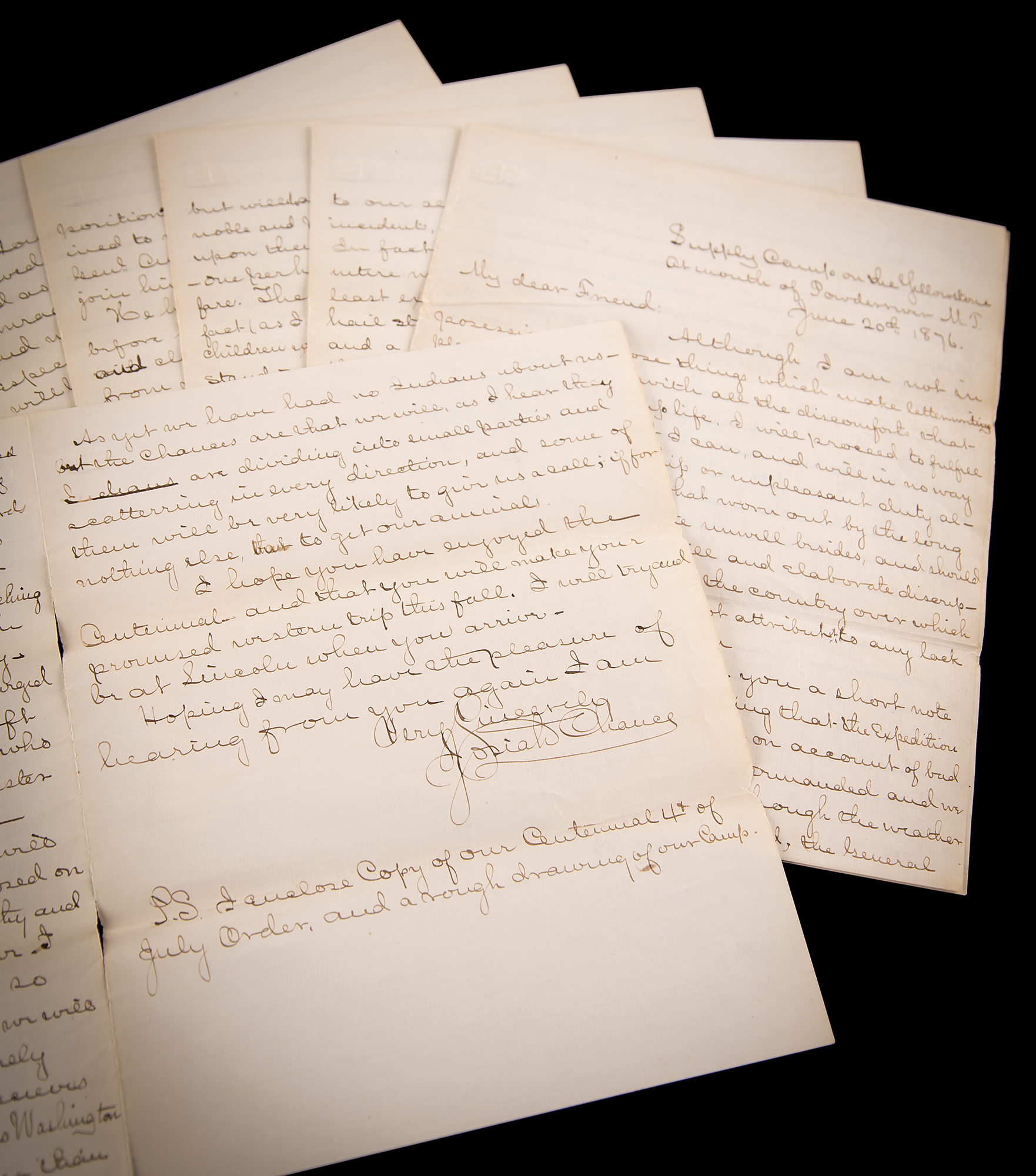
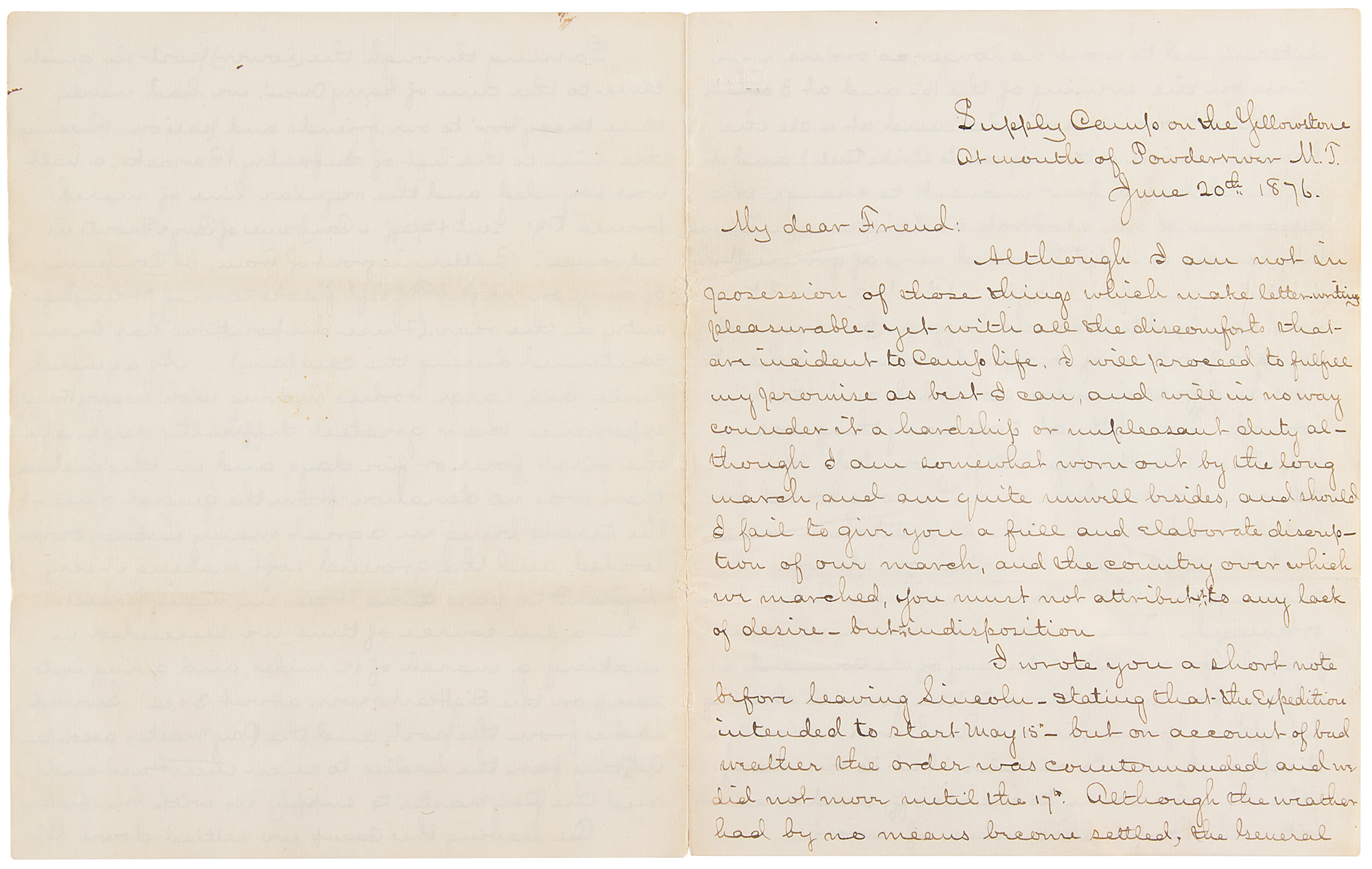
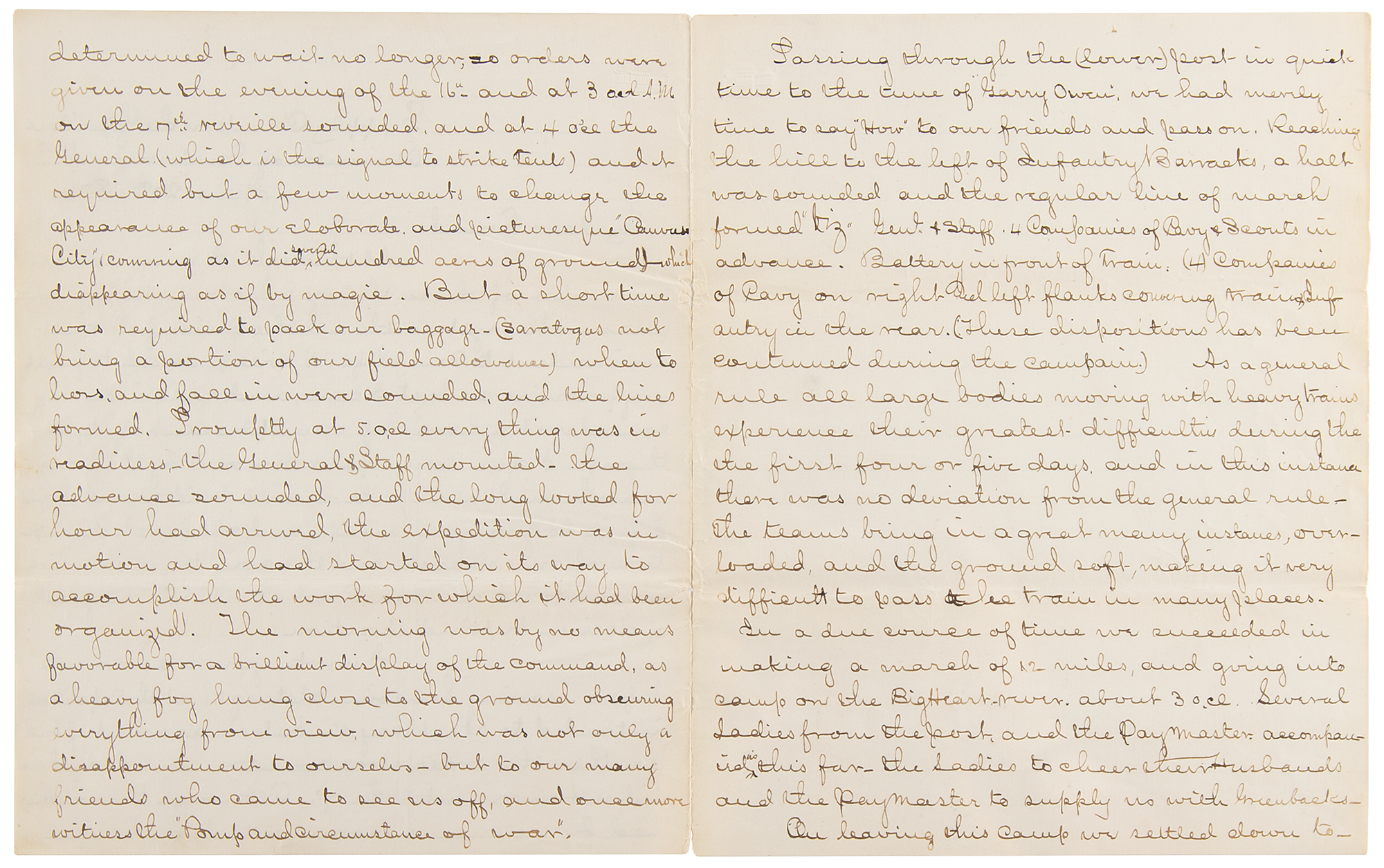
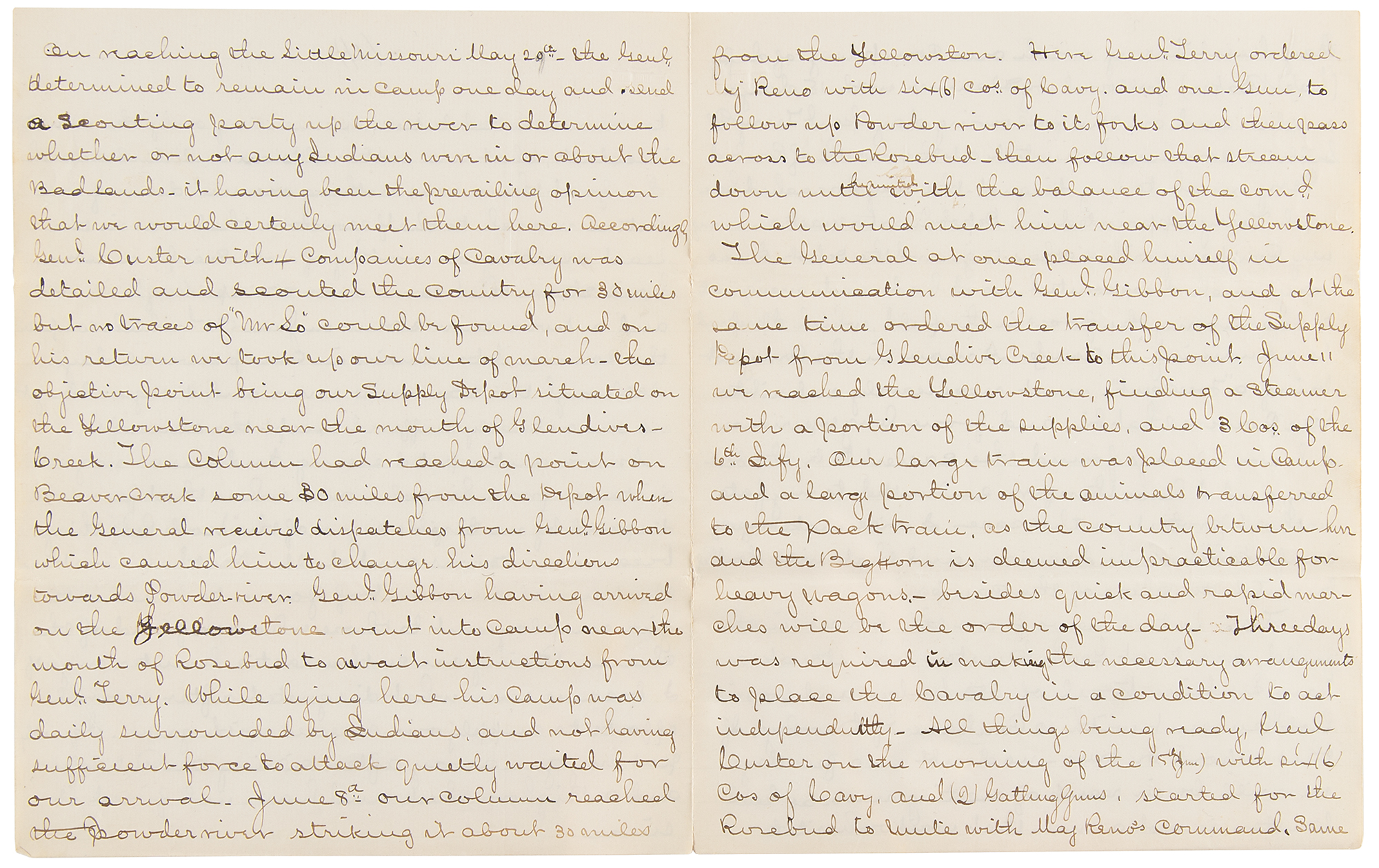
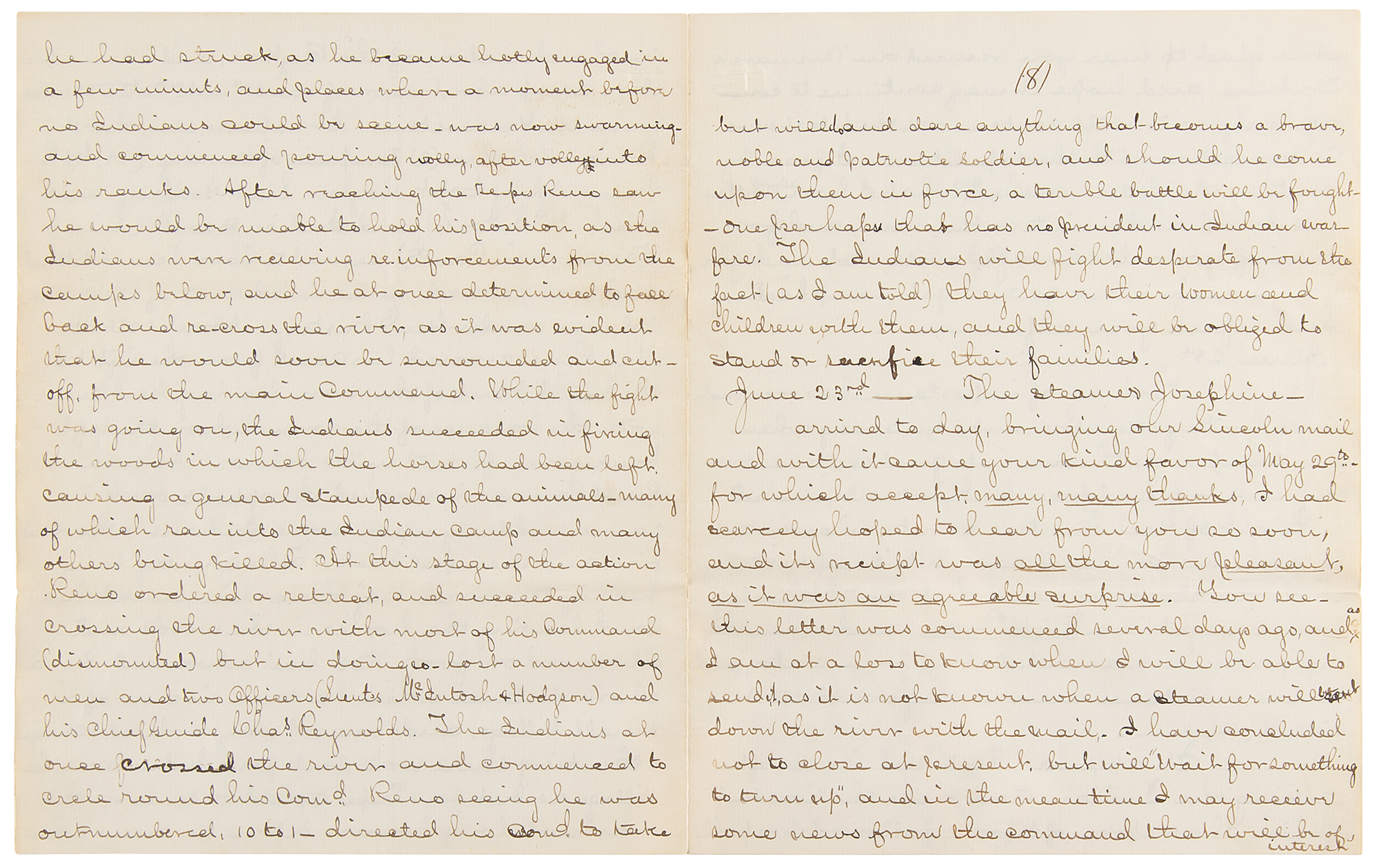
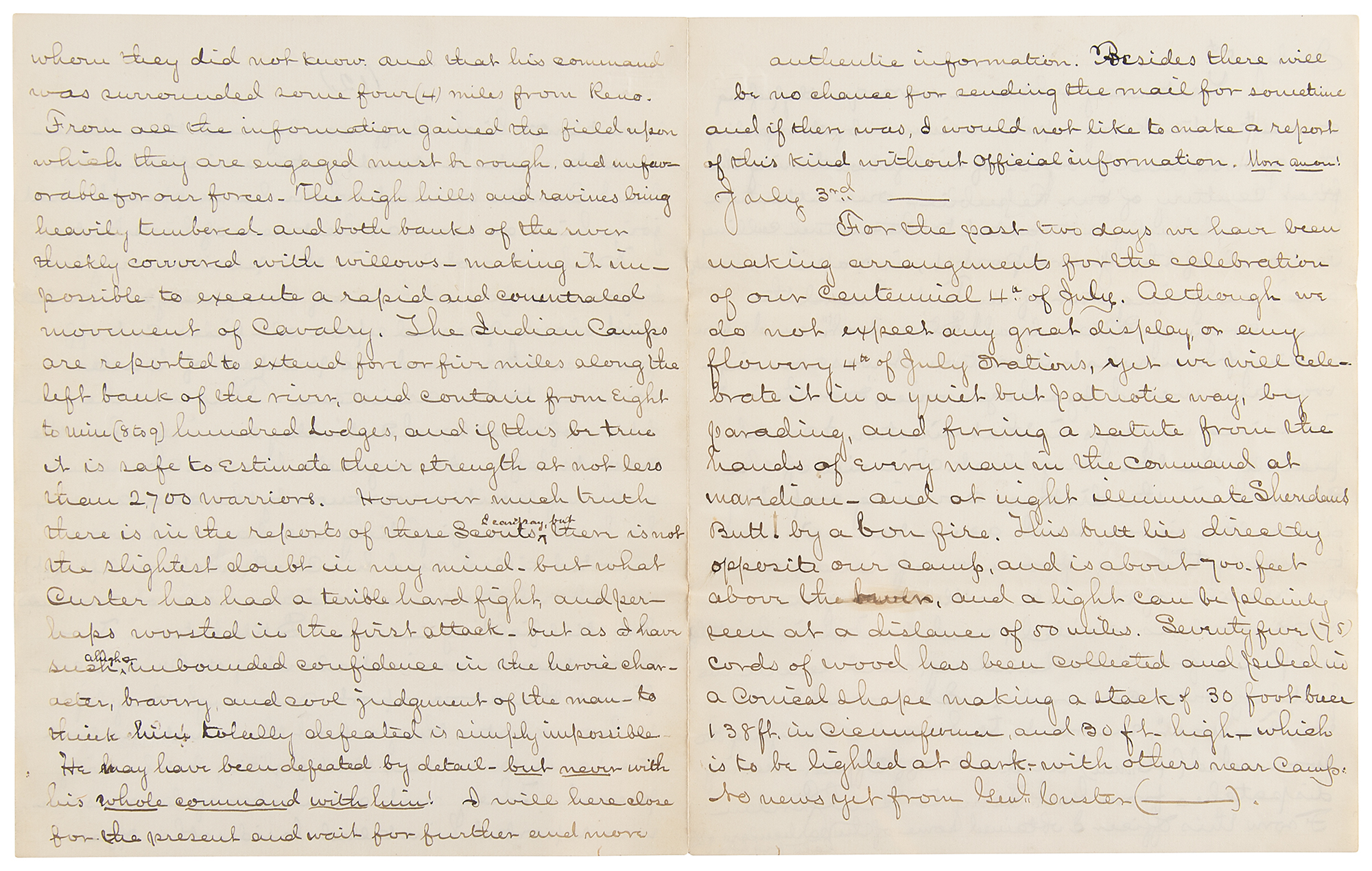
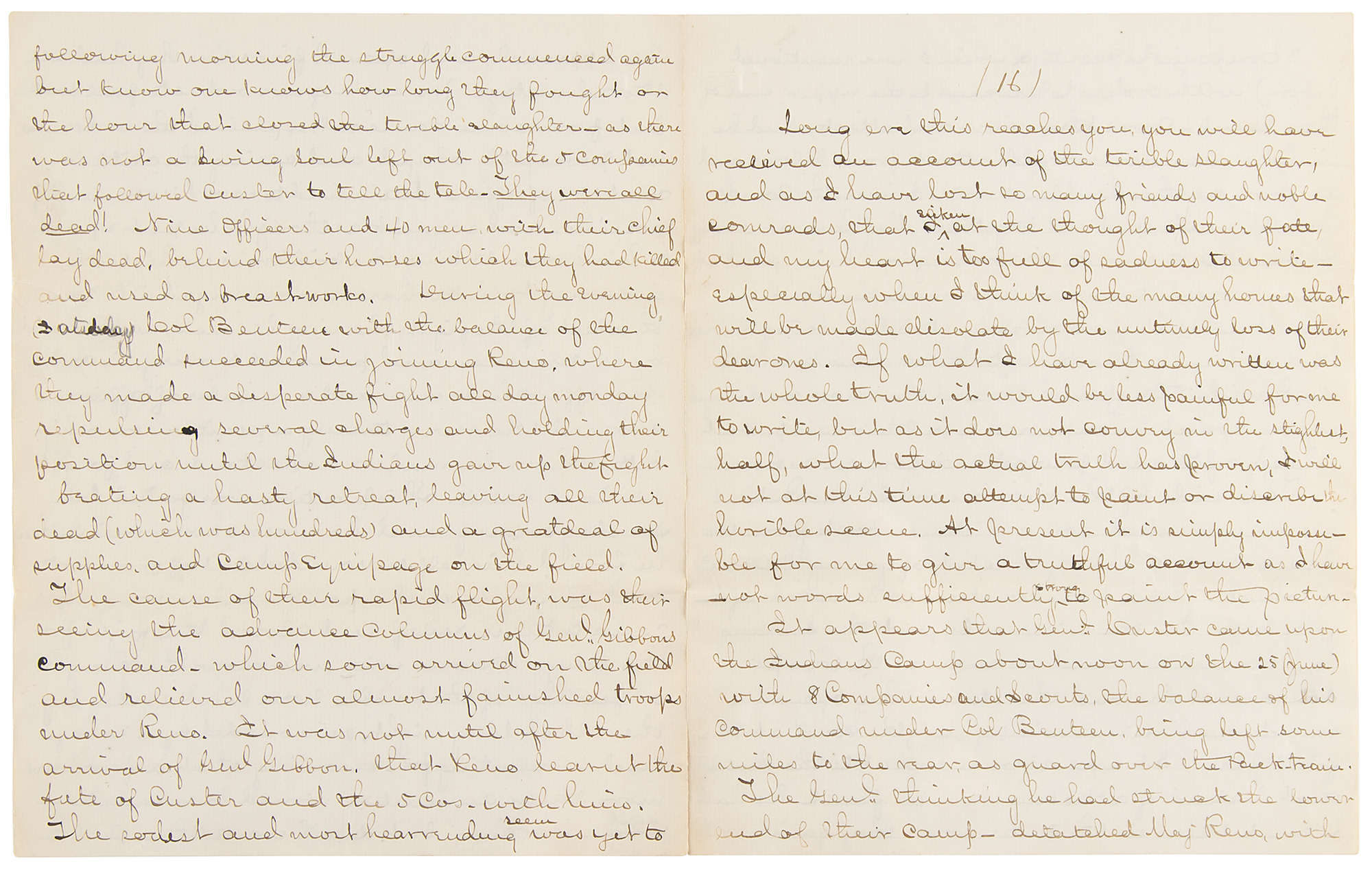
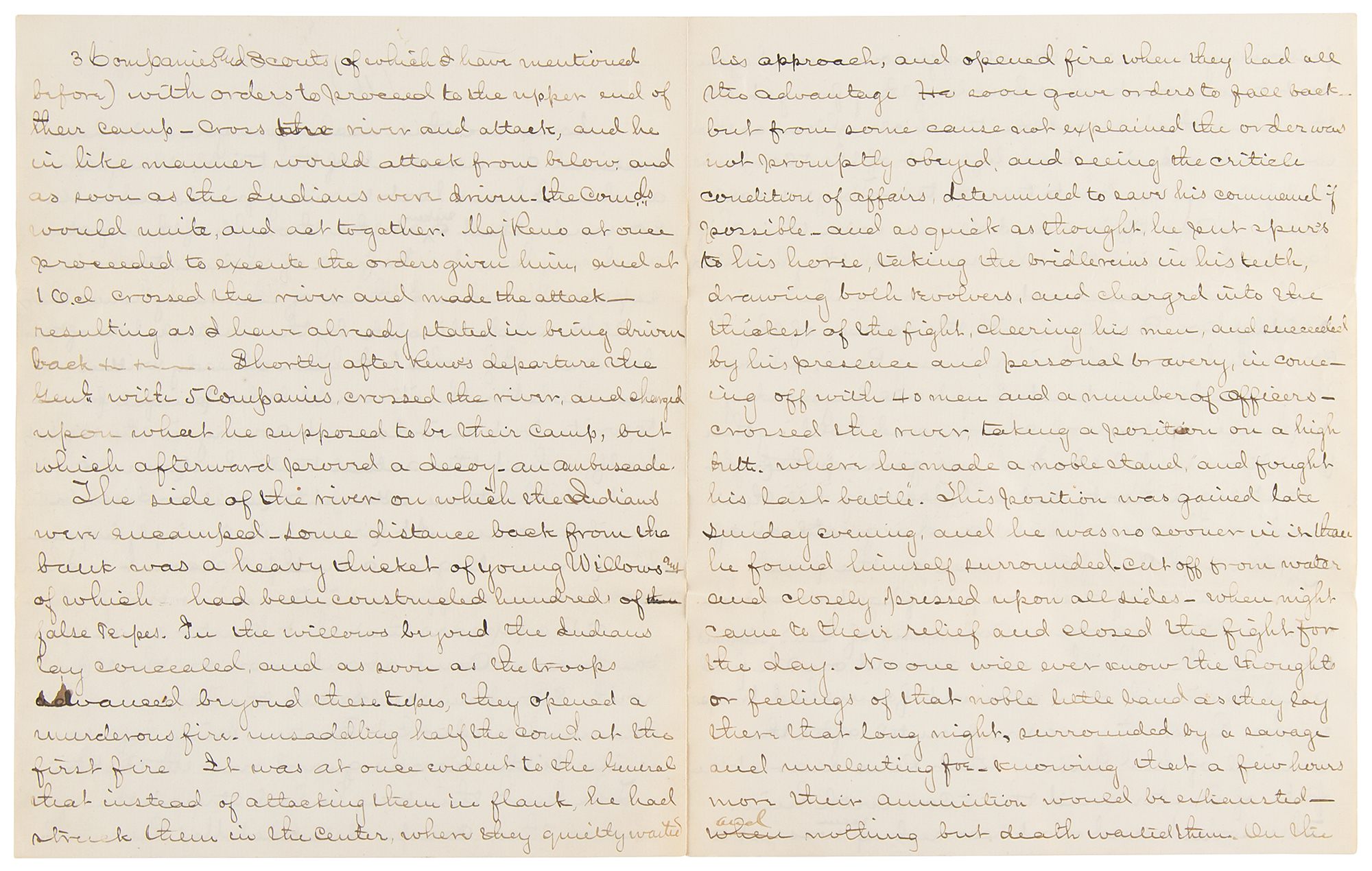
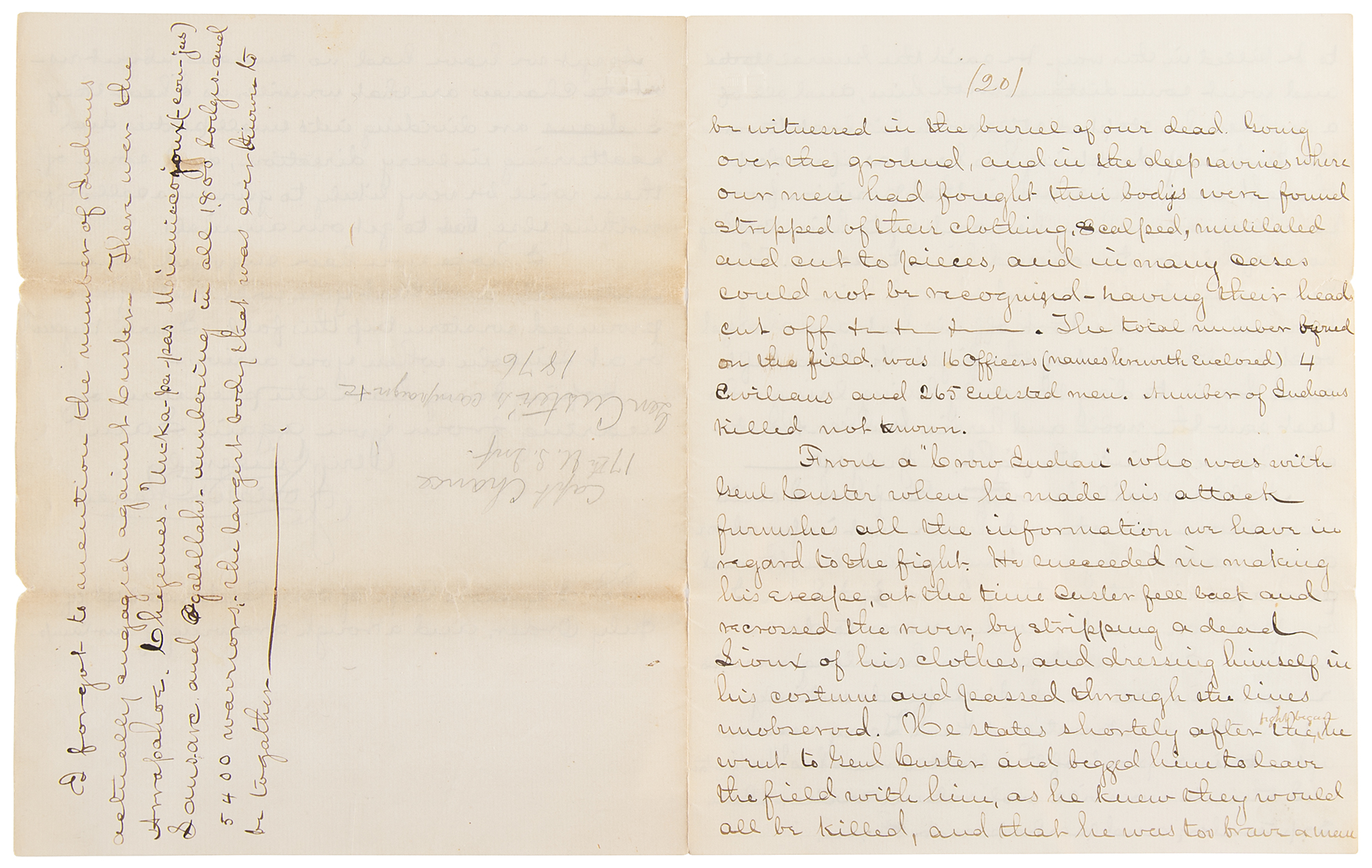
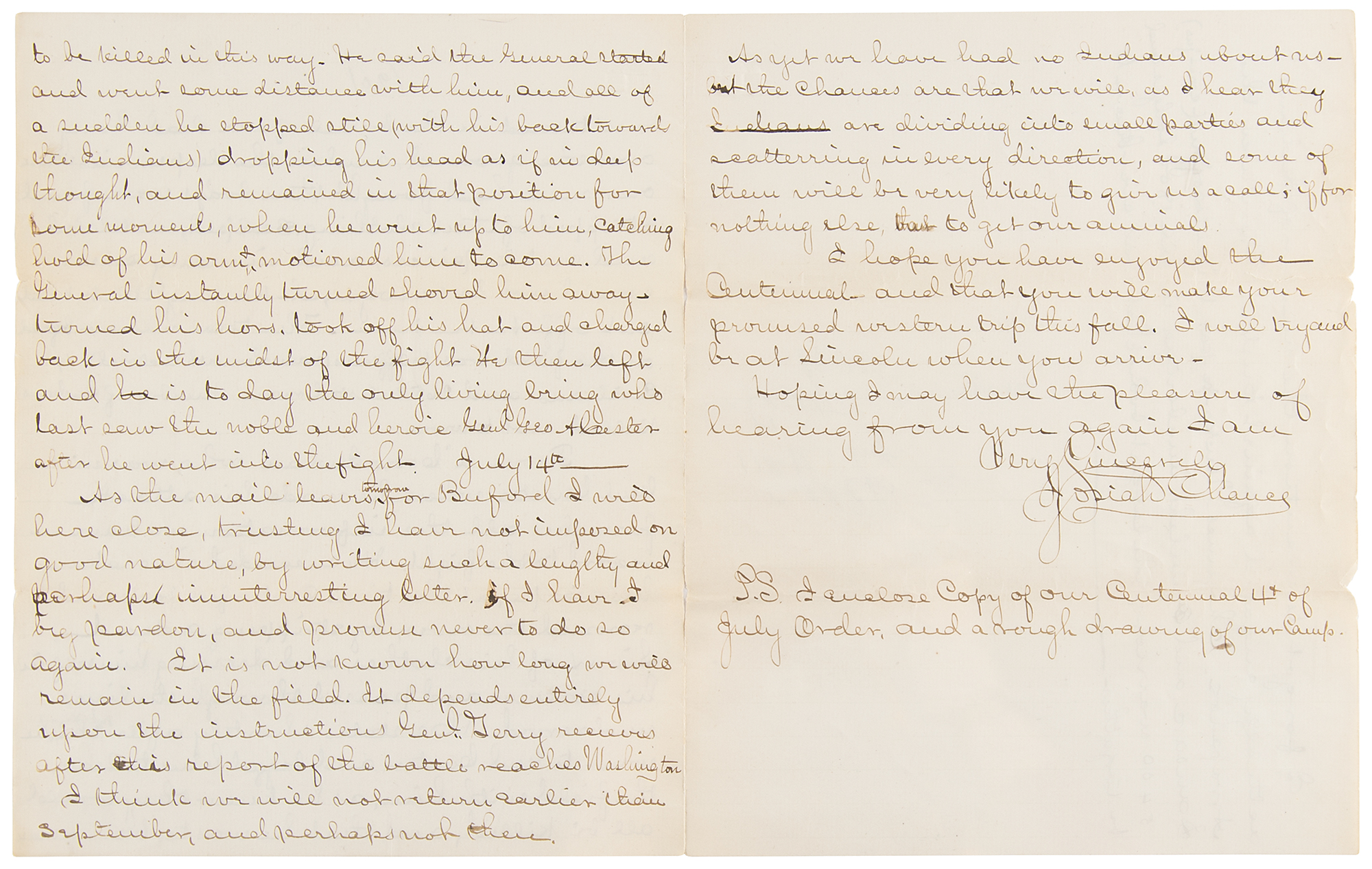
ALS signed “Josiah Chance,” 23 pages, 7.75 x 9.75, June 20–July 5, 1876. Lengthy handwritten letter to a friend, written from the "Supply Camp on the Yellowstone, at mouth of Powder River, M.T.," written over the course of two weeks, providing a remarkable firsthand, boots-on-the-ground account of the Battle of the Little Bighorn, fought on June 25–26, 1876.
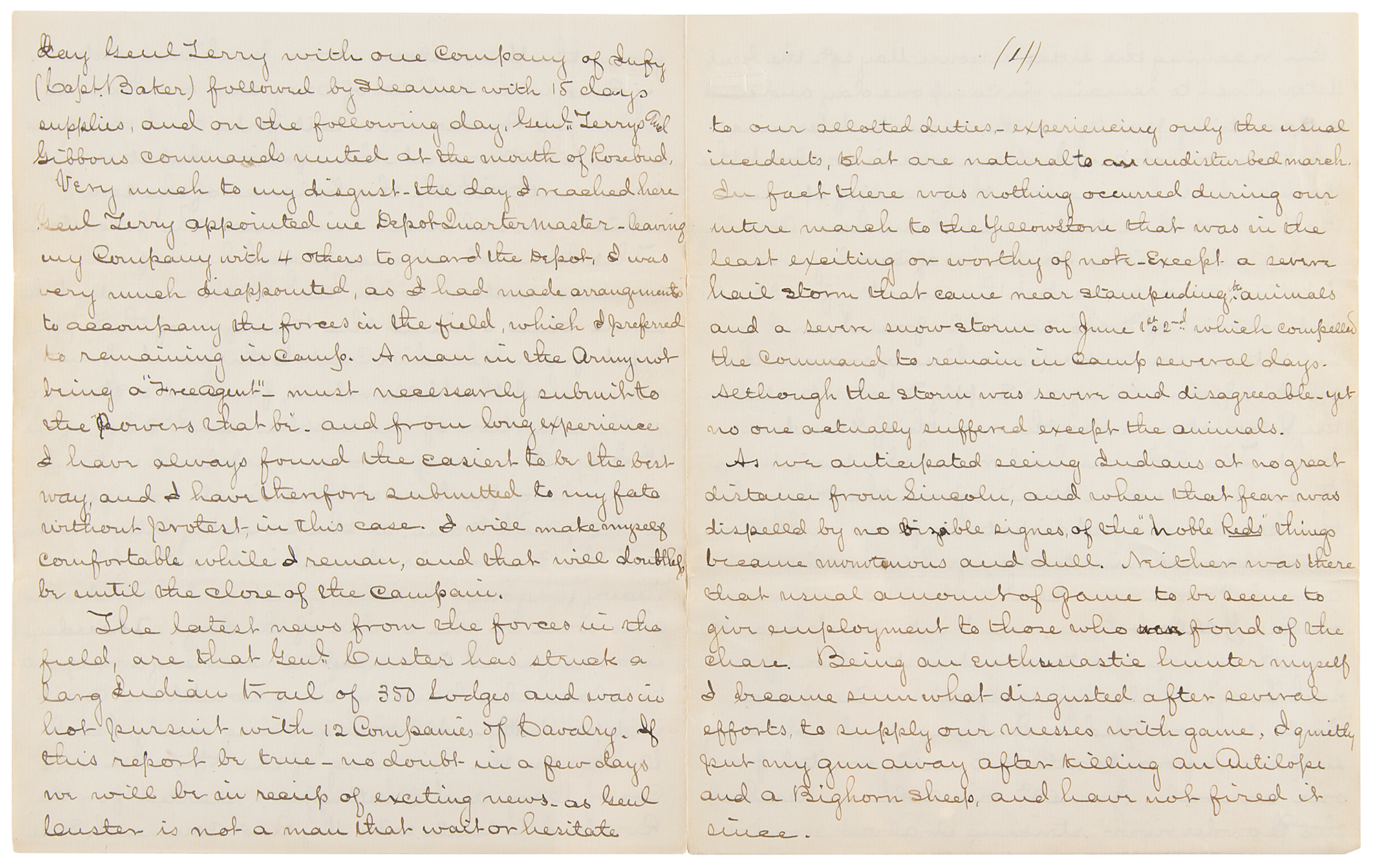
In part: "I wrote you a short note before leaving Lincoln, stating that the Expedition intended to start May 15th, but on account of bad weather the order was countermanded and we did not move until the 17th…As we anticipated seeing Indians at no great distance from Lincoln, and when that fear was dispelled by no visible signs of the 'Noble Reds' things became monotonous and dull. Neither was there that usual amount of game to be seen to give employment to those fond of the chase. Being an enthusiastic hunter myself I became somewhat disgusted after several efforts, to supply our messes with game, I quietly put my gun away after killing an antelope and a Bighorn sheep, and have not fired it since…
Very much to my disgust, the day I marched here Genl. Terry appointed me Depot Quarter Master, leaving my Company with 4 others to guard the Depot. I was very much disappointed, as I had made arrangements to accompany the forces in the field, which I preferred to remaining in camp. A man in the Army not being a 'Free agent,' must necessarily submit to the powers that be, and from long experience I have always found the easiest to be the best way, and I have therefore submitted to my fate without protest, in this case. I will make myself comfortable while I remain, and that will doubtless be until the close of the campaign.
The latest news from the forces in the field, are that Genl. Custer has struck a long Indian trail of 350 lodges and was in hot pursuit with 12 Companies of Cavalry. If this report be true—no doubt in a few days we will be in receipt of exciting news, as Genl. Custer is not a man that wait or hesitate…should he come upon them in force, a terrible battle will be fought—one perhaps that has no precedent in Indian warfare. The Indians will fight desperate from the fact (as I am told) that they have their women and children with them, and they will be obliged to stand or sacrifice their families."
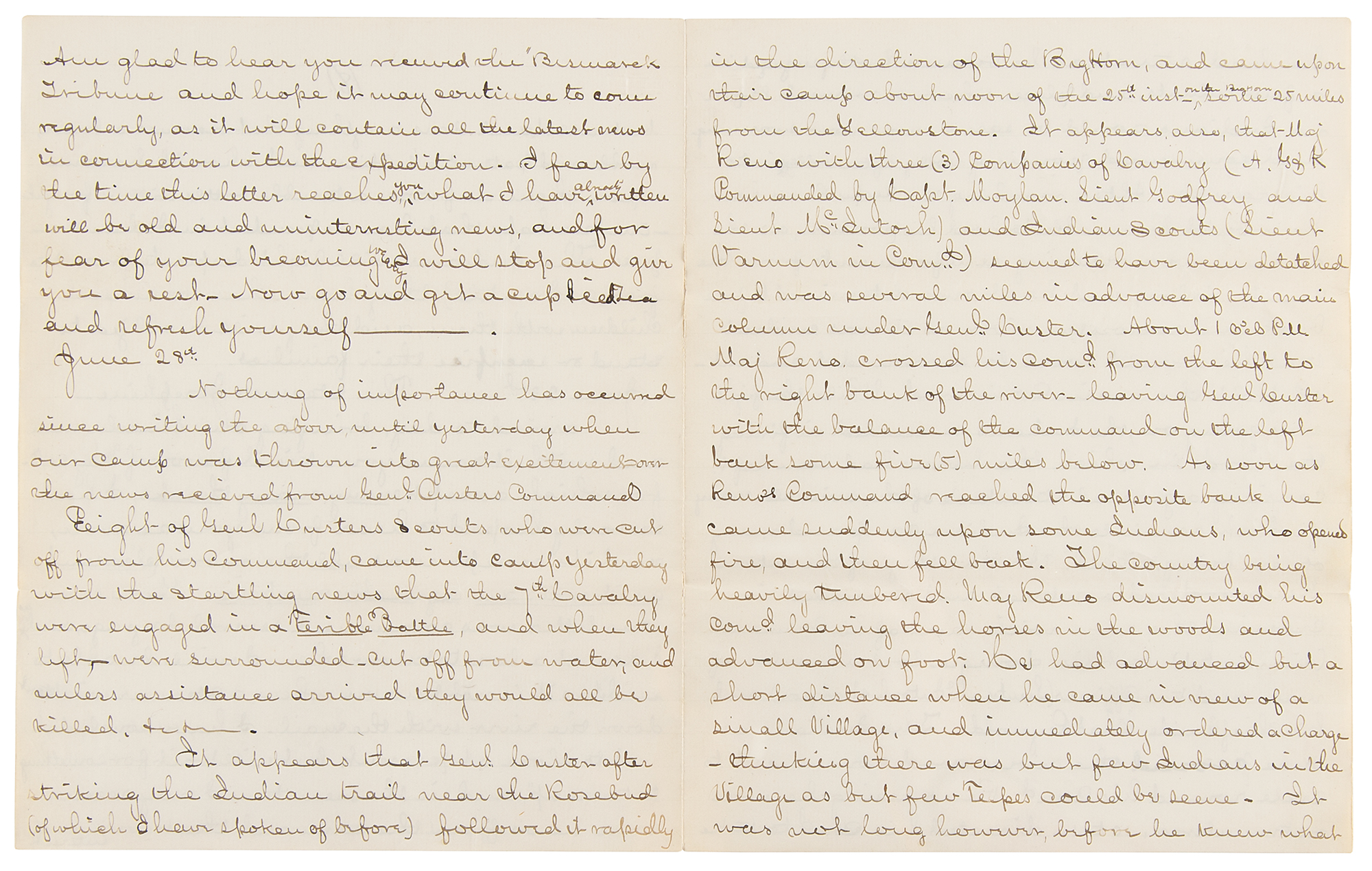
Though clearly unhappy to be out of the action, Chance's assignment no doubt saved his life and allowed for this remarkable account to be written. Chance proceeds to record all the intelligence he received from a group of eight of General Custer's scouts: "Nothing of importance has occurred since writing the above, until yesterday when our Camp was thrown into great excitement over the news received from Genl. Custer's Command. Eight of Genl. Custer's Scouts who were cut off from his Command, came into camp yesterday with the startling news that 7th Cavalry were engaged in a terrible battle, and when they left were surrounded—cut off from water, and unless assistance arrived they would all be killed.
It appears that Genl. Custer after striking the Indian trail near the Rosebud (of which I have spoken of before) followed it rapidly in the direction of the Bighorn, and came upon their camp about noon of the 25th, inst. on the Bighorn some 25 miles from the Yellowstone. It appears, also, that Maj. Reno with three (3) Companies of Cavalry (A, G & K Commanded by Capt. Moylan. Lieut. Godfrey and Lieut. McIntosh) and Indian Scouts (Lieut. Varnum in the Com'd) seemed to have been detached and was several miles in advance of the main column under Genl. Custer. About 1 o'cl P.M. Maj. Reno crossed his com'd from the left to the right bank of the river, leaving Genl. Custer with the balance of the command on the left bank some five (5) miles below. As soon as Reno's Command reached the opposite bank he came suddenly upon some Indians, who opened fire, and they fell back…Maj. Reno dismounted his com'd leaving the horses in the woods and advanced on foot. He had advanced but a short distance when he came in view of a small village, and immediately ordered a charge—thinking there was but few Indians in the village as but few teepees could be seen. It was not long however, before he knew what he had struck, as he became hotly engaged in a few minutes, and places where a moment before no Indians could be seen, was now swarming and commenced pouring volly, after volley, into his ranks. After reaching the teepees Reno saw he would be unable to old his position, as the Indians were receiving reinforcements from the camps below, and he at once determined to fall back and re-cross the river, as it was evident that he would soon be surrounded and cutoff from the main Command.
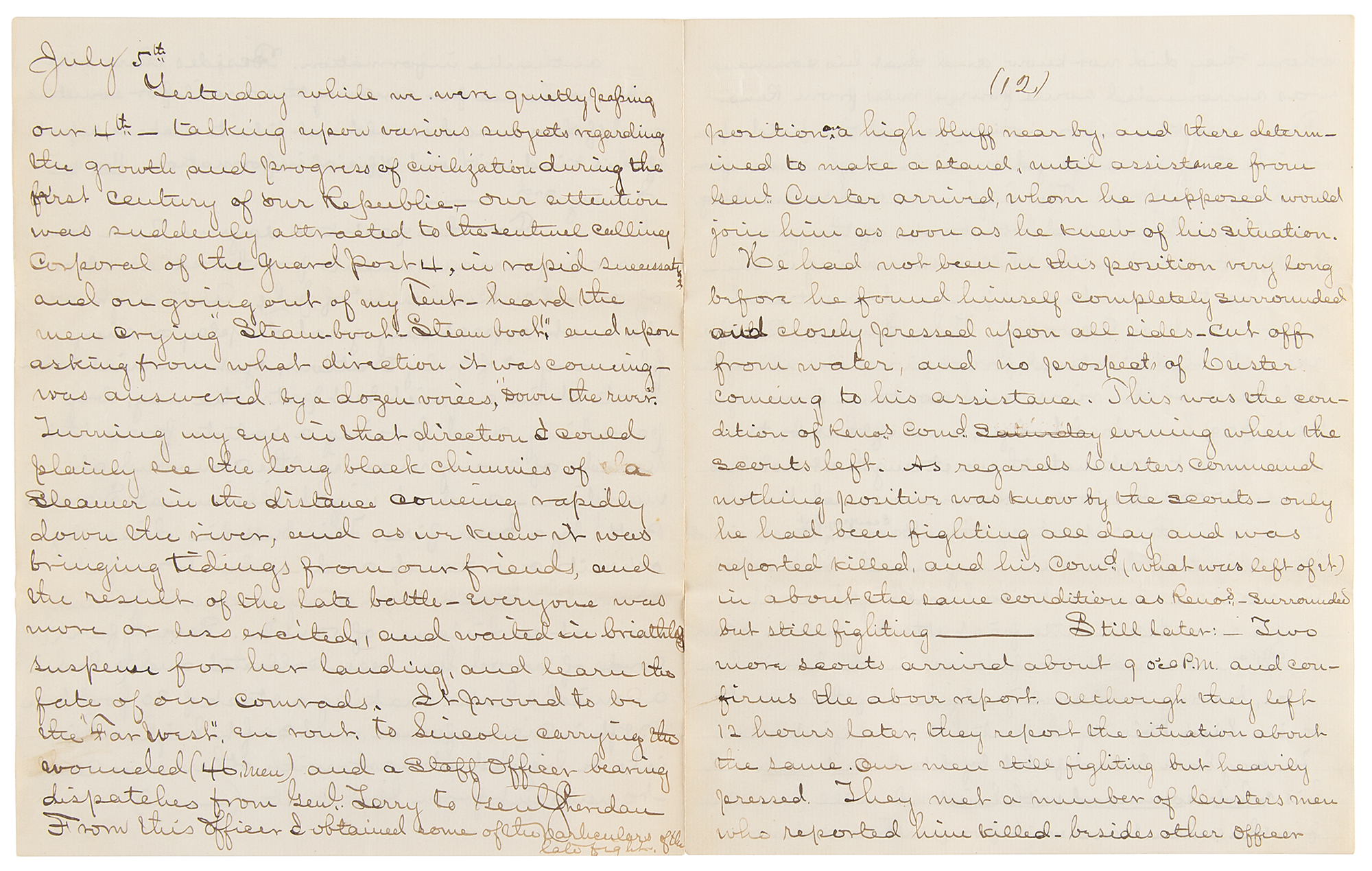
While the fight was going on, the Indians succeeded in firing the woods in which the horses has been left, causing a general stampede of the animals, many of which ran into the Indian camp and many others being killed. At this stage of the action Reno ordered a retreat, and succeeded in crossing the river with most of his command (dismounted) but in doing so, lost a number of men and two officers (Lieuts. McIntosh & Hodgson) and his chief guide Chas. Reynolds. The Indians at once crossed the river and commenced to circle round his com'd. Reno seeing he was outnumbered, 10 to 1—directed his com'd to take position on a high bluff near by, and there determined to make a stand, until assistance from Genl. Custer arrived, whom he supposed would join him as soon as he knew of his situation.
He had not been in this position very long before he found himself completely surrounded and closely pressed upon all sides—cut off from water, and no prospect of Custer coming to his assistance. This was the condition of Reno's Com'd Saturday evening when the scouts left. As regards Custer's command nothing positive was known by the scouts—only he had been fighting all day and was reported killed, and his com'd (what was left of it) in about the same condition as Reno's—surrounded but still fighting.
Still later:—Two more scouts arrived about 9 o'cl P.M. and confirms the above report. Although they left 12 hours later, they report the situation about the same. Our men still fighting but heavily pressed. They met a number of Custer's men who reported him killed, besides other officer whom they did not know, and that his command was surrendered some four (4) miles from Reno. From all the information gained the field upon which they are engaged must be rough, and unfavorable for our forces. The high hills and ravines being heavily lumbered and both banks of the river thickly covered with willows—making it impossible to execute a rapid and concentrated movement of Cavalry. The Indian Camps are reported to extend four or five miles along the left bank of the river, and contain from eight to nine (8 to 9) hundred lodges, and if this be true it is safe to estimate their strength at not less than 2,700 warriors. However much truth there is in the reports of these Scouts, I can't say, but there is not the slightest doubt in my mind, but what Custer has had a terrible hard fight, and perhaps wounded in the first attack, but as I have such doubts, unbounded confidence in the heroic character, bravery, and cool judgement of the man, to think him totally defeated is simply impossible. He may have been defeated by detail—but never with his whole command with him! I will here close for the present and wait for further and more authentic information. Besides there will be no chance for sending the mail for sometime and if there was, I would not like to make a report of this kind without official information…
July 3rd—For the past two days we have been making arrangements for the celebration of our centennial 4th of July. Although we do not expect any great display, or any flowery 4th of July orations, yet we will celebrate it in a quiet but patriotic way, by parading, and firing a salute from the hands of every man in the command…No news yet from Genl. Custer…
July 5th: Yesterday while we were…talking upon various subjects regarding the growth and progress of civilization during the first century of our Republic, our attention was suddenly attracted to the beautiful calling corporal of the Guard Post 4, in rapid succession and our going out of my tent—heard the men crying 'Steam boat! Steam boat!' and upon asking from what direction it was coming, was answered by a dozen voices, 'Down the river.' Turning my eyes in that direction I could plainly see the long black chimnnies of a steamer in the distance coming rapidly down the river, and as we knew it was bringing tidings from our friends, and the result of of the late battle, everyone was more or less excited, and waited in breathy suspense for her landing, and learning the fate of our comrades. It proved to be the 'Far West,' en route to Lincoln carrying the wounded (46 men) and a staff officer bearing dispatches from Genl. Terry to Genrl. Sheridan. From this officer I obtained some of the particulars of the late fight.
Long before this reaches you, you will have received an account of the terrible slaughter, and as I have lost so many friends and noble comrades, that I sicken at the thought of their fate, and my heart is too full of sadness to write…If what I have already written was the whole truth, it would be less painful for me to write, but as it does not convey in the slightest, half, what the actual truth has proven, I will not at this time attempt to paint or describe the horrible scene. At present it is simply impossible for me to give a truthful account as I have not words sufficiently strong to paint the picture.
It appears that Genl. Custer came upon the Indian Camp about noon on the 25 (June) with 8 Companies and Scouts, the balance of his command under Col. Benteen, being left some miles to the rear, as guard over the Pack-train. The Genl., thinking he had struck the lower end of their camp, detached Maj. Reno, with 3 Companies and Scouts (of which I have mentioned before) with orders to proceed to the upper end of their camp, cross the river and attack, and he in like manner would attack from below, and as soon as the Indians were driven, the Com'ds would unite, and act together. Maj. Reno at once proceeded to execute the orders given him, and at 1 o'cl crossed the river and made the attack—resulting as I have already stated in being driven back…Shortly after Reno's departure the Genl. with 5 Companies, crossed the river, and charged upon what he supposed to be their camp, but which afterwards proved a decoy, an ambuscade.
The side of the river on which the Indians were encamped, some distance back from the bank was a heavy thicket of young willows and of which had been constructed hundreds of false teepees. In the willows beyond the Indians lay concealed, and as soon as the troops advanced beyond these teepees, they opened a murderous fire, unsaddling half the com'd at the first fire. It was at once evident to the General that instead of attacking them in flank, he had struck them in the center, where they quietly waited his approach, and opened fire when they had all this advantage. He soon gave orders to fall back, but from some cause not explained the order was not promptly obeyed, and seeing the critical condition of affairs, determined to leave his command if possible—and as quick as thought, he put spurs to his horse, taking the bridle reins in his teeth, drawing both revolvers, and charged into the thickest of the fight, cheering his men, and succeeded by his presence and personal bravery, in coming off with 40 men and a number of officers—crossed the river, taking a position on a high butte where he made a noble stand, 'and fought his last battle.'
This position was gained late Sunday evening, and he was no sooner in it than he found himself surrounded, cut off from water and closely pressed upon all sides, when night came to their relief and closed the fight for the day. No one will ever know the thoughts or feelings of that noble little band as they lay there that long night, surrounded by a savage and unrelenting foe, knowing that a few hours more their ammunition would be exhausted—and nothing but death waited them. On the following morning the struggle commenced again but no one knows how long they fought on the hour that closed the terrible slaughter—as there was not a living soul left out of the 5 Companies that followed Custer to tell the tale. They were all dead! Nine officers and 40 men with their chief lay dead, behind their horses which they had killed and used as breastworks. During the evening, (Saturday), Col. Benteen with the balance of the command succeeded in joining Reno, where they made a desperate fight all day Monday repulsing several charges and holding their position until the Indians gave up the fight, beating a hasty retreat, leaving all their dead (which was hundreds) and a great deal of supplies and camp equipage on the field.
The cause of their rapid flight was their seeing the advance Columns of Genl. Gibbons command, which soon arrived on the field and relieved our almost famished troops under Reno. It was not until after the arrival of Genl. Gibbon, that Reno learnt the fate of Custer and the 5 Cos. with him. The saddest and most heartrending scene was yet to be witnessed in the burial of our dead. Going over the ground, and in the deep ravines where our men had fought their body's were found stripped of their clothing, scalped, mutilated and cut to pieces, and in many cases could not be recognized—having their heads cut off. The total number buried on the field, was 16 officers…4 civilians and 265 enlisted men. Number of Indians killed not known.
From a 'Crow Indian' who was with Genl. Custer when he made his attack furnished all the information we have in regard to the fight. He succeeded in making his escape, at the time Custer fell back and recrossed the river, by stripping a dead Sioux of his clothes, and dressing himself in his costume and passed through the lines unobserved. He states shortly after the fight began he went to Genl. Custer and begged him to leave the field with him, as he knew they would all be killed, and that he was too brave a man to be killed in this way. He said the General started and went some distance with him, and all of a sudden he stopped still (with his back towards the Indians) dropping his head as if in deep thought, and remained in that position for some moments, when he went up to him, catching hold of his arm & motioned him to come. The General instantly turned shoved him away—turned his horse, took off his hat and charged back in the midst of the fight. He then left and he is today the only living being who last saw the noble and heroic Genl. Geo. A. Custer after he went into the fight."
On the reverse, he adds: "I forgot to mention the number of Indians actually engaged against Custer. There were the Arrapahoe, Cheyennes, Un-ka-pa-pas, Minniecojoux (-con-jus), Sans-arc and Ogalallahs, numbering in all 1800 lodges, and 5400 warriors—the largest body that was ever known to be together." In fine condition.
Composed before, during, and after the Battle of the Little Bighorn—one of the most consequential and mythologized clashes of the American Indian Wars—this extraordinary letter occupies a unique place within the documentary record of the 1876 Great Sioux War. Written from a supply camp along the Yellowstone River during the United States’ centennial celebrations, Chance’s account captures the jarring juxtaposition of national triumph and frontier catastrophe, as news of Custer’s annihilation filtered eastward in fragments, rumor, and raw emotion.
Unlike retrospective narratives shaped by legend and controversy, this contemporaneous report preserves the uncertainty, misinformation, and psychological shock experienced by officers on the periphery of the campaign, offering insight into how the disaster was first understood by the Army itself. His detailed recounting of scout intelligence, tactical movements, and the scale of Native resistance reflects the evolving realization that U.S. forces had gravely underestimated a unified coalition of Lakota Sioux, Cheyenne, and Arapaho warriors at the height of their power. As such, the letter stands not only as a vivid eyewitness-adjacent chronicle of Custer’s last campaign, but also as a poignant artifact of a pivotal moment when the expansionist ambitions of the United States collided with Indigenous resistance in one of the final and most dramatic episodes of the western frontier.
The Western Americana auction of Jochen Zeitz.

This item is Pre-Certified by PSA/DNA
Buy a third-party letter of authenticity for
(inquire for price)
*This item has been pre-certified by a trusted third-party authentication service, and by placing a bid on this item, you agree to accept the opinion of this authentication service. If you wish to have an opinion rendered by a different authenticator of your choosing, you must do so prior to your placing of any bid. RR Auction is not responsible for differing opinions submitted 30 days after the date of the sale.

