The 30 Minute Rule begins May 21 at 7:00 PM EDT. An Initial Bid Must Be Placed By May 21 at 6:00 PM EDT To Participate After 6:00 PM EDT
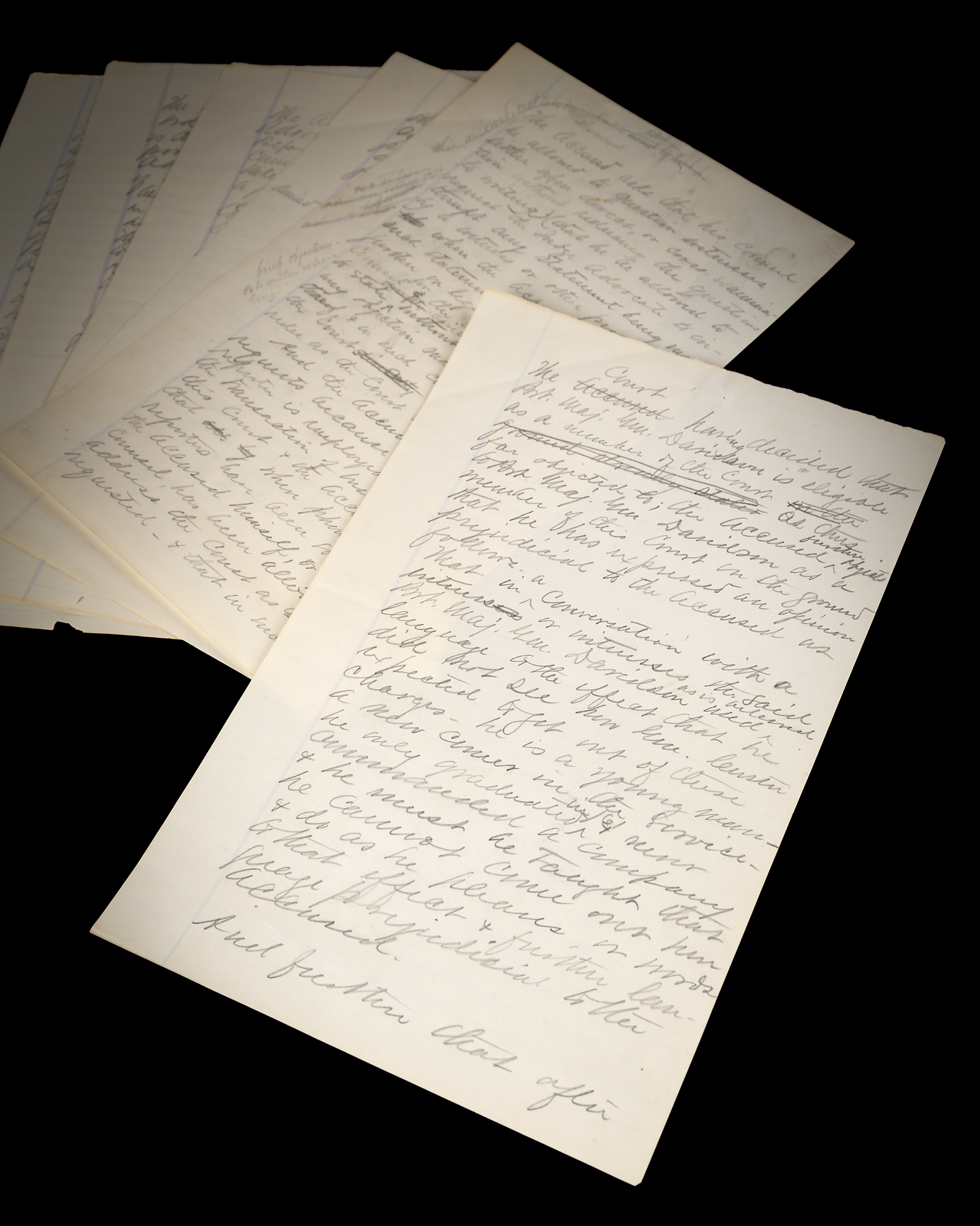
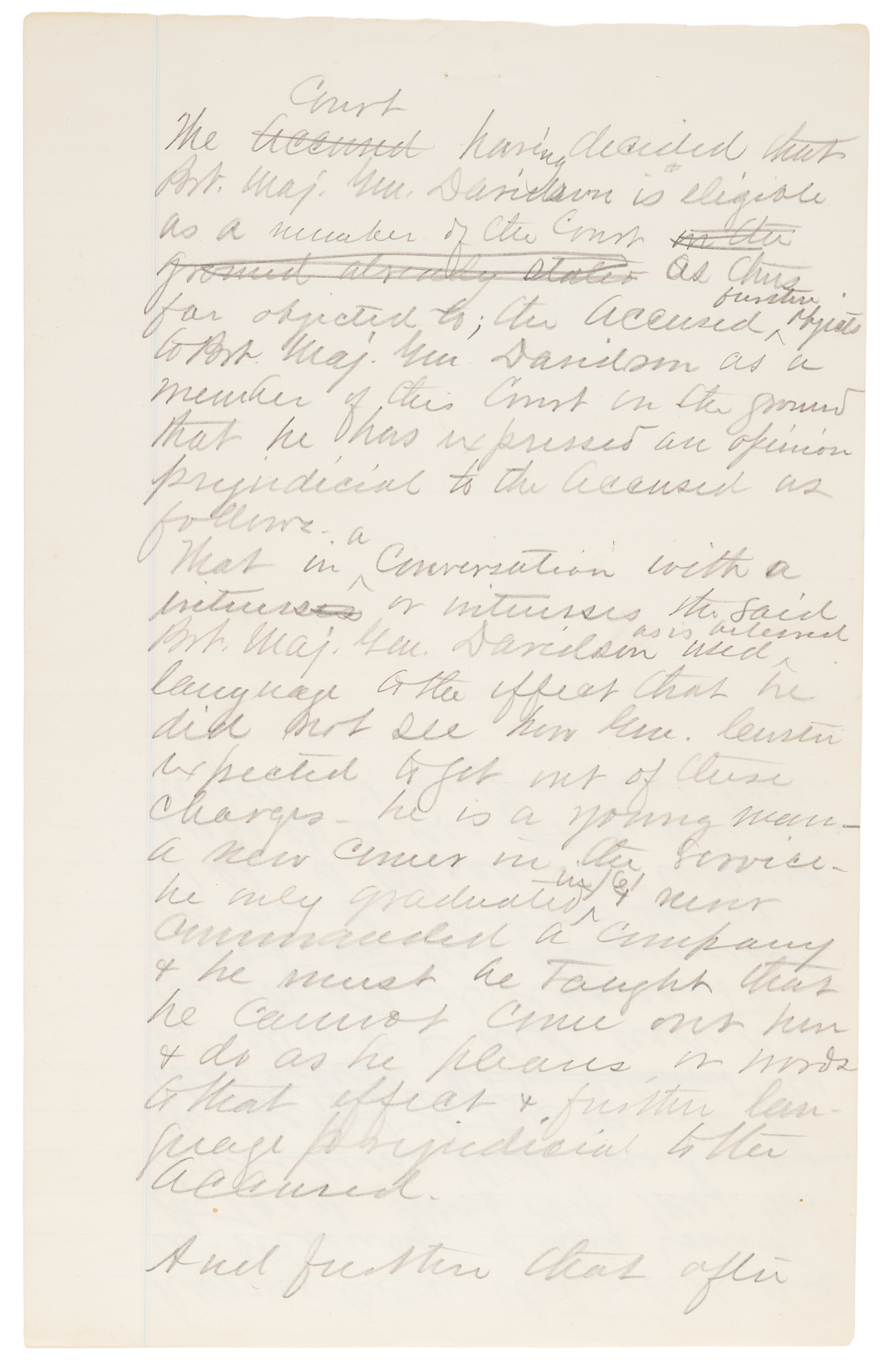
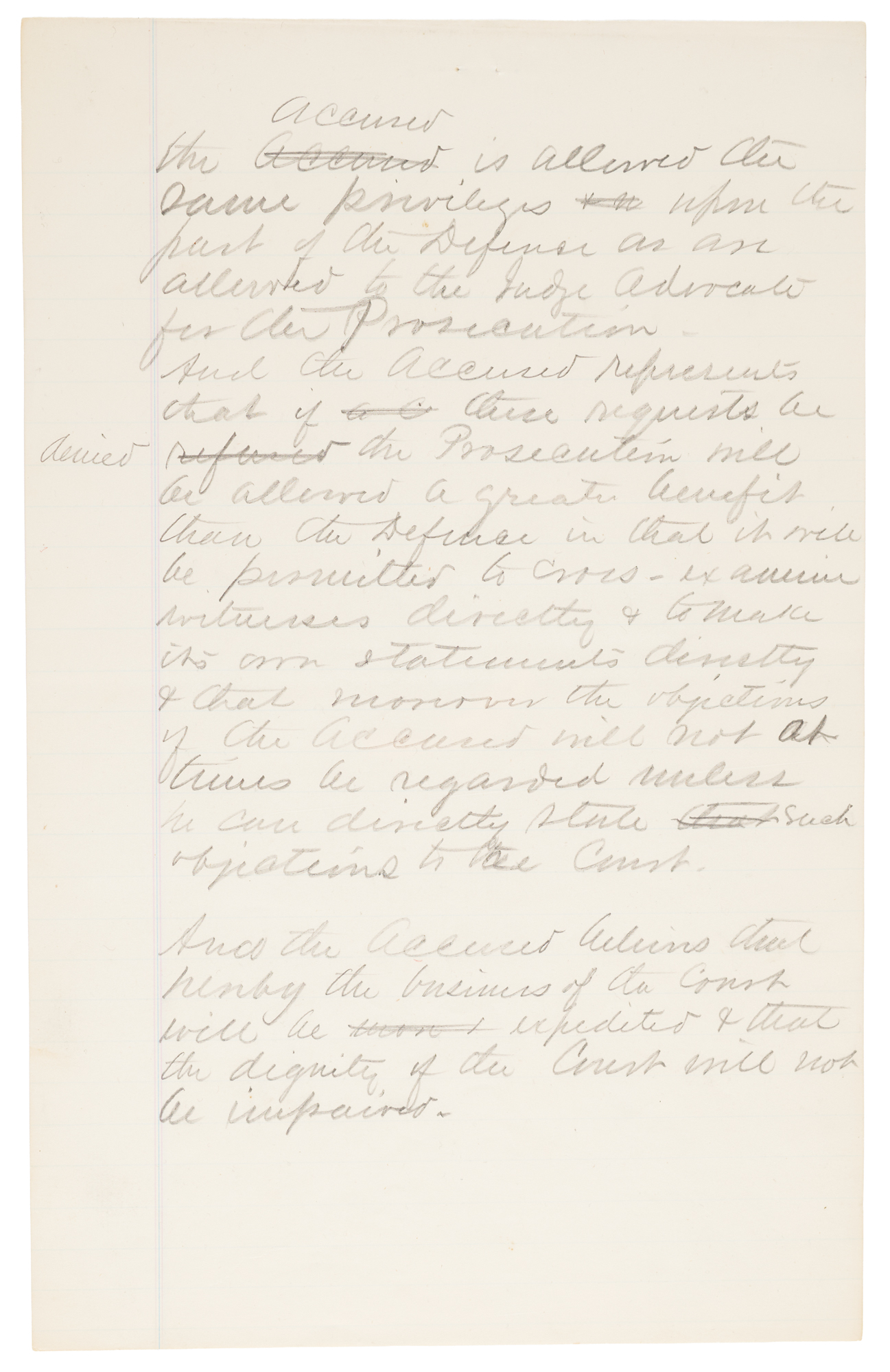
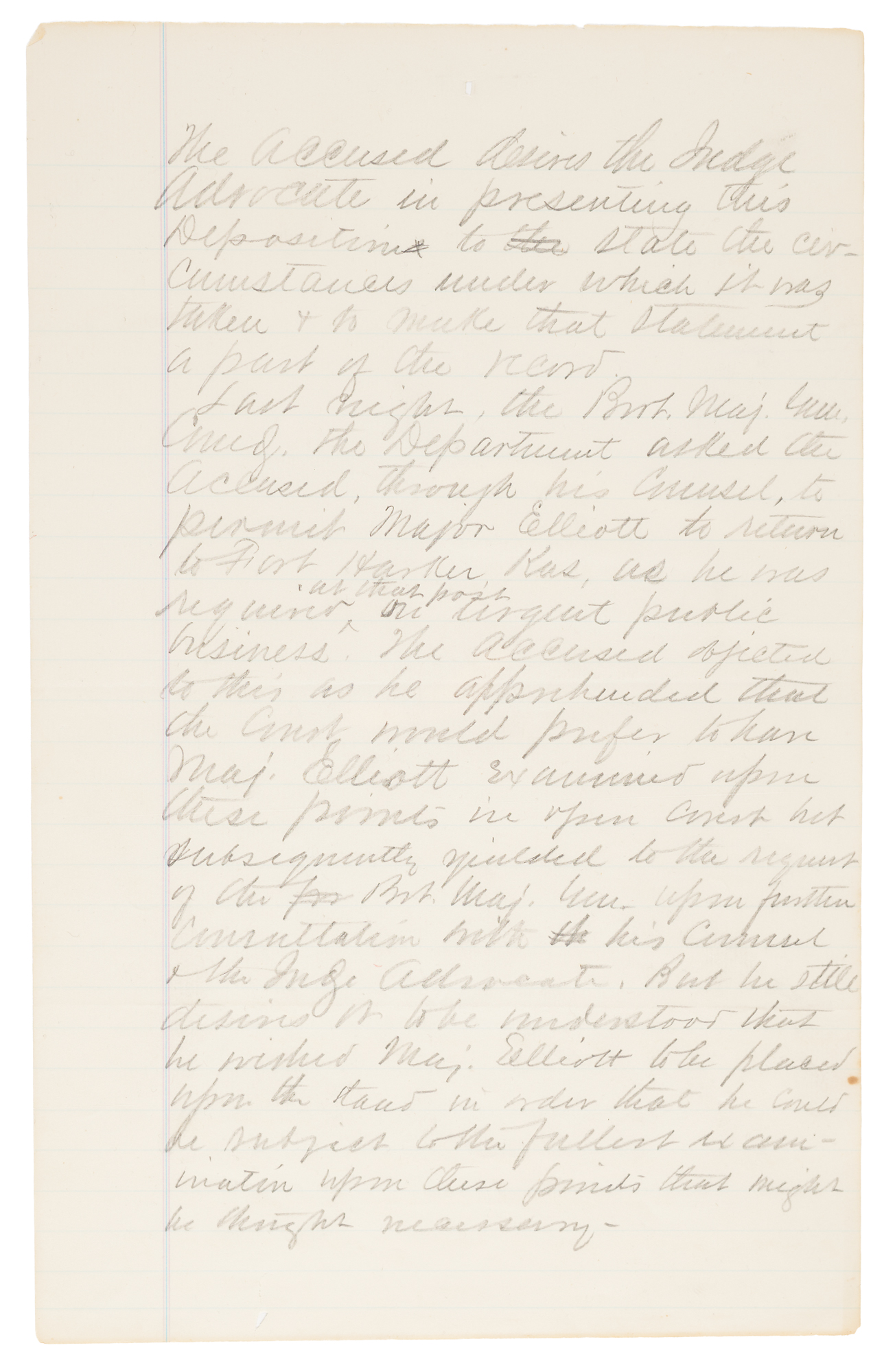
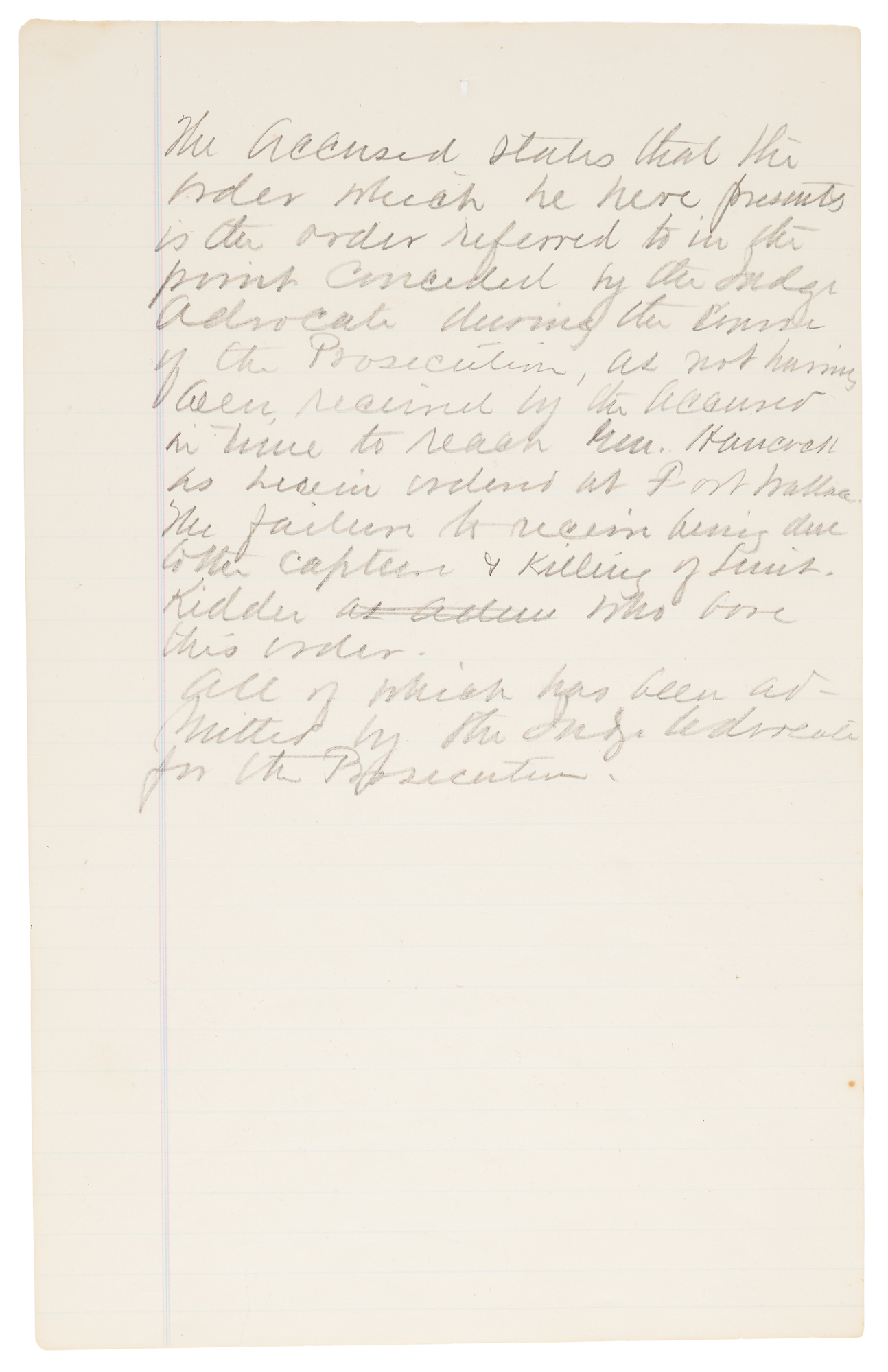
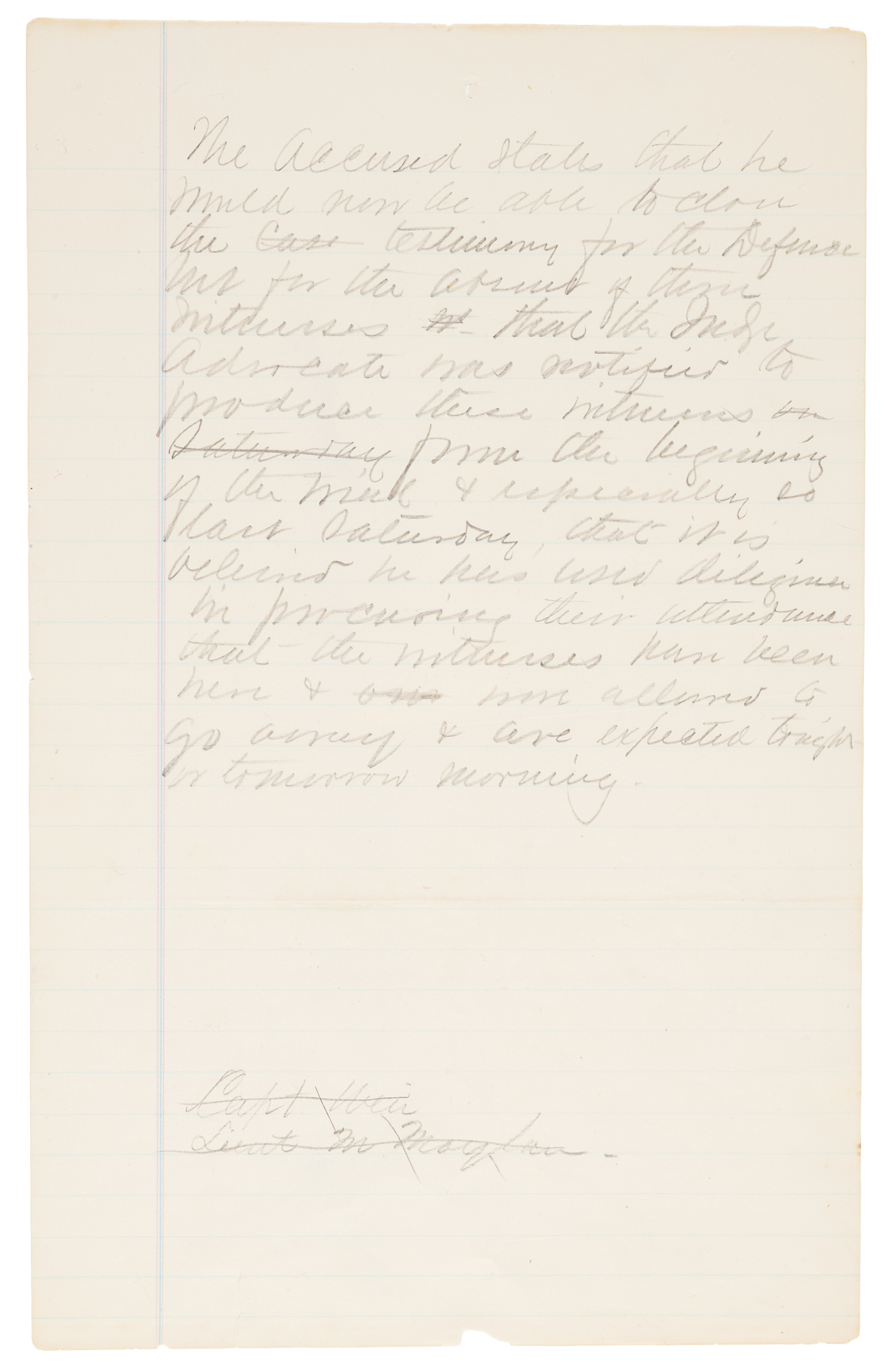
Third-person AMS in pencil, signed within the text, "Gen. Custer," seven pages on six sheets, 8 x 12.5, no date but circa September 1867. Facing court-martial at Fort Leavenworth, Kansas, for ordering the shooting of deserters, George A. Custer carefully drafts his defense. Custer writes, in full: "The court having decided that Bvt. Maj. Gen. Davidson is eligible as a member of the court as thus far objected to; the accused further objects to Bvt. Maj. Gen. Davidson as a member of this court on the ground that he has expressed an opinion prejudicial to the accused as follows.
That in a conversation with a witness or witnesses the said Bvt. Maj. Gen. Davidson as is witnessed used language of the effect that he did not see how Gen. Custer expected to get out of these charges—he is a young man—a new comer in the service—he only graduated in /61 never commanded a company & he must be taught that he cannot come out here & do as he pleases, in words to that effect & further language prejudicial to the accused.
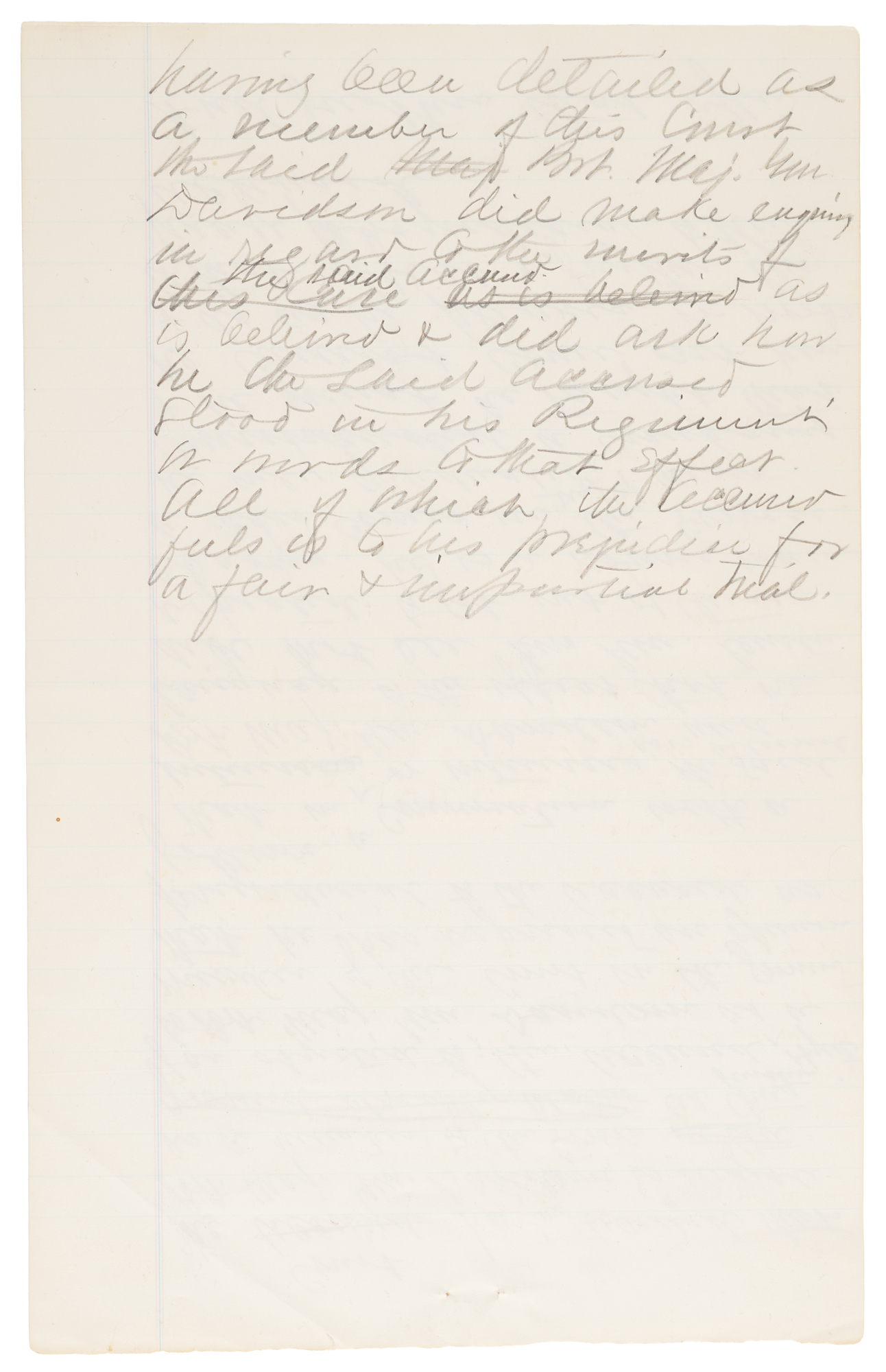
And further that after having been detailed as a member of this court who said Bvt. Maj. Gen. Davidson did make enquiry in regard to the merits of the said accused as is believed & did ask how he the said accused stood in his Regiment in words to that effect all of which the accused feels is to his prejudice for a fair & impartial trial.
The accused states that the order which he here presents is the order referred to in the point conceded by the Judge advocate during the course of the Prosecution, as not having been received by the accused in time to reach Gen. Hancock as herein ordered at Fort Wallace the failure to receive being due to the capture & killing of Lieut. Kidder who bore this order.
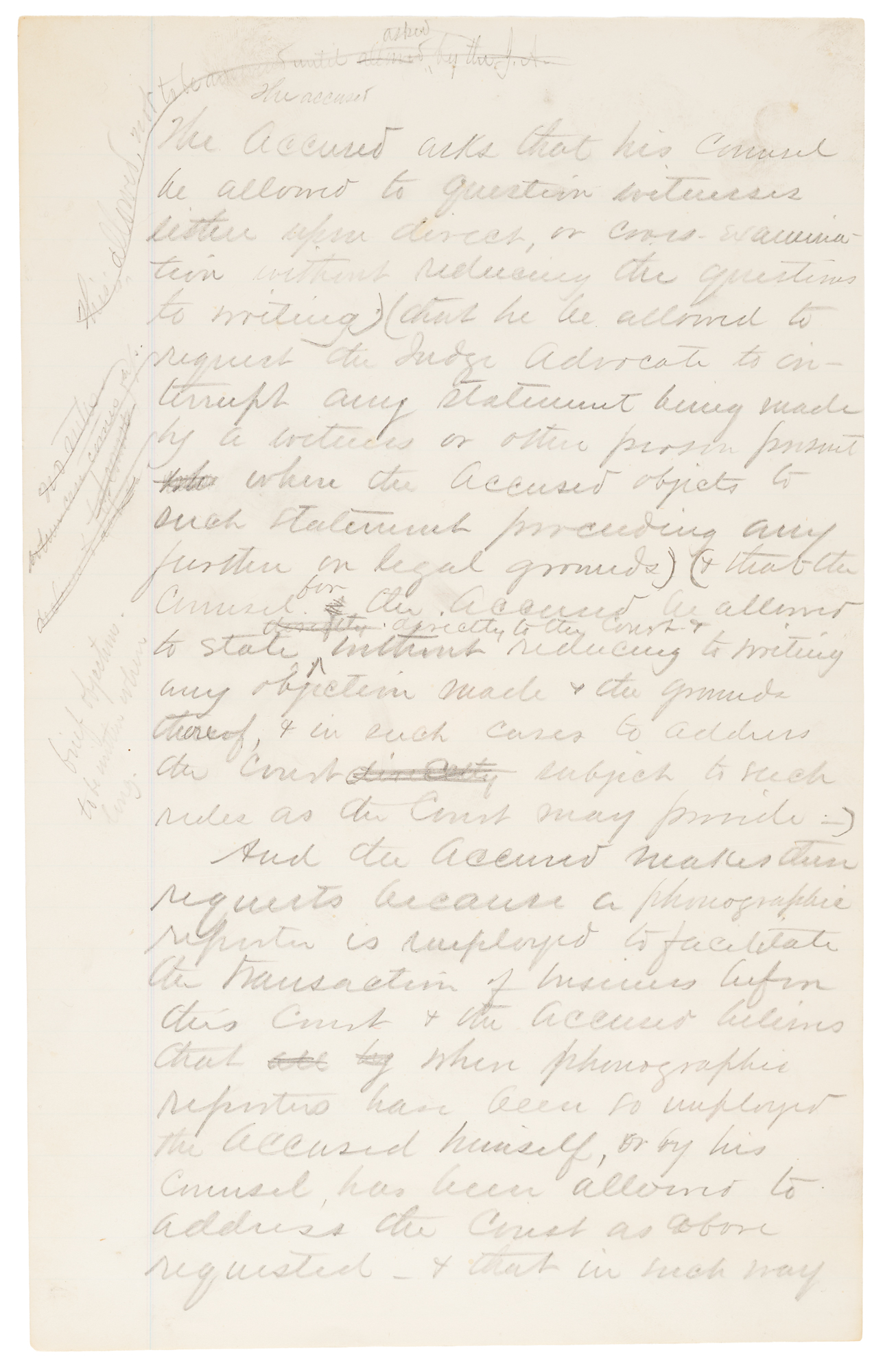
All of which has been admitted by the Judge advocate for the Prosecution. The accused asks that his counsel be allowed to question witnesses either upon direct, or cross examination without reducing the questions to writing) (that he be allowed to request the Judge Advocate to interrupt any statement being made by a witness or other person present when the accused objects to such statement proceeding any further on legal grounds) (& that the counsel for the accused be allowed to state directly to the court & without reducing to writing any objection made & to grounds thereof, & in such cases to address the court subject to such rules as the court may provide—) (Brief objections to be written when long)
And the accused makes these requests because a phonographic reporter is employed to facilitate the transaction of miscues upon this court & the accused believes that when phonographic reporters have been so employed the accused himself, or by his counsel, has been allowed to address the court, as above requested & that in such way the accused is allowed the same privileges upon the part of the Defense as are allowed to the Judge Advocate for the prosecution.
And the Accused represents that if these requests be denied the Prosecution will be allowed a greater benefit than the Defense in that it will be permitted to cross-examine witnesses directly & to make its own statements directly & that moreover the objections of the accused will not at times be regarded unless he can directly state such objections to the court.
And the Accused believes that hereby the business of the court will be expedited & that the dignity of the court will not be impaired. The Accused desires the Judge Advocate in presenting this Deposition to state the circumstances under which it was taken & to make that statement a part of the record. Last night, the Bvt. Maj. Gen. Cmd. the Department asked the accused, through his counsel, to permit Major Elliott to return to Fort Harker, Kas, as he was required at that post on urgent public business. The accused objected to this as he apprehended that the Court would prefer to have Maj. Elliott examined upon these points in open court but subsequently yielded to the request of the Bvt. Maj. Gen. upon further consultation with his counsel and the Judge Advocate. But he still desires it to be understood that he wished Maj. Elliott to be placed upon the stand in order that he could be subject to the fullest examination upon these points that might be thought necessary.
The Accused states that he would now be able to close the testimony for the Defense but for the absence of these witnesses that the Judge Advocate was notified to produce these witnesses from the beginning of the trial & especially so last Saturday, that it is believed he has used diligence in procuring their attendance that the witnesses have been here & were allowed to go away & are expected tonight or tomorrow morning." In fine condition.
Following Major General Winfield Scott Hancock's expedition against the Cheyenne that achieved little and contributed to instability in the region, Custer was arrested and tried at Fort Leavenworth between mid-September and early October 1867, facing charges tied to his absence without leave and his harsh orders for the execution of deserters. In this document, Custer emerges not as the triumphant Civil War cavalryman, but as an embattled officer navigating a deteriorating command environment—marked by high desertion rates, poor communication (including the fatal loss of Lt. Kidder carrying orders), and shifting leadership under generals Hancock and Sheridan. His detailed procedural objections and emphasis on fairness reflect his awareness of the stakes and his attempt to justify controversial actions within a broader culture of frontier military discipline, where even the shooting of deserters could be defended as sanctioned practice. As such, the manuscript is significant not only as a rare firsthand defense statement, but as a vivid artifact of the Army’s struggle to impose order in the volatile post–Civil War West, capturing the moment when Custer’s aggressive leadership style collided with military law and nearly derailed his career.
The Western Americana auction of Jochen Zeitz.

This item is Pre-Certified by PSA/DNA
Buy a third-party letter of authenticity for
$250.00
*This item has been pre-certified by a trusted third-party authentication service, and by placing a bid on this item, you agree to accept the opinion of this authentication service. If you wish to have an opinion rendered by a different authenticator of your choosing, you must do so prior to your placing of any bid. RR Auction is not responsible for differing opinions submitted 30 days after the date of the sale.

