
The 30 Minute Rule begins May 21 at 7:00 PM EDT. An Initial Bid Must Be Placed By May 21 at 6:00 PM EDT To Participate After 6:00 PM EDT
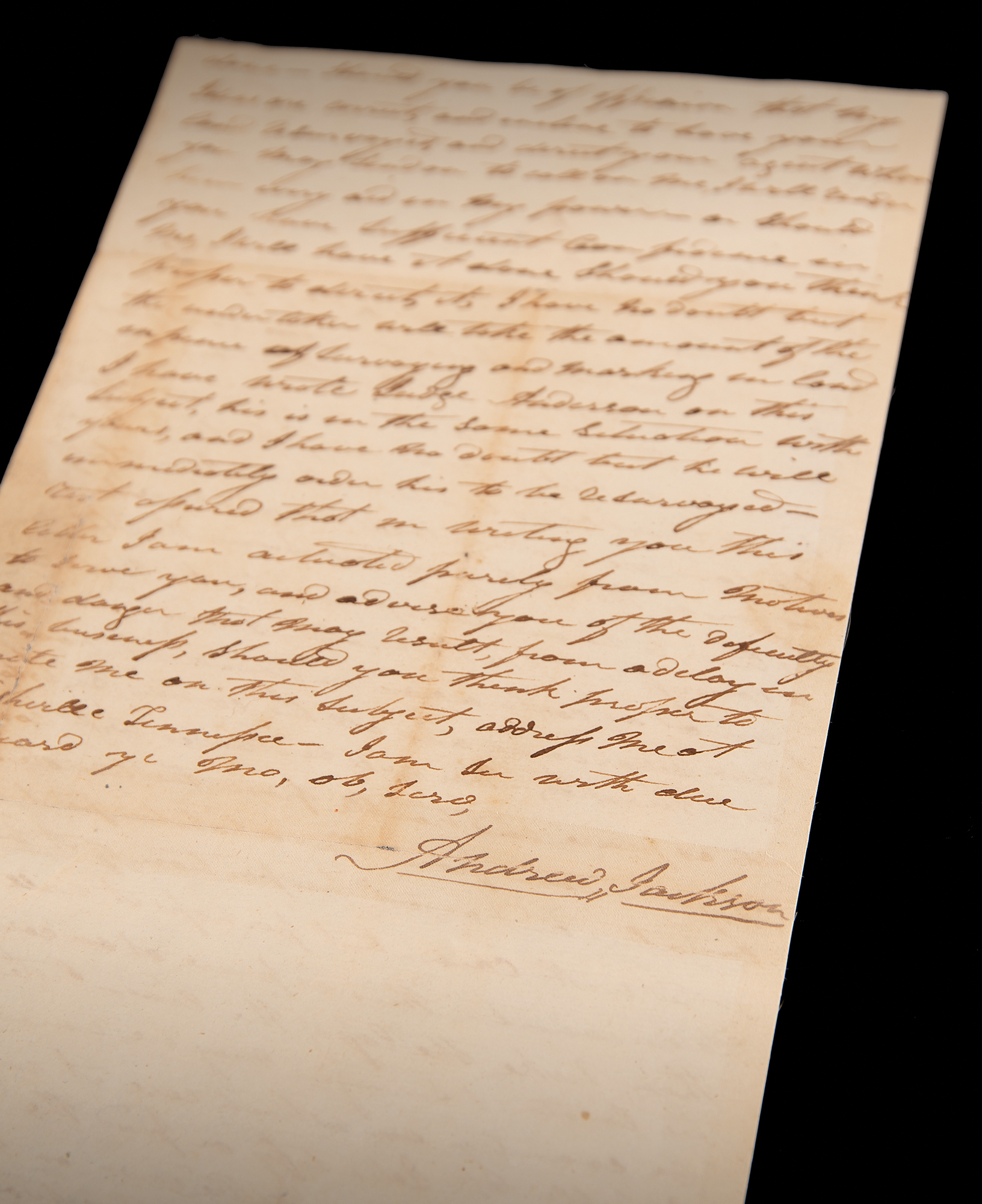
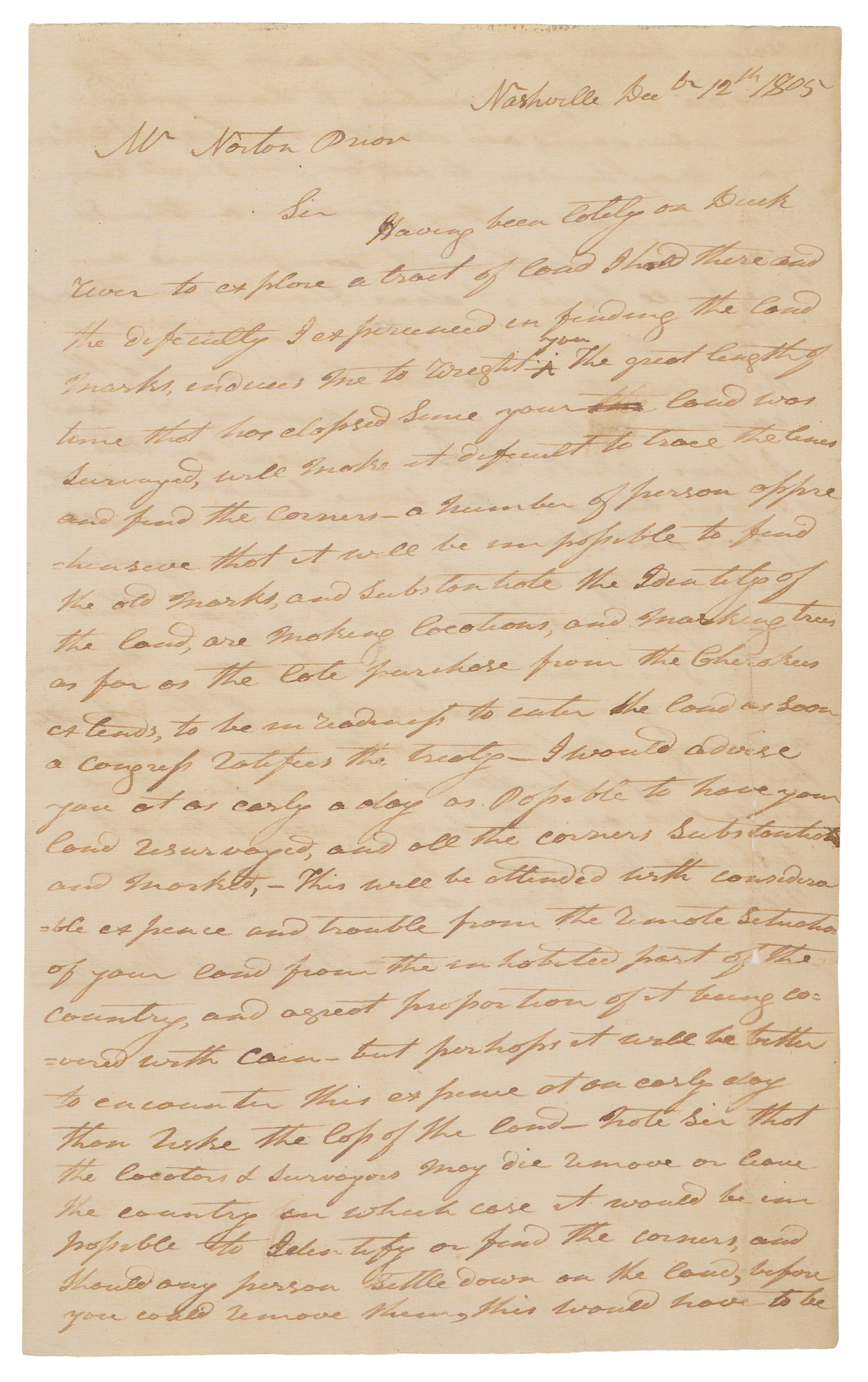
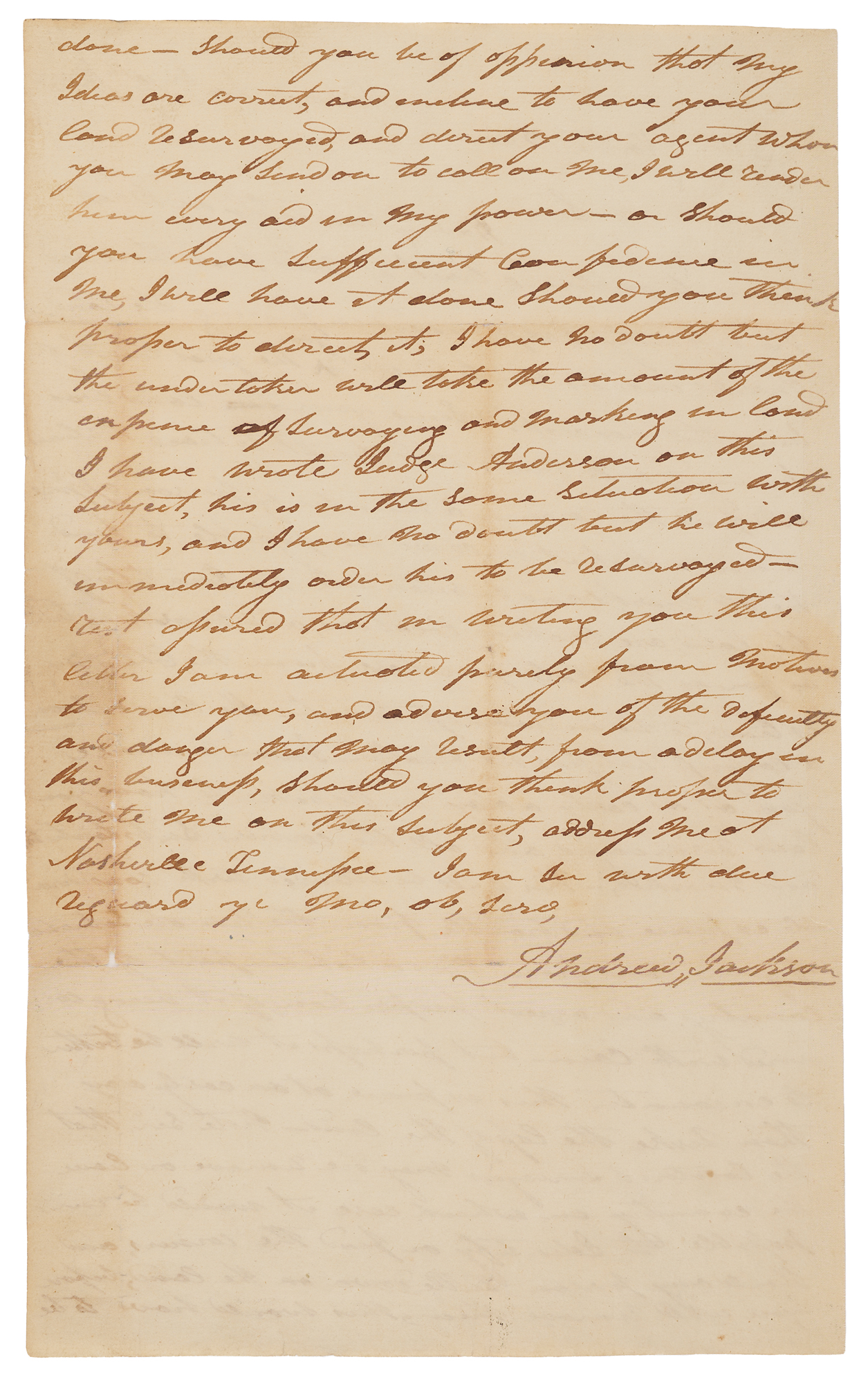
ALS, signed "Andrew Jackson," one page both sides, 7.5 x 12.25, December 12, 1805. Handwritten letter to Norton Prior, touching upon early American land speculation and a recently concluded treaty with the Cherokee. In full: "Having been lately on Duck River to explore a tract of land I hold there and the difficulty I experienced in finding the landmarks, induces me to write you. The great length of time that has elapsed since your land was surveyed, will make it difficult to trace the lines and find the corners. A number of persons observe that it will be impossible to find the old marks and substantiate the identitys of the land, are marking locations and marking trees as far as the late purchase from the Cherokees extends, to be in readiness to enter the land as soon as Congress ratifies the treaty. I would advise you at as early a day as possible to have your land resurveyed, and all the corners substantiated and marked. This will be attended with considerable expense and trouble from the remote sections of your land from the inhabited part of the country, and a great proportion of it being covered with corn but perhaps it will be better to encounter this expense at an early day than make the loss of the land.
Note sir that the locators and surveyors may die, remove or leave the county in which case it would be impossible to identify or find the corners, and should any person settle down on the land before you could remove them, this would have to be done. Should you be of apprehension that my ideas are correct, and incline to have your land surveyed, and direct your agent whom you may send on to call on me, I will render him every aid in my power—or should you have sufficient confidence in me, I will have it done. Should you think proper to direct it, I have no doubt but the undertaking will take the amount of the expense of surveying and marking in land. I have wrote Judge Anderson on this subject, his is in the same situation with yours, and I have no doubt that he will immediately order his to be surveyed. Rest assured that in writing you this letter, I am acting purely from motives to serve you, and advise you of the difficulty and danger that may result from a delay in this business. Should you think proper to write me on this subject, address me at Nashville, Tennessee." In very good to fine condition, with a tear along the right edge, repaired and reinforced by complete archival silking to the both sides. Accompanied by a custom-made quarter-morocco presentation folder.
On October 25, 1805, the Cherokees surrendered a large tract north of the Duck River, spanning over 7,000 square miles in Tennessee and over 1,000 square miles in present-day Kentucky, and granted the U.S. the right to establish a 'free use of a road' (part of the Federal Road) through Cherokee country, connecting Georgia to Tennessee. The Duck River, which Jackson refers to having recently visited, is the longest river located entirely in Tennessee.
In his History of Andrew Jackson, A. C. Buell writes: 'The Cherokees…had from time immemorial claimed Tennessee as their hunting-ground….the Indians observed a kind of traditional law or usage, by virtue of which certain regions were set apart as hunting-grounds, in which no permanent villages should be established, and no habitation built more substantial than the camps of hunters; a sort of primitive 'game-law' which their mode of living made absolutely necessary to self-preservation. Therefore an occupation of their hunting-grounds was resented and resisted quite as bitterly as an attack on their villages. The Cherokees east of the mountains had long been subdued. But their Western brethren were wild and ferocious as ever…the Cherokees were the more numerous; the Chickasaws the more enterprising, or rather the more implacably hostile…were represented in the warfare waged against the Tennessee settlements. The total number…at the end of the Eighteenth Century, has been estimated at…20,000 Cherokees….
When Jackson arrived in Tennessee the practical situation was an effort on the part of, say, 60,000 Indians to drive out or exterminate 5,000 or 6,000 settlers. The available fighting strength of the Indians was one to every seven or eight of the total in tribes that had not been much at war with the whites, and one to every ten or eleven in tribes that had lost a good many of their braves in battle. The Southern Indians at that time had not been much punished by warfare with the white race and their fighting strength was at the maximum. It is, therefore, safe to say that they could muster at least 7,000 warriors at any time between 1780 and 1794; and that a considerable part of this force was on the warpath all the time against the Tennessee settlements, having not more than 5,000 to 10,000 people at any time during that period.'
The Western Americana auction of Jochen Zeitz.

This item is Pre-Certified by PSA/DNA
Buy a third-party letter of authenticity for
$150.00
*This item has been pre-certified by a trusted third-party authentication service, and by placing a bid on this item, you agree to accept the opinion of this authentication service. If you wish to have an opinion rendered by a different authenticator of your choosing, you must do so prior to your placing of any bid. RR Auction is not responsible for differing opinions submitted 30 days after the date of the sale.

