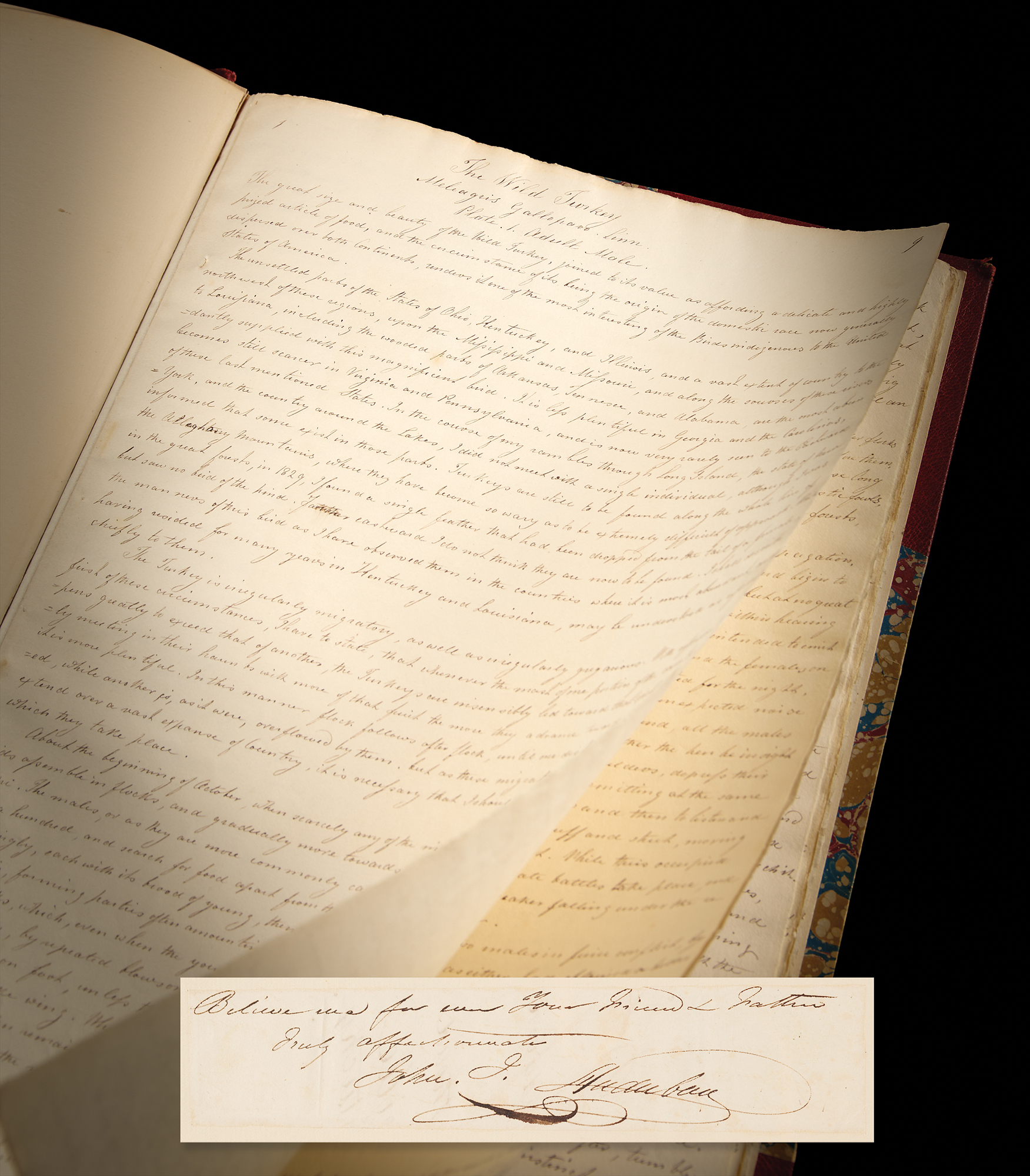
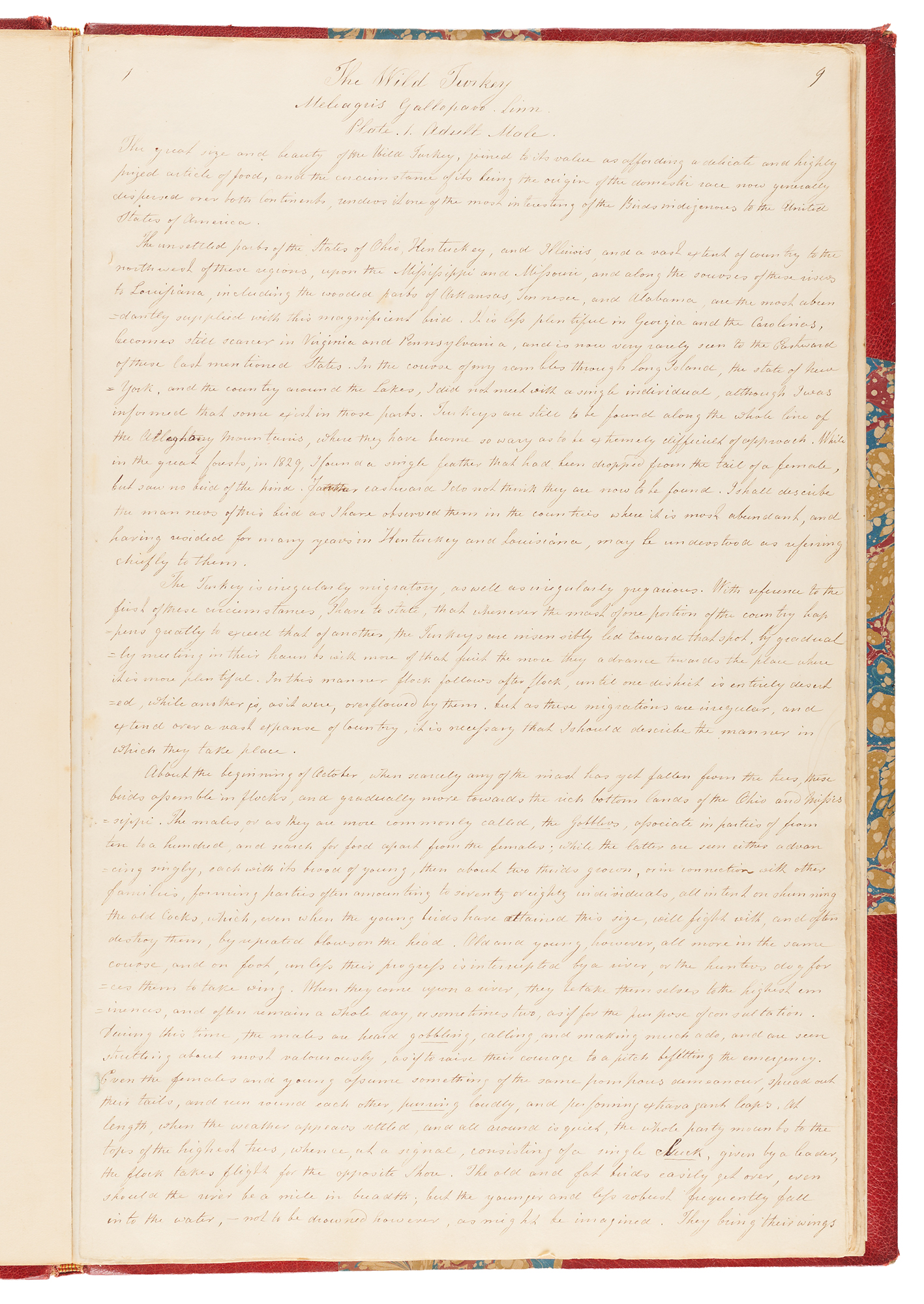
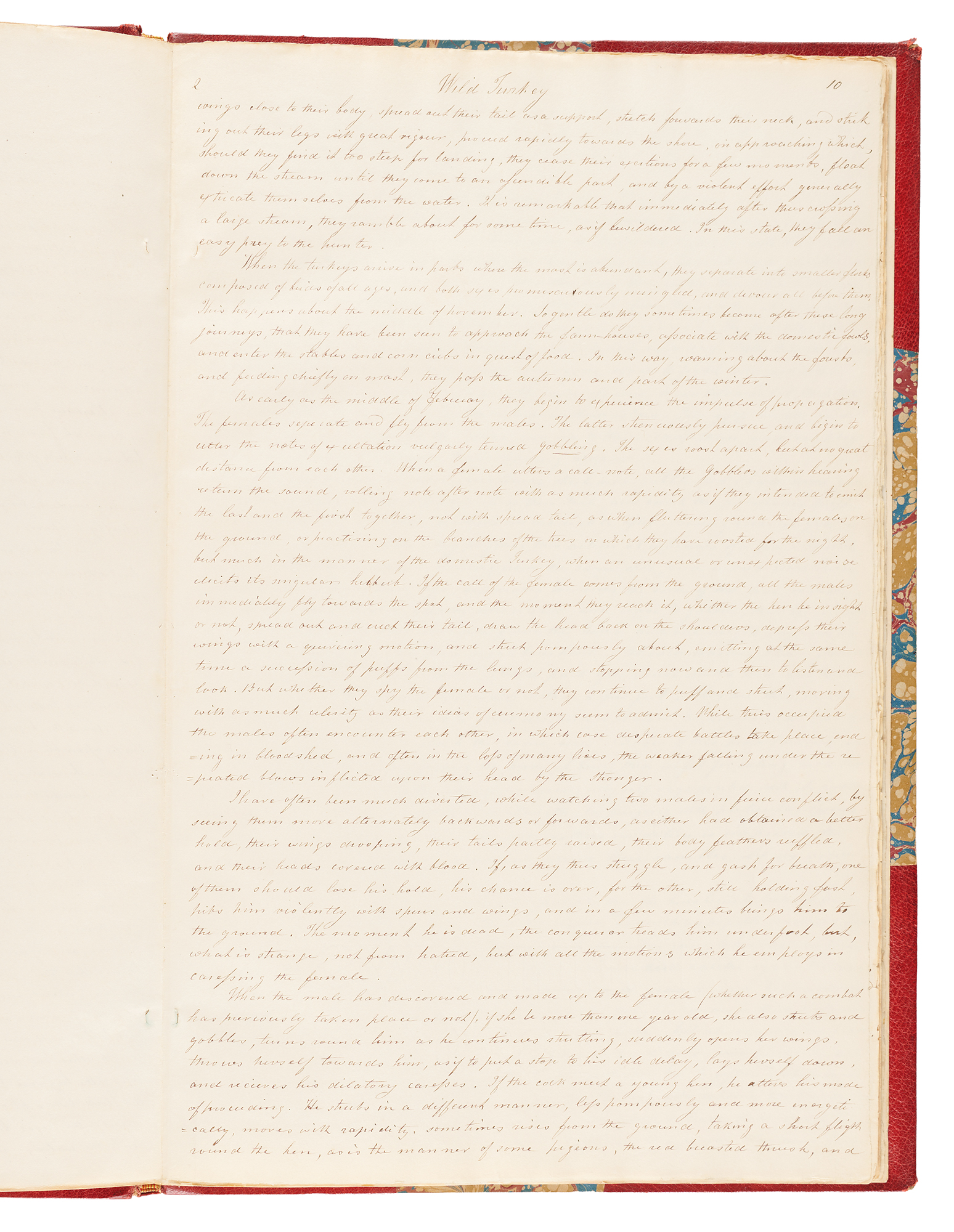
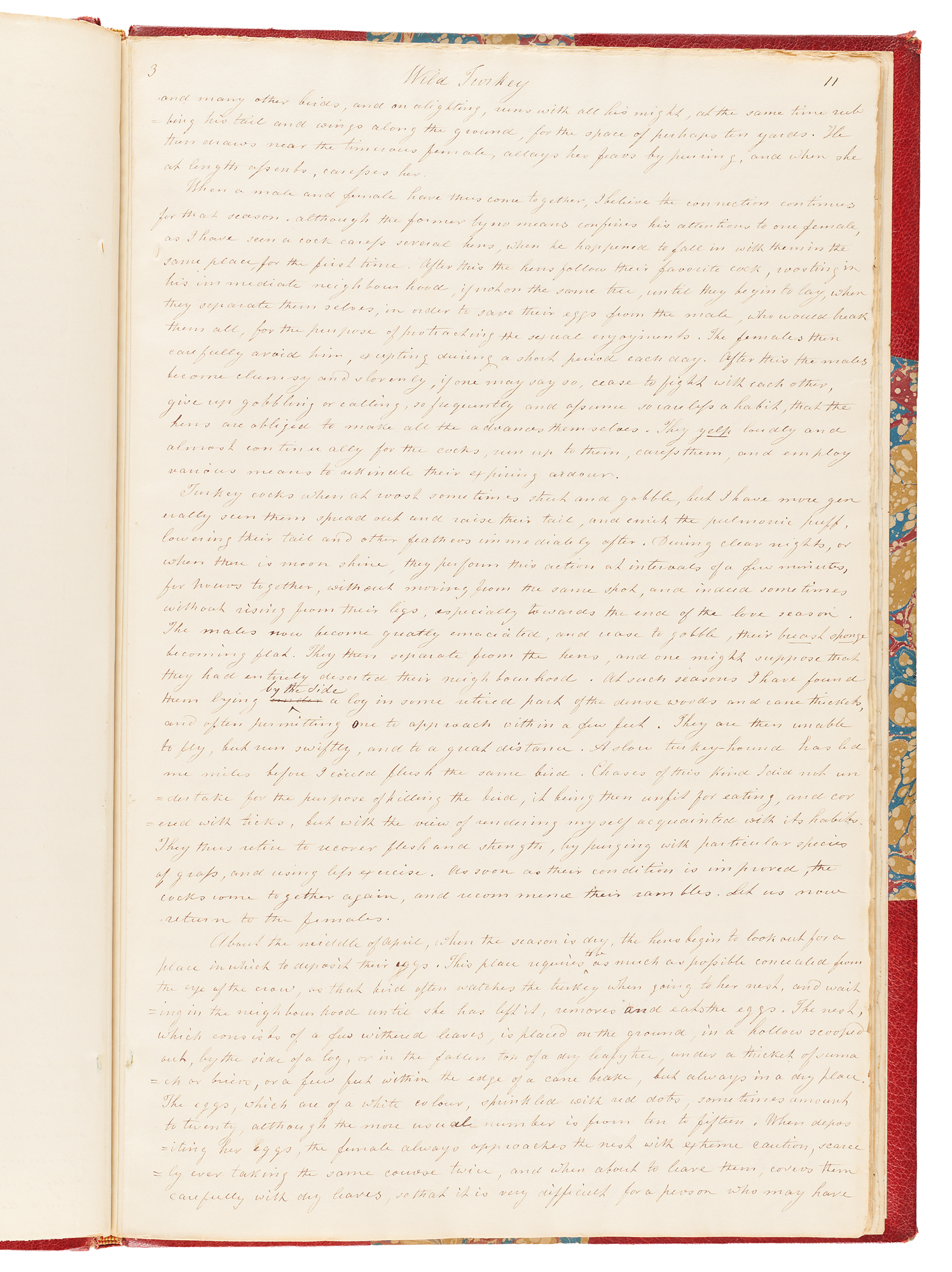
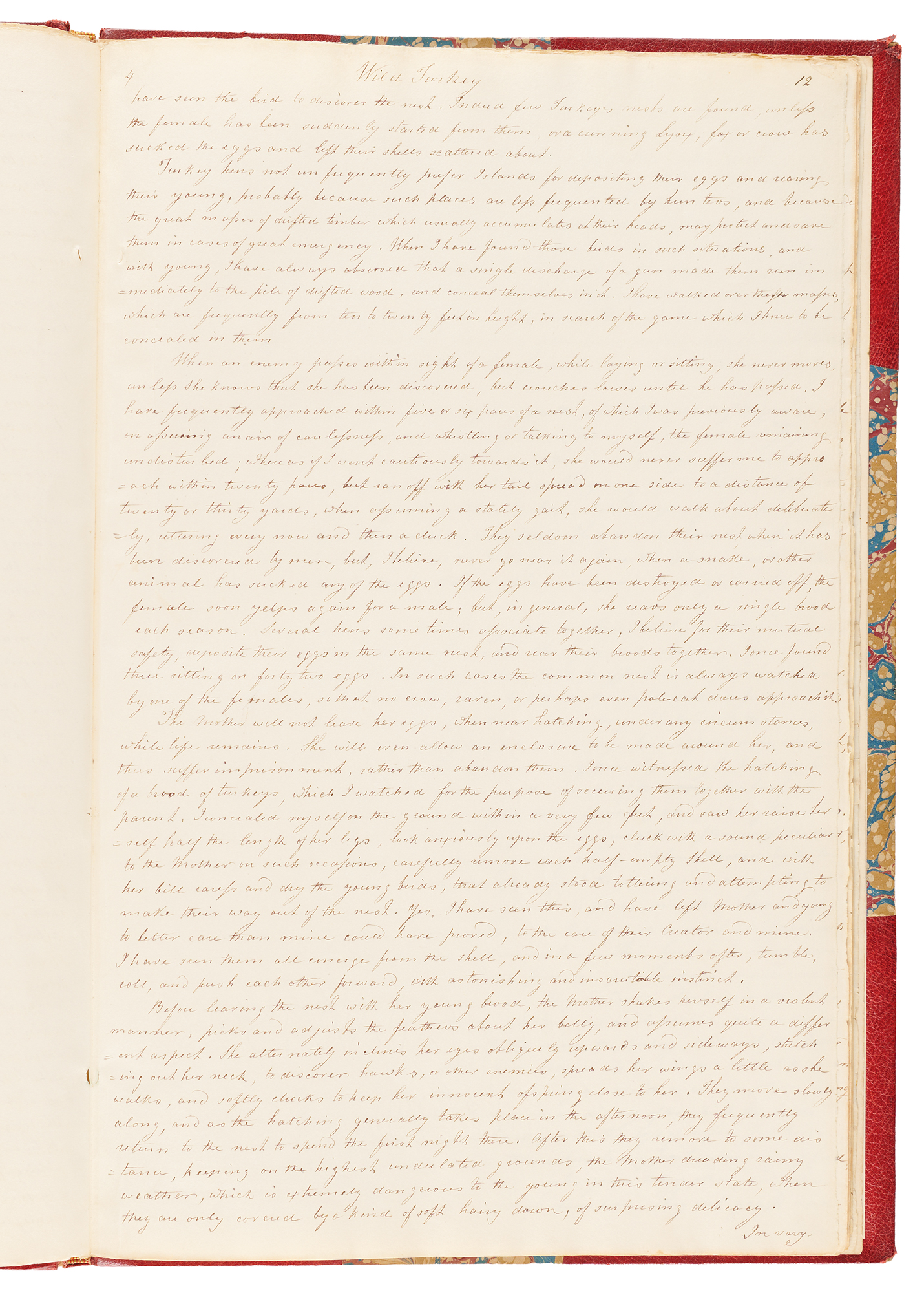
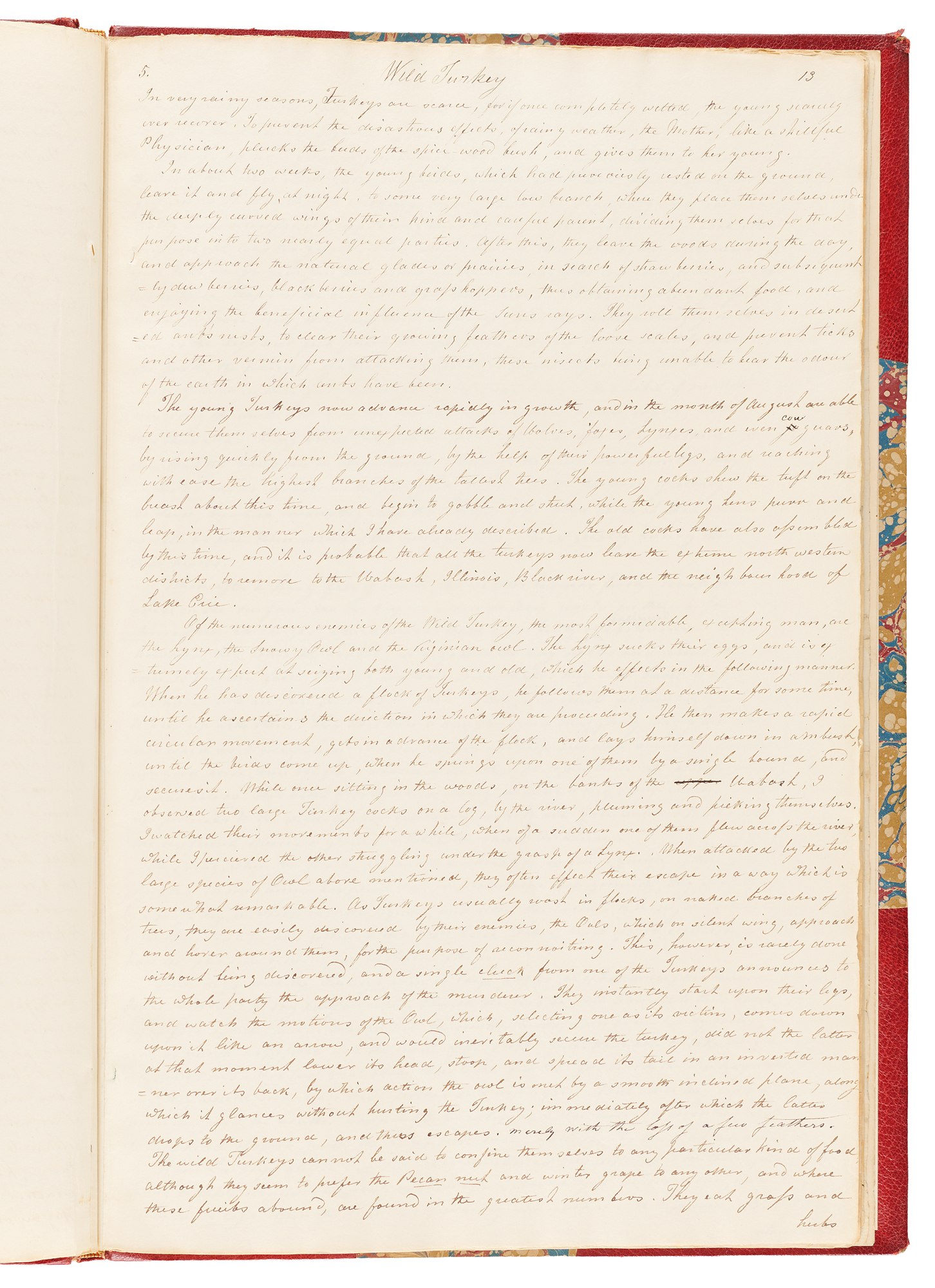
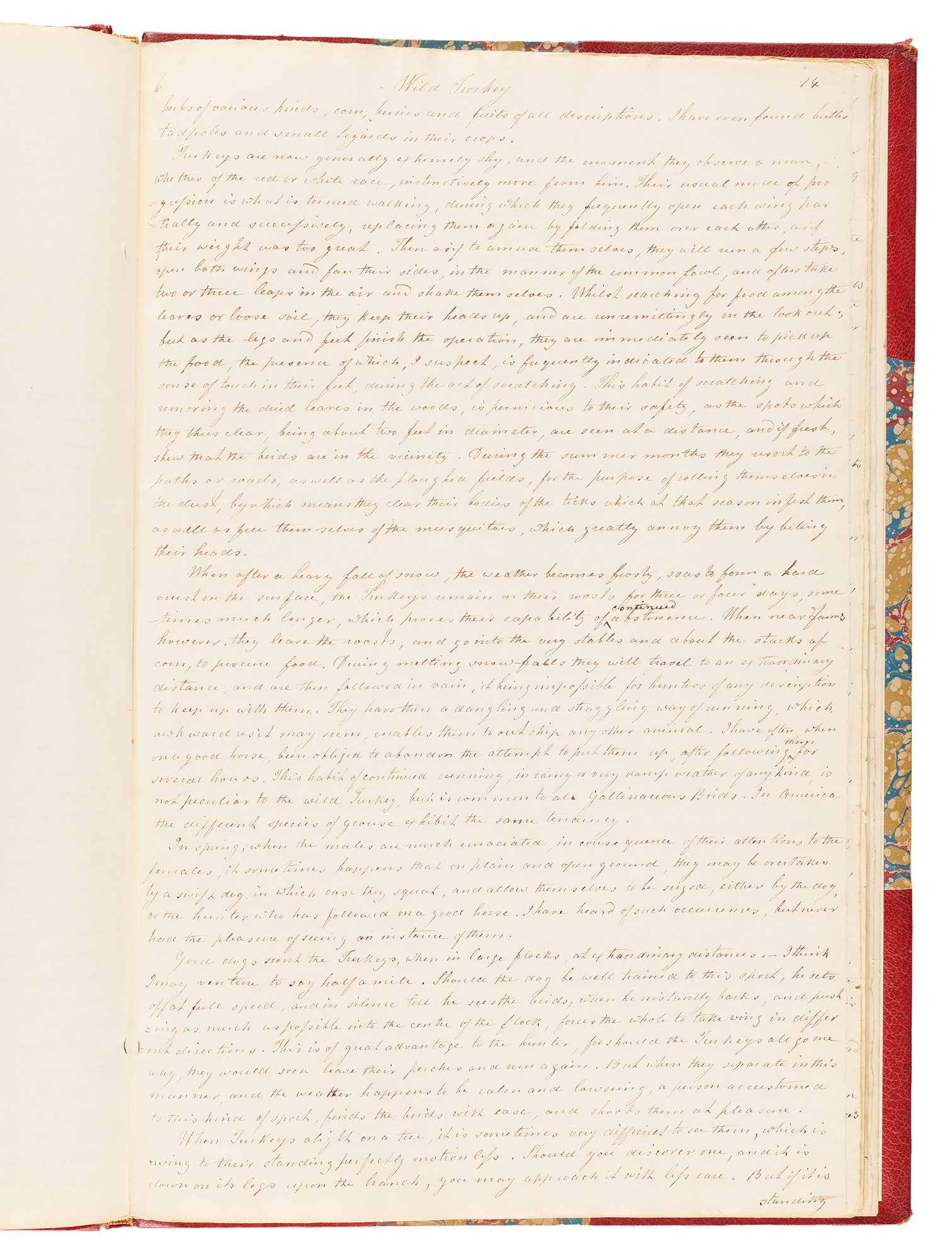
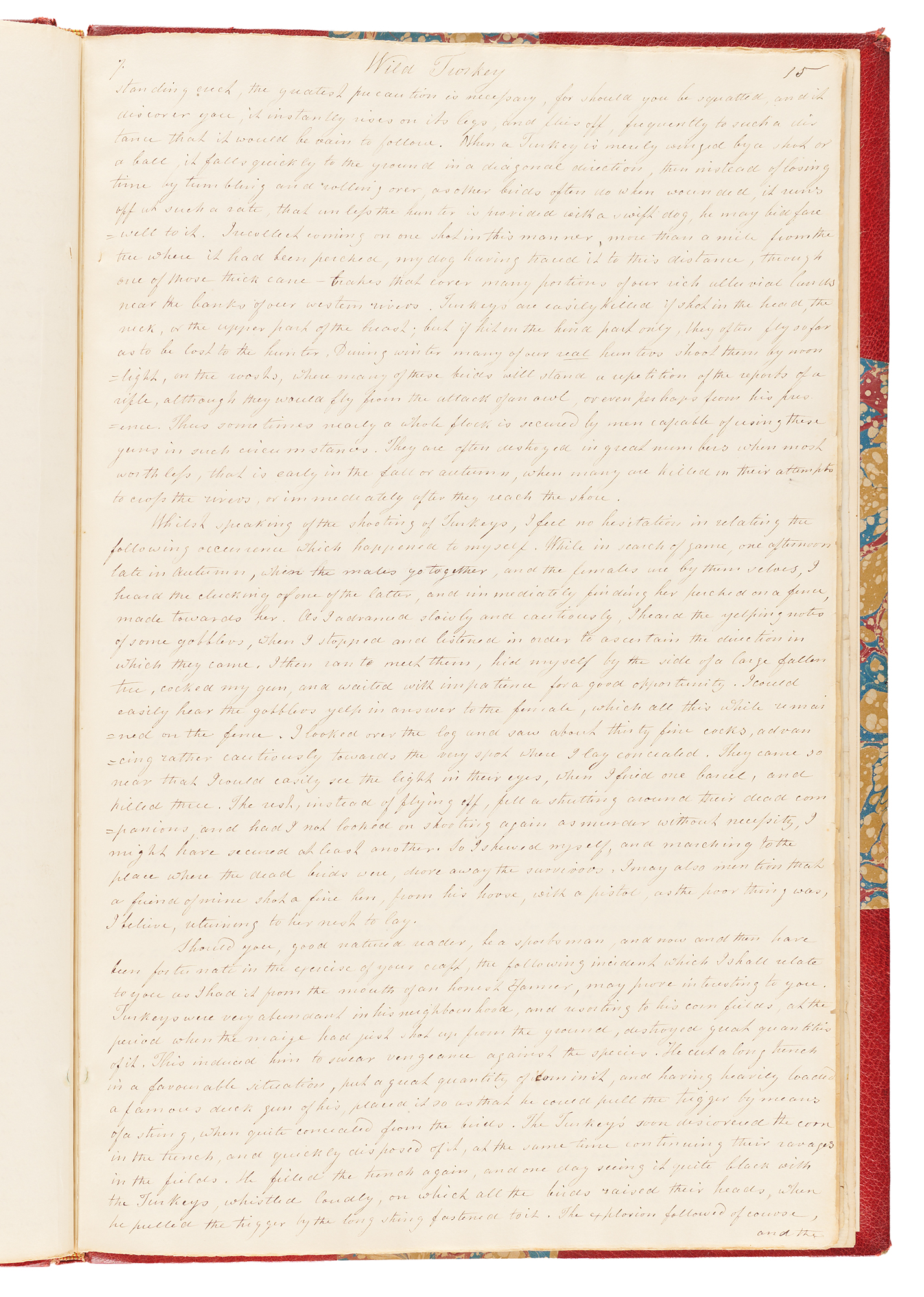
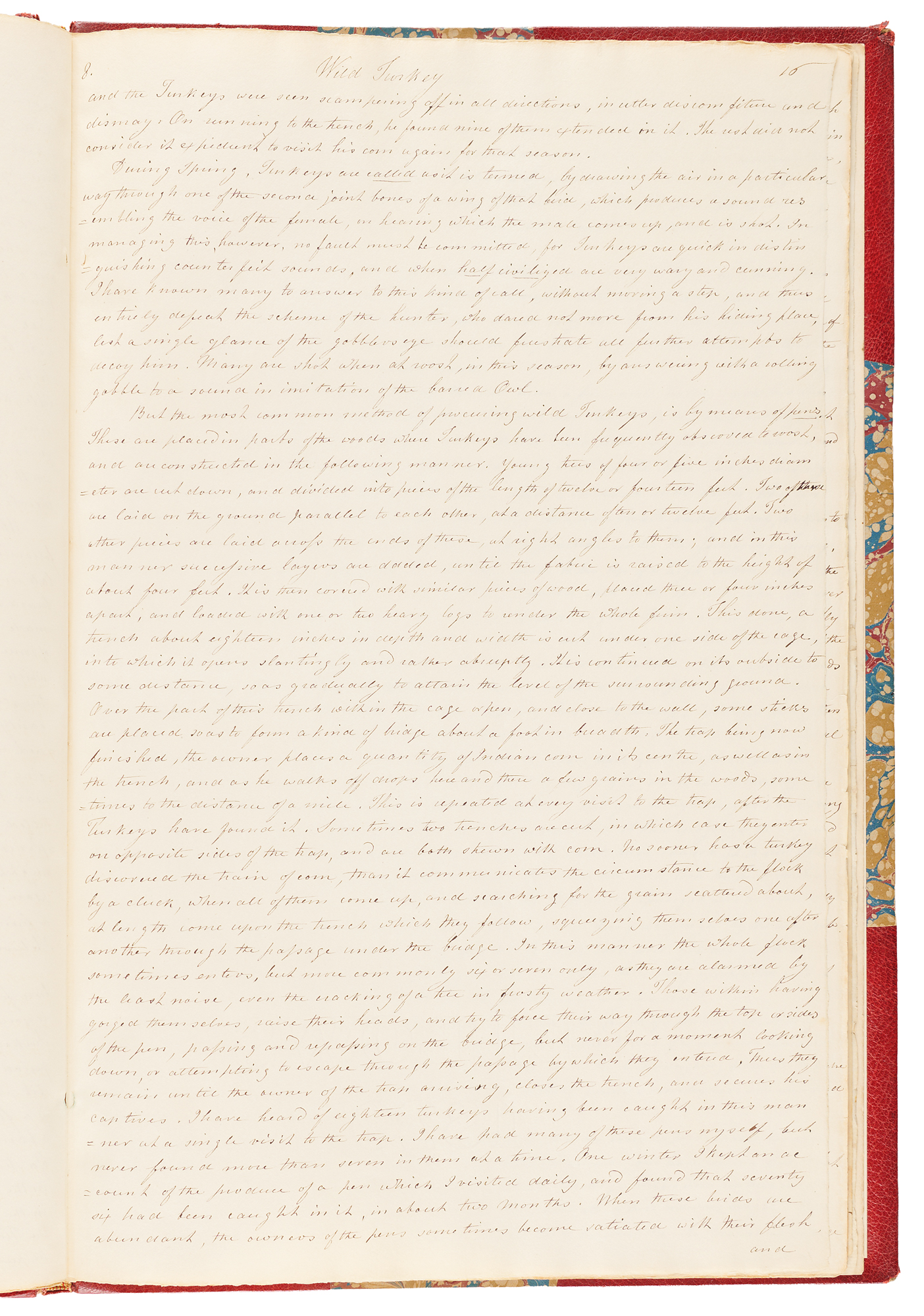
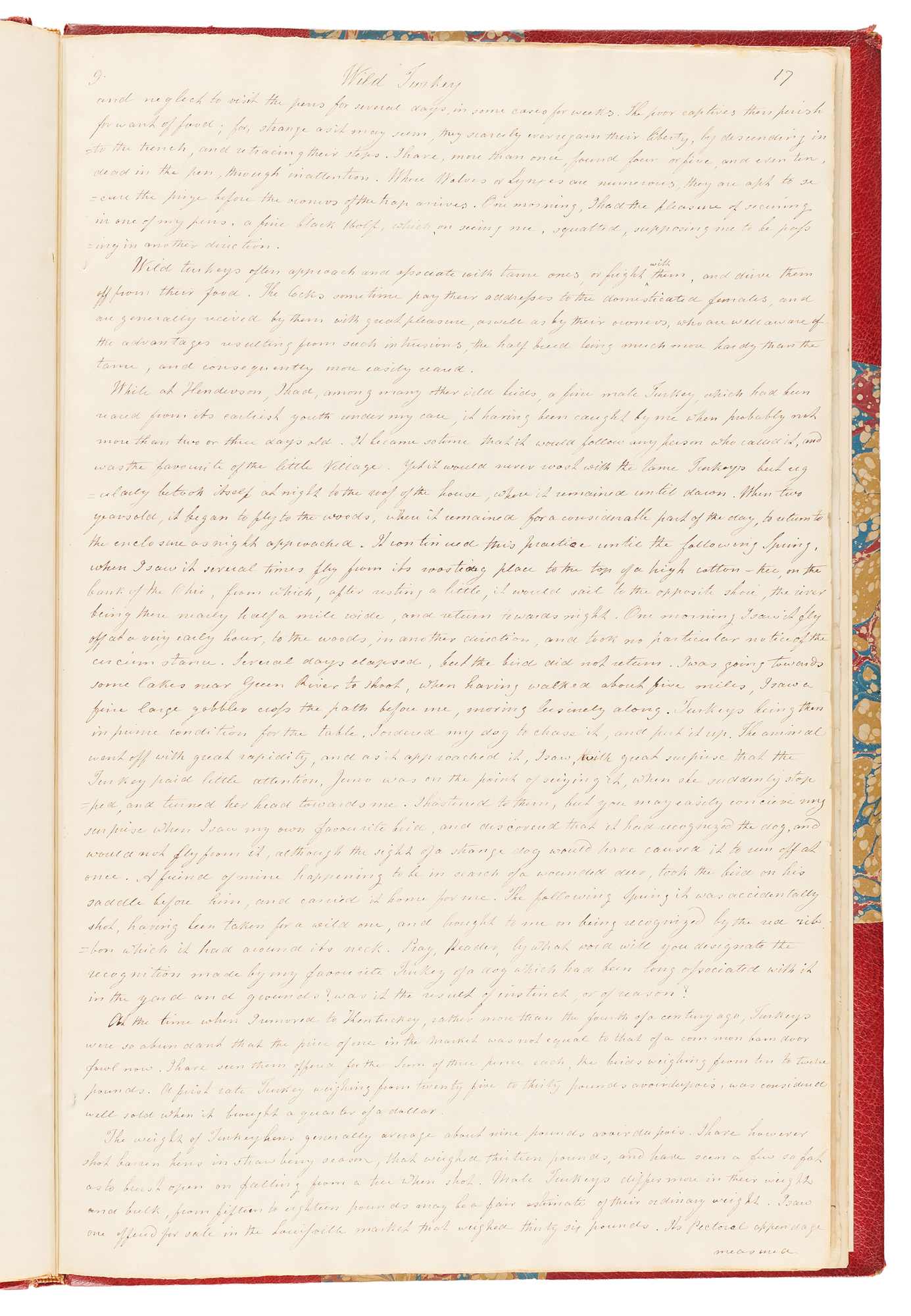
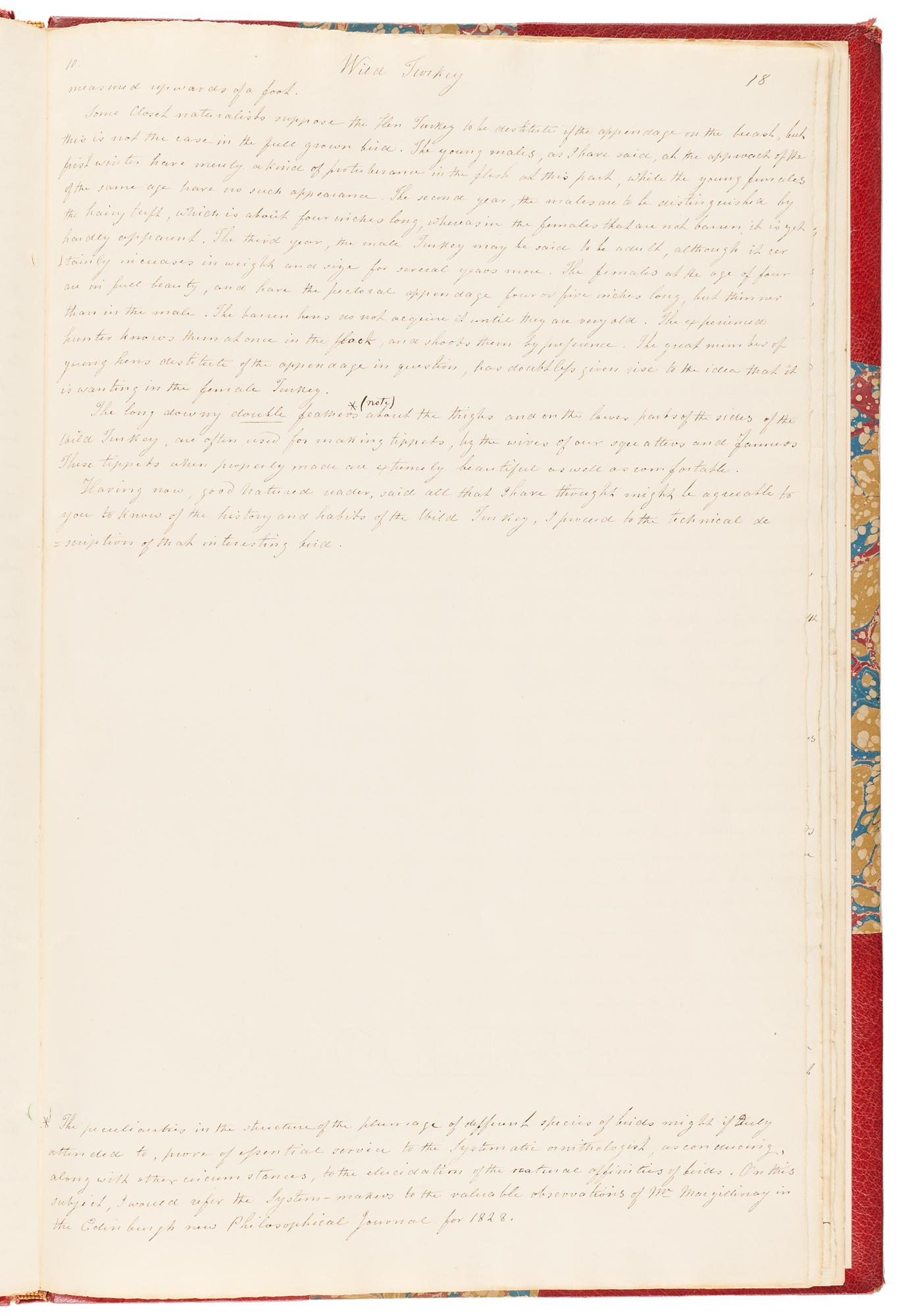
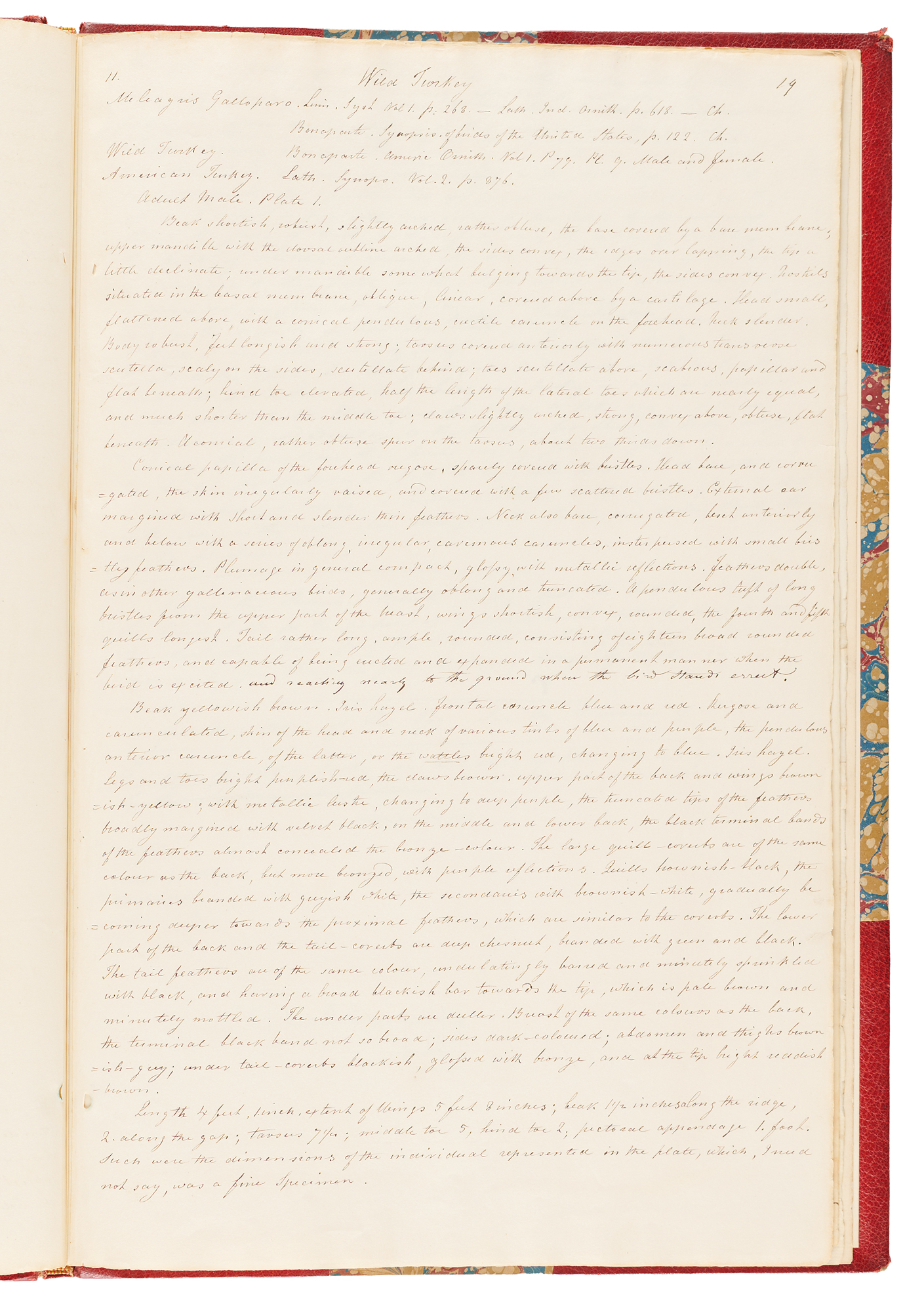
Six pages of John J. Audubon's handwritten working draft on the "Wild Turkey," penned on four 10.25 x 16.25 sheets, portions of which were incorporated into his description of the bird published in his 'Ornithological Biography' of 1831. The fragmentary draft contains fascinating commentary on the wild turkey's appearance, habits, and behavior, as well as advice for trapping and hunting.
Audubon writes, in part: "The usual gate of the Turkey is a walk, during which time it frequently opens each wing…During the summer months Turkeys seek the paths on roads & the plowed fields for the purpose of wallowing in the dust by which means they clean their bodies from the Ticks that at that season infect them…The eggs of the wild Turkey are delicate…The enclosures that are made to entrap wild Turkeys are called Pens–they are placed in such parts of the woods where a flock or flocks of Turkeys have been observed…
Whilst at Henderson I had among many other wild birds a fine Male Turkey, raised from its earliest youth under my care, I had caught it when probably only 2 or 3 days old—it grown well and so tame that he would follow any person who called it and became the favourite of the little village…One morning I saw it fly off very early toward the wood…Several days elapsed but the bird did not return. I went toward some lakes near Green River to shoot when having walked about 5 miles I saw a fine large Male Turkey cross the path before me moving leisurely along—Turkey being at that season in best order for the table, I ordered my dog to chase it and put it up—The animal went off with great rapidity, and I saw it near the Bird with surprise as I observed this latter paying but little attention to him. Juno was on the point of seizing it when she suddenly stop'd & turned her head towards me, as I saw my own favourite Bird and discovered that it has known the Dog at a glance and would not fly from it although the sight of a strange one would have caused it to run off at once…The following spring it was accidentally shot being taken for a wild one & brought to me on being recognized by the red ribbon it had round its neck…
The Flight of this bird is powerful & swift, it is composed of strong flapping that would at first induce the observer to think that the wild Turkey could not easily raise to the tall tops of our largest forest trees, but no sooner as the bird left the ground which it does with a great spring of its powerful legs than it raises with velocity and thus ascends to the highest branches…
Turkeys when alighted on a tree are sometimes very difficult to be seen, they stand so still that no clue of their position is granted to the hunter.—Should you discover it, and it is down on its legs on the branch, you may approach with less care, but if it is standing erect the greatest precaution is necessary…When a Turkey is merely winged by a shot or a ball it falls in such quick manner…the bird on reaching the ground instead of loosing time by tumbling & rolling over and about as other wounded birds often do, the Turkey makes ample usage of its long & powerful legs and runs off."
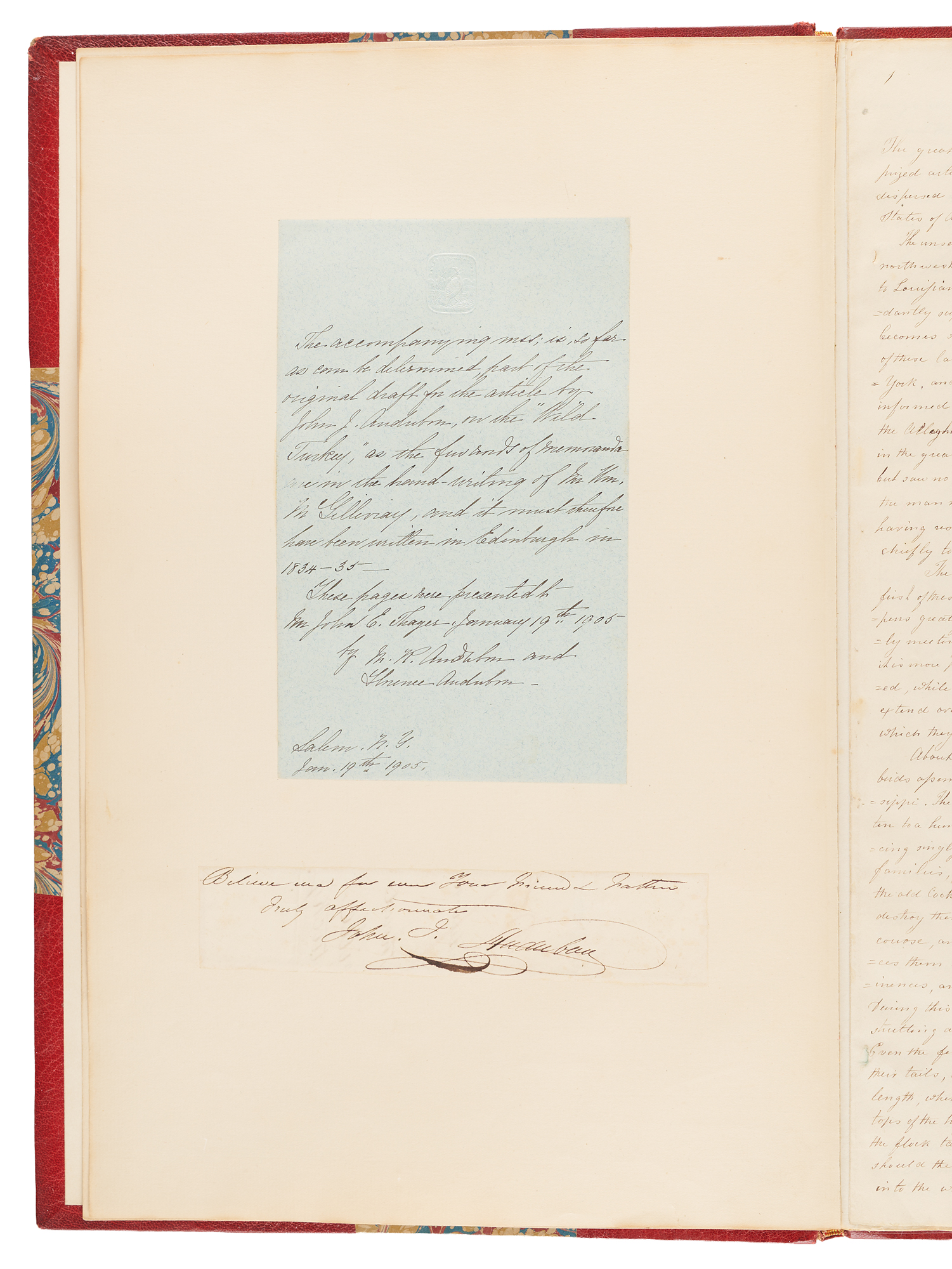
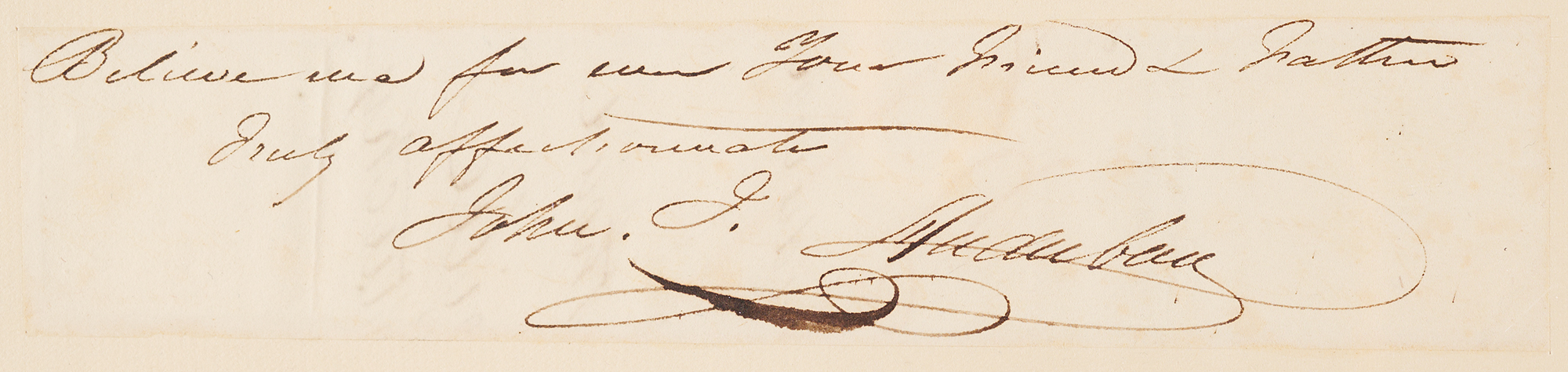
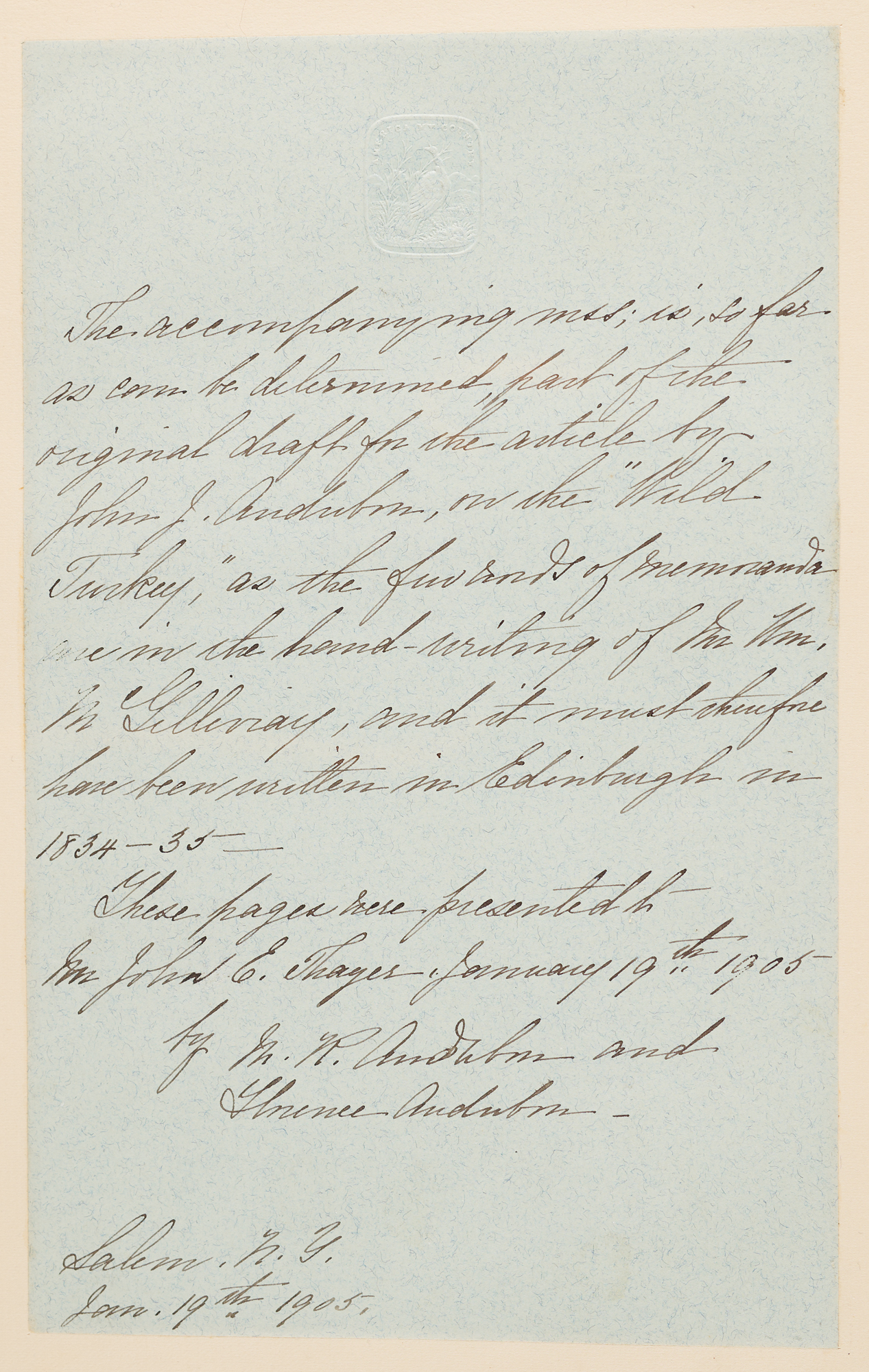
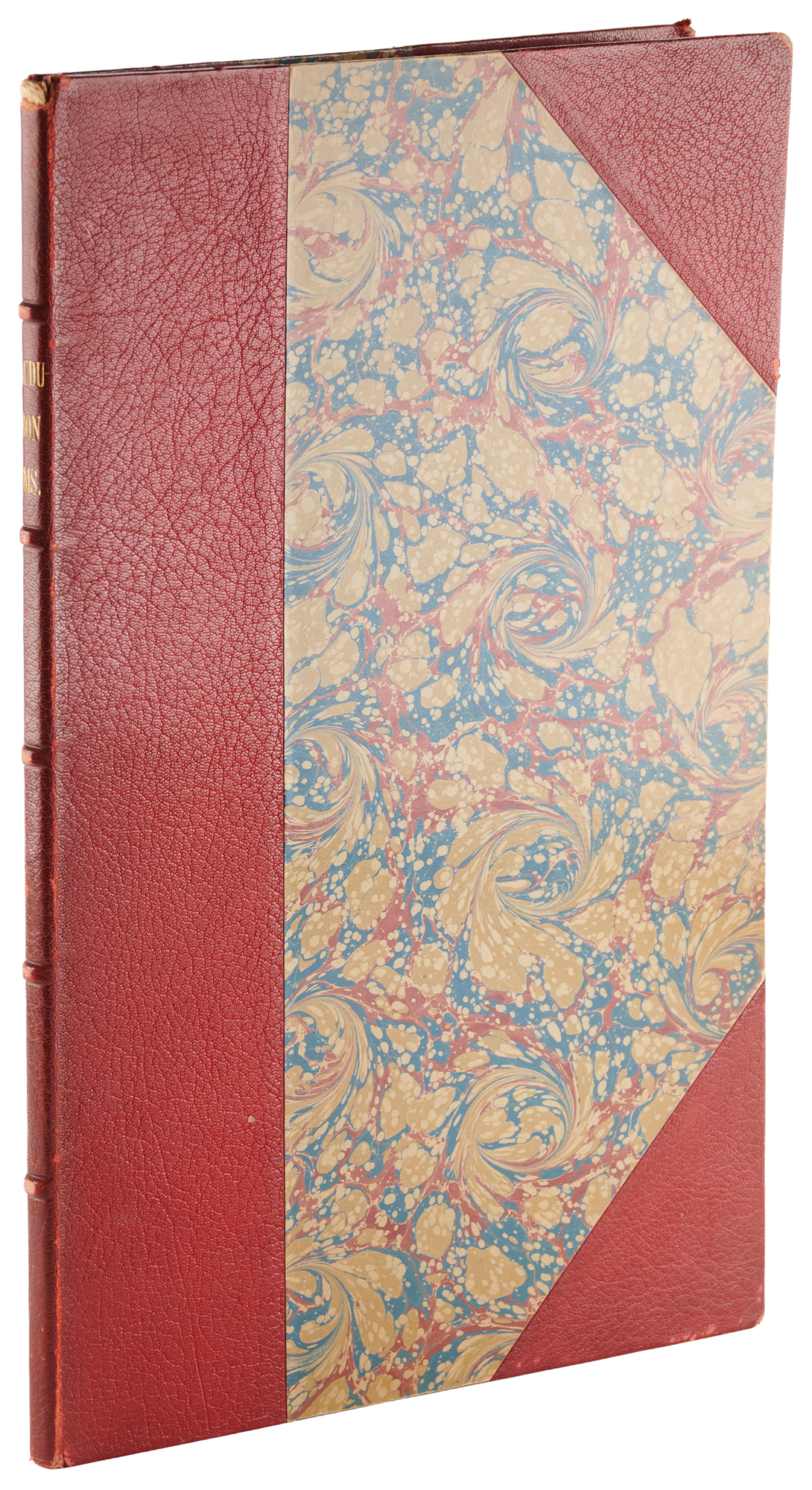
Three of the manuscript pages are bound in three-quarter morocco with marbled boards, along with a clipped signature, "Believe me for ever Your Friend & Father, Truly affectionate, John J. Audubon," a brief presentation letter from 1905 ("The accompanying MSS; is, so far as can be determined, part of the original draft for the article by John J. Audubon, on the 'Wild Turkey'"), and an eleven-page transcript of Audubon's final draft, penned in an unknown hand. In fine condition, with some light staining.
Audubon’s detailed commentary on the Wild Turkey reflect the themes he later polished in his Ornithological Biography (the textual companion to his monumental The Birds of America, 1827–1838) and reveal how he combined empirical observation with narrative flair to bring North American bird life to an eager public. Audubon’s choice of the bird as the very first plate in The Birds of America reflects both his personal affinity for this native species and its symbolic importance in early America—so much so that Benjamin Franklin and Audubon himself championed the turkey as a more fitting U.S. emblem than the bald eagle. The manuscript’s vivid reflections on trapping, seasonal habits, and a beloved tamed bird also illustrate the naturalist’s immersive approach: he lived closely with his subjects and recorded not just measurements but the lived experience of wildlife on the early American frontier.

This item is Pre-Certified by PSA/DNA
Buy a third-party letter of authenticity for
$100.00
*This item has been pre-certified by a trusted third-party authentication service, and by placing a bid on this item, you agree to accept the opinion of this authentication service. If you wish to have an opinion rendered by a different authenticator of your choosing, you must do so prior to your placing of any bid. RR Auction is not responsible for differing opinions submitted 30 days after the date of the sale.
Third-party authentication service applies only to signatures and handwriting, and does not cover the addition of sketches, artwork, musical quotations, etc.

