Sold For $3,163
*Includes Buyers Premium
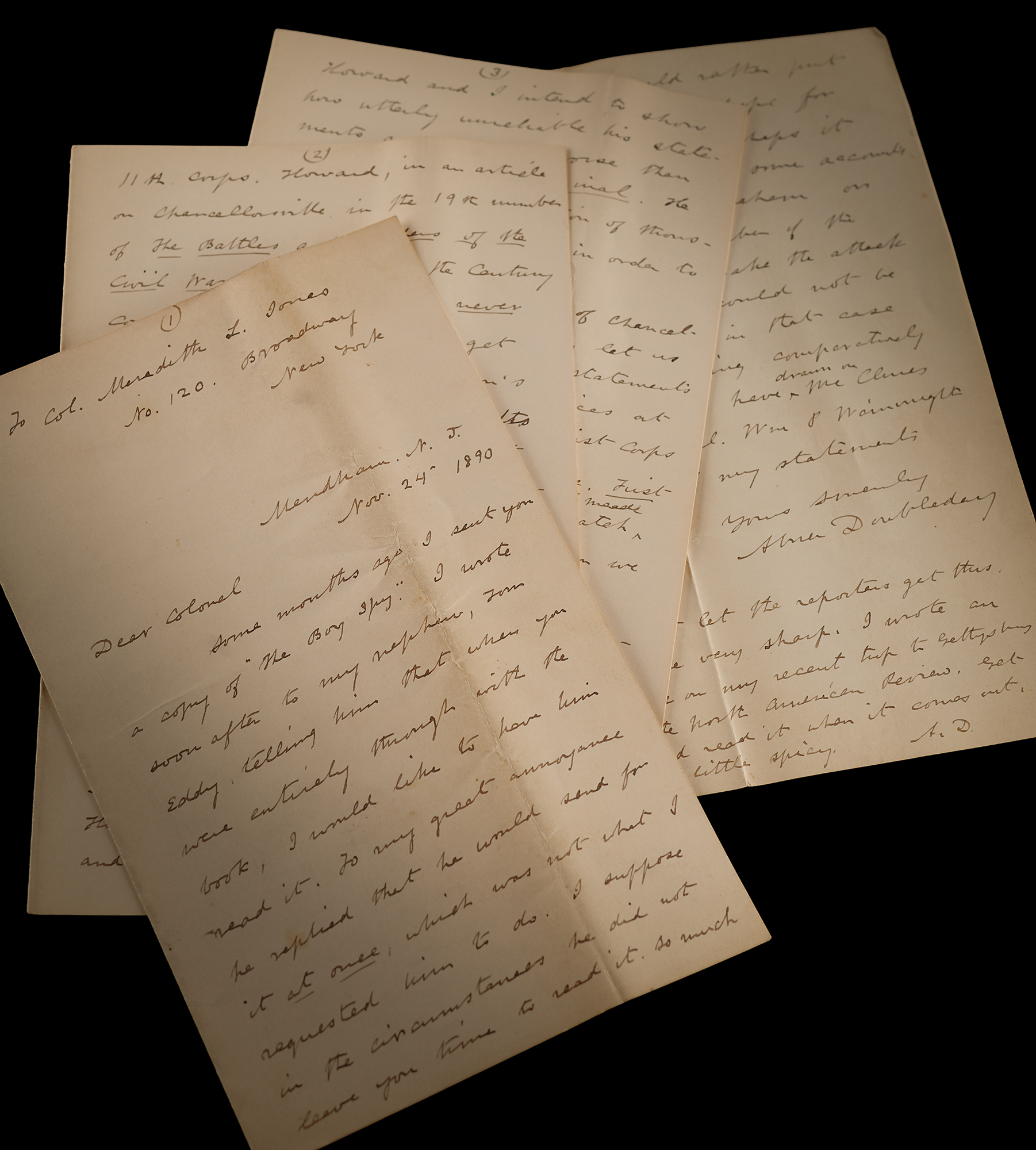
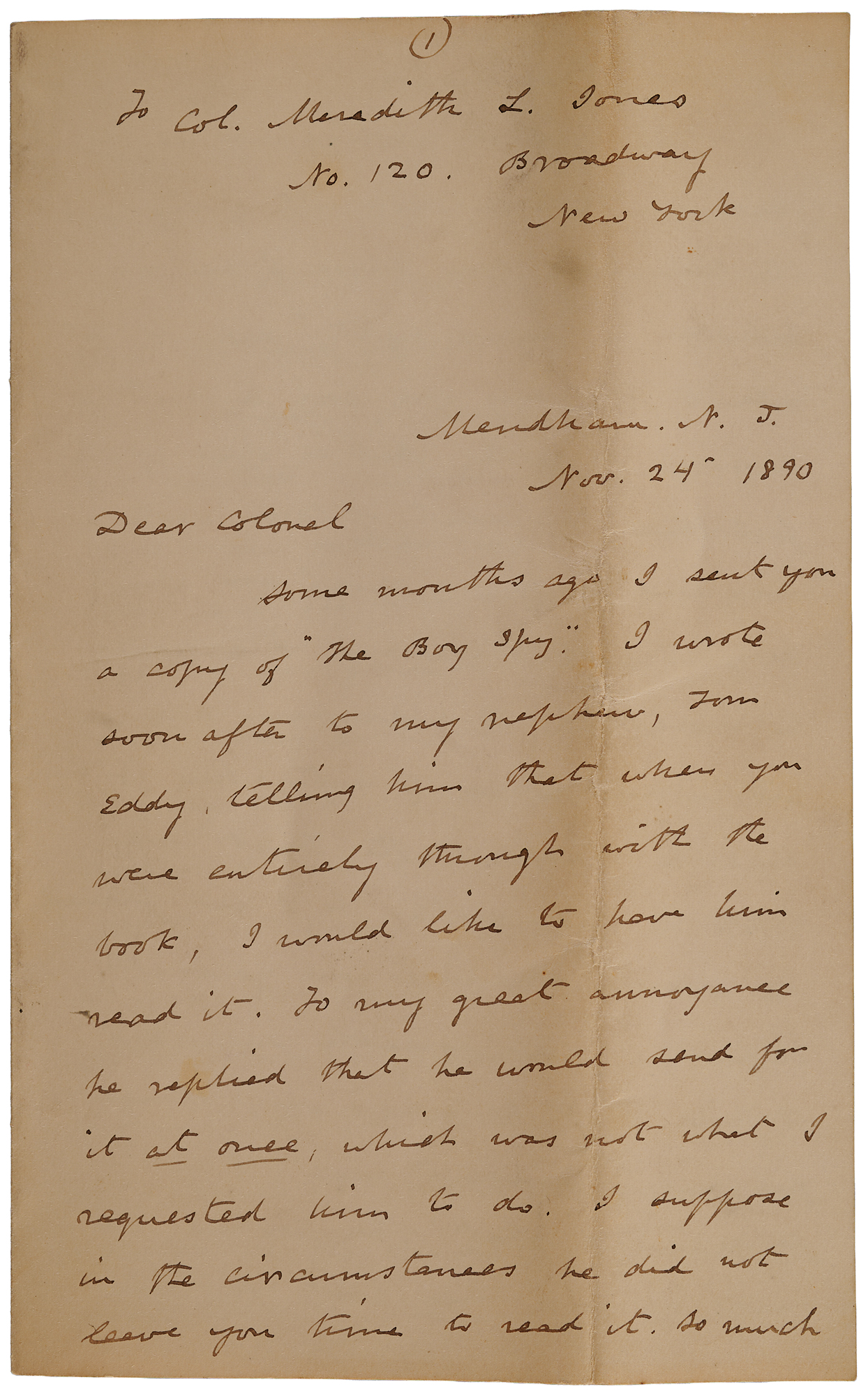
ALS, fourteen pages, 5 x 8, November 24, 1890. Addressed from Mendham, New Jersey, a lengthy handwritten letter to Union Colonel Meredith L. Jones, who served under Doubleday in the First Corps. In it, Doubleday offers a controlled but impassioned indictment of Oliver O. Howard for what he viewed as false and self-serving accounts of Chancellorsville and Gettysburg. The letter, in part: “My object in writing now is to give you a brief account of my trip to Gettysburg. You know, I am no believer in ‘divine right’ and do not admit that anyone can inherit a kingdom by birth. But the view of the fact that the Count of Paris wrote a long history of our Civil War, which he will probably revise, I expected the invitation to accompany him in his private train to Gettysburg to explain the part the First Corps took in the battle. As I had formed the idea that princes are generally stupid, I was agreeably surprised to find that he was a very thoughtful and intelligent man. I took it for granted that other parties had made up as huge work for him, and that he had simply put his name to it, but he was too well acquainted with details to justify such a belief, and he assured me that he had personally edited all the volumes.
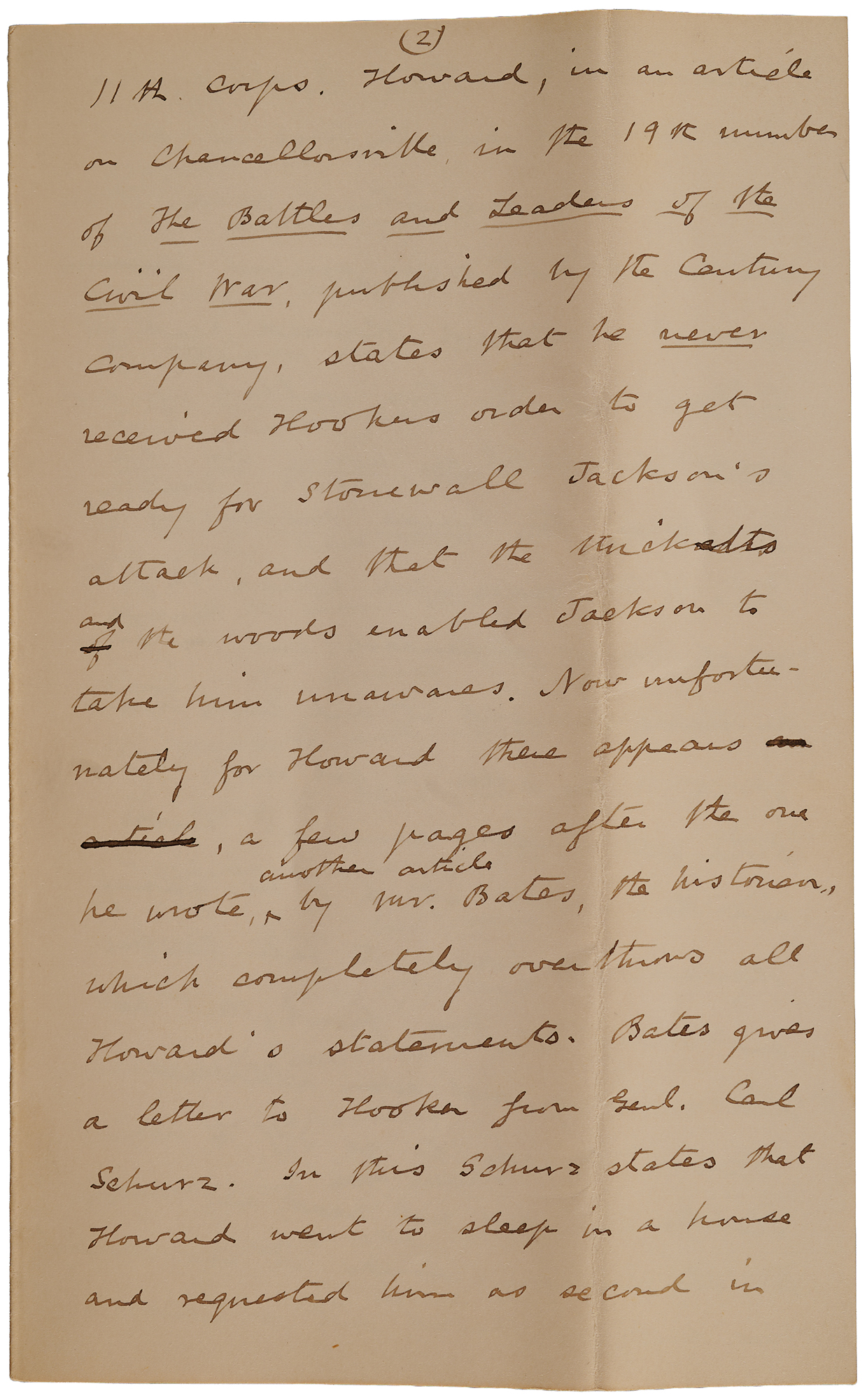
I found General [Oliver Otis] Howard seated opposite the group of Frenchmen and endeavoring to impress them and the Count with the excellence of his generalship, and trying to do away with the facts stated in my book. I could've controverted his statements, but did think it would be very seemly to have anything in the way of an altercation in presence of the foreigners. At the same time, I did not think I ought to maintain silence in the midst of so many misstatements. So I compromised the matter by writing a letter to the count, justifying my printed statements. This I handed to Colonel Parseval, who is a great strategist and who I thought accompanied the Count as a kind of military critic. The colonel was much interested not only in this, but in my pamphlet on Gettysburg published about a year ago by the Century Company. I think I sent you a copy of this last. In the paper referred to, I dissected Howard's account of Chancellorsville and exposed the glaring falsehoods in which it abounds. It goes without saying that the defeat of our army and that battle was caused by the shock and surprise of Jackson's force, which caused the other route of the 11th Corps.
Howard, in an article on Chancellorsville in the 19th number of The Battles and Leaders of the Civil War, published by the Century Company, states that he never received [Joseph] Hooker’s order to get ready for [Thomas J.] Stonewall Jackson's attack, and that the thickets and woods enabled Jackson to take him unawares. Now, unfortunately, for Howard, there appears a few pages after the one he wrote, another article by Mr. Bates, the historian, which completely overthrows all Howard’s statements. Bates gives a letter to Hooker from Genl. Carl Schurz. In this, Schurz states that Howard went to sleep in a house and requested him as second in command to attend to all routine business and awake him as soon as anything important came. When the important order arrived Schurz awakened Howard, read it to him, and the two walked up and down for half an hour on the porch of the house discussing it. This is the order upon which the fate of the Army depended; and Howard says he never received it and never heard of it. The order to get ready for Stonewall Jackson came at noon and the attack at 6 PM giving Howard six hours to fell timber and strengthen his front; but he did nothing and even allowed [Francis] Barlow’s brigade to go off to help [Daniel] Sickles who did not need any help for the circumstances it was clearly his duty to throw out a strong picket line supported by grand guards so that he would not only have ample notice of the enemy's approach but be able to detain him until the main line could form to meet the attack. From what I can learn, he only had two companies of the 17th Conn. out on the picket line. Of course, the enemy and the pickets all came together.
He asserts that he was surprised in consequence of the dense thickets around him, but omits to state that his own officers, becoming alarmed, sent out scouts who came in reporting Jackson’s advance. The cavalry made the same report, which was confirmed by two deserters who came in. To make the assertion still more preposterous that the enemy stole on him under cover of the thickets, Bates found a dispatch from Howard himself to Hooker notifying Hooker of the progress of Jackson’s movement. These facts rest on official documents and the histories of individual regiments. While traveling with the Count of Paris I heard Howard lay the whole blame of Chancellorsville on poor [Leopold] Von Gilsa, whose brigade was next to the enemy as if any single brigade could hold out against Jackson’s whole force, who was assailing it in front flank and rear at the same time.
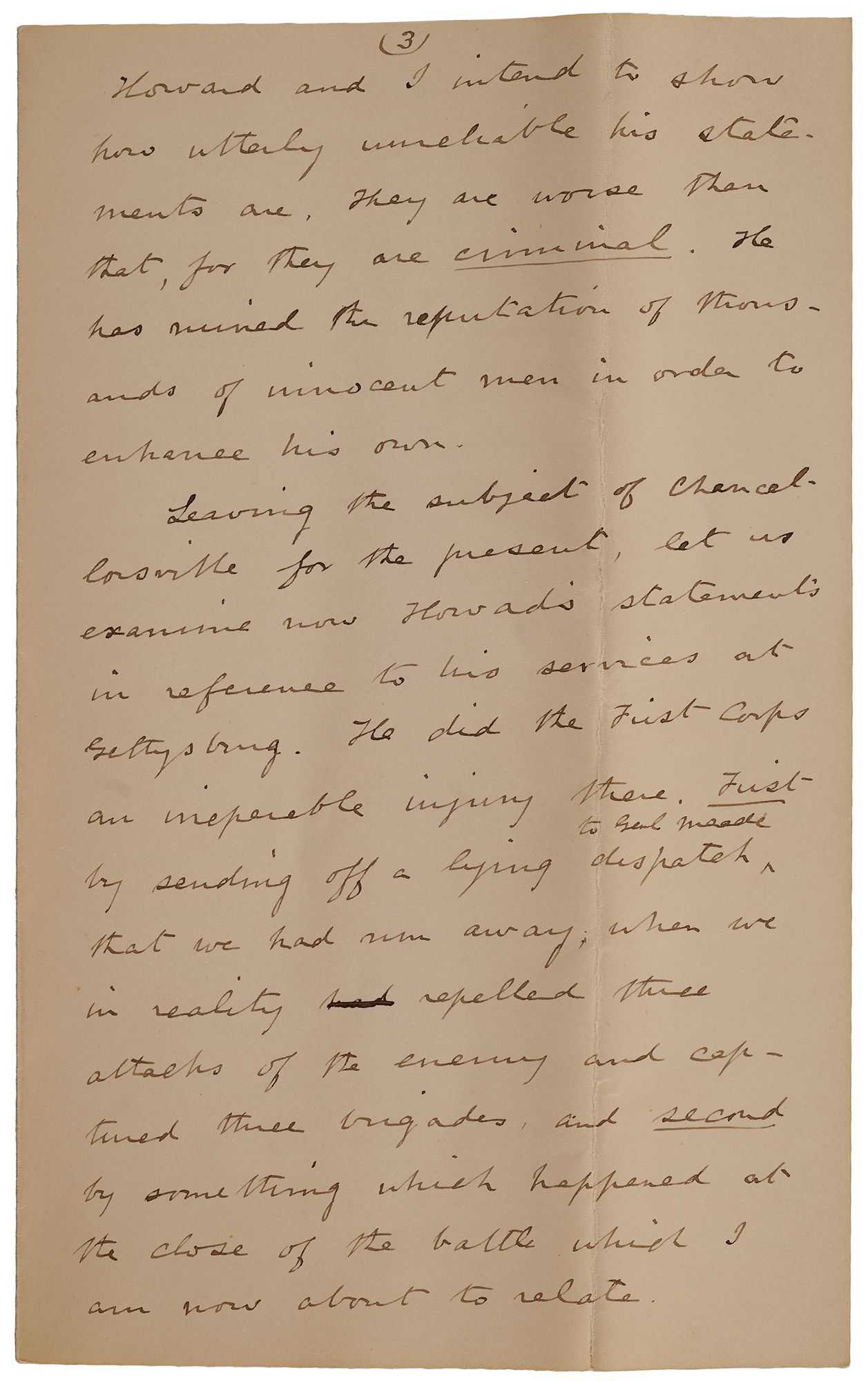
You may consider this pretty much an old story and ask why I revive it, but you will see later on that the First Corps have a serious accusation to make against Howard, and I intend to show how utterly unreliable his statements are. They are worse than that, for they are criminal. He has ruined the reputation of thousands of innocent men in order to enhance his own.
Leaving the subject of Chancellorsville for the present, let us examine now Howard’s statements in reference to his services at Gettysburg. He did the First Corps an irreparable injury there. First by sending off a lying dispatch to Genl. Meade that we had run away, when we in reality repelled three attacks of the enemy and captured three brigades, and second by something which happened at the close of the battle, which I am now about to relate.
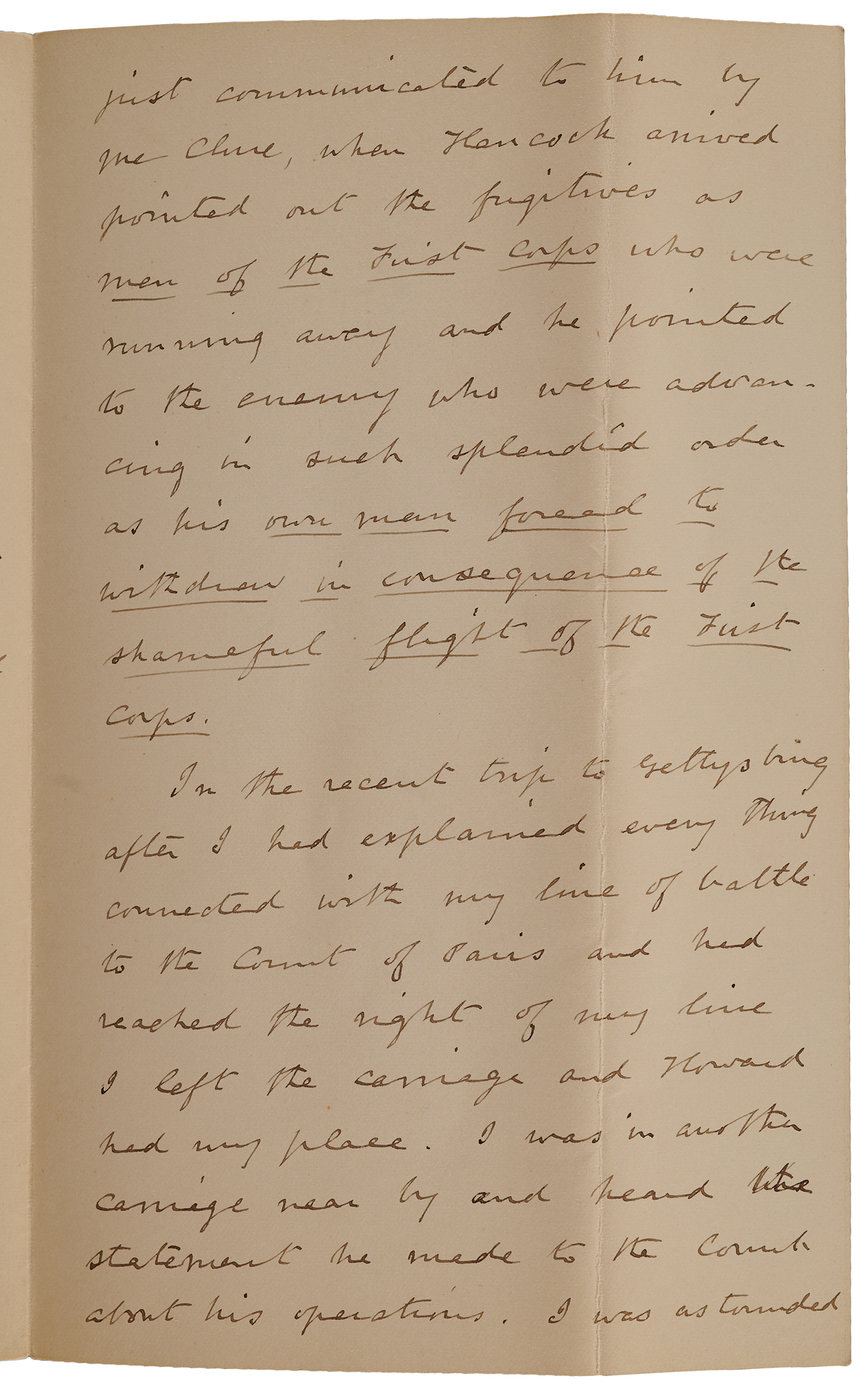
Col. McClure of the Com’g Dept. could have remained in rear in charge of his train, but preferring the post of danger, he came to the front and volunteered to act as Aid to Genl. [James] Wadsworth. When the enemy attacked the 11th Corps on the north, McClure went to Howard with a joint message from Genl Wadsworth and myself to inform him that his men had all left the front and that General Wadsworth’s right was no longer tenable in consequence, and asking him to issue immediate orders to meet the emergency. The First Corps were still facing West and having no orders to the contrary, fought for three quarters of an hour after that. Yet Howard, in the teeth of this information just communicated to him by McClure, when Hancock arrived, pointed out the fugitives as men of the First Corps who were running away, and he pointed to the enemy who were advancing in such splendid order as his own men forced to withdraw in consequence of the shameful flight of the First Corps.
In the recent trip to Gettysburg, after I had explained everything connected with my line of battle to the Count of Paris and had reached the sight of my line, I left the carriage, and Howard had my place. I was in another carriage nearby and heard the statement he made to the Count about his operations. I was astounded to hear him talk. Everyone knows that he left a wide gap (Robinson estimates it at half a mile) between his line and mine. Our lines ran in this way. [Doubleday draws columns for the 1st Corps and 11th Corps].
First, he told the Count of Paris that there was no interval between the two Corps but that his line joined mine. There, however, the guide who had studied the matter thoroughly from having explained the battle for years and having conversed with an immense number of soldiers who were in it, took the liberty of correcting the general by saying, ‘Oh, general, you are mistaken. The left of your line was over at the barn.’ Howard then tried to represent his line as a direct echelon to mine [Doubleday again draws lines for the 1st and 11th Corps] but he failed in this also. He then represented the interval as filled with [Thomas] Devin’s cavalry, who were a mile off on our right flank near the bridge over Stock Creek.
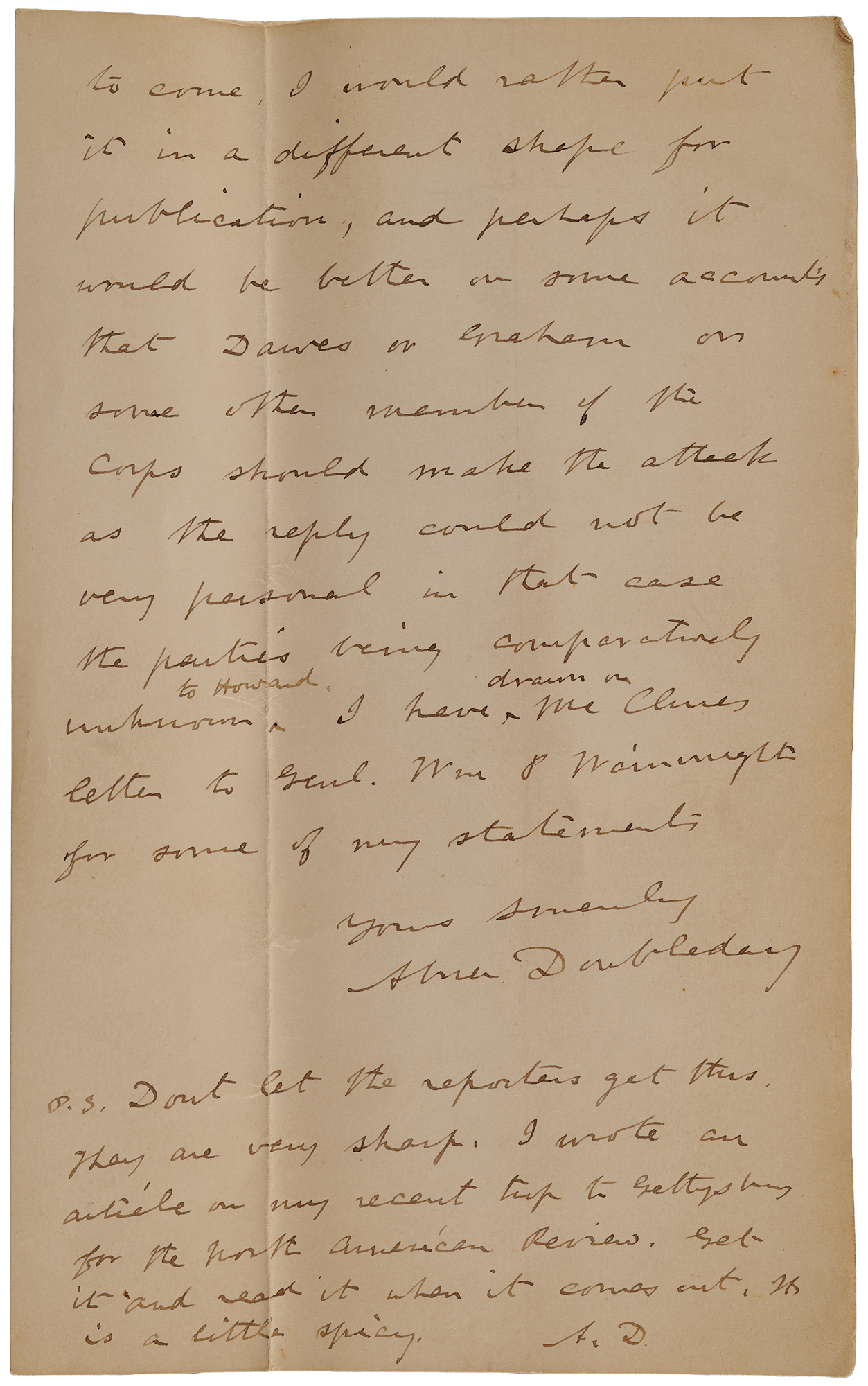
I have written this to you to explain what was done in my late trip to Gettysburg, and I will send some parties to you to see this letter, for I cannot write this long account to each member of the First Corps. You can show this to anyone you please. I think I would like Clarkson to see it. Do not let it get in print for although that may have to come I would rather put it in a different shape for publication, and perhaps it would be better on some accounts that Dawes or Graham or some other member of the Corps should make the attack, as the reply could not be very personal, in that case the parties being comparatively unknown to Howard. I have drawn on McClure’s letter to Genl. Wm. P. Wainwright for some of my statements.” Doubleday signs again with his initials “A.D,” after his added postscript: “Don’t let the reporters get this. They are very sharp. I wrote an article on my recent trip to Gettysburg for the North American Review. Get it and read it when it comes out. It is a little spicy.” In fine condition, with an offset vertical fold to each page.
Written late in life, this letter presents Doubleday as a devoted steward of memory, deeply concerned with how the war—and the service of the First Corps—would be understood by later generations. In retirement, he devoted himself to writing, publishing Reminiscences of Forts Sumter and Moultrie (1876) and Chancellorsville and Gettysburg (1882), and his criticism of Oliver O. Howard reflects long-standing disagreements over Howard’s leadership at Chancellorsville and Gettysburg—episodes that prompted debate among contemporaries and historians alike regarding battlefield decisions, command judgment, and postwar interpretation.
At Chancellorsville, it's claimed that Howard failed to properly secure and reconnoiter his corps’ exposed right flank—despite repeated warnings—leaving the XI Corps unprepared and largely facing the wrong direction when Stonewall Jackson launched his surprise evening attack on May 2, 1863. At Gettysburg, Howard overextended his forces north of town on July 1, 1863, failed to coordinate effectively with arriving Union corps, and did not adequately prepare defensive positions, contributing to the collapse of the Union right and the retreat through Gettysburg to Cemetery Hill.
In the letter, Doubleday recounts personally hearing Howard, even years after the war, advance versions of events that he believed were demonstrably false, statements he described as “criminal,” and which he viewed as part of Howard’s continued effort to preserve his own legacy rather than fully acknowledge the historical record. A fascinating and revealing letter from Doubleday in his postwar effort to define responsibility, reputation, and historical truth among Union commanders.

This item is Pre-Certified by PSA/DNA
Buy a third-party letter of authenticity for
$150.00
*This item has been pre-certified by a trusted third-party authentication service, and by placing a bid on this item, you agree to accept the opinion of this authentication service. If you wish to have an opinion rendered by a different authenticator of your choosing, you must do so prior to your placing of any bid. RR Auction is not responsible for differing opinions submitted 30 days after the date of the sale.
Third-party authentication service applies only to signatures and handwriting, and does not cover the addition of sketches, artwork, musical quotations, etc.

