Sold For $18,760
*Includes Buyers Premium
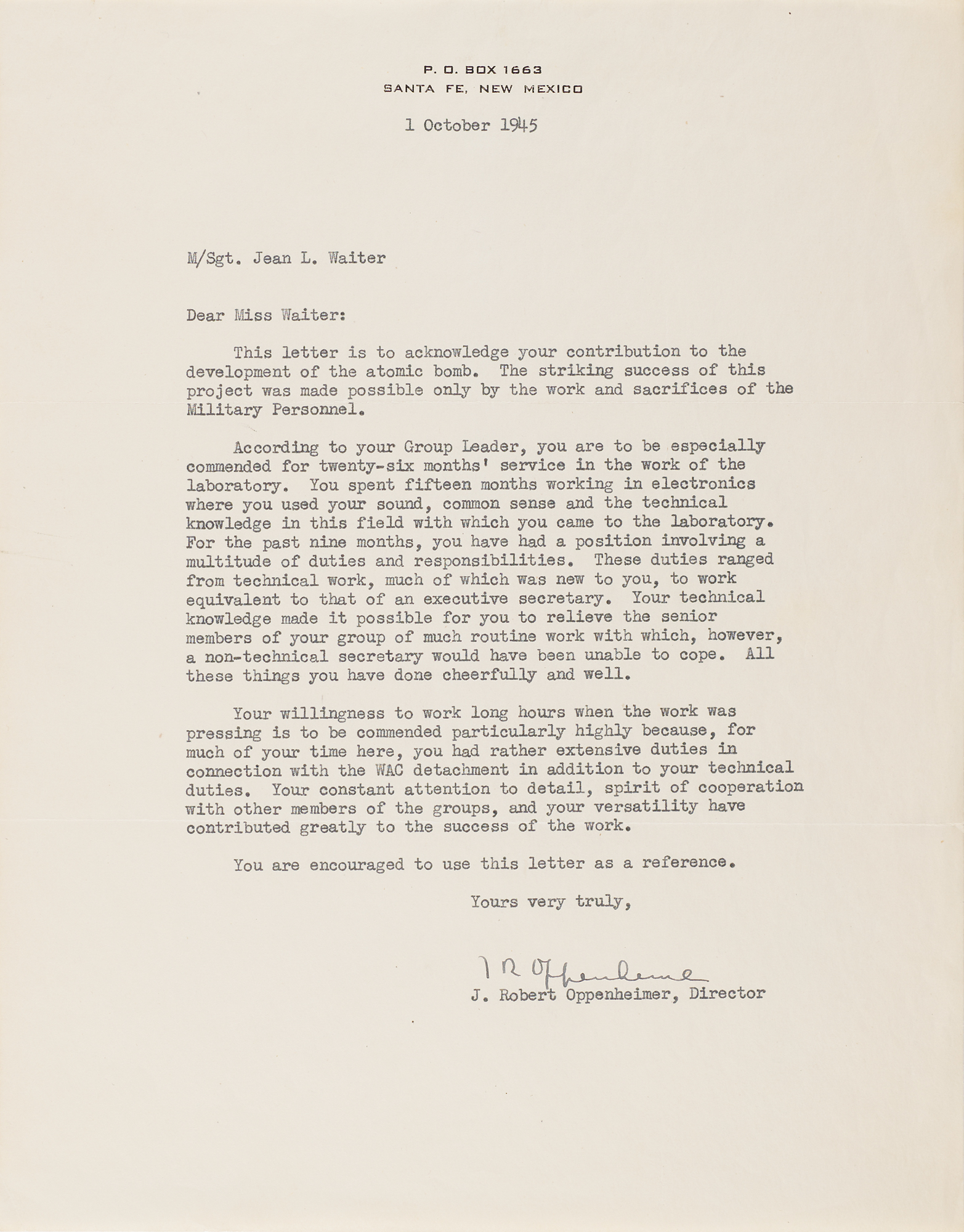
TLS signed “J. R. Oppenheimer,” one page, 8.5 x 11, P.O. Box 1663, Santa Fe, New Mexico letterhead, October 1, 1945. Letter to M/Sgt. Jean L. Waiter, in full: “This letter is to acknowledge your contribution to the development of the atomic bomb. The striking success of this project was made possible only by the work and sacrifices of the Military Personnel. According to your Group Leader, you are to be especially commended for twenty-six months’ service in the work of the laboratory. You spent fifteen months working in electronics where you used your sound, common sense and the technical knowledge in this field with which you came to the laboratory. For the past nine months, you have had a position involving a multitude of duties and responsibilities. These duties ranged from technical work, much of which was new to you, to work equivalent to that of an executive secretary. Your technical knowledge made it possible for you to relieve the senior members of your group of much routine work with which, however, a non-technical secretary would have been unable to cope. All these things you have done cheerfully and well. Your willingness to work long hours when the work was pressing is to be commended particularly highly because, for much of your time here, you had rather extensive duties in connection with the WAC [Women’s Army Corps] detachment in addition to your technical duties. Your constant attention to detail, spirit of cooperation with other members of the groups, and your versatility have contributed greatly to the success of the work. You are encouraged to use this letter as a reference.” In fine condition.
An exceptional letter from the director of the Los Alamos Laboratory, dated two months after the atomic bombings of Hiroshima and Nagasaki and a month after the close of World War II. Oppenheimer writes a gracious letter to a Women’s Army Corps (WAC) master sergeant assigned to Los Alamos, whose work combined electronics and administrative responsibilities in support of the Manhattan Project. He acknowledges the difficulty of the position, with its blend of technical and administrative demands, and commends her long hours, versatility, and service both in electronics work and in connection with the WAC detachment.
The Women’s Army Corps, established on July 1, 1943, as the women’s branch of the U.S. Army (evolving from the Women’s Army Auxiliary Corps of 1942), played a vital supporting role in the Manhattan Project. At sites such as Los Alamos, WAC personnel carried out essential administrative, communications, and technical duties, freeing scientists and engineers to focus on atomic research and development. Though often working behind the scenes, their contributions were integral to the day-to-day operations and ultimate success of the program.
Oppenheimer mailed numerous letters of gratitude to former Los Alamos employees, some of which reemphasized the ‘absolute secrecy’ of the work, a mandate initiated by President Franklin D. Roosevelt, and a chief concern of General Leslie R. Groves. Anyone on the grounds of Los Alamos needed a purpose and a pass, information was compartmentalized, all employees were required to sign secrecy oaths, and signs and billboards across the facility admonished workers: ‘What you see here, what you do here, what you hear here, when you leave here, let it stay here!’ Secrecy proved a daunting task for the Manhattan Project, which, at its peak in June 1944, employed about 129,000 workers.

This item is Pre-Certified by PSA/DNA
Buy a third-party letter of authenticity for
$50.00
*This item has been pre-certified by a trusted third-party authentication service, and by placing a bid on this item, you agree to accept the opinion of this authentication service. If you wish to have an opinion rendered by a different authenticator of your choosing, you must do so prior to your placing of any bid. RR Auction is not responsible for differing opinions submitted 30 days after the date of the sale.
Third-party authentication service applies only to signatures and handwriting, and does not cover the addition of sketches, artwork, musical quotations, etc.

