Sold For $13,764
*Includes Buyers Premium
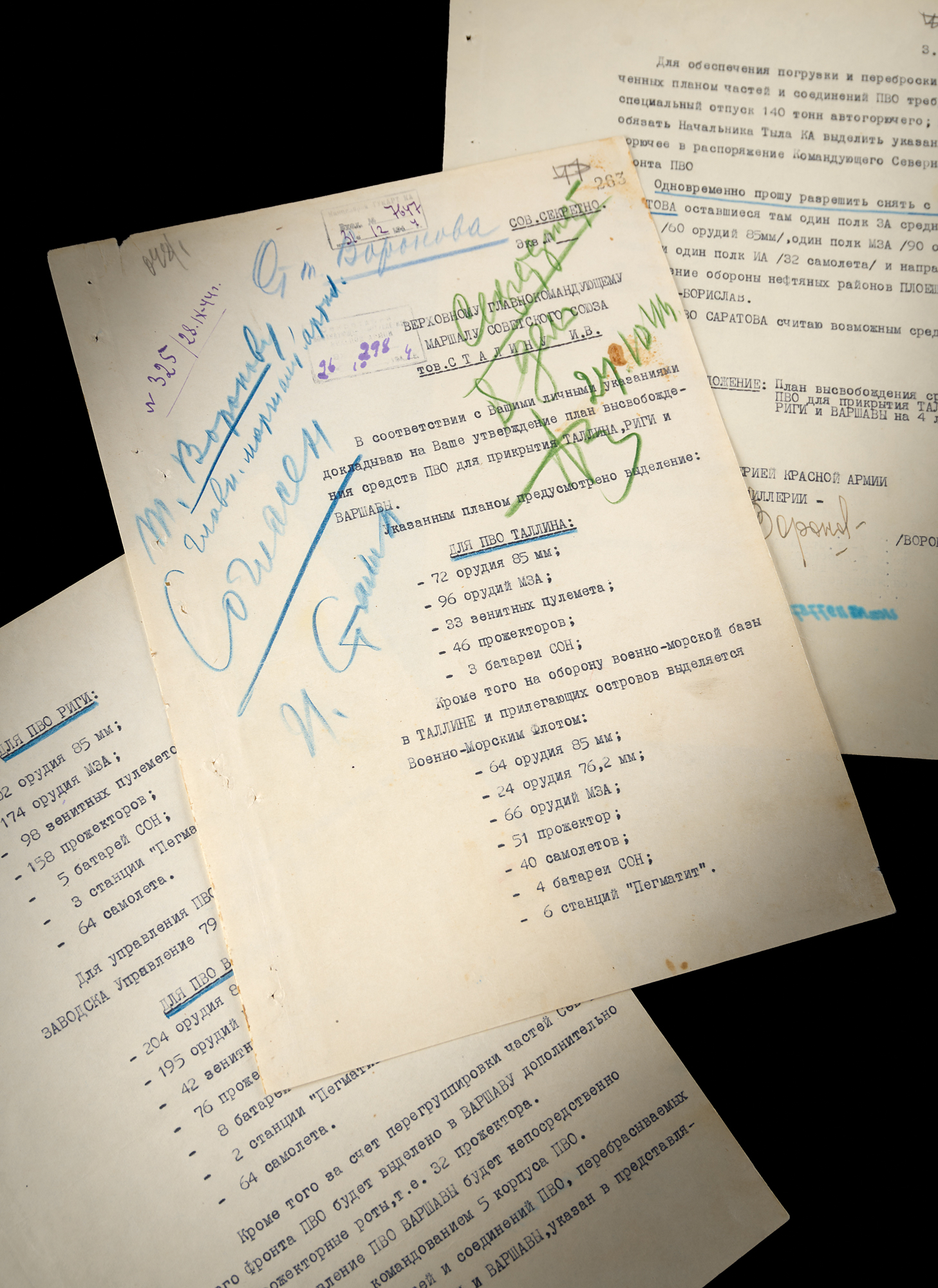
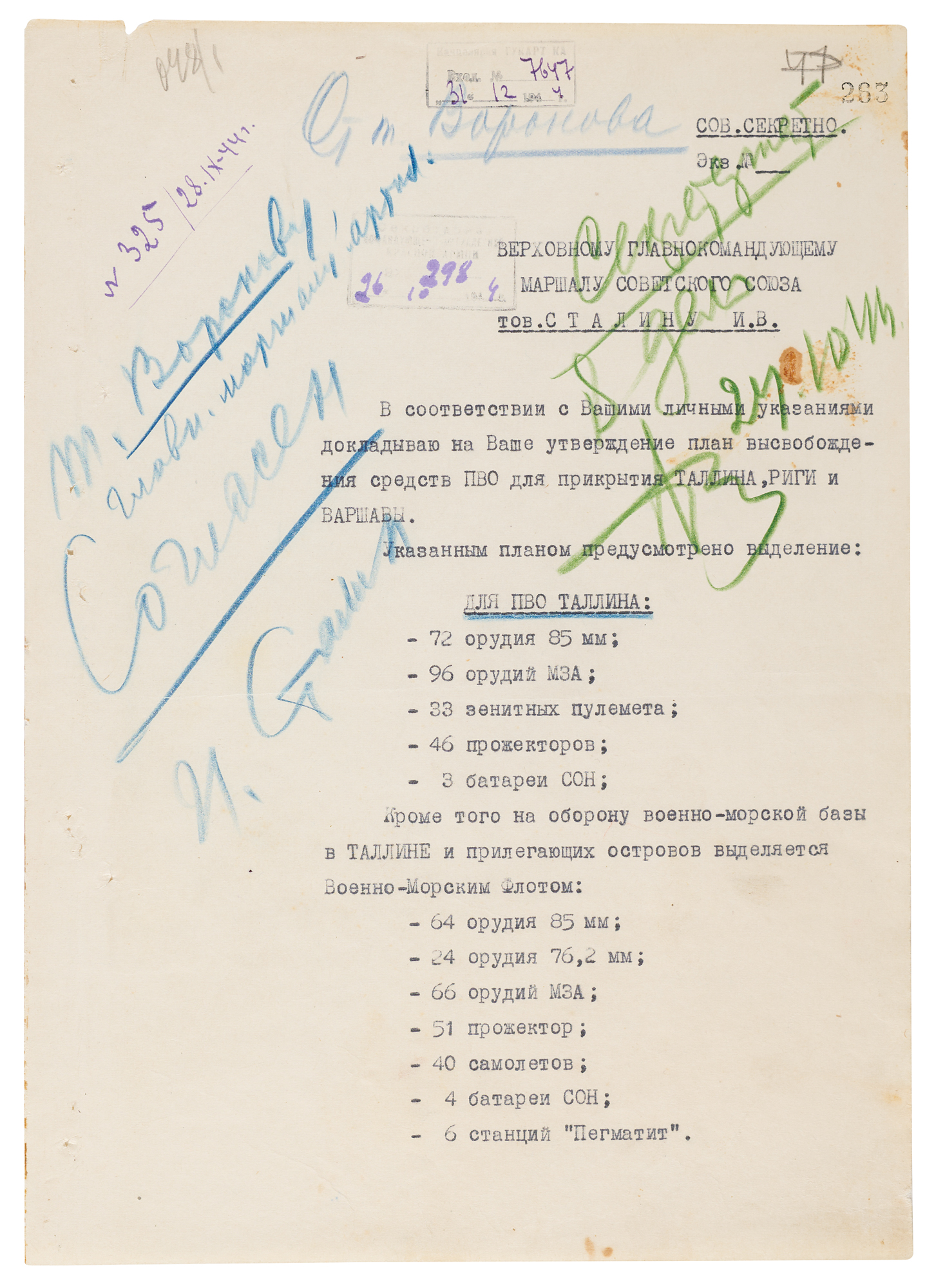
World War II–dated DS in Russian, signed “J. Stalin,” three pages, 8.25 x 11.75, September 28, 1944. Document marked "Top Secret," addressed to the "Supreme Commander in Chief, Marshal of the Soviet Union, Comrade Stalin," detailing the exact weapons to be used for the defense of major cities of Eastern Europe following their liberation: Tallinn, Riga, and Warsaw. In part (translated): "In accordance with your personal instructions, I am submitting for your approval a plan for the release of anti-aircraft defense assets to cover Tallinn, Riga, and Warsaw." Endorsed at the head in blue indelible pencil by Joseph Stalin.
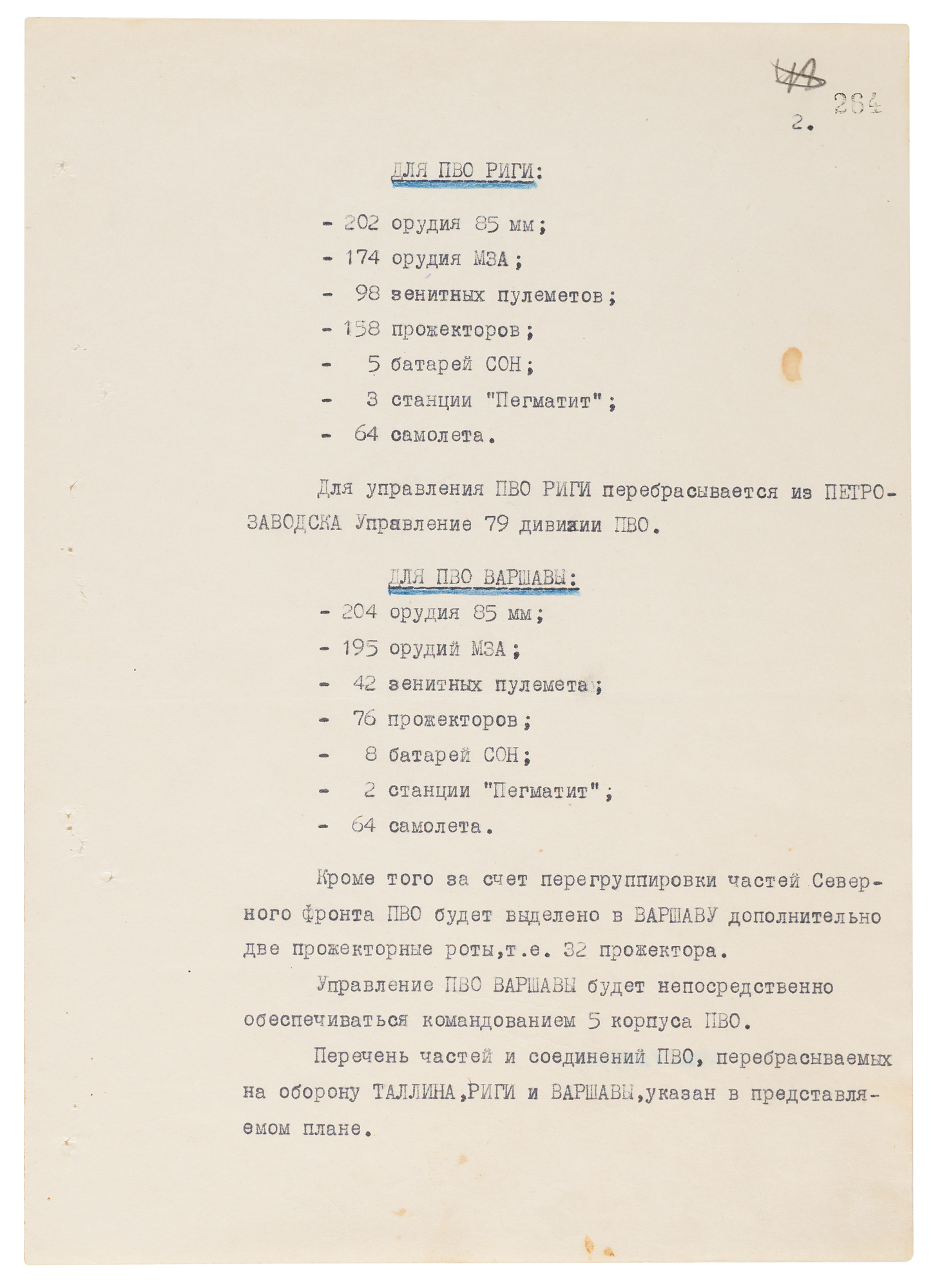
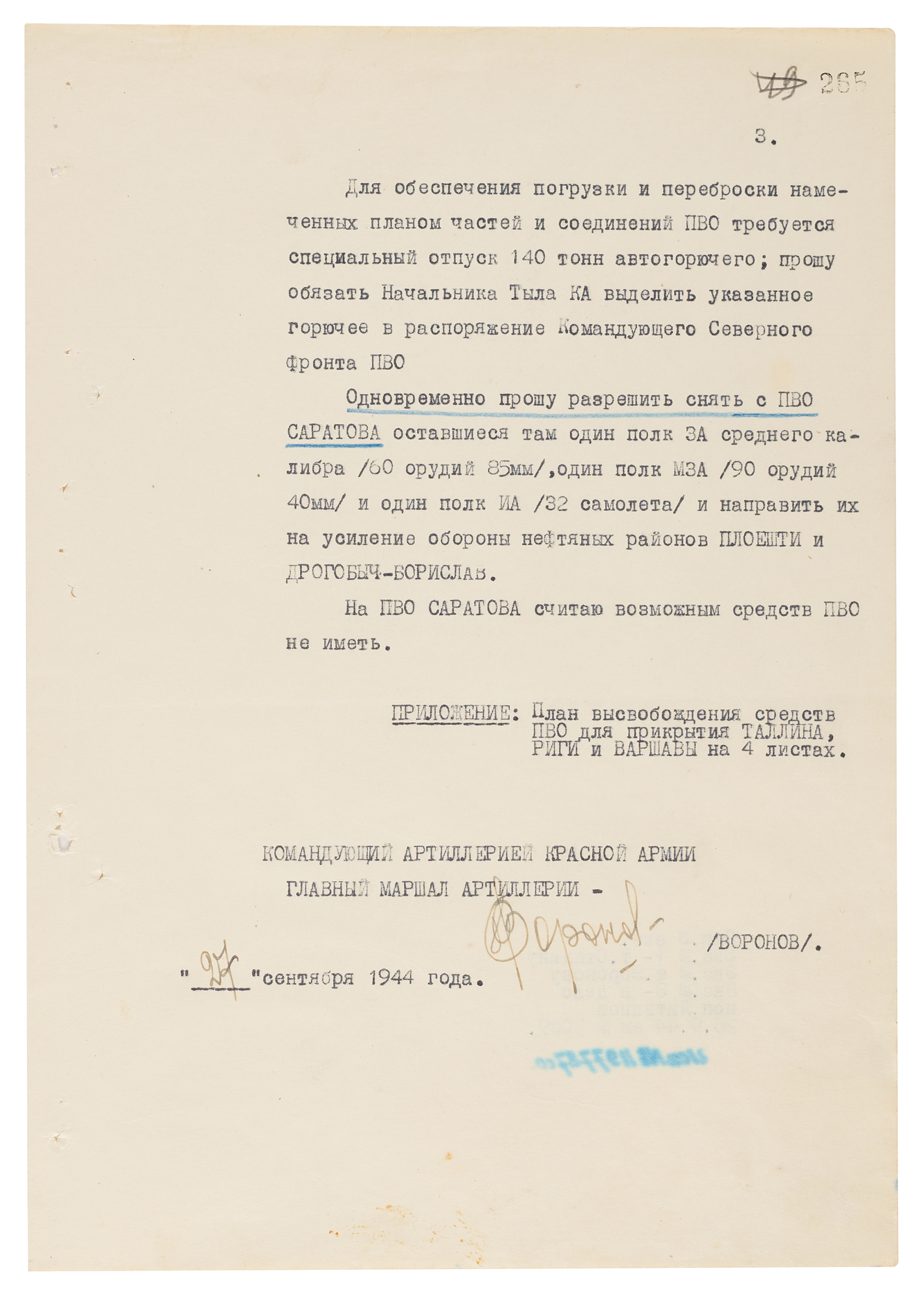
Equipment listed includes: 72 85mm weapons, 96 small-caliber anti-aircraft guns, 33 anti-aircraft machine guns, 46 searchlights, and 6 'Pegmantit' radar stations for the defense of Tallinn; 202 85mm guns, 174 small-caliber anti-aircraft guns, 98 anti-aircraft machine guns, 3 'Pegmantit' radar stations, and 64 aircraft for the defense of Riga; and 204 85mm guns, 195 small-caliber anti-aircraft guns, 42 anti-aircraft machine guns, 2 'Pegmantit' radar stations, and 64 aircraft for the defense of Warsaw. The document further outlines allocations of fuel and reassignment of certain regiments, and is signed at the conclusion in ink by Nikolai Voronov, commander of artillery forces of the Red Army during World War II. In fine condition, with light soiling and small stains.
This top-secret 1944 document offers a rare, granular look into the operational mechanics of the Soviet war effort at a defining moment in World War II. Dated during the final push into Nazi-occupied Eastern Europe, it reflects not only the scale of Soviet military planning but also the centralized authority under Joseph Stalin. The fact that the report was prepared “in accordance with your personal instructions” and personally endorsed by Stalin reveals his direct involvement in strategic decisions, illustrating how the liberation of key cities—Tallinn, Riga, and Warsaw—required carefully coordinated air defense systems to protect against German counterattacks. Such documentation reveals the Soviet emphasis on overwhelming material superiority, detailing precise allocations of artillery, radar, aircraft, and logistical support.
The timeline of the liberation of these cities further reinforces the document’s importance as part of the Red Army’s coordinated late-war offensives. Tallinn, the capital of Estonia, was liberated from German occupation on September 22, 1944, just days before this report was finalized, indicating that Soviet planners were already consolidating defensive control immediately after its capture. Riga, the capital of Latvia, was liberated shortly thereafter on October 13, 1944, during the Baltic Offensive. Warsaw’s situation was more complex: although the city had risen against German occupation during the Warsaw Uprising in August 1944, it was ultimately captured and largely destroyed by German forces before being liberated by the Red Army on January 17, 1945.

This item is Pre-Certified by PSA/DNA
Buy a third-party letter of authenticity for
$200.00
*This item has been pre-certified by a trusted third-party authentication service, and by placing a bid on this item, you agree to accept the opinion of this authentication service. If you wish to have an opinion rendered by a different authenticator of your choosing, you must do so prior to your placing of any bid. RR Auction is not responsible for differing opinions submitted 30 days after the date of the sale.
Third-party authentication service applies only to signatures and handwriting, and does not cover the addition of sketches, artwork, musical quotations, etc.

