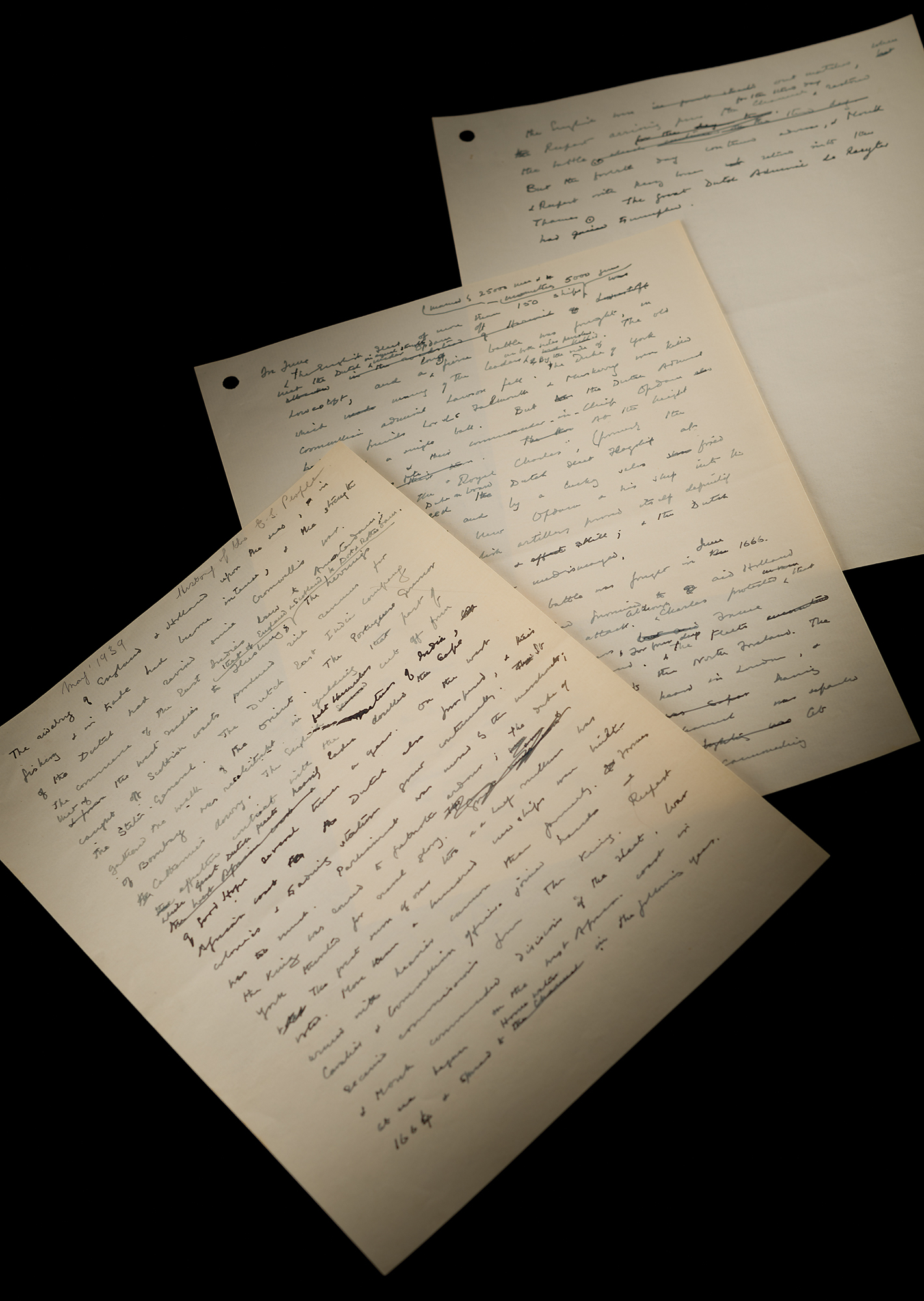
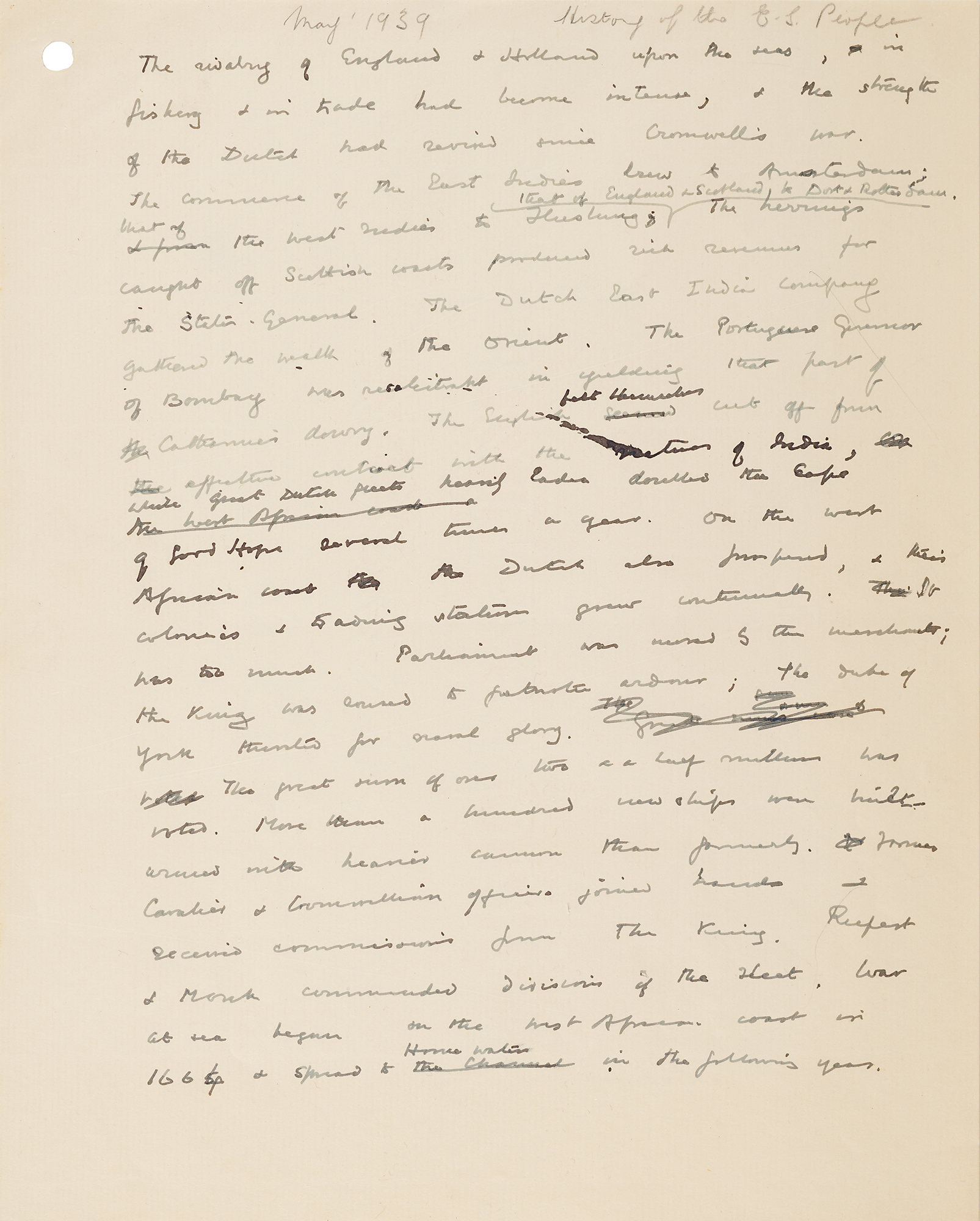
Three pages of Winston Churchill's original handwritten working draft of his epic four-volume A History of the English-Speaking Peoples, 8 x 10, identified and dated at the head in pencil by Churchill's secretary Kathleen Hill, "May 1939, History of the E. S. People."
In this passage, Churchill focuses on the Anglo-Dutch rivalry of the 1660s, beginning: "The rivalry of England & Holland upon the seas, in fishing & in trade had become intense, & the strength of the Dutch had revived since Cromwell's war. The commerce of the East Indies drew to Amsterdam; that of the West Indies to Flushing; that of England & Scotland to Dort & Rotterdam. The herrings caught off Scottish coasts produced rich revenues for the States-General. The Dutch East India Company gathered the wealth of the Orient. The Portuguese Governor of Bombay was recalcitrant in yielding that part of Catherine's dowry….
On the West African coast the Dutch also prospered, & their colonies & trading stations grew continually. It was too much. Parliament was moved by the merchants; the King was roused to patriotic ardour; the Duke of York thirsted for naval glory…More than a hundred new ships were built, armed with heavier cannon than previously. Former Cavalier & Cromwellian officers joined hands & received commissions from the King. Rupert & Monk commanded divisions of the Fleet. War at sea began on the West African coast in 1664, and spread to home waters in the following year.
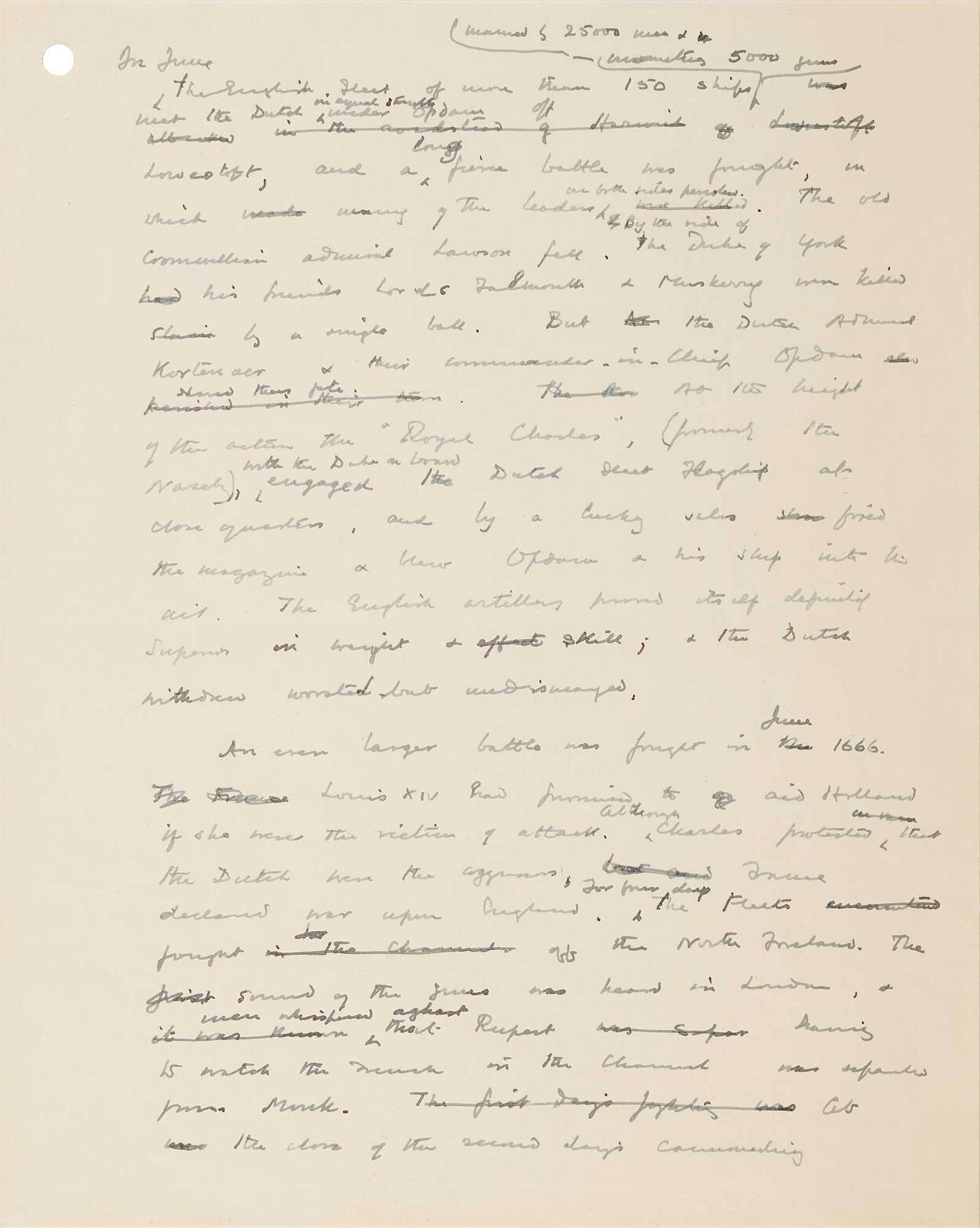
In June the English fleet of more than 150 ships, manned by 25,000 men & mounting 5,000 guns, met the Dutch in equal strength off Lowestoft, and a long, fierce battle was fought, in which many of the leaders on both sides perished…
An even larger battle was fought in June 1666. Louis XIV had promised to aid Holland if she were the victim of attack. Although Charles protested that the Dutch were the aggressors, France declared war upon England. For four days the English and Dutch fleets battled off the North Foreland. The sound of the guns was heard in London…
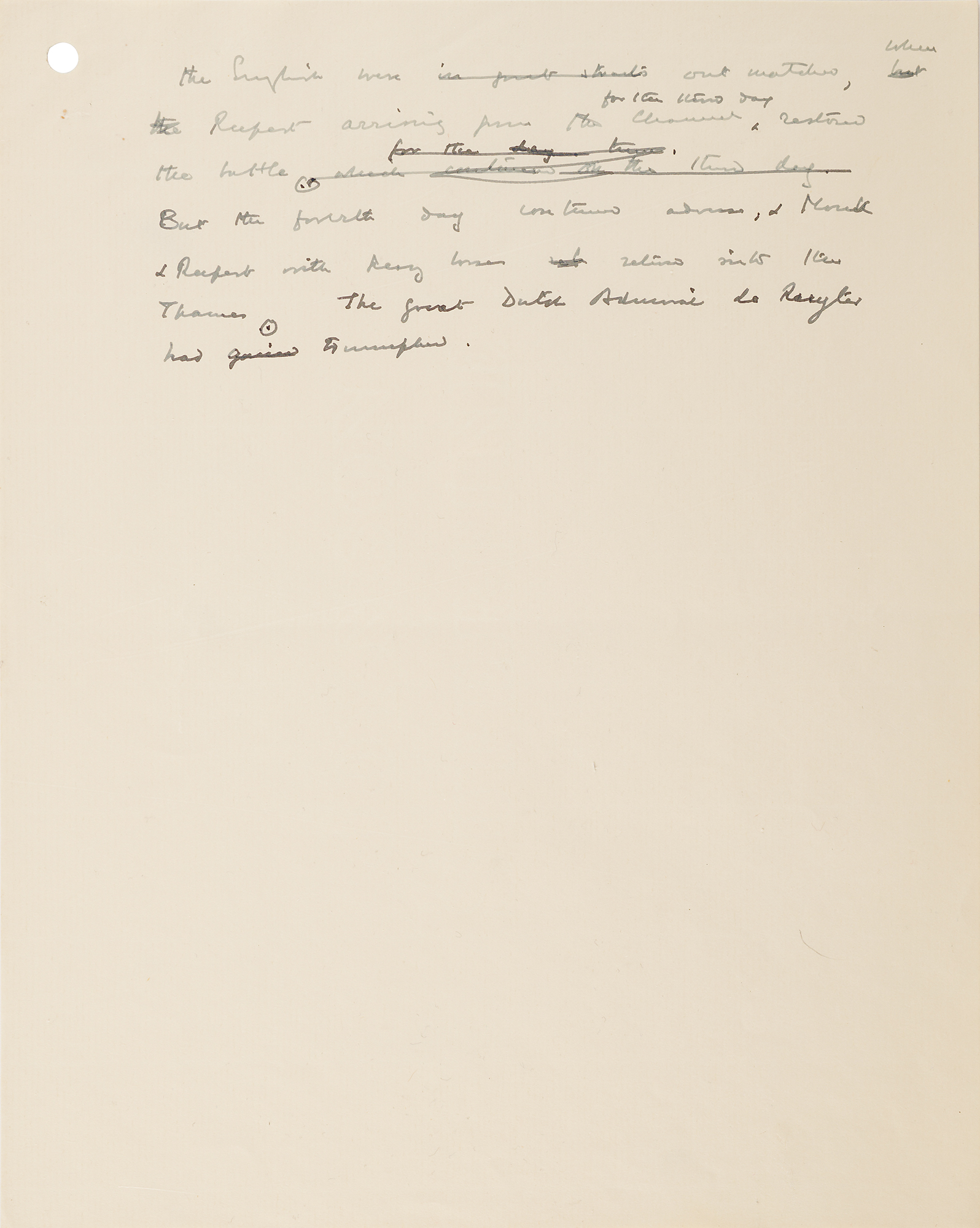
The English were out matched, when Rupert arriving from the Channel for the third day, restored the battle. But the fourth day continued adverse, & Monk & Rupert with heavy losses retired into the Thames. The great Dutch Admiral de Ruyter had triumphed." Churchill makes several revisions and corrections throughout the text. In fine condition.
Skilled as a writer, orator, and historian, Churchill would receive the Nobel Prize in Literature in 1953 'for his mastery of historical and biographical description as well as for brilliant oratory in defending exalted human values.' These working manuscript pages come from one of Churchill’s most ambitious and long-gestating literary projects. A History of the English-Speaking Peoples was primarily conceived and largely written during his 'wilderness years' in the late 1930s, heavily interrupted by World War II, and finally published between 1956 and 1958. The ambitious, comprehensive work covers the period from the Roman conquest of Britain in 55 B.C. to the beginning of the First World War.

