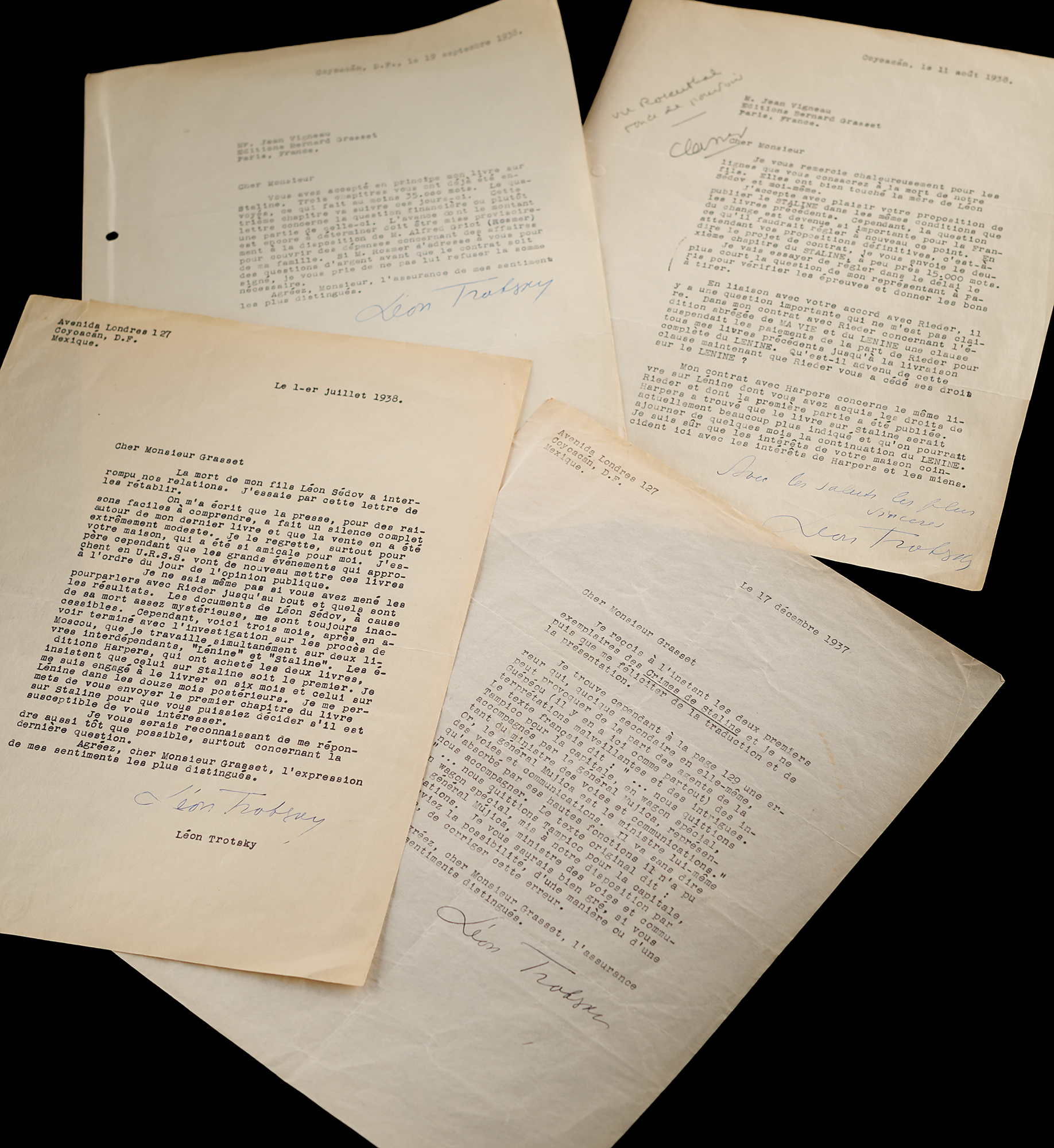
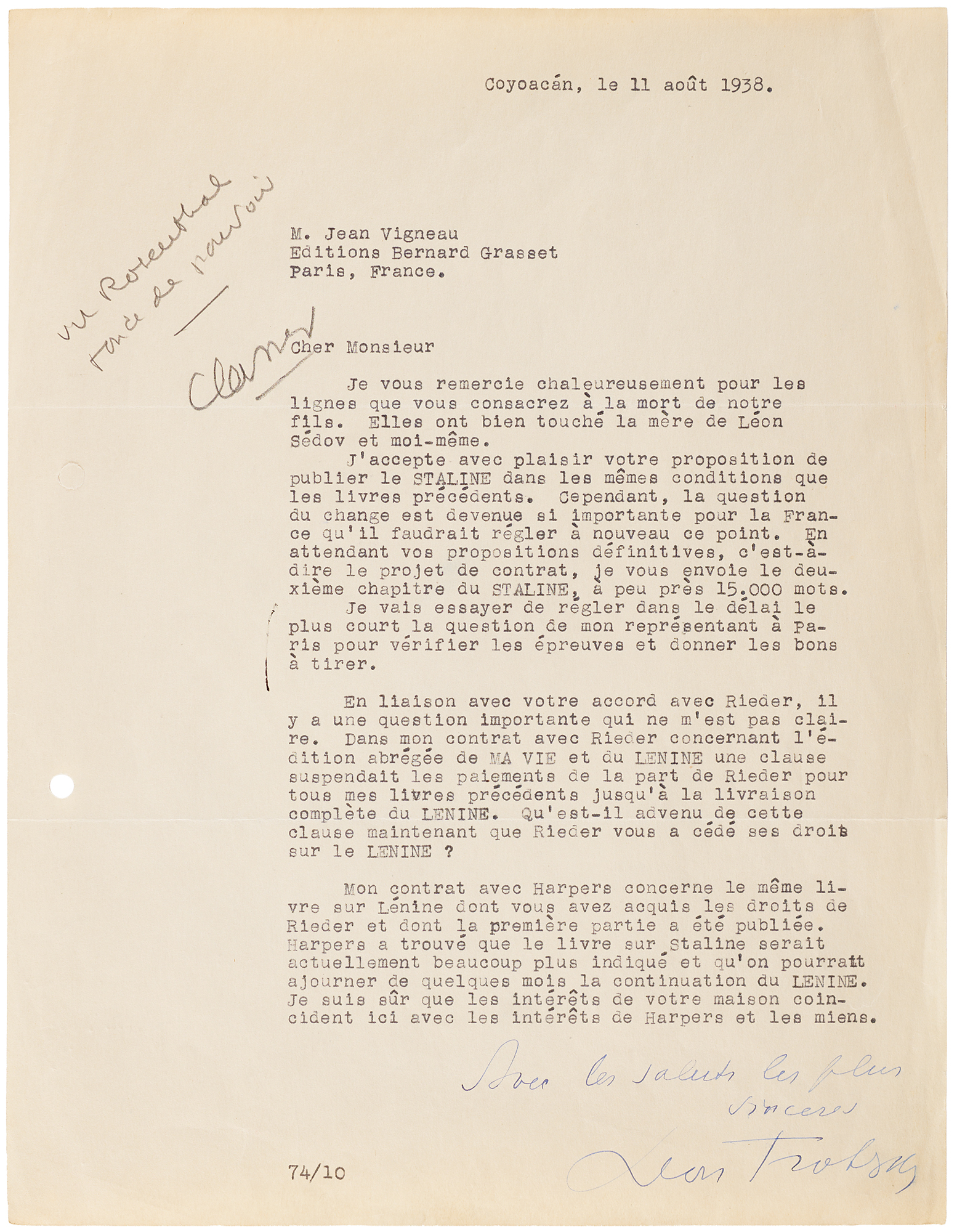
Four TLSs in French, signed "Leon Trotsky," each one page, 8.25 x 11, dated from December 1937 to September 1938. Trotsky writes from Coyoacán, Mexico, to his publishers, Bernard Grasset and Jean Vigneau, about his books on Stalin and Lenin, and the mysterious death of his son Lev Sedov. Excerpts from the letters, in translation:
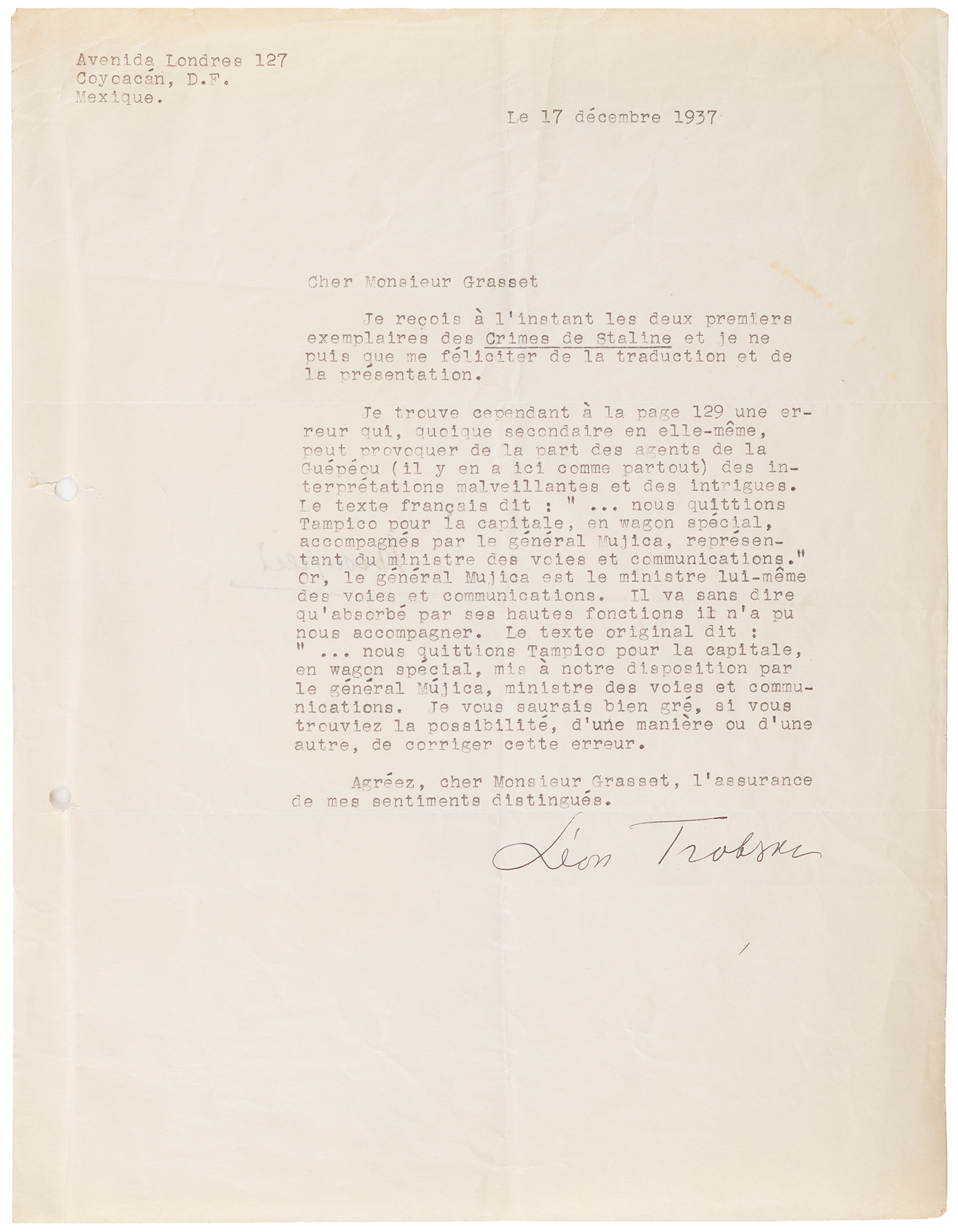
December 17, 1937: "I have just received the first two copies of 'Stalin's Crimes' and I can only express my satisfaction with the translation and presentation. I do, however, find on page 129 an error which, although secondary by itself, may provoke malicious interpretations and intrigues by the agents of the GPU (there are some of them here, as everywhere).” He explains what should be changed and how poorly chosen words can have the most disastrous consequences. He would be assassinated in Mexico two and a half years later, on August 20, 1940, by an agent of Stalin.
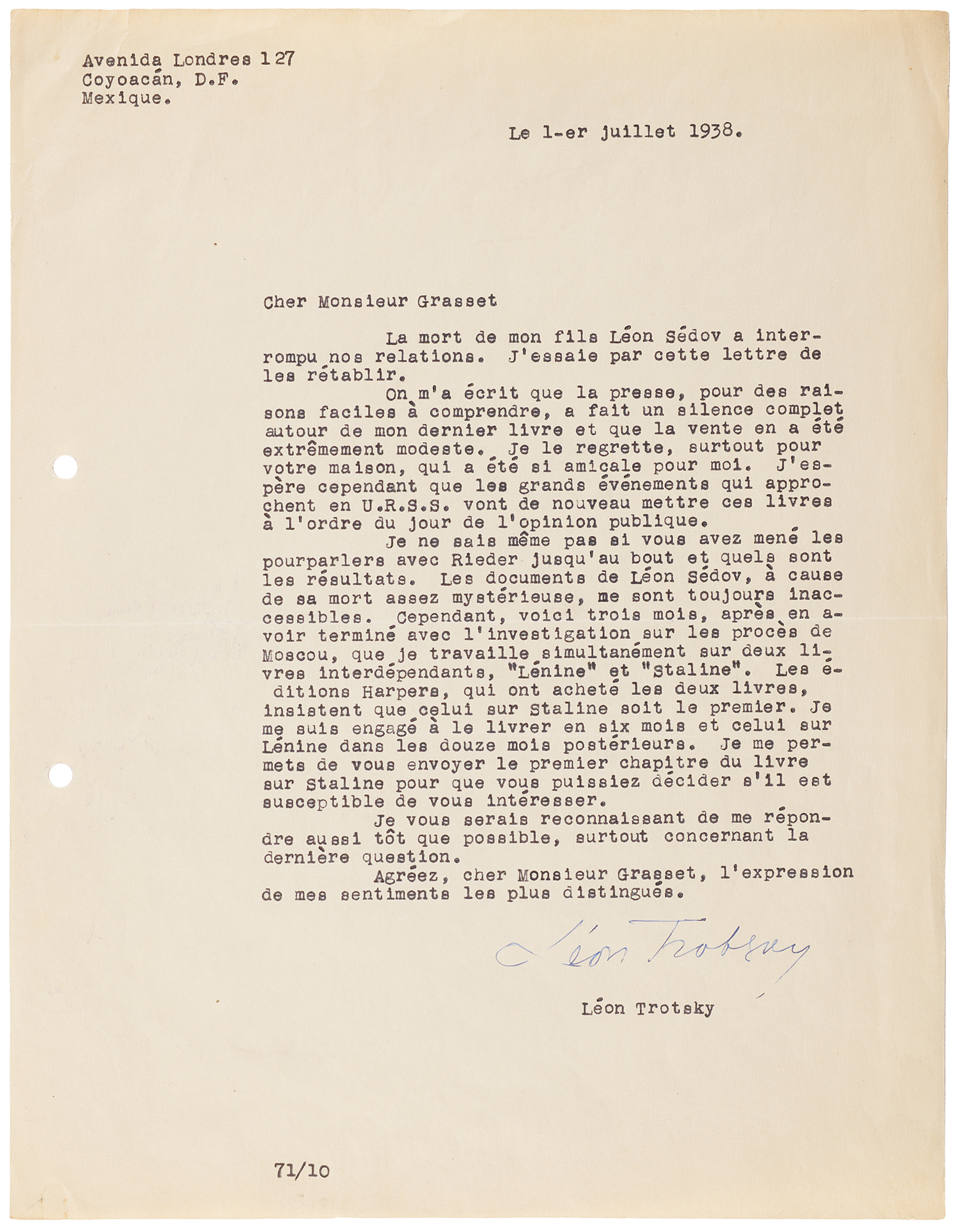
July 1, 1938: "The death of my son Léon Sedov interrupted our relationship. I am trying through this letter to re-establish them. I have been told that the press, for reasons easy to understand, maintained complete silence around my latest book and that sales were extremely modest. I regret this, especially for your firm, which has always been so friendly toward me. I nevertheless hope that the great events coming up in the U.S.S.R. will once again bring these books to the forefront of public opinion. I do not even know whether you pursued discussions with Rieder to the end and what were the results. The documents of Léon Sedov, because of his rather mysterious death, are still inaccessible to me. However, three months ago, after finishing the investigation into the Moscow Trials, I began working simultaneously on two connected books, Lenin and Stalin. Harper Editions, which bought both books, insists that the one on Stalin be published first. I have committed myself to deliver it within six months, and the one on Lenin in the twelve months following. I allow myself to send you the first chapter on Stalin so that you may decide whether it is likely to interest you."
August 11, 1938: "I warmly thank you for the lines you devoted to the death of our son. They deeply touched Léon Sedov’s mother and myself. I gladly accept your proposal to publish Stalin under the same conditions as the previous books…While awaiting your definitive proposals, that is to say the draft contract, I am sending you the second chapter of Stalin, approximately 15,000 words." He continues, saying that he is charging his correspondent in Paris with correcting the proofs and, in the meantime, he wishes to clarify an important question: "In my contract with Rieder concerning the abridged edition of My Life and Lenin, a clause suspended payments by Rieder for all my previous books until the complete delivery of Lenin. What has become of this clause now that Rieder has ceded its rights on Lenin to you? My contract with Harpers concerns the same book, Lenin, for which you have acquired the rights from Rieder and for which the first part has been published. Harpers has found that the book on Stalin would at present be much more timely and that one could postpone for a few months the continuation of Lenin."
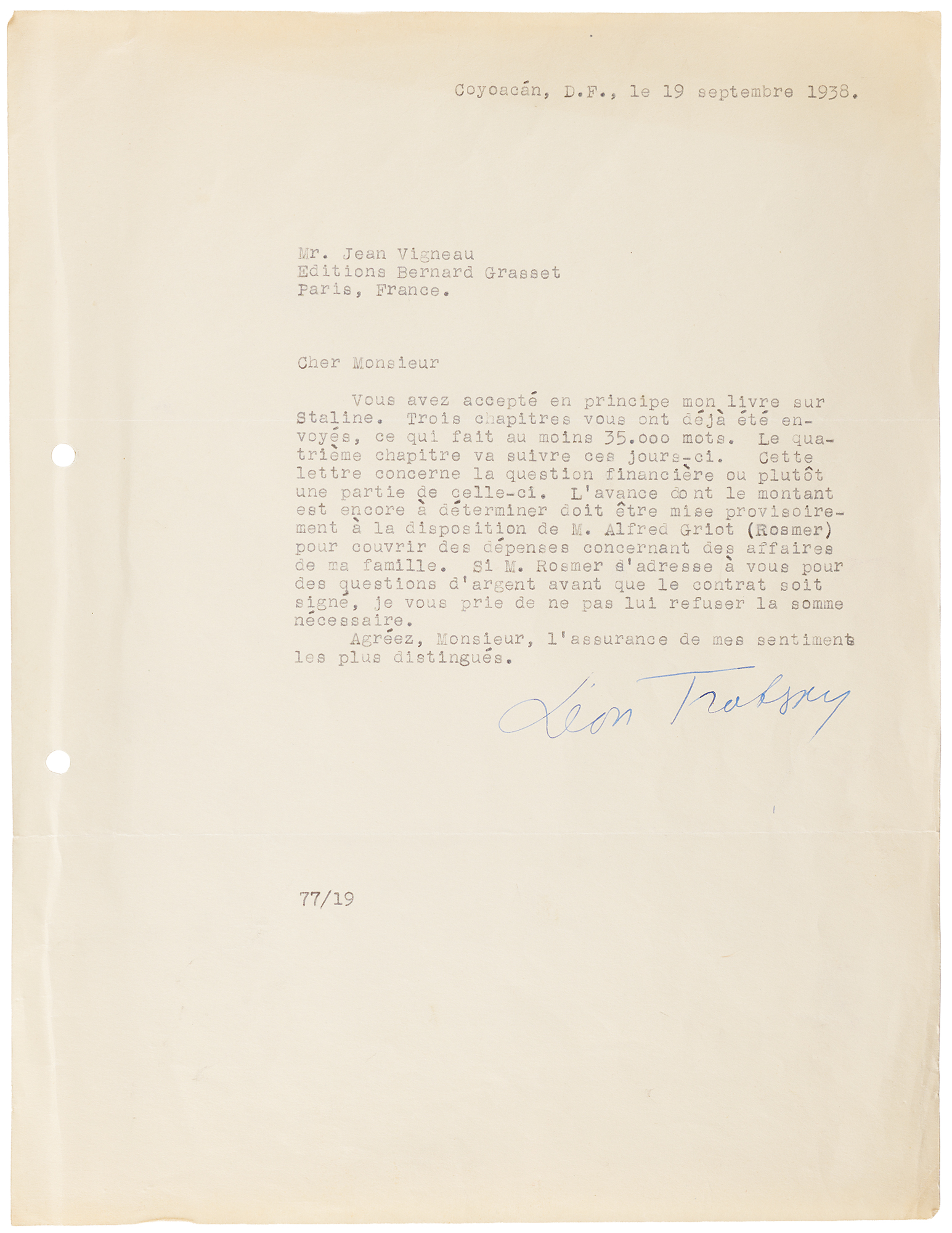
September 19, 1938: "You have accepted my book on Stalin in principle. Three chapters have already been sent, amounting to at least 35,000 words. This letter concerns the financial question." He explains the manner in which he wishes it to be settled.
Together, these letters vividly situate Trotsky at one of the most precarious and intellectually productive moments of his life: a revolutionary in permanent exile, writing under constant threat while racing to shape the historical record of Bolshevism against Stalinist distortion. Composed from his fortified residence in Coyoacán amid the terror of the Moscow Trials and the shadowy reach of the Soviet secret police, the correspondence reveals Trotsky not only as a political thinker but as a meticulous author and shrewd negotiator, deeply involved in translation, contracts, publicity, and timing. The references to surveillance, suppressed sales, and the “mysterious” death of his son reveal the personal cost of his opposition to Stalin. As primary-source material linking Trotsky’s final major works to the events that would soon culminate in his assassination, these letters offer exceptional insight into the intersection of Trotsky's ideology and exile.

