Sold For $1,613
*Includes Buyers Premium
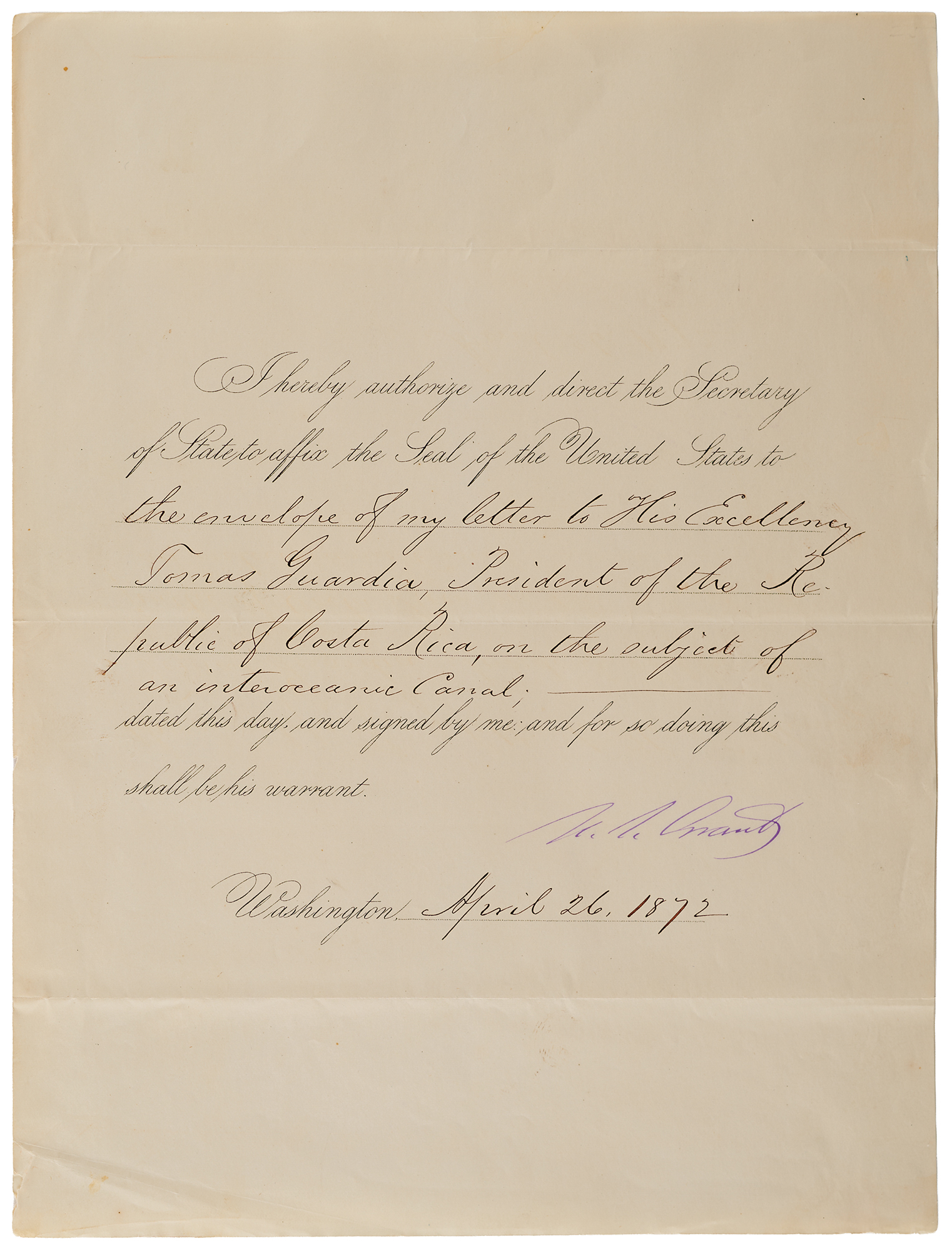
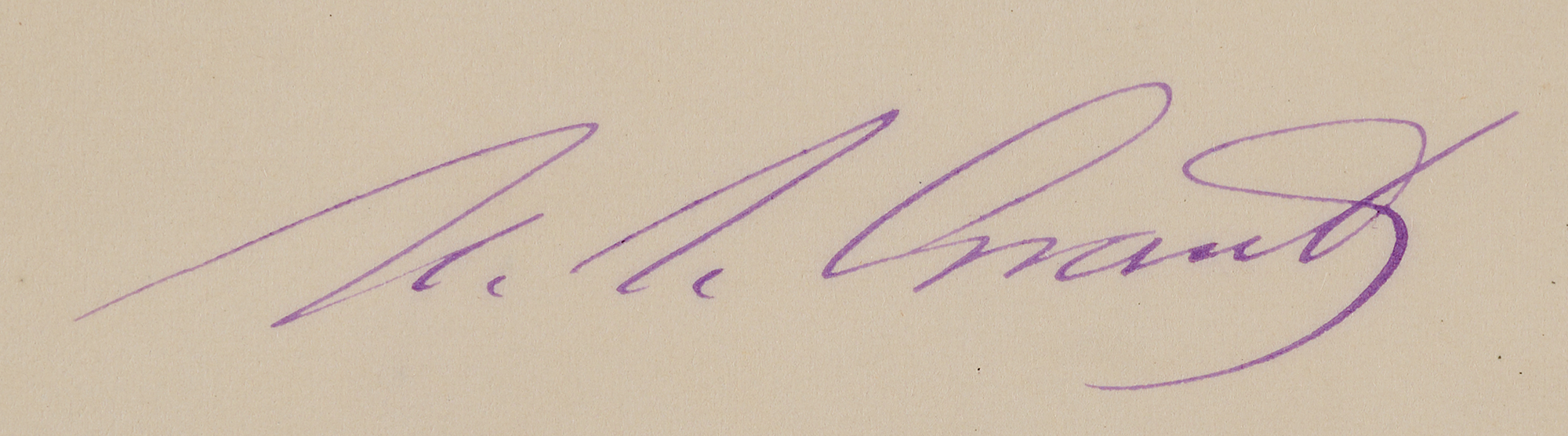
Partly-printed DS as president, one page, 8.5 x 11, April 26, 1872. President Grant authorizes and directs the Secretary of State to affix the Seal of the United States to “the envelope of my letter to His Excellency Tomas Guardia, President of the Republic of Costa Rica, on the subject of an interoceanic Canal.” Signed neatly at the conclusion by U. S. Grant. In very good to fine condition, with several horizontal folds, and creasing to the lower left corner.
When Grant became president in 1869, he was determined to advance the long-debated idea of an interoceanic canal linking the Atlantic and Pacific. His commitment was personal, shaped by a brutal 1852 crossing of the Isthmus of Panama that revealed the dangers of existing transit routes. As president, Grant insisted on serious, scientific exploration rather than speculation, placing the Navy at the center of a sustained survey effort. Expeditions examined routes through Darién, Tehuantepec, and Nicaragua, gradually ruling out the first two as impractical or prohibitively expensive. By the mid-1870s, careful surveys of the San Juan River, Lake Nicaragua, and the Pacific outlet demonstrated that a canal through Nicaragua was feasible.
In 1876, the Interoceanic Canal Commission formally recommended the Nicaraguan route, citing lower costs, fewer engineering obstacles, and reduced risk from natural disasters. Yet political realities stalled what engineering had achieved. The route depended on the San Juan River, which was also claimed by Costa Rica, turning canal negotiations into a two-nation problem complicated by boundary disputes, changing governments, and disagreements over sovereignty and control. Grant favored American leadership of the canal but, late in his presidency, accepted the idea of an internationally guaranteed, neutral passage in hopes of moving the project forward.
Negotiations nevertheless collapsed, and although Grant’s administration never built a canal, the surveys and experience gained under his leadership gave the United States its first reliable understanding of where a canal could—and could not—be built in Central America. Just as importantly, the diplomatic difficulties encountered in Nicaragua helped later policymakers see why Panama would ultimately offer a more workable solution.
This item is Pre-Certified by PSA/DNA
Buy a third-party letter of authenticity for
$100.00
*This item has been pre-certified by a trusted third-party authentication service, and by placing a bid on this item, you agree to accept the opinion of this authentication service. If you wish to have an opinion rendered by a different authenticator of your choosing, you must do so prior to your placing of any bid. RR Auction is not responsible for differing opinions submitted 30 days after the date of the sale.
Third-party authentication service applies only to signatures and handwriting, and does not cover the addition of sketches, artwork, musical quotations, etc.

