Sold For $7,753
*Includes Buyers Premium
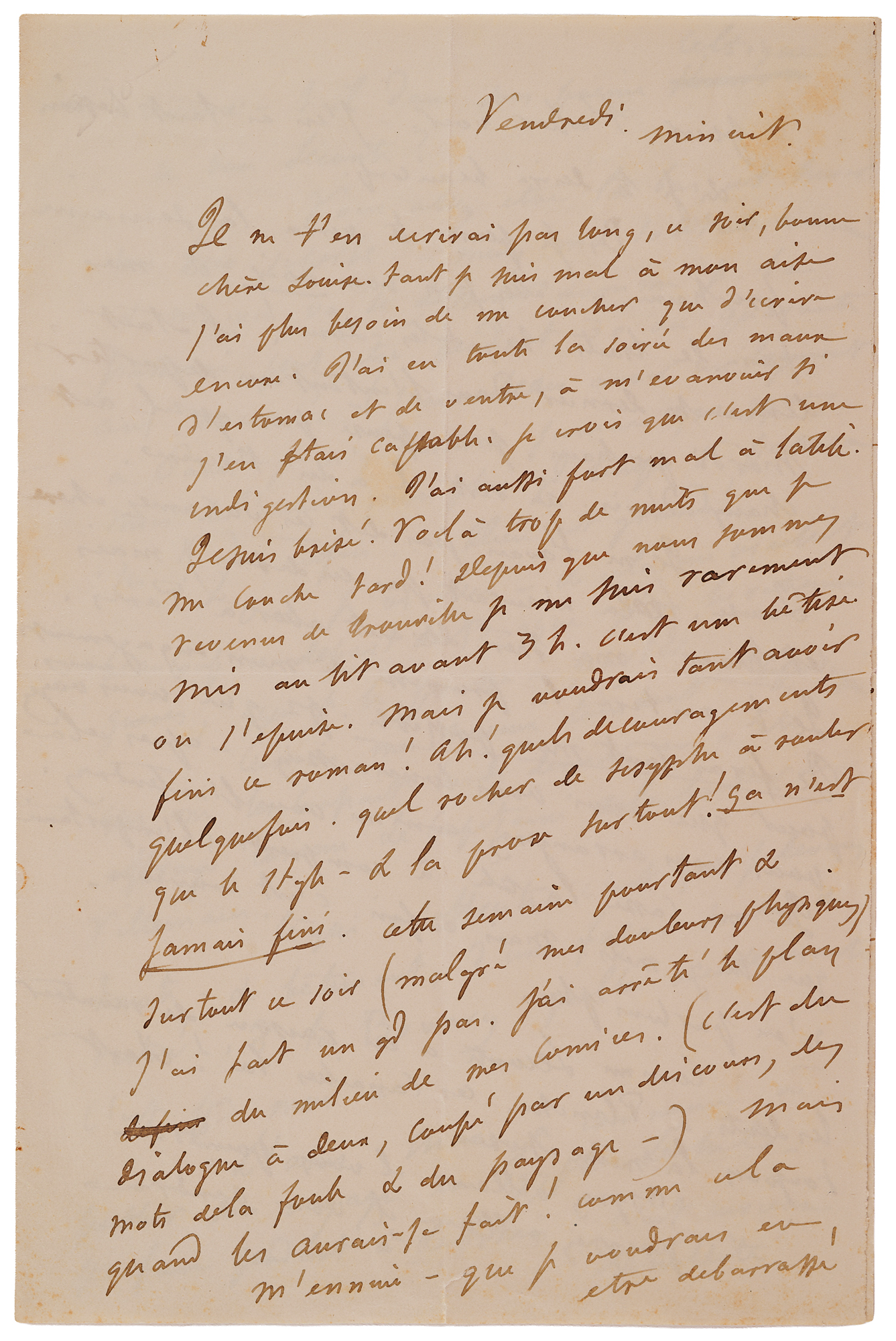
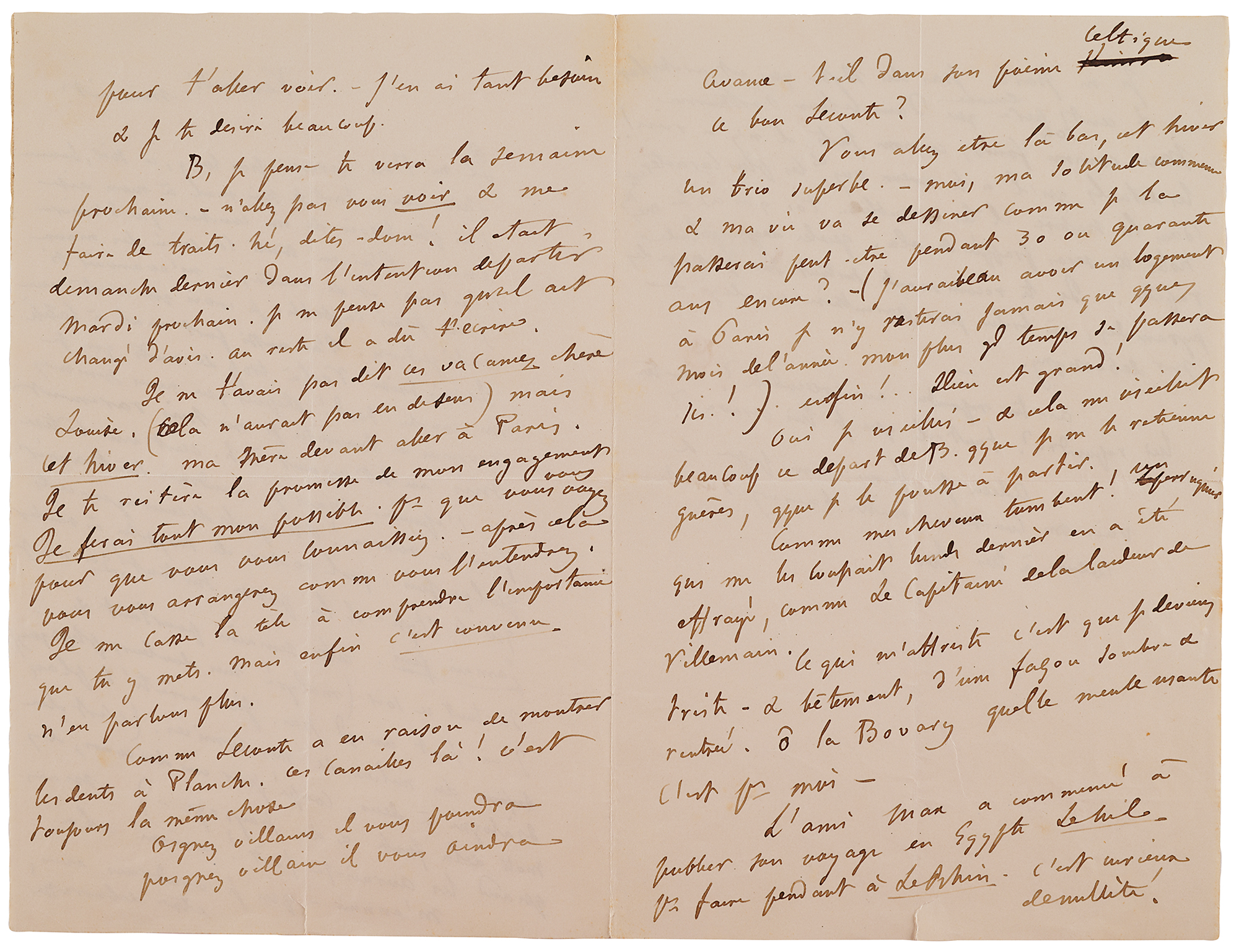
ALS in French, signed “G,” four pages on two adjoining sheets, 5.25 x 8.25, October 7, 1853. Handwritten letter to his lover, the poet Louise Colet, concerning his writing of Madame Bovary. In part (translated): "I'll not write you at length this evening, good, dear Louise. I am so uneasy, I need more to lie down than to write again. I have had a stomach and belly ache all evening, to the point of fainting, if I were capable of it. I think it is indigestion. I also have a bad headache. I am exhausted. That's what comes from going to bed too late too many nights! Since we returned from Trouville I have rarely gone to bed before 3 A.M. That's stupid, one gets exhausted. But I would like so much to have this novel finished! Ah! what discouragements sometimes, what cliff of Sisyphus to roll style up & prose, above all. That will never end. This week, however, and above all this evening (in spite of my physical sufferings), I have taken a great step. I have resolved on a plan of the middle of my agricultural fair (it is of a dialogue of two, cut off by a speech, by words from the crowd & by the countryside!). But when will I have them done! How that vexes me that I would like to be relieved of it to come to visit you. I have such a need for it & I desire you very much. B[ouilhet] will see you next week, I think. Well, not just to see you, and play tricks on me, hm, own up! Last Sunday he had the intention of leaving next Tuesday. I don't think he has changed his mind. As to the rest, he should have written you. I didn't say this vacation, dear Louise (that would not have made sense), but this winter my mother has to go to Paris.
I reiterate the promise of my engagement to you. I will do everything I possibly can so that you can meet and get to know each other. After that you will make arrangements as you see fit. I am breaking my head to comprehend the importance you place in this. But it is settled after all; let's not talk about it anymore. How right Leconte was to show Planche his teeth. Those scoundrels! It's always the same, 'Anoint a rogue, he will stab you; / Stab a rogue, he will anoint you.' Is the good Leconte getting on with his Celtic poem? This winter you will be a superb trio down there. Me, my solitude begins & my life is going to take on a form the way I will spend it perhaps 30 or forty years more. (I may very well have a dwelling in Paris, I will never stay there but some months of the year, most of my time I will spend here!) So!—God is great! Yes, I am getting old and that makes me feel old very much, this departure of B[ouilhet], although I hardly held him back, although I urged him to leave.
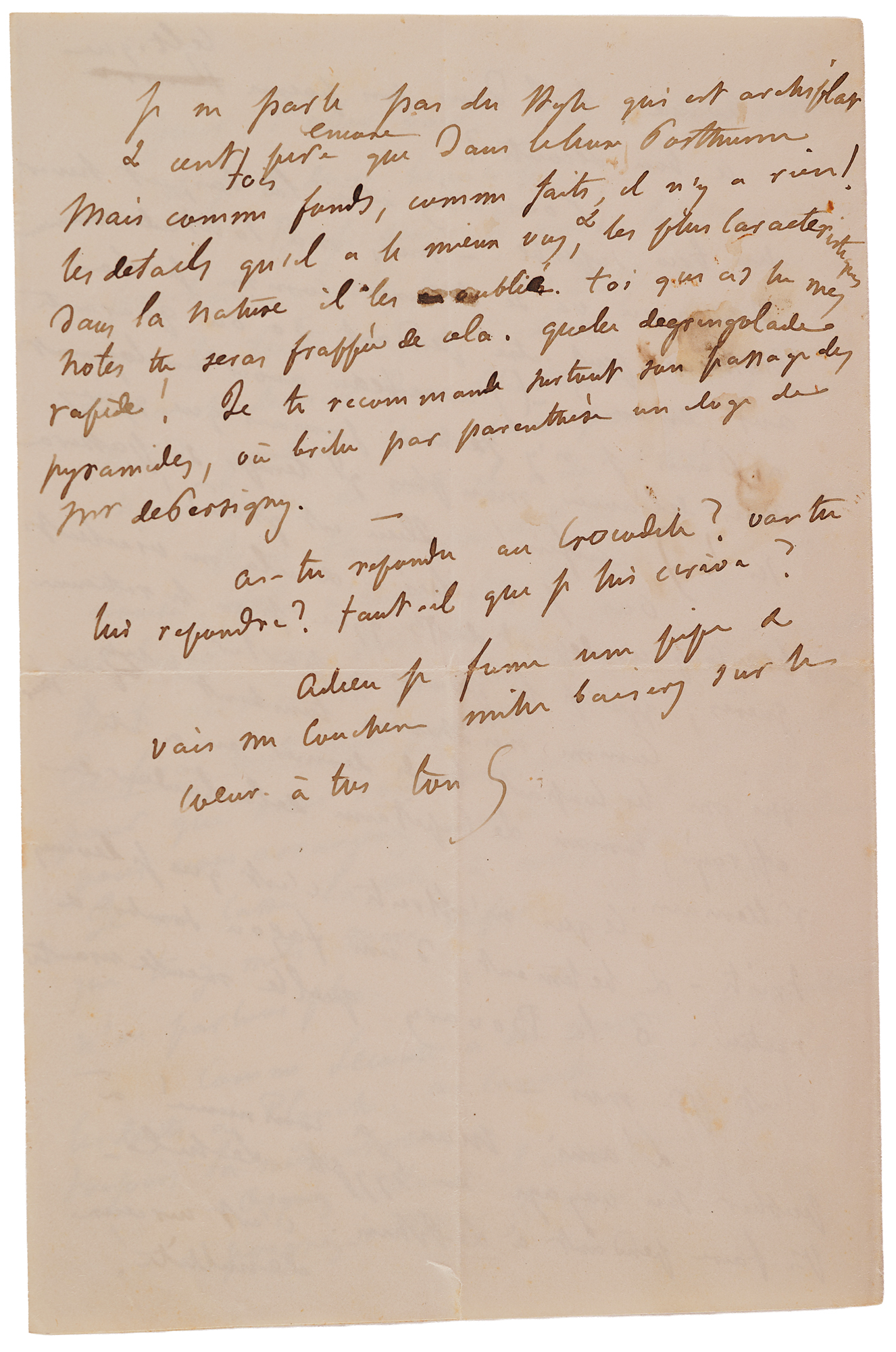
How my hair is falling out! A wigmaker who cut it last Monday was alarmed by it, like the Captain of Ugliness, de Villemain. What saddens me is that I am getting sad, and, stupidly, in a somber way of thinking. Oh, Bovary, what a grinding millstone it is for me. Friend Max has begun publishing his voyage in Egypt. Le Nil to be a counterpart to The Rhin [Hugo's book]. It is strange in its nothingness. I'm not referring to the style, which is exceedingly flat, a hundred times worse than in Le Livre Posthume. But as subject matter, as facts, there is nothing in it at all! The details he has best seen & the most characteristic in nature, he forgets them. You, who have read my notes, will be struck by that. What a sudden come-down. I above all recommend his passage on the pyramids, where a hymn of praise to M. de Persigny stands out as an aside. Did you answer the Crocodile? Are you going to answer him? Do I have to write him? Adieu, I'll smoke a pipe and go to bed, a thousand kisses to your ear." In fine condition.
Famed for his sometimes-debilitating perfectionist style, Flaubert struggled with writer's block in the months prior to beginning his debut novel, Madame Bovary, in September 1851. He would spend six years toiling on the piece, always searching for 'le mot juste'—the right word—in his pursuit of precise prose. This letter conveys his perfectionist disposition as a writer, grinding away day after day, sometimes occupying a week in the completion of one page, and never satisfied with what he had composed. He also refers to his mentor, guide, and best friend, the French dramatist Louis Bouilhet; Flaubert never wrote anything without his advice.
Finally published in 1856, Flaubert's novel follows Emma Bovary, a dissatisfied and ambitious woman trapped in a mundane marriage, as she seeks escape through extravagant affairs and reckless spending. A seminal work of literary realism, the novel sparked an obscenity trial and is considered to be one of the most influential works of the 19th century.

This item is Pre-Certified by PSA/DNA
Buy a third-party letter of authenticity for
$300.00
*This item has been pre-certified by a trusted third-party authentication service, and by placing a bid on this item, you agree to accept the opinion of this authentication service. If you wish to have an opinion rendered by a different authenticator of your choosing, you must do so prior to your placing of any bid. RR Auction is not responsible for differing opinions submitted 30 days after the date of the sale.
Third-party authentication service applies only to signatures and handwriting, and does not cover the addition of sketches, artwork, musical quotations, etc.

