Sold For $10,799
*Includes Buyers Premium
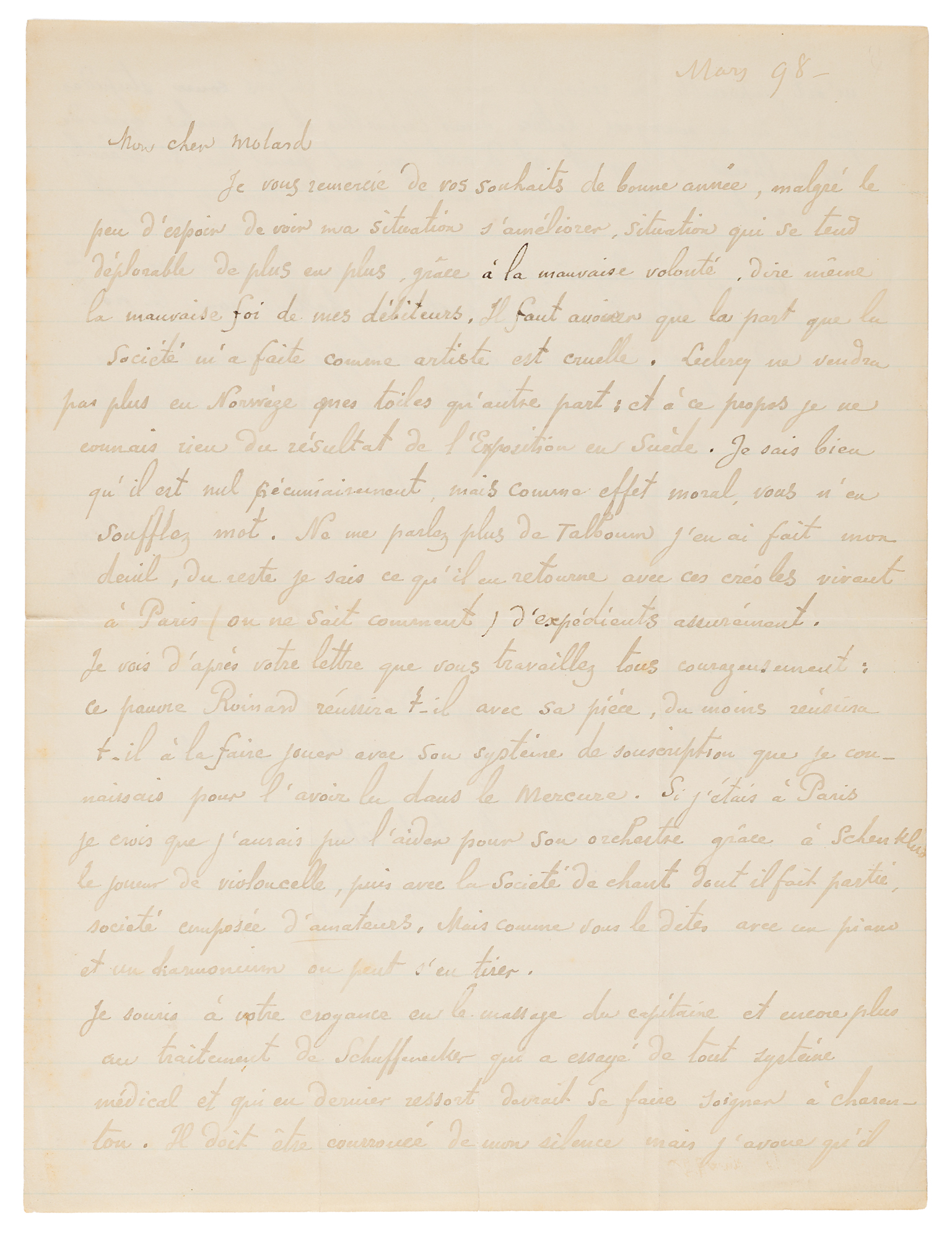
ALS in French, one page both sides, 8 x 10.5, March 1898. Handwritten letter to his close friend, the French avant-garde composer William Molard (1862-1936), in full (translated): “Thank you for your New Year wishes, even if I have little hope of seeing my situation improve. It is becoming more and more deplorable because of the reluctance, I would even say the bad faith, of my creditors. Society has certainly reserved for me, as an artist, a cruel fate. Moreover, Leclercq will sell more than paintings in Norway, and since we are at it, I do not know at all how the exhibition in Sweden went. I know well that it brought in nothing financially, but you did not say a word about its intellectual result. Do not speak to me any more about Talboum. I have dismissed him from my mind. Besides, I know what is happening with those creoles living in Paris, God knows how, through various means without a doubt. I see from your letter that you are working hard. Will the poor Roinard succeed with his play, or at least succeed in staging it with his subscription system, which I learned about in the Mercure. If I were in Paris, I think I would have help in assembling the orchestra through Schenklud, the cellist, and the Choral Society of amateur singers to which he belongs. But like everything, one can manage with a piano and a harmonium.
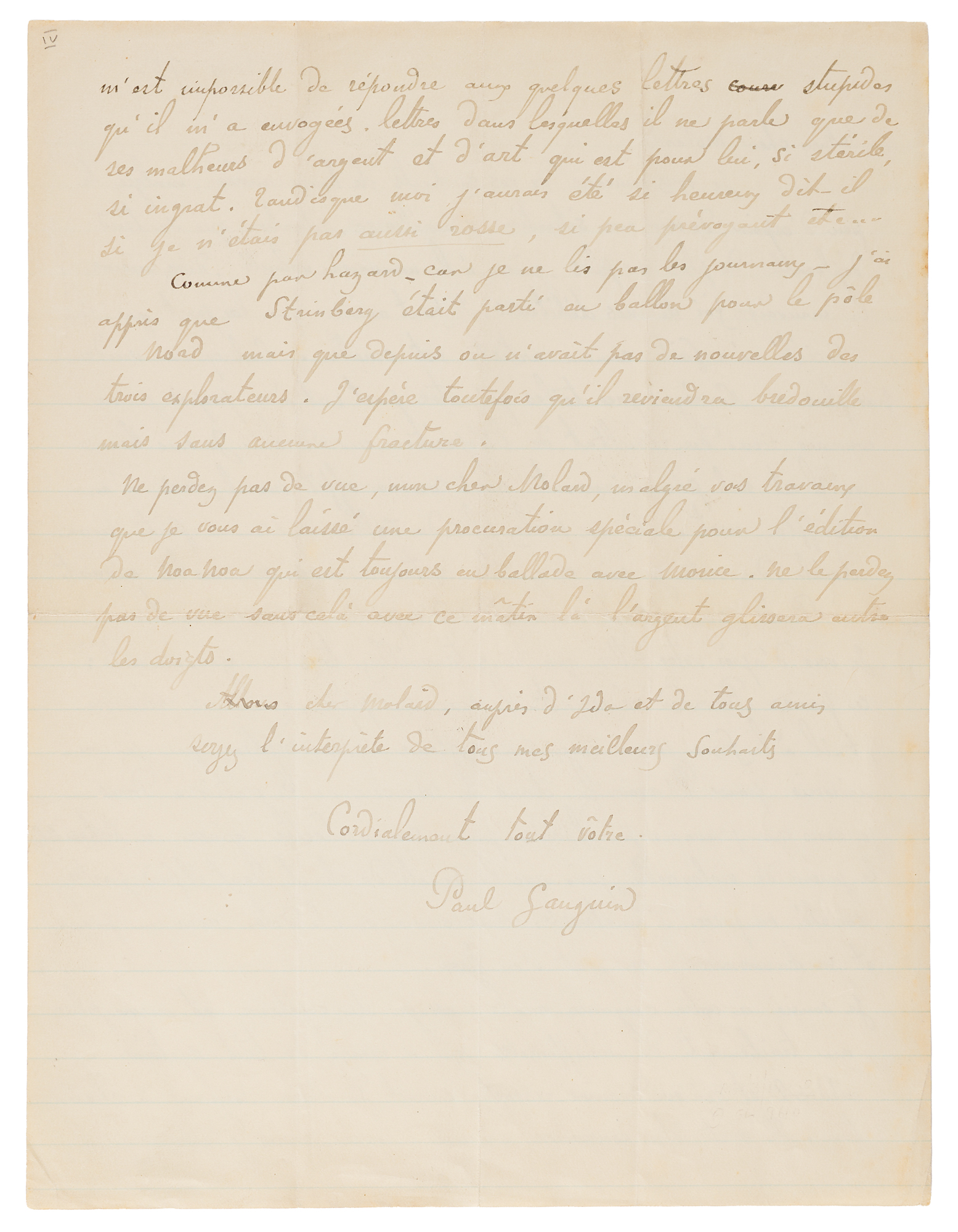
I must smile at your confidence in the captain’s message and even more at the treatment of Schuffenecker, who has tried all the medical systems known and who should, in the end, be treated in a psychiatric asylum. He must be furious at my silence. But I admit that it has been impossible for me to respond to the numerous foolish letters he has sent me. He writes exclusively about his problems of money and art, which he finds sterile and unpleasant, whereas I would have been so happy, he says, if I were not so wicked, so mean, etc. Without reading the newspapers, I learned that Strindberg had set off in a balloon toward the North Pole, but that since then there has been no news of the three explorers. I hope that he will return from a failure, but without any injury.
Do not let your work make you forget, my dear Molard, that I have given you a special authorization for the publication of Noa Noa, which is still with Maurice. Do not forget this, otherwise the money will vanish like this morning’s dew. Please, dear Molard, convey my best wishes to Ida and to all my friends.” In fine condition.
Gauguin visited Tahiti for the first time in 1891, and in 1895, enchanted and inspired by the simple beauty of the island and no longer wishing to remain in Paris, he returned. His paintings from this period are among his best, bold and colorful, depicting a society he viewed as spared from the ills of civilization. However, despite the praise of his colleagues and the efforts of dealers, Gauguin met with little success, and, reduced to poverty, he attempted suicide in late 1897 or early 1898.
Written shortly after this desperate episode, the present letter expresses Gauguin’s chronic depression and frustration to a friend who counted among his most ardent supporters. It was, for example, at the salon held by Molard and his wife, the Swedish sculptor Ida Ericson, that Gauguin was introduced to the Swedish novelist and dramatist August Strindberg (1849 to 1912). Strindberg declined Gauguin’s request to write a preface for the catalogue of the Drouot sale of February 1895, organized to raise funds for the painter’s second voyage to Tahiti.
Later in Tahiti, Gauguin was informed of Strindberg’s balloon voyage toward the North Pole. The expedition mentioned above was probably undertaken in search of the Swedish engineer Salomon Andrée and his two companions who, the previous July, had encountered the author P. Napoléon Roinard.
Emile Schuffenecker (1851 to 1934) was a French Post Impressionist artist, painter, art teacher, and collector, and one of Van Gogh’s earliest supporters. A close friend of Gauguin, he was an outspoken advocate for his work and was instrumental in organizing the important 1889 exhibition at the Volpini Gallery, a key moment in Gauguin’s career.
Julien Leclercq (1865 to 1901) was a French poet and Symbolist art critic, a contributor to the Mercure de France, and an organizer of contemporary art exhibitions. A supporter and associate of Gauguin, he at times acted as his financial secretary and helped promote his work abroad, notably in Scandinavia. In 1901, he organized a major Van Gogh retrospective in Paris at the Bernheim Jeune Galleries before dying unexpectedly later that year while preparing another exhibition.

This item is Pre-Certified by PSA/DNA
Buy a third-party letter of authenticity for
$300.00
*This item has been pre-certified by a trusted third-party authentication service, and by placing a bid on this item, you agree to accept the opinion of this authentication service. If you wish to have an opinion rendered by a different authenticator of your choosing, you must do so prior to your placing of any bid. RR Auction is not responsible for differing opinions submitted 30 days after the date of the sale.
Third-party authentication service applies only to signatures and handwriting, and does not cover the addition of sketches, artwork, musical quotations, etc.

