The 30 Minute Rule begins June 10 at 7:00 PM EDT. An Initial Bid Must Be Placed By June 10 at 6:00 PM EDT To Participate After 6:00 PM EDT
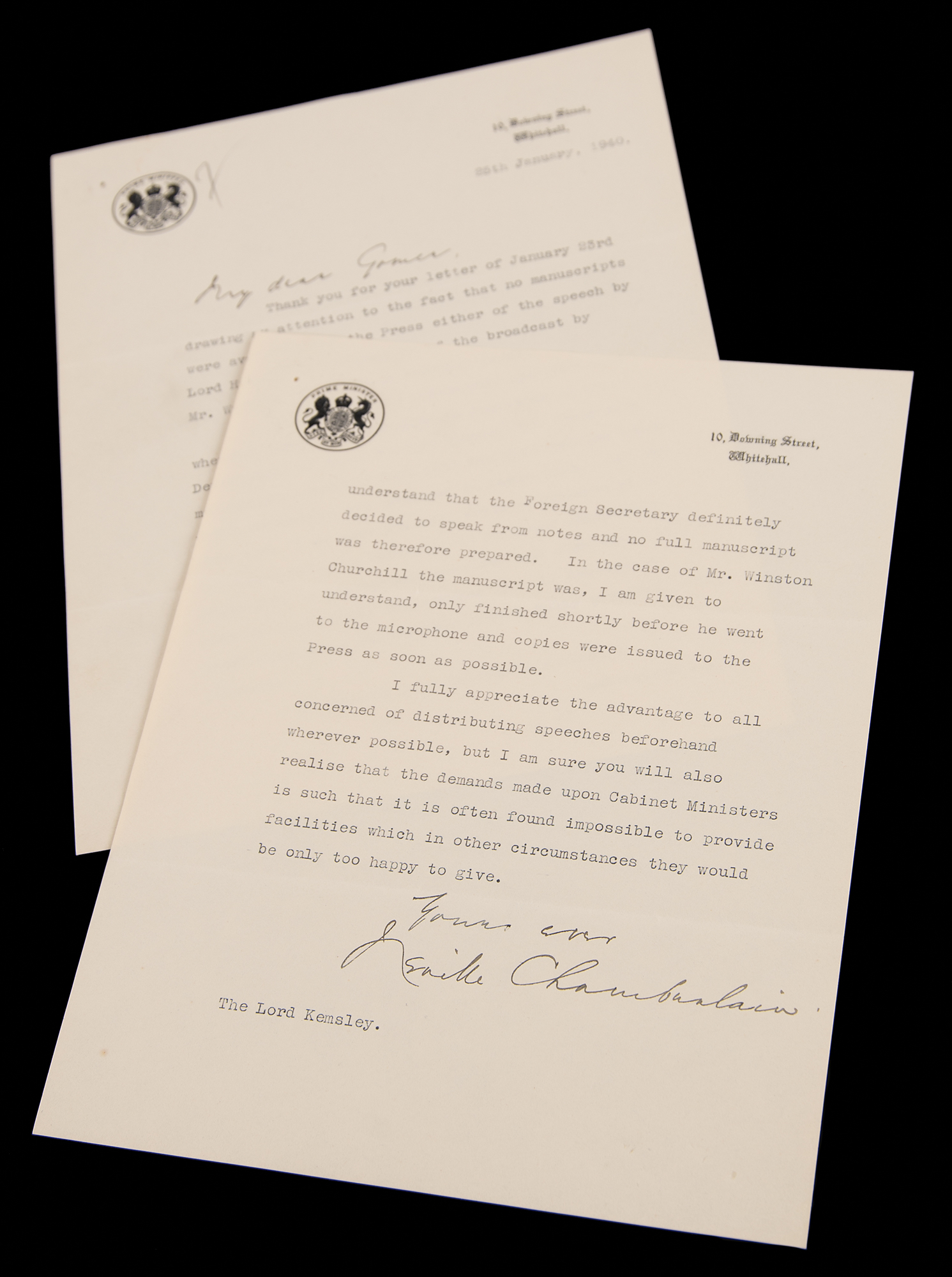
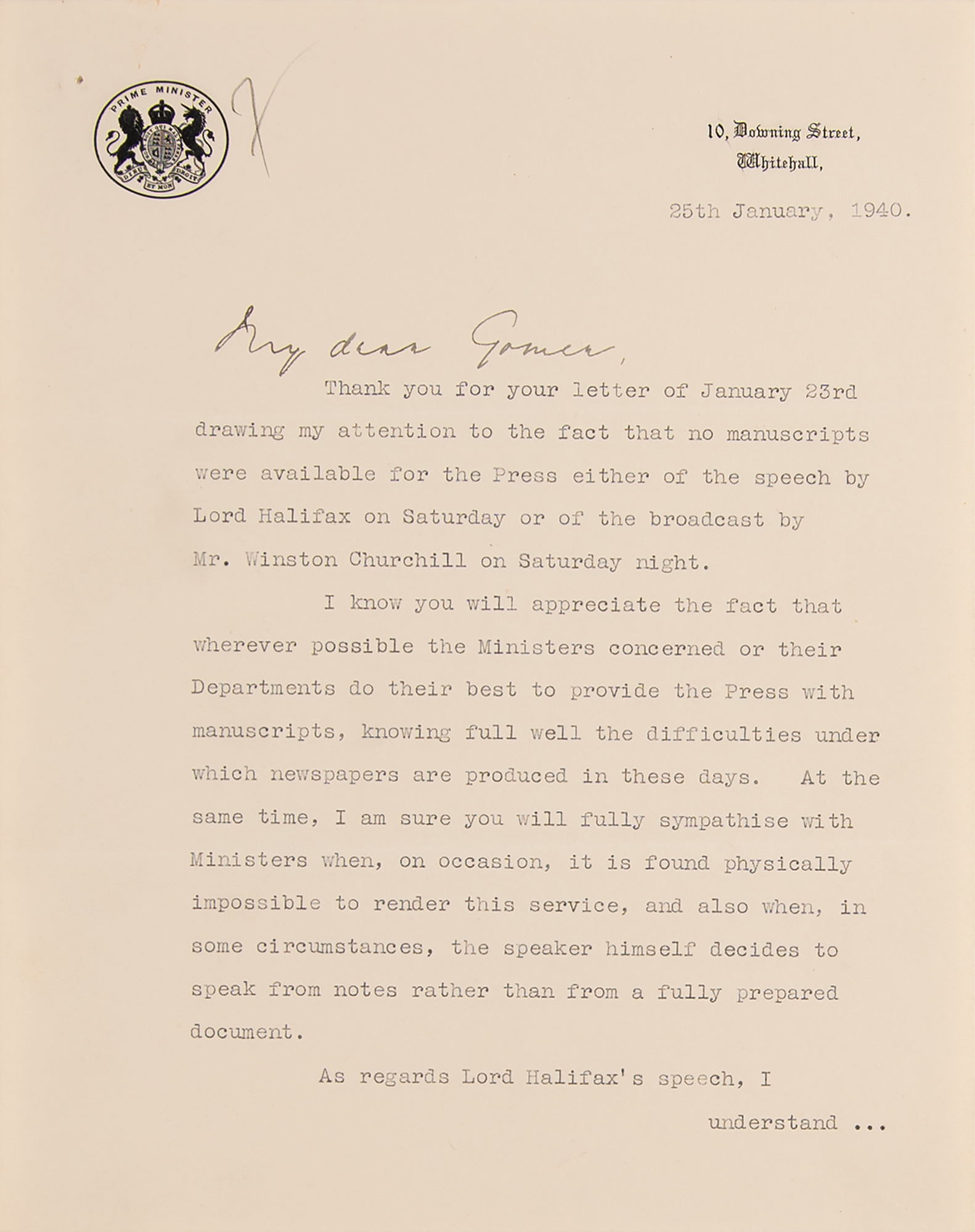
World War II–dated TLS signed “Yours ever, Neville Chamberlain,” two pages, 7.5 x 9.5, Prime Minister, 10 Downing Street letterhead, January 25, 1940. Letter to newspaper publisher Gomer Berry, 1st Viscount Kemsley, referring to Winston Churchill's famous 'House of Many Mansions' speech. In full: "Thank you for your letter of January 23rd drawing my attention to the fact that no manuscripts were available for the Press either of the speech by Lord Halifax on Saturday or of the broadcast by Mr. Winston Churchill on Saturday night.
I know you will appreciate the fact that wherever possible the Ministers concerned or their Departments do their best to provide the Press with manuscripts, knowing full well the difficulties under which newspapers are produced in these days. At the same time, I am sure you will fully sympathise with Ministers when, on occasion, it is found physically impossible to render this service, and also when, in some circumstances, the speaker himself decides to speak from notes rather than from a fully prepared document.
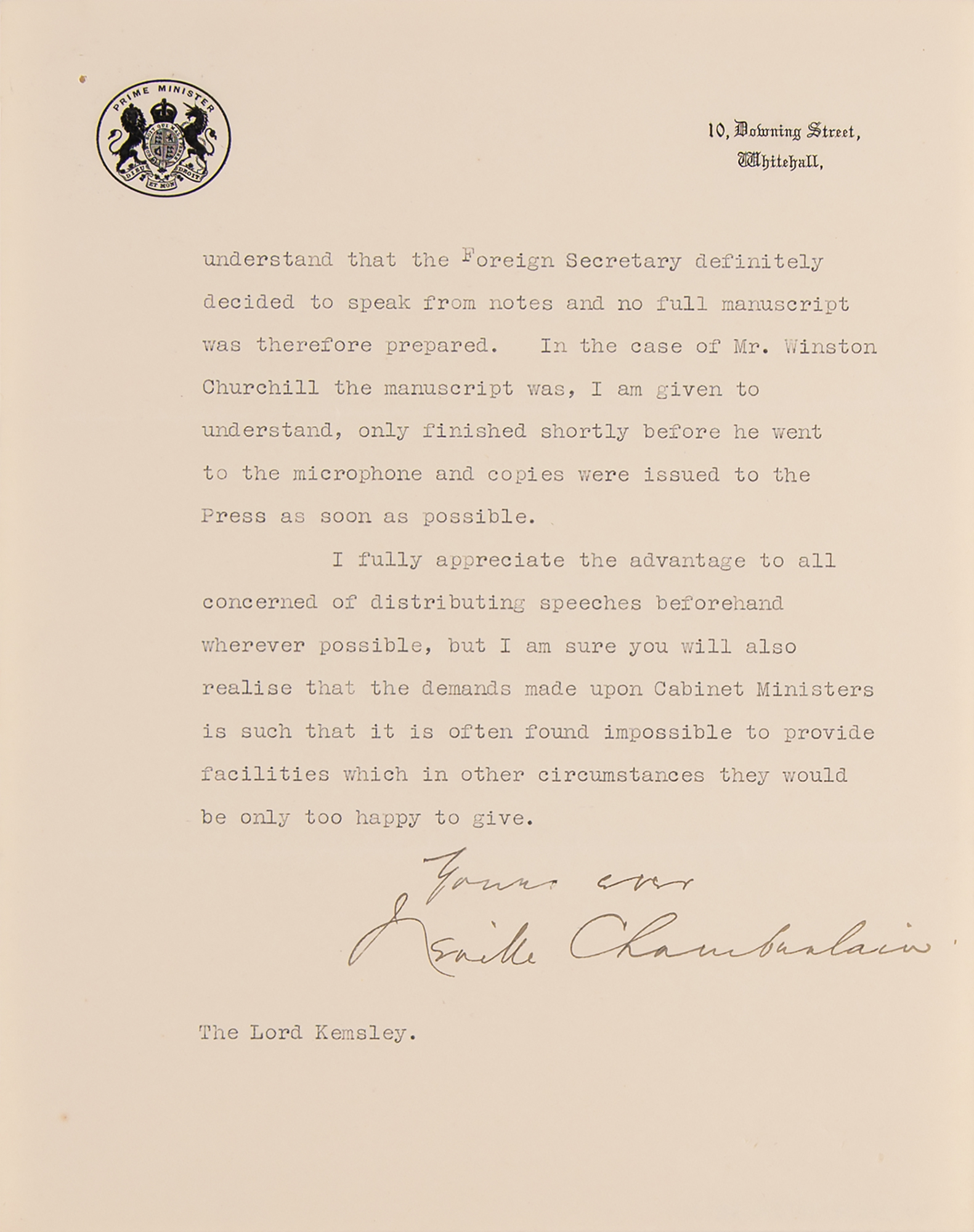
As regards Lord Halifax's speech, I understand that the Foreign Secretary definitely decided to speak from notes and no full manuscript was therefore prepared. In the case of Mr. Winston Churchill the manuscript was, I am given to understand, only finished shortly before he went to the microphone and copies were issued to the Press as soon as possible.
I fully appreciate the advantage to all concerned of distributing speeches beforehand wherever possible, but I am sure you will also realise that the demands made upon Cabinet Ministers is such that it is often found impossible to provide facilities which in other circumstances they would be only too happy to give." In fine condition.
Chamberlain refers to Winston Churchill’s speech of January 20, 1940, known as the 'House of Many Mansions' address, which was broadcast from London during the early months of World War II. Speaking as First Lord of the Admiralty, Churchill framed the conflict not merely as a military contest, but placed it in stark moral terms. He painted a grim picture of the plight of small neutral nations: 'Every one of them is wondering which will be the next victim on whom the criminal adventurers of Berlin will cast their rending stroke.' He hailed Finland’s resistance to Russian invasion as a spotlight on the rot of totalitarian regimes: 'Everyone can see how Communism rots the soul of a nation; how it makes it abject and hungry in peace, and proves it base and abominable in war.' Churchill warned that if Britain and France were to capitulate, 'nothing would remain for the smaller States of Europe…but to be divided between the opposite, though similar, barbarisms of Nazidom and Bolshevism.'
Yet he ended on a note of hope. Churchill foresaw a time when 'victorious nations…will plan and build in justice, in tradition, and in freedom a house of many mansions where there will be room for all.' In doing so, Churchill situated the war not as an isolated British struggle but as a fight for the very idea of civilization, whose outcome would determine whether a pluralistic Europe could survive.
Churchill, whose famous oratory strengthened British resolve in the face of Nazi terror, would soon supplant Chamberlain as prime minister. On May 10, 1940, Chamberlain resigned following growing criticism of his failed policy of appeasement and the disastrous Allied campaign in Norway. As Germany launched its invasion of France and the Low Countries that same day, King George VI turned to Winston Churchill to form a new government. Churchill, long a critic of appeasement, was seen as the leader best suited to rally the nation in its darkest hour, declaring upon taking office that he had nothing to offer but 'blood, toil, tears, and sweat.'

This item is Pre-Certified by PSA/DNA
Buy a third-party letter of authenticity for
$50.00
*This item has been pre-certified by a trusted third-party authentication service, and by placing a bid on this item, you agree to accept the opinion of this authentication service. If you wish to have an opinion rendered by a different authenticator of your choosing, you must do so prior to your placing of any bid. RR Auction is not responsible for differing opinions submitted 30 days after the date of the sale.
Third-party authentication service applies only to signatures and handwriting, and does not cover the addition of sketches, artwork, musical quotations, etc.

