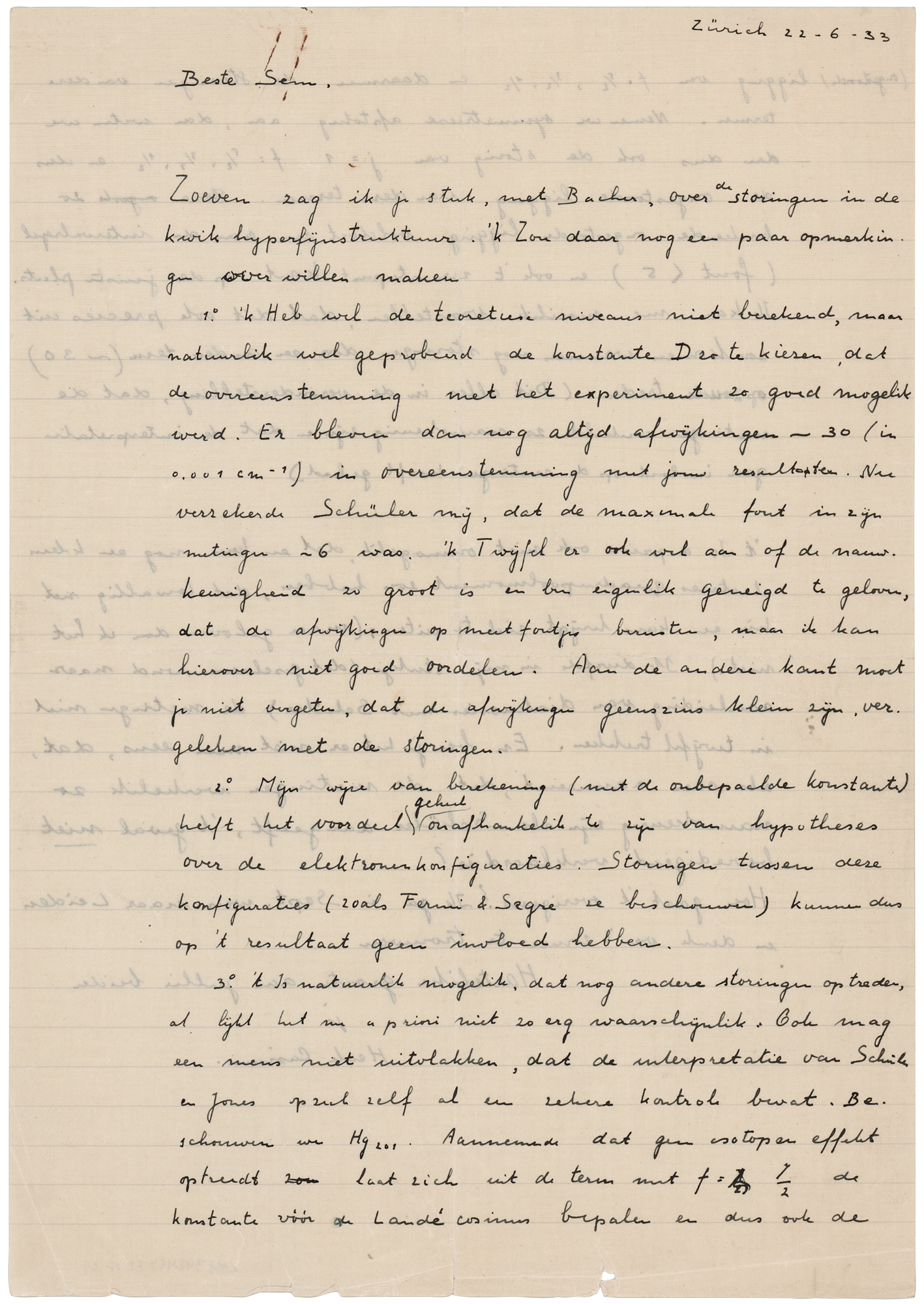
Dutch physicist (1909–2000) best known for his research on the two-fluid model of superconductors and the Casimir effect. ALS in Dutch, signed “Henk. Casimir,” one page both sides, 8.25 x 11.75, June 22, 1933. Letter to Dutch-American physicist Samuel A. Goudsmit. In part (translated): "I just saw your piece…about failures in the mercury hyperfine structure. I would like to make a few comments about that. 1st. I did not want to calculate the theoretical levels, but obviously tried to select the constant ‘D,’ that compliance with the experiment was as good as possible. There were still deviations ~30 (0.001 cm-1) in accordance with your results. Now Schüler assured me that the maximum error in his measurement was ~6. I also doubt whether the accuracy is so great and I am actually inclined to believe that the deviations are based on mistakes, but I cannot judge properly about it. On the other hand you have to remember that the differences are rather small compared to the faults.
2nd. My method of calculation (with the indefinite/undetermined constant) has the advantage of being completely independent of hypotheses about the electron configurations. Disruptions between these configurations (as Fermi & Segre consider) can therefore have no influence on the result.
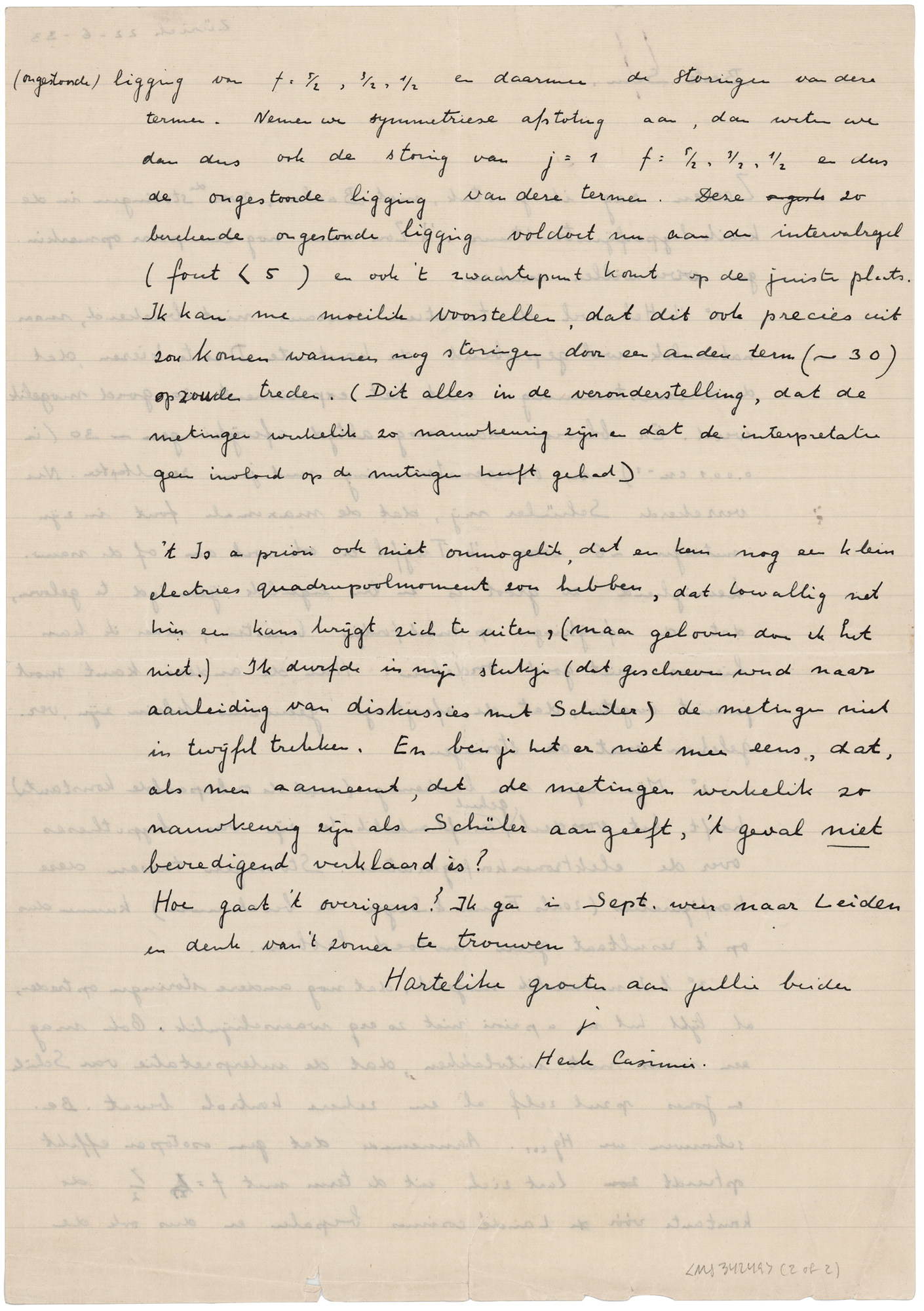
3rd. It is of course possible that additional issues can occur interference, though it appears a priori not very probable. Nor should a person flatten out, that the interpretation of Schüler and Jones in itself already contains a certain control. If we consider Hg 201 assuming no isotope effect is let out, the term with f = 7/2 determine the constant in front of the Landé cosine and therefore (established) location of f = 5/2, 3/2, 1/2, and hence, the interference of these terms. If we take a symmetrical adjustment, then we also know the interference of j = 1, f = 5/2, 3/2, 1/2 and thus the undisturbed location of these terms. This thus calculated undisturbed location and will now meet the interval control (error <5), and also the center of gravity comes to the right place. I can hardly imagine that this exactly would come out even when interference would occur with another term (~30). (All this assuming that the measurements are really accurate and that the interpretation has had no influence on the measurements).
It is a priori not impossible that and can still would have a small electric dipole moment in terms that will not happen to have a chance to express here, (but I can believe it). I did not dare question the measurements in my text (which was written in response to discussions with Schüler). If you do not agree with this on behalf of the fact that the measurements are really as accurate as Schüler indicates, in that case it is declared unsatisfactory. How are you doing? I'm going back to Leiden in September, I think I'm getting married in the summer." In fine condition, with a rusty paperclip impression to the top edge, and some tiny tears to the bottom edge.
In this remarkable letter, Casimir discusses in great technical detail the hyperfine structure of mercury and his experimental means of taking measurements. In doing so, he makes reference to fellow physicists Hermann Schüler, Enrico Fermi, and Emilio Segre. Casimir’s letters with scientific content are very rare.

This item is Pre-Certified by PSA/DNA
Buy a third-party letter of authenticity for
(inquire for price)
*This item has been pre-certified by a trusted third-party authentication service, and by placing a bid on this item, you agree to accept the opinion of this authentication service. If you wish to have an opinion rendered by a different authenticator of your choosing, you must do so prior to your placing of any bid. RR Auction is not responsible for differing opinions submitted 30 days after the date of the sale.
Third-party authentication service applies only to signatures and handwriting, and does not cover the addition of sketches, artwork, musical quotations, etc.

