Sold For $2,625
*Includes Buyers Premium
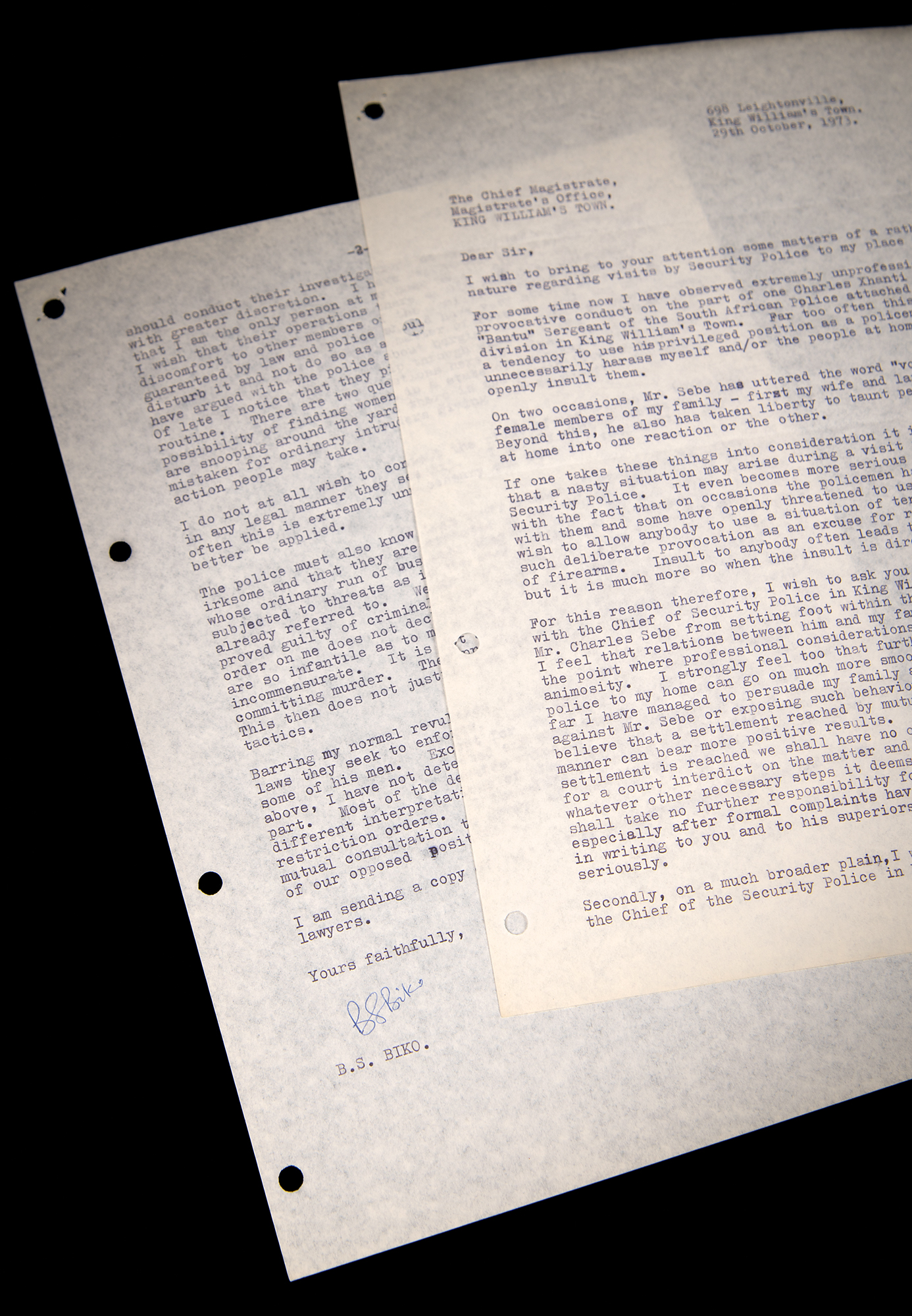
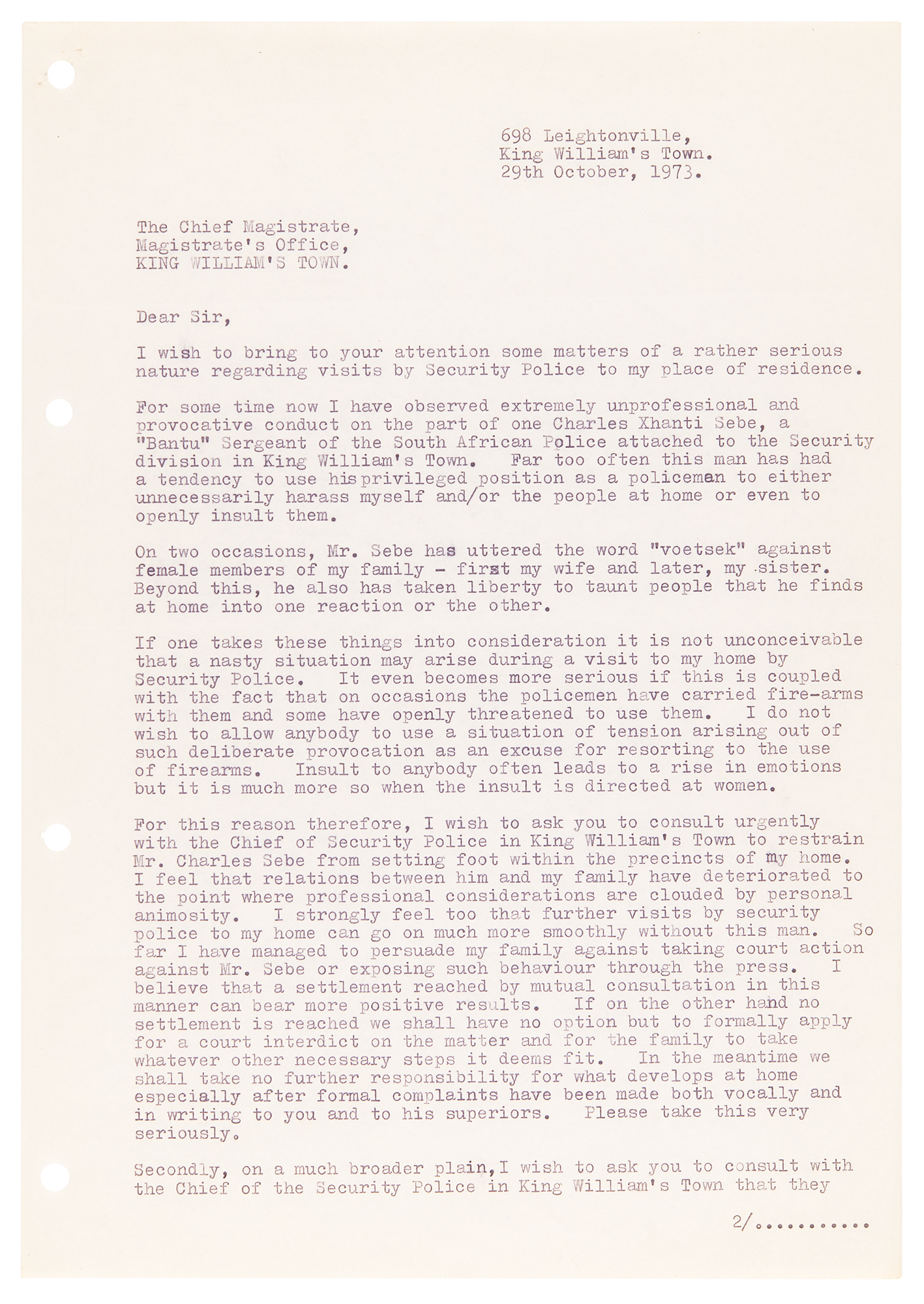
South African anti-apartheid activist (1946–1977) at the forefront of the Black Consciousness Movement during the late 1960s and 1970s, known for popularizing the slogan 'Black Is Beautiful.' He was severely beaten during an interrogation by police and died of his wounds while imprisoned. TLS signed “B. S. Biko,” two pages, 8.25 x 11.75, October 29, 1973. Letter to the chief magistrate of King William's Town, complaining of police harassment. In full: "I wish to bring to your attention some matters of a rather serious nature regarding visits by Security Police to my place of residence.
For some time now I have observed extremely unprofessional and provocative conduct on the part of one Charles Xhanti Sebe, a 'Bantu' Sergeant of the South African Police attached to the Security division in King William's Town. Far too often this man has had a tendency to use his privileged position as a policeman to either unnecessarily harass myself and/or the people at home or even to openly insult them.
On two occasions, Mr. Sebe has uttered the word 'voetsek' against female members of my family first my wife and later, my sister. Beyond this, he also has taken liberty to taunt people that he finds at home into one reaction or the other.
If one takes these things into consideration it is not unconceivable that a nasty situation may arise during a visit to my home by Security Police. It even becomes more serious if this is coupled with the fact that on occasions the policemen have carried fire-arms with them and some have openly threatened to use them. I do not wish to allow anybody to use a situation of tension arising out of such deliberate provocation as an excuse for resorting to the use of firearms. Insult to anybody often leads to a rise in emotions but it is much more so when the insult is directed at women.
For this reason therefore, I wish to ask you to consult urgently with the Chief of Security Police in King William's Town to restrain Mr. Charles Sebe from setting foot within the precincts of my home. I feel that relations between him and my family have deteriorated to the point where professional considerations are clouded by personal animosity. I strongly feel too that further visits by security police to my home can go on much more smoothly without this man. So far I have managed to persuade my family against taking court action against Mr. Sebe or exposing such behaviour through the press. I believe that a settlement reached by mutual consultation in this manner can bear more positive results. If on the other hand no settlement is reached we shall have no option but to formally apply for a court interdict on the matter and for the family to take whatever other necessary steps it deems fit. In the meantime we shall take no further responsibility for what develops at home especially after formal complaints have been made both vocally and in writing to you and to his superiors. Please take this very seriously.
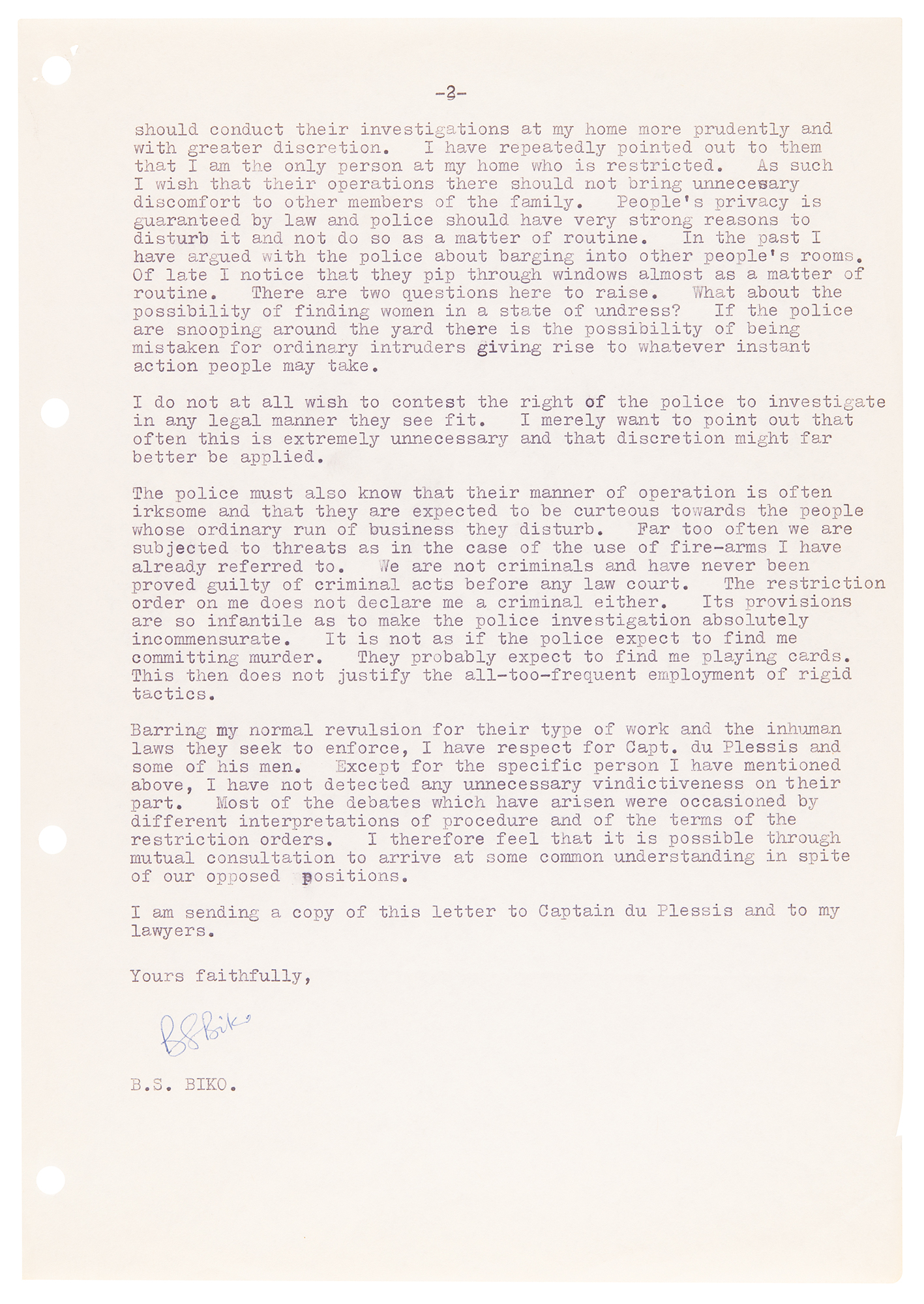
Secondly, on a much broader plain, I wish to ask you to consult with the Chief of the Security Police in King William's Town that they should conduct their investigations at my home more prudently and with greater discretion. I have repeatedly pointed out to them that I am the only person at my home who is restricted. I wish that their operations there should not bring unnecessary discomfort to other members of the family. People's privacy is guaranteed by law and police should have very strong reasons to disturb it and not do so as a matter of routine. In the past I have argued with the police about barging into other people's rooms. Of late I notice that they pip through windows almost as a matter of routine. There are two questions here to raise. What about the possibility of finding women in a state of undress? If the police are snooping around the yard there is the possibility of being mistaken for ordinary intruders giving rise to whatever instant action people may take.
I do not at all wish to contest the right of the police to investigate in any legal manner they see fit. I merely want to point out that often this is extremely unnecessary and that discretion might far better be applied.
The police must also know that their manner of operation is often irksome and that they are expected to be courteous towards the people whose ordinary run of business they disturb. Far too often we are subjected to threats as in the case of the use of fire-arms I have already referred to. We are not criminals and have never been proved guilty of criminal acts before any law court. The restriction order on me does not declare me a criminal either. Its provisions are so infantile as to make the police investigation absolutely incommensurate. It is not as if the police expect to find me committing murder. They probably expect to find me playing cards. This then does not justify the all-too-frequent employment of rigid tactics.
Barring my normal revulsion for their type of work and the inhuman laws they seek to enforce, I have respect for Capt. du Plessis and some of his men. Except for the specific person I have mentioned above, I have not detected any unnecessary vindictiveness on their part. Most of the debates which have arisen were occasioned by different interpretations of procedure and of the terms of the restriction orders. I therefore feel that it is possible through mutual consultation to arrive at some common understanding in spite of our opposed positions.
I am sending a copy of this letter to Captain du Plessis and to my lawyers." In fine condition.
This 1973 letter from Steve Biko to the chief magistrate of King William’s Town reflects the daily harassment he and his family endured under South Africa’s apartheid regime. At the time, Biko was under a government 'banning order' that severely restricted his movements and subjected him to constant surveillance. In the letter, he protests the abusive conduct of Sergeant Charles Sebe, who repeatedly insulted and intimidated Biko’s family members, including his wife and sister. Biko’s appeal highlights both the personal strain of police intrusion into private life and his broader critique of the arbitrary and demeaning tactics of apartheid security forces. The letter underscores his measured insistence on dignity, legal redress, and nonviolent resolution, even as he was targeted for his leadership in the Black Consciousness Movement.

This item is Pre-Certified by PSA/DNA
Buy a third-party letter of authenticity for
(inquire for price)
*This item has been pre-certified by a trusted third-party authentication service, and by placing a bid on this item, you agree to accept the opinion of this authentication service. If you wish to have an opinion rendered by a different authenticator of your choosing, you must do so prior to your placing of any bid. RR Auction is not responsible for differing opinions submitted 30 days after the date of the sale.
Third-party authentication service applies only to signatures and handwriting, and does not cover the addition of sketches, artwork, musical quotations, etc.

