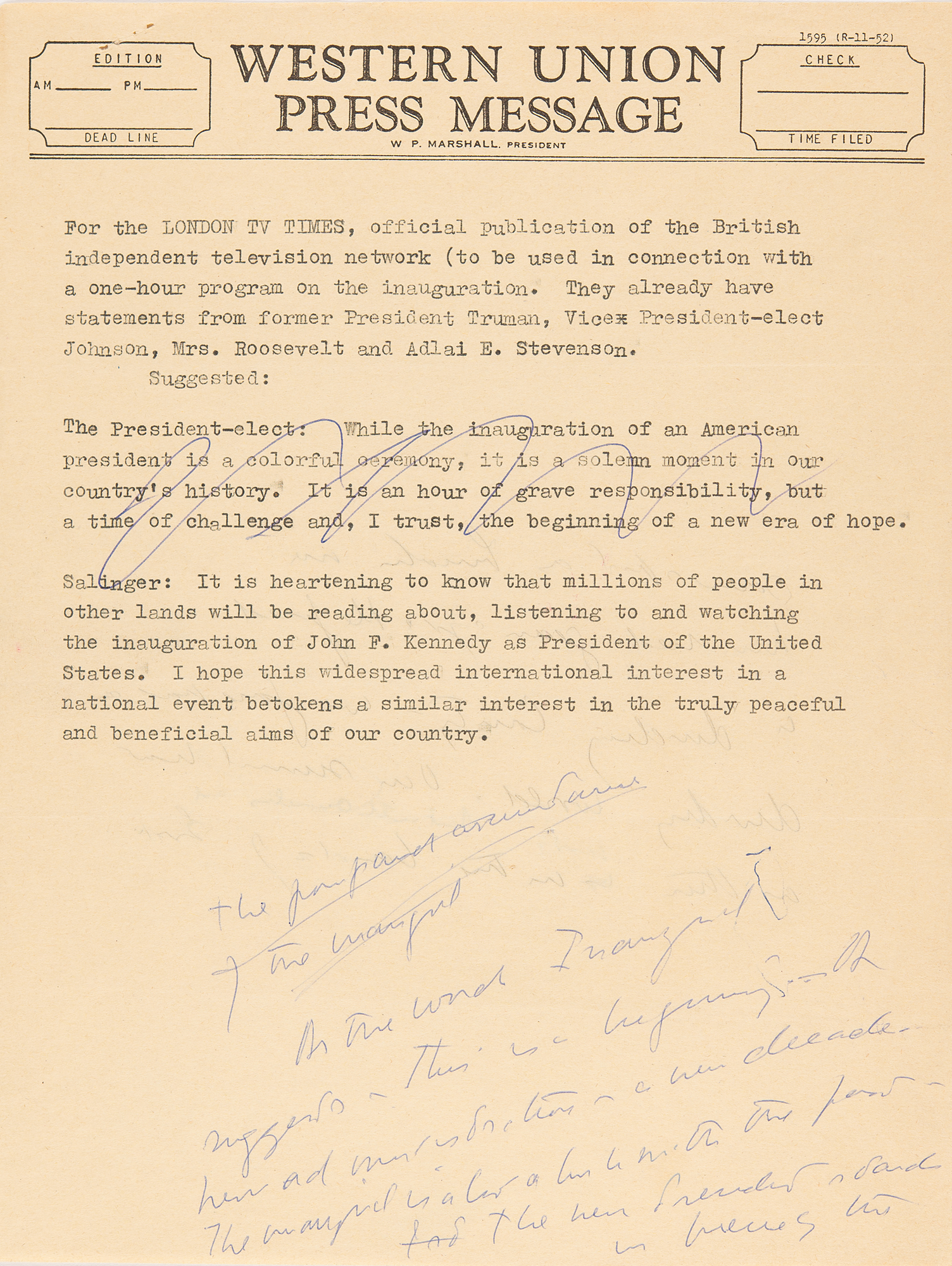
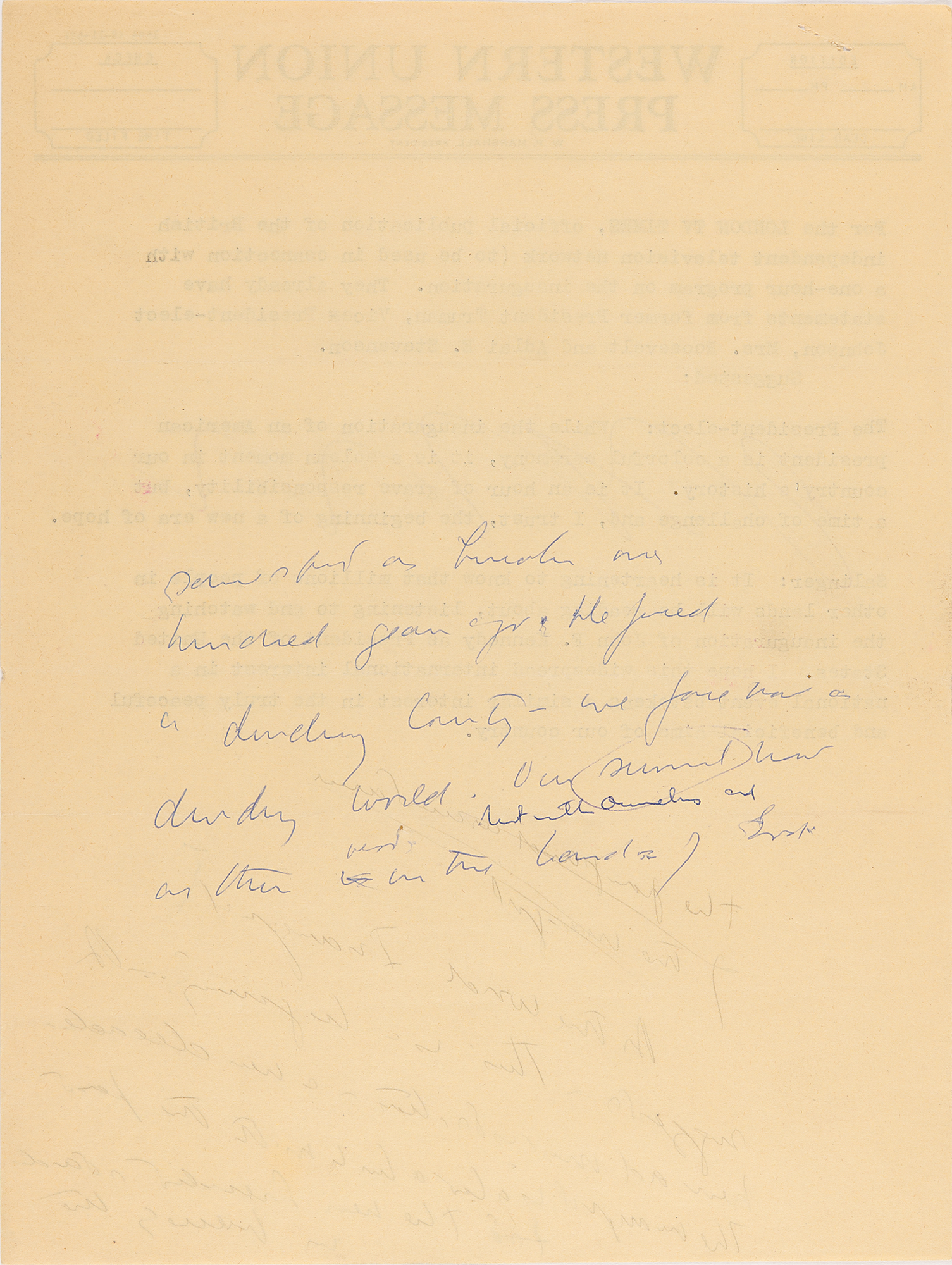
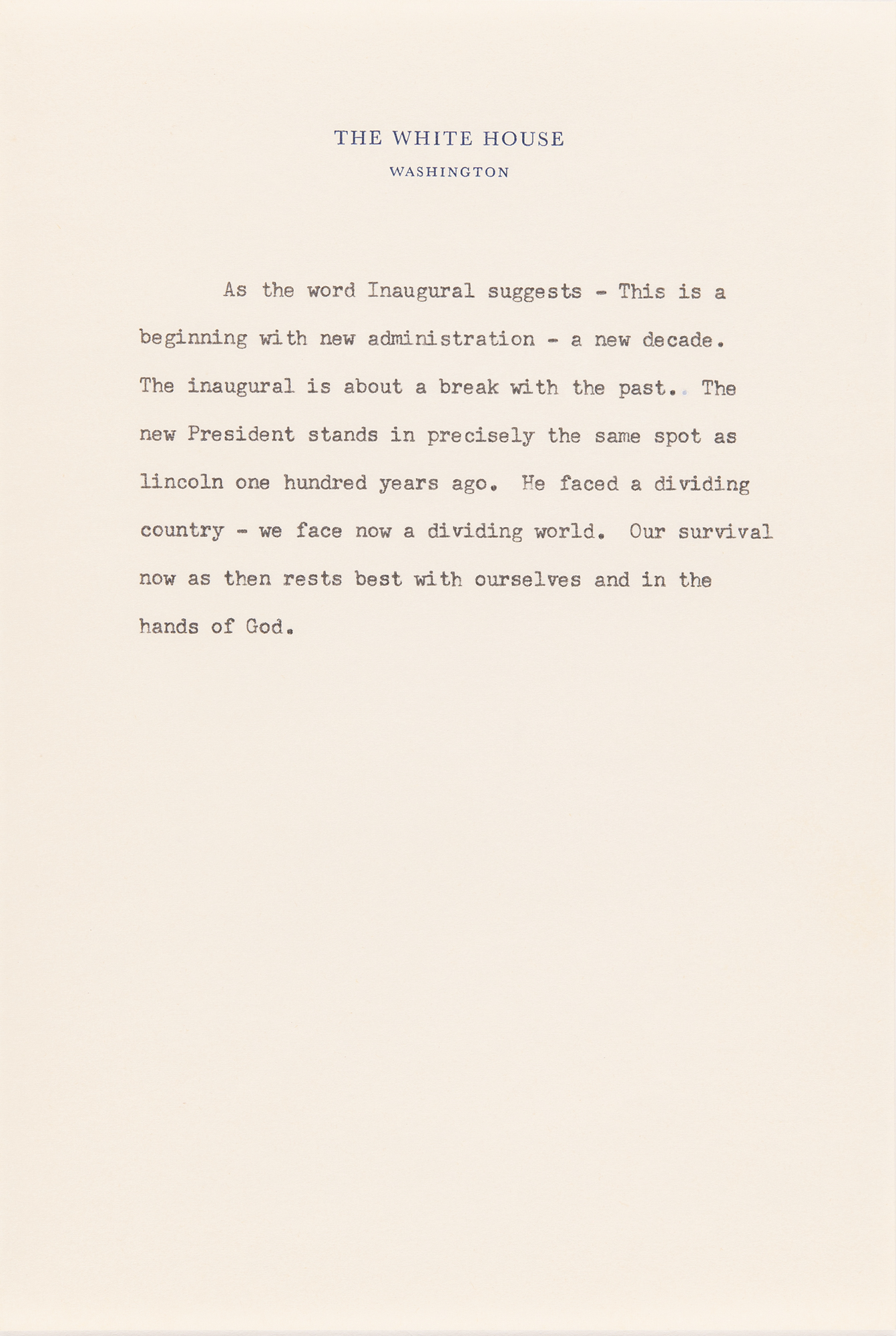
Handwritten draft statement from President-elect John F. Kennedy to White House correspondent Merriman Smith of United Press International, unsigned, penned by Kennedy in blue ballpoint on both sides of a Western Union Press Message telegram, 8 x 10.5, which Merriman had forwarded to Kennedy for approval in the lead-up to the latter’s historic inauguration on January 20, 1961. Unsatisfied with the quote attributed to him, “The President-elect,” Kennedy has struck through the second paragraph and added his own statement below. He starts with “The pomp and circumstance of the inaugural,” but then strikes through that and begins anew: “As the word Inaugural suggests – This is a beginning with new administration – a new decade. The inaugural is about a break with the past. The new President stands in precisely the same spot as Lincoln one hundred years ago. He faced a dividing country – we face now a dividing world. Our survival now as then rests best with ourselves and in the hands of God.”
Kennedy’s original attributed statement, which is bookended by a paragraph related to the London TV Times inauguration coverage and a statement made by The Catcher in the Rye author J. D. Salinger, reads: “While the inauguration of an American president is a colorful ceremony, it is a solemn moment in our country's history. It is an hour of grave responsibility, but a time of challenge and, I trust, the beginning of a new era of hope.” In fine condition.
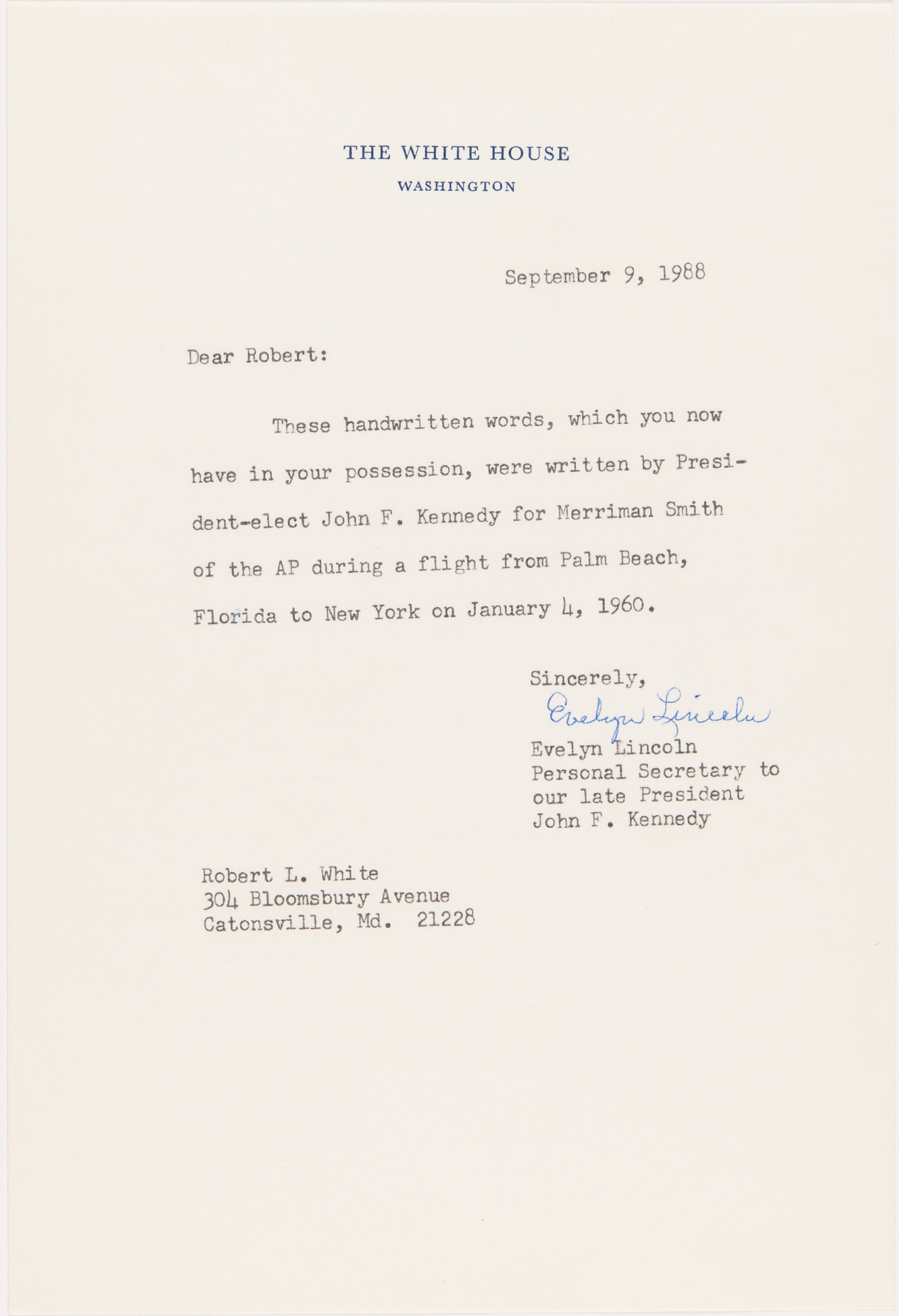
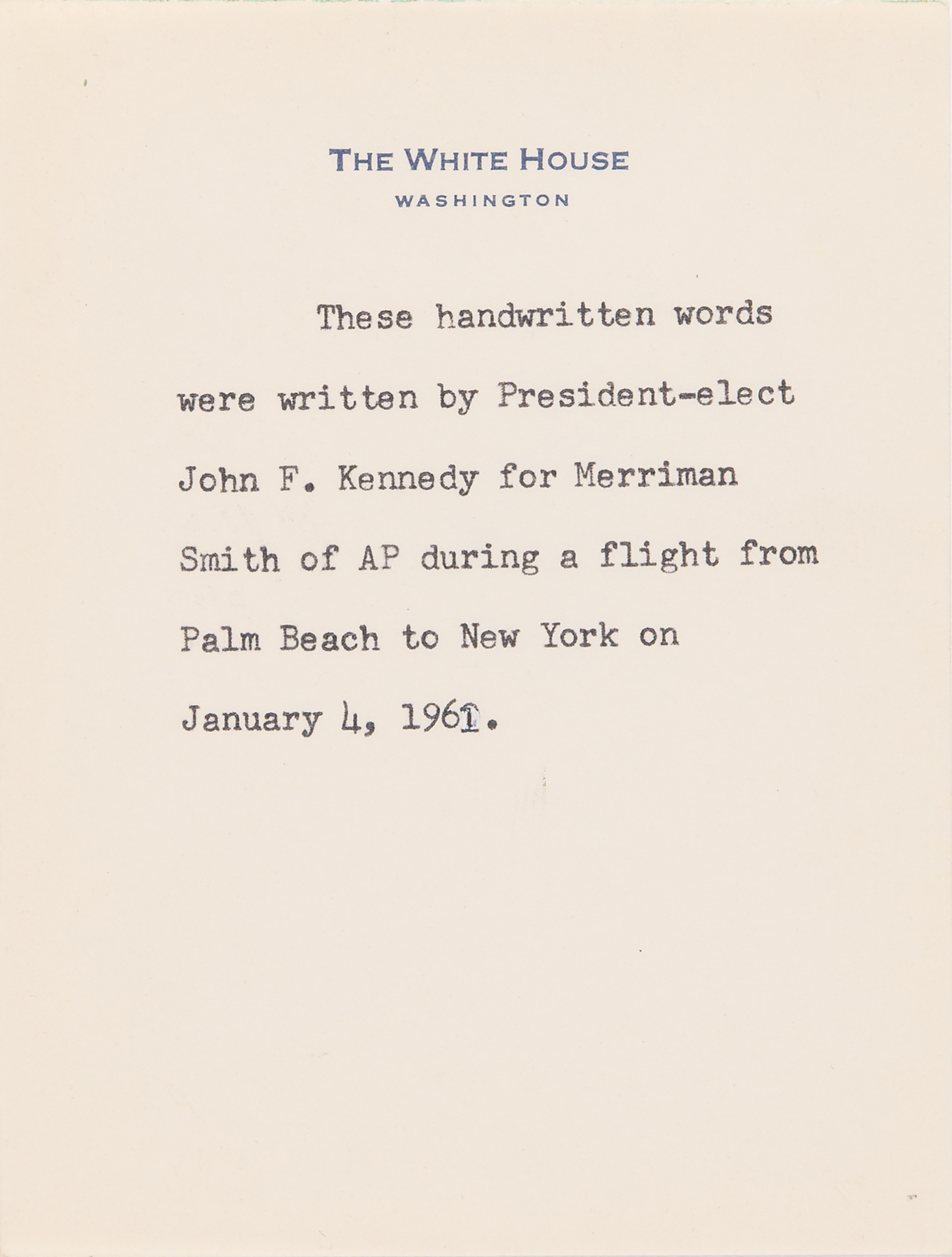
Accompanied by a 1988 letter of provenance sent to noted JFK collector Robert L. White by Evelyn Lincoln, John F. Kennedy's personal secretary, which reads: “These handwritten notes, which you now have in your possession, were written by President-elect John F. Kennedy for Merriman Smith of the AP during a flight from Palm Beach, Florida to New York on January 4, 1960.” Lincoln has errantly written 1960 instead of 1961; a second included letter has amended that mistake.
These January 4th notes introduced ideas and phrasings that Kennedy later expanded and refined in a 9-page inaugural speech draft that he wrote two weeks later, on January 17th, which is now in the JFK Library. The start of our offered statement, “As the word inaugural suggests – This is a beginning with new administration – a new decade. The inaugural is about a break with the past,” was condensed and revised in the January 17th draft to read, ‘An inaugural is an end as well as a beginning.’
Another instance relates to the line, “The new President stands in precisely the same spot as Lincoln one hundred years ago.” Kennedy develops this phrase in the 17th draft, broadening it into a shared lineage of presidents: ‘Today I am linked with the 35 other Presidents, three of whom are with us today and stood in this same place.’
Another from the 4th finds Kennedy observing, “He [Lincoln] faced a dividing country – we face now a dividing world. Our survival now as then rests best with ourselves and in the hands of God.” In the subsequent version, JFK shifted the historical framework away from Lincoln to the revolutionary founders, writing: ‘The world is very different now….the concept that the rights of man come not from the generosity of the state but from the hand of God.’
Eager to make a lasting impression with his own inaugural address, Kennedy turned to Lincoln’s Second Inaugural—long celebrated as one of the greatest inauguration speeches—as the benchmark he hoped to match. To accomplish this, he asked his speechwriter, Ted Sorensen, to tally the word counts of various presidential inaugurals, a select group that included Lincoln’s Gettysburg Address. Both men deeply admired Lincoln’s oratory, with Kennedy regarding the Gettysburg Address as the ideal example of a short, memorable, and powerful speech. A comparison of Kennedy’s Inaugural Address with Lincoln’s First Inaugural revealed a familiar line:
Lincoln: ‘In your hands, my dissatisfied fellow countrymen, and not in mine, is the momentous issue of civil war.’
Kennedy: ‘In your hands, my fellow citizens, more than mine, will rest the final success or failure of our course.’
This item is Pre-Certified by PSA/DNA
Buy a third-party letter of authenticity for
$200.00
*This item has been pre-certified by a trusted third-party authentication service, and by placing a bid on this item, you agree to accept the opinion of this authentication service. If you wish to have an opinion rendered by a different authenticator of your choosing, you must do so prior to your placing of any bid. RR Auction is not responsible for differing opinions submitted 30 days after the date of the sale.
Third-party authentication service applies only to signatures and handwriting, and does not cover the addition of sketches, artwork, musical quotations, etc.

