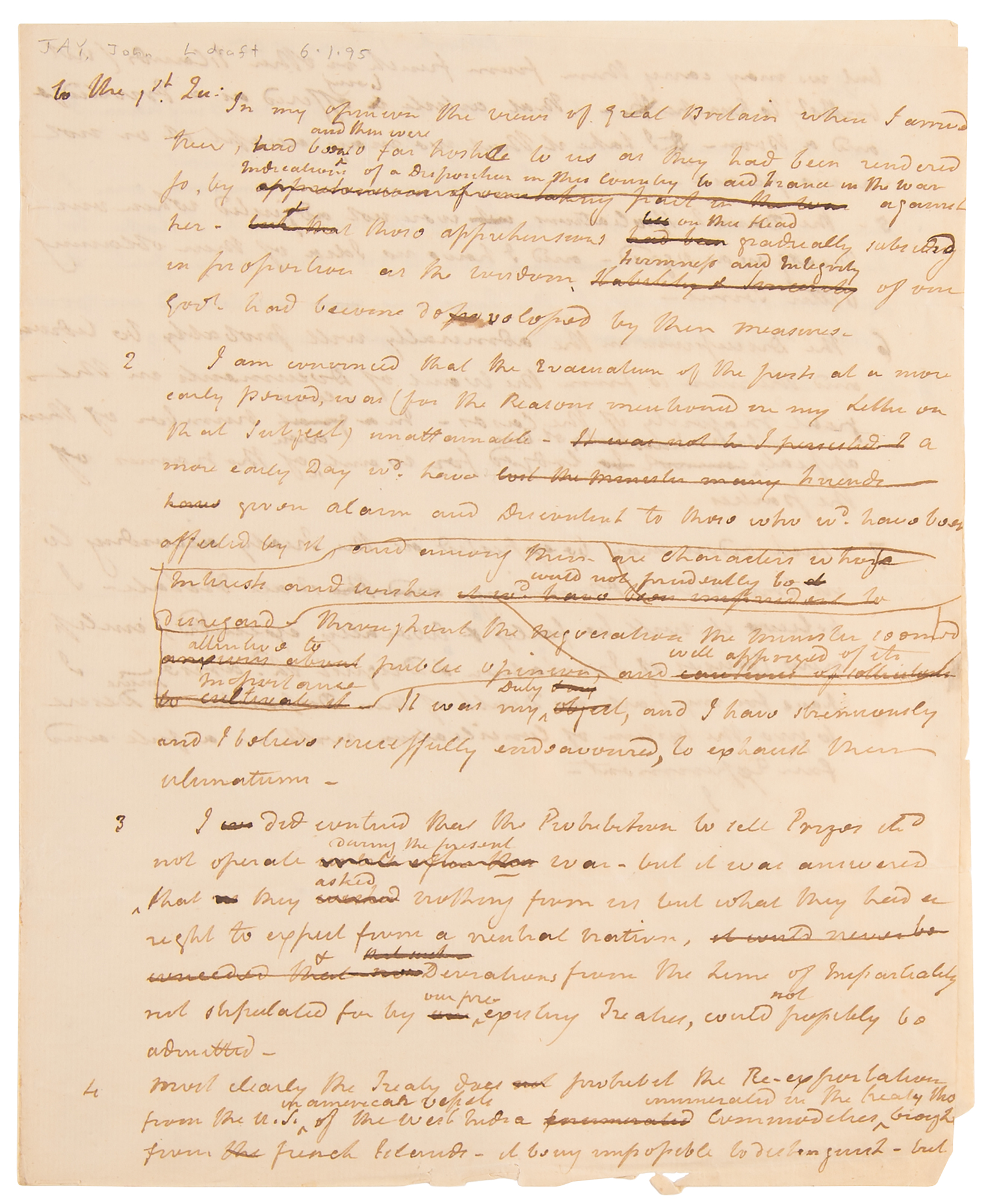
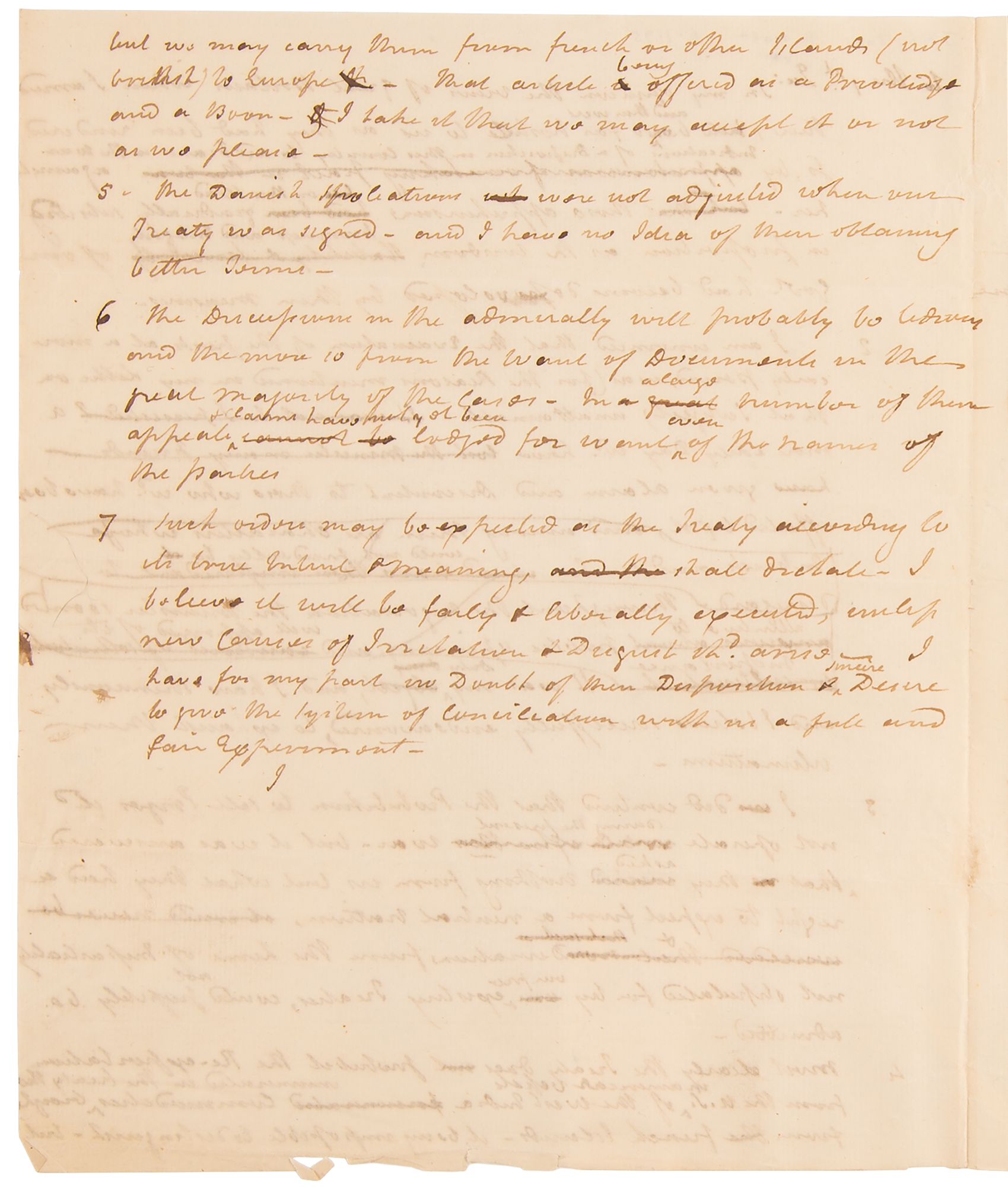
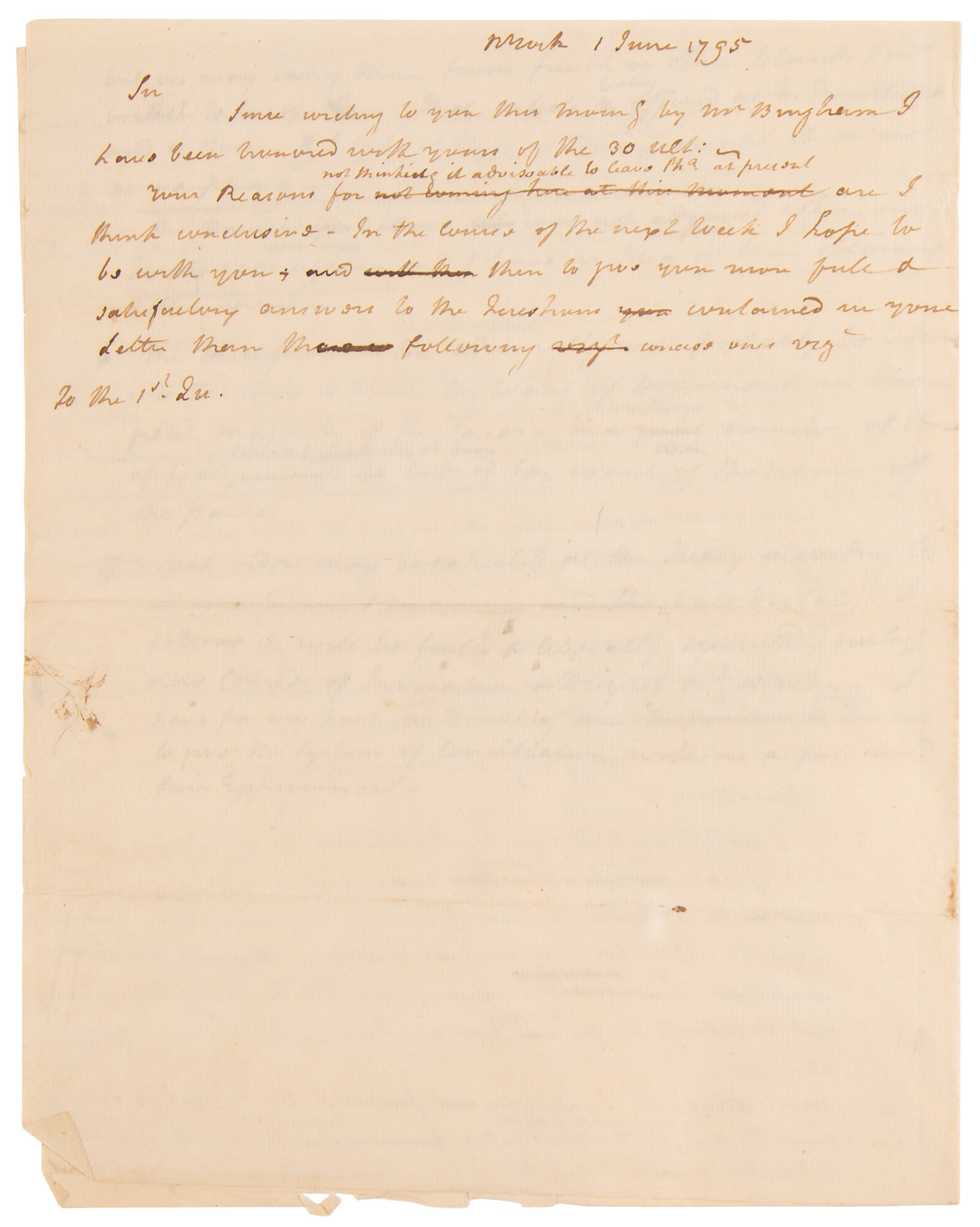
Historic unsigned handwritten draft of a letter by John Jay, three pages on two adjoining sheets, 8 x 10, June 1, 1795. Handwritten draft giving his defense of his treaty with Great Britain, prior to its ratification by the United States Senate. In part: "Your reasons for not thinking it advisable to leave Philadelphia at present are I think conclusive. In the course of the next week I hope to be with you and then to give you more full and satisfactory answers to the questions contained in your letter than the following concise ones, viz.
To the 1st Qu.: In my opinion the views of Great Britain when I arrived there had been and then were so far hostile to us, as they had been rendered so by indications of a disposition in this country to aid France in the war against her. Their apprehensions on this head gradually subsided in proportion as the wisdom, firmness and integrity of our government had become developed by their measures.
2. I am convinced that the evacuation of the posts at a more early period was (for the reasons mentioned in my letter on that subject) unattainable. A more early day would have given alarm and discontent to those who would have been affected by it, and among these are characters whose interests and wishes would not prudently be disregard[ed]. Throughout the negotiations the Minister seemed attentive to public opinion and well apprised of its importance. It was my duty, and I have strenuously and I believe successfully endeavored, to exhaust their ultimatum.
3. I did contend that the prohibition to sell prizes should not operate during the present war, but it was answered that they asked nothing from us but what they had a right to expect from a neutral nation, and deviations from the lien of impartiality not stipulated for by our pre-existing treaties could not possibly be admitted.
4. Most clearly the Treaty does prohibit the re-exportation from the U. S. in American vessels of the West Indies commodities enumerated in the treaty they brought from French Islands it being impossible to distinguish—but we may carry them from French or other islands (not British) to Europe. That article being offered as a privilege and a boon. I take it that we may accept it or not as we please.
5. The Danish spoliations were not adjusted when our treaty was signed, and I have no idea of their obtaining better terms.
6. The discussion in the admiralty will probably be tedious, and the more so from the want of documents in the great majority of the cases. In a large number of them appeals and claims have not yet been lodged for want even of the names of the parties.
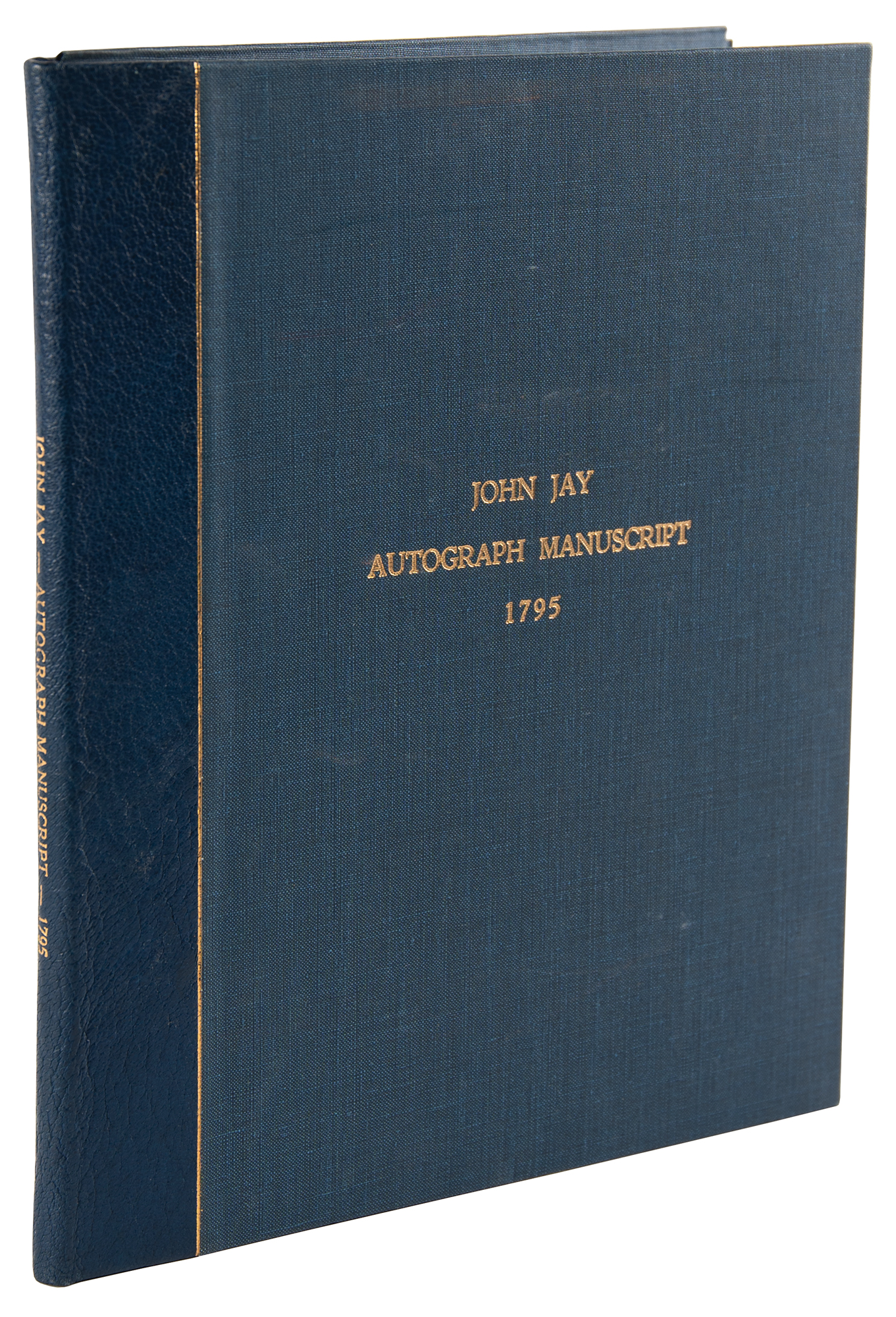
7. Such orders may be expected as the Treaty according to its true intent and meaning shall dictate. I believe it will be fairly and literally executed, unless new courses of irritation and disgust should arise. I have for my part no doubt of their disposition and sincere desire to give the system of conciliation with us a full and fair Experiment." Jay makes substantial revisions throughout the text, striking through and rewriting several lines. In fine condition. Accompanied by a custom-made quarter-leather presentation folder.
In 1794 the United States faced its most important foreign crisis since the Revolution, and as Chief Justice, John Jay was selected by George Washington to negotiate a settlement with Great Britain concerning that country's continued occupation of posts in the northwest, pending private debts to English creditors, and the British plunder of neutral American shipping during their hostilities with France. The importance to the young America of maintaining peace and financial stability was enormous, and Jay spent the summer of 1794 in London negotiating with Lord Grenville to reach an agreement.
The result of his work, the Jay Treaty, which was signed on November 19, 1794, created a system to settle financial claims between the two nations, provided for the removal of British troops from the Northwest Territory, established commissions to settle boundary disputes on the northern frontier, and extended free trade and navigation guarantees to the English on the Mississippi River. It was submitted to the United States Senate for its advice and consent on June 8, 1795, and ratified by a two-thirds majority on June 24, 1795.
The Treaty, however, aroused a storm of protest in the United States among the Jeffersonian Republicans, who denounced it as a sellout by pro-British Federalists. Mobs burned Jay in effigy, and opponents denounced him as a traitor. Before the negotiations, Jay at one time had been considered a leading candidate to succeed Washington, but the unpopular treaty ruined whatever chances he had for the presidency. New York Federalists, however, elected him governor after his return from England.
This item is Pre-Certified by PSA/DNA
Buy a third-party letter of authenticity for
$100.00
*This item has been pre-certified by a trusted third-party authentication service, and by placing a bid on this item, you agree to accept the opinion of this authentication service. If you wish to have an opinion rendered by a different authenticator of your choosing, you must do so prior to your placing of any bid. RR Auction is not responsible for differing opinions submitted 30 days after the date of the sale.
Third-party authentication service applies only to signatures and handwriting, and does not cover the addition of sketches, artwork, musical quotations, etc.

