UPDATE: Click here to read more analysis of this important letter.
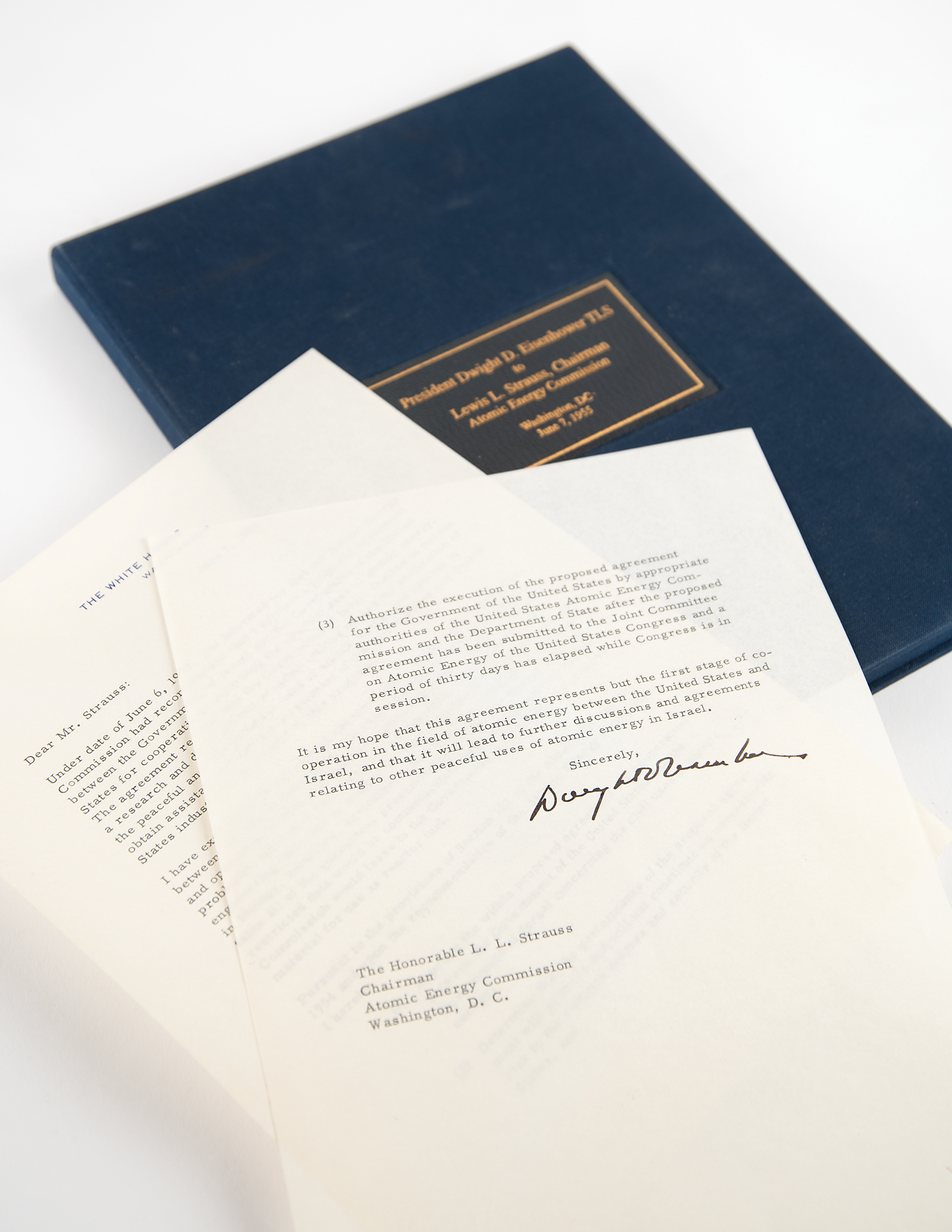
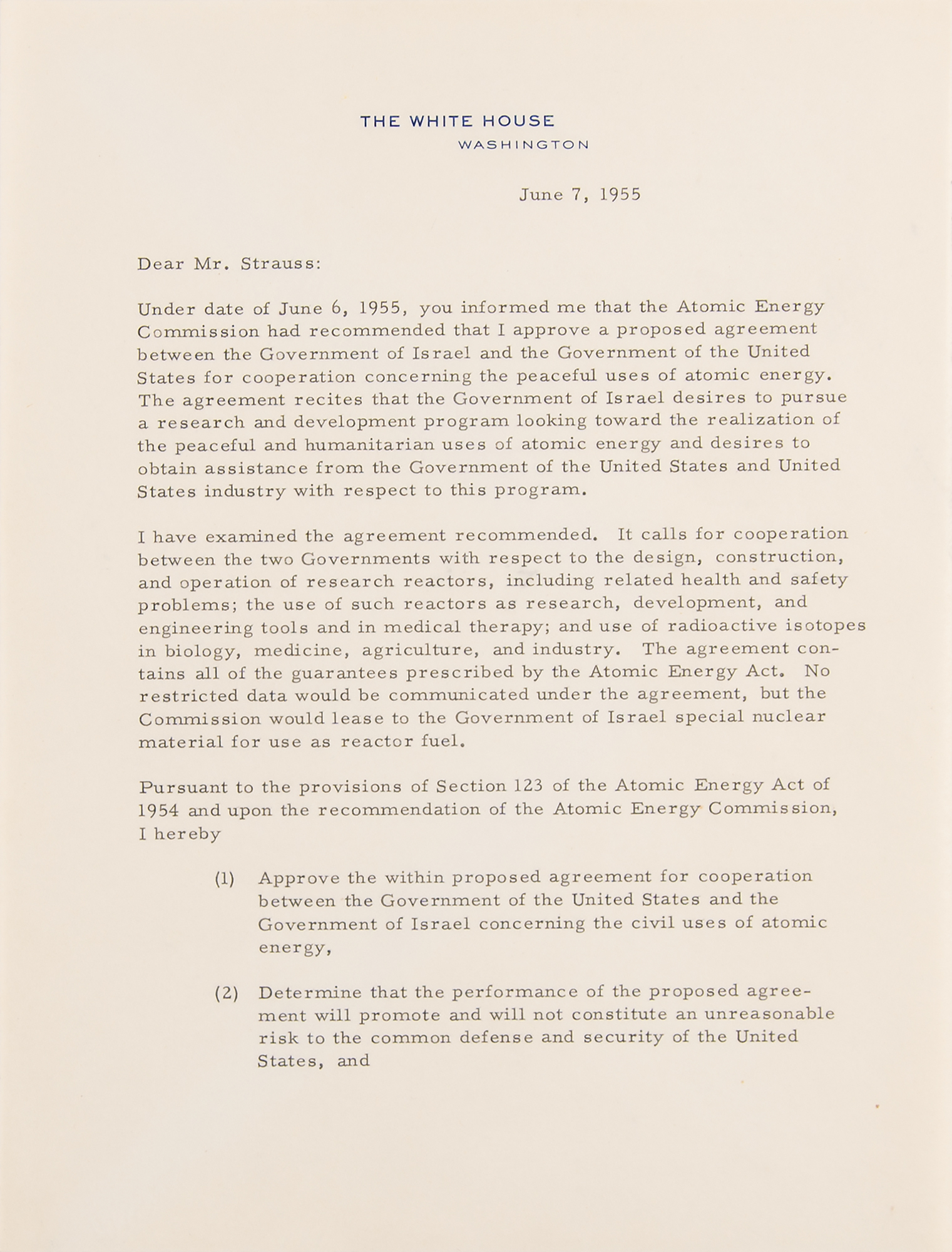
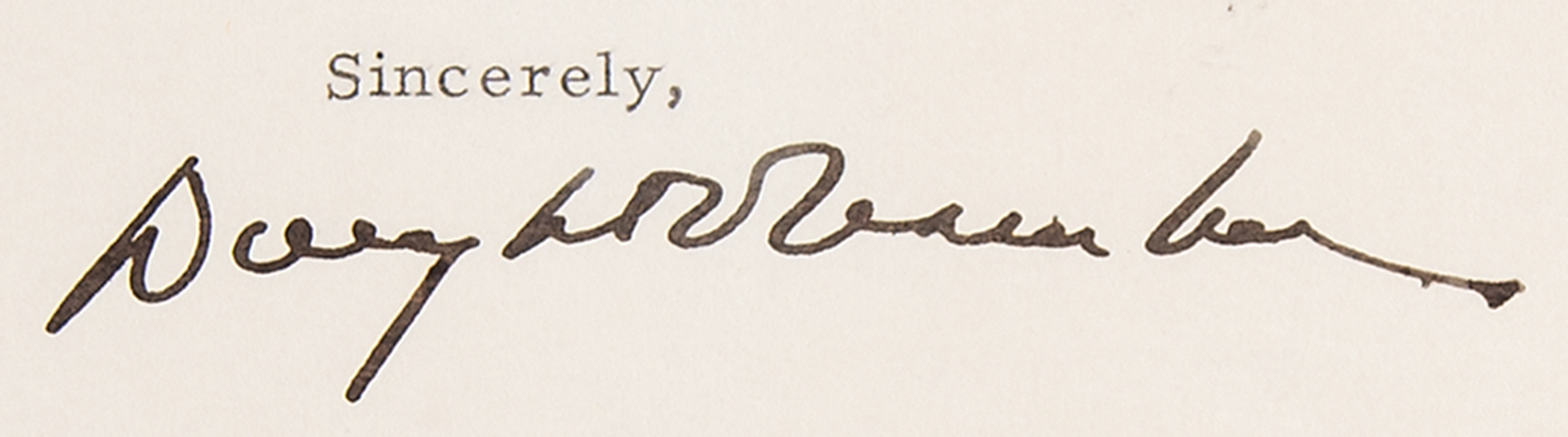
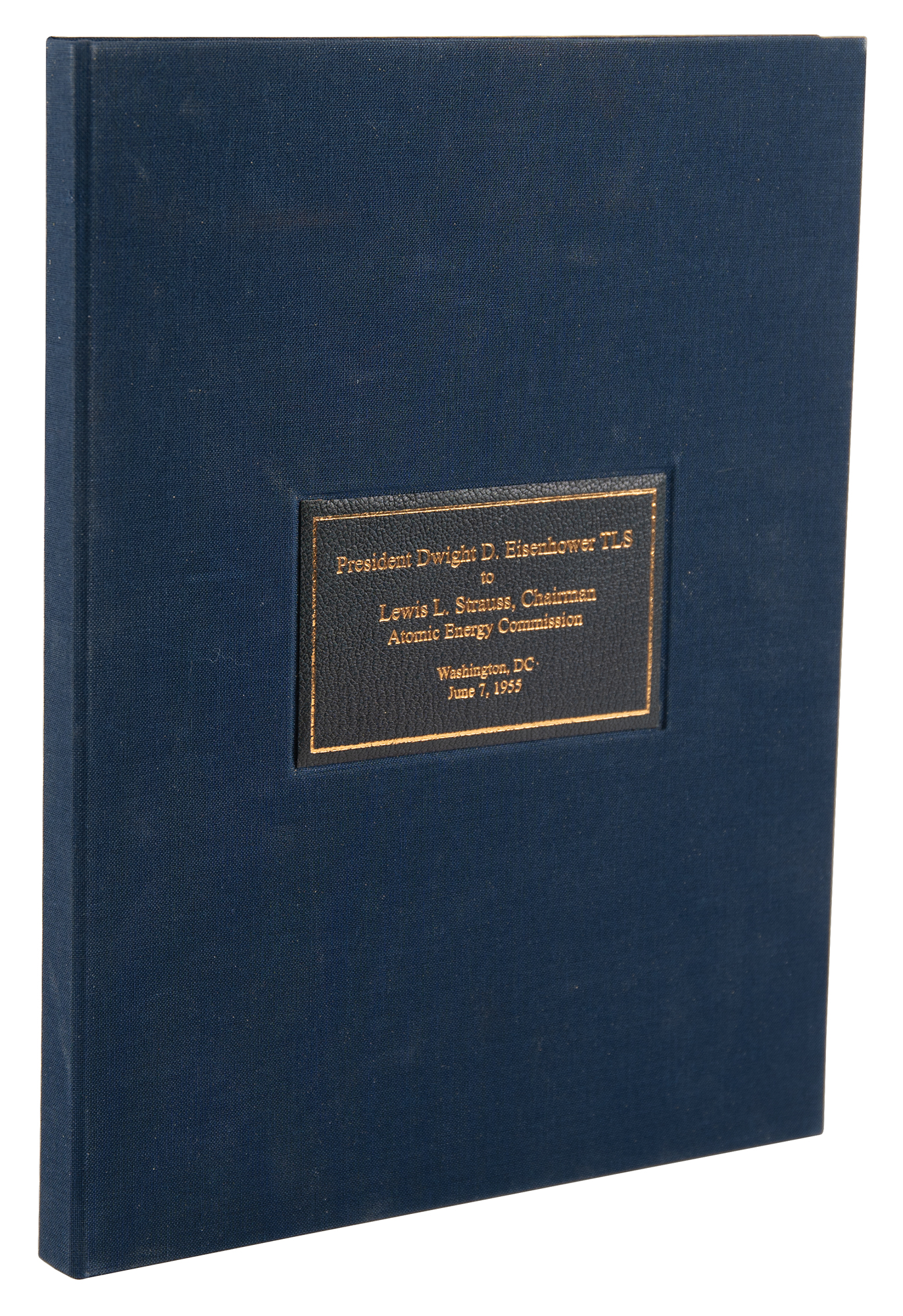
TLS as president, two pages, 8 x 10.5, White House letterhead, June 7, 1955. Letter to Lewis Strauss, Chairman of the Atomic Energy Commission, in full: ?Under date of June 6, 1955, you informed me that the Atomic Energy Commission had recommended that I approve a proposed agreement between the Government of Israel and the Government of the United States for cooperation concerning the peaceful uses of atomic energy. The agreement recites that the Government of Israel desires to pursue a research and development program looking toward the realization of the peaceful and humanitarian uses of atomic energy and desires to obtain assistance from the Government of the United States and United States industry with respect to this program.
I have examined the agreement recommended. It calls for cooperation between the two Governments with respect to the design, construction, and operation of research reactors, including related health and safety problems; the use of such reactors as research, development, and engineering tools and in medical therapy; and use of radioactive isotopes in biology, medicine, agriculture, and industry. The agreement contains all of the guarantees prescribed by the Atomic Energy Act. No restricted data would be communicated under the agreement, but the Commission would lease to the Government of Israel special nuclear material for use as reactor fuel.
Pursuant to the provisions of section 123 of the Atomic Energy Act of 1954 and upon the recommendation of the Atomic Energy Commission I hereby
1) Approve the within proposed agreement for cooperation between the Government of the United States and the Government of Israel concerning the civil uses of atomic energy,
2) Determine that the performance of the proposed agreement will promote and will not constitute an unreasonable risk to the common defense and security of the United States, and
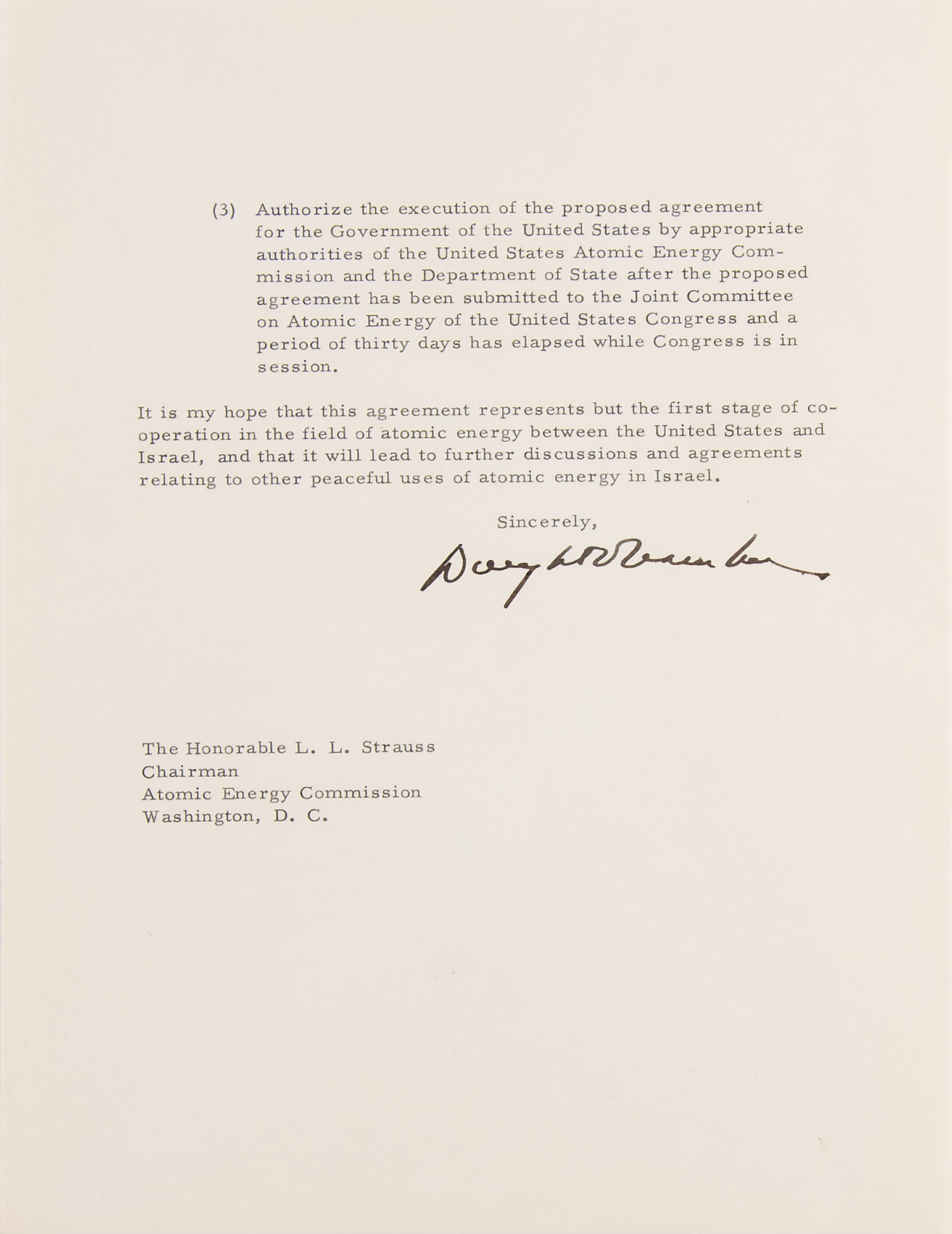
3) Authorize the execution of the proposed agreement for the Government of the United States by appropriate authorities of the United States Atomic Energy Commission and the Department of State after the proposed agreement has been submitted to the Joint Committee on Atomic Energy of the United States Congress and a period of thirty days has elapsed while Congress is in session.
It is my hope that this agreement represents but the first stage of cooperation in the field of atomic energy between the United States and Israel, and that it will lead to further discussions and agreements relating to other peaceful uses of atomic energy in Israel.? Housed in a handsome cloth-bound clamshell presentation case. In very fine condition.
After Stalin?s death in 1953, President Eisenhower proposed to the United Nations that the United States and the Soviet Union share their monopoly of information on atomic power with the rest of the world, but for purely peaceful purposes, and with safeguards against military use of such information. His Atoms for Peace proposal was embodied in the Atomic Energy Act of 1954, which authorized the president to transfer unclassified atomic information and nuclear material to foreign governments, and to assist such governments in establishing atomic research and energy reactors ? Israel among them.
The United States turned over to Israel a treasure trove of atomic information. A research reactor was soon constructed, and within a year, the American and Israeli Governments staged a joint exhibit in Tel Aviv on the peaceful uses of atomic energy. By mid-1959, Israel?s first energy reactor was under construction, and Prime Minister David Ben-Gurion predicted that soon nuclear reactors would generate all of Israel?s electrical power. At this time, Israel was secretly building a plutonium-producing nuclear reactor at Dimona in the Negev Desert, including the capability of reprocessing nuclear material for atomic weapons. By the time of the 1967 Six-Day War, Israel was able to produce at least one nuclear warhead.
Eisenhower saw the survival of the Jewish people and Israel in very personal terms. He had personally visited Buchenwald soon after its liberation in April 1945, declaring, ?The things I saw beggar description?The visual evidence and the verbal testimony of starvation, cruelty and bestiality were so overpowering as to leave me a bit sick?I made the visit deliberately, in order to be in a position to give first-hand evidence of these things if ever, in the future, there develops a tendency to charge these allegations merely to ?propaganda.?? Eisenhower declared, ?The Jewish people couldn?t have a better friend than me,? and he acted on that friendship by giving Israel access to the most valuable technology in the world. The new state of Israel would become America?s strategic partner in an increasingly threatening world, and Israel would soon have the wherewithal to protect itself.
Eisenhower recognized that America had a special obligation to the Jewish people and to the Jewish state that soon came into being. For Eisenhower, Atoms for Peace clearly meant more than power plants and medical research when it came to Israel. When President Eisenhower?s cabinet would gather to discuss their concerns about whether Israel was building the bomb, the President was not interested in having the matter fully explored. Dino Brugioni of the CIA Photographic Intelligence Center stated, ?I never did figure out whether the White House wanted Israel to have the bomb or not? (Hersh, The Samson Option: Israel?s Nuclear Arsenal and American Foreign Policy). In a 1958 briefing, two CIA aerial photography experts showed President Eisenhower and AEC Chairman Lewis Strauss the first spy-plane photographs of the Dimona site in the Negev Desert. The CIA authorities were left feeling ?that Eisenhower wanted Israel to acquire nuclear weapons? (Cohen, Israel and the Bomb).
Decades later, while the world had accepted the fact that Israel possessed the bomb (though Israel continued to deny it), ?unlike Pakistan and India, North Korea and Iran, Libya and Iraq, Israel has not been asked to give up its nuclear capability or to bare it to the world?s scrutiny; it has not been censured for producing the ultimate weapon, nor has it been threatened with sanctions?the United States has not hesitated openly to express its understanding of Israel?s status? (Karpin, The Bomb in the Basement).
Israel continues as a matter of public policy to sidestep the question of its status as a nuclear power. If direct comment were forthcoming, however, the Israeli government would surely echo the statement of the Indian official after India?s first nuclear bomb test: ?I can say with confidence that the initial [Atoms for Peace] cooperation agreement itself has been the bedrock on which our nuclear program has been built.? An important letter that represents a defining moment in modern history and the history of the Jewish people.

This item is Pre-Certified by PSA/DNA
Buy a third-party letter of authenticity for
$100.00
*This item has been pre-certified by a trusted third-party authentication service, and by placing a bid on this item, you agree to accept the opinion of this authentication service. If you wish to have an opinion rendered by a different authenticator of your choosing, you must do so prior to your placing of any bid. RR Auction is not responsible for differing opinions submitted 30 days after the date of the sale.
Third-party authentication service applies only to signatures and handwriting, and does not cover the addition of sketches, artwork, musical quotations, etc.

