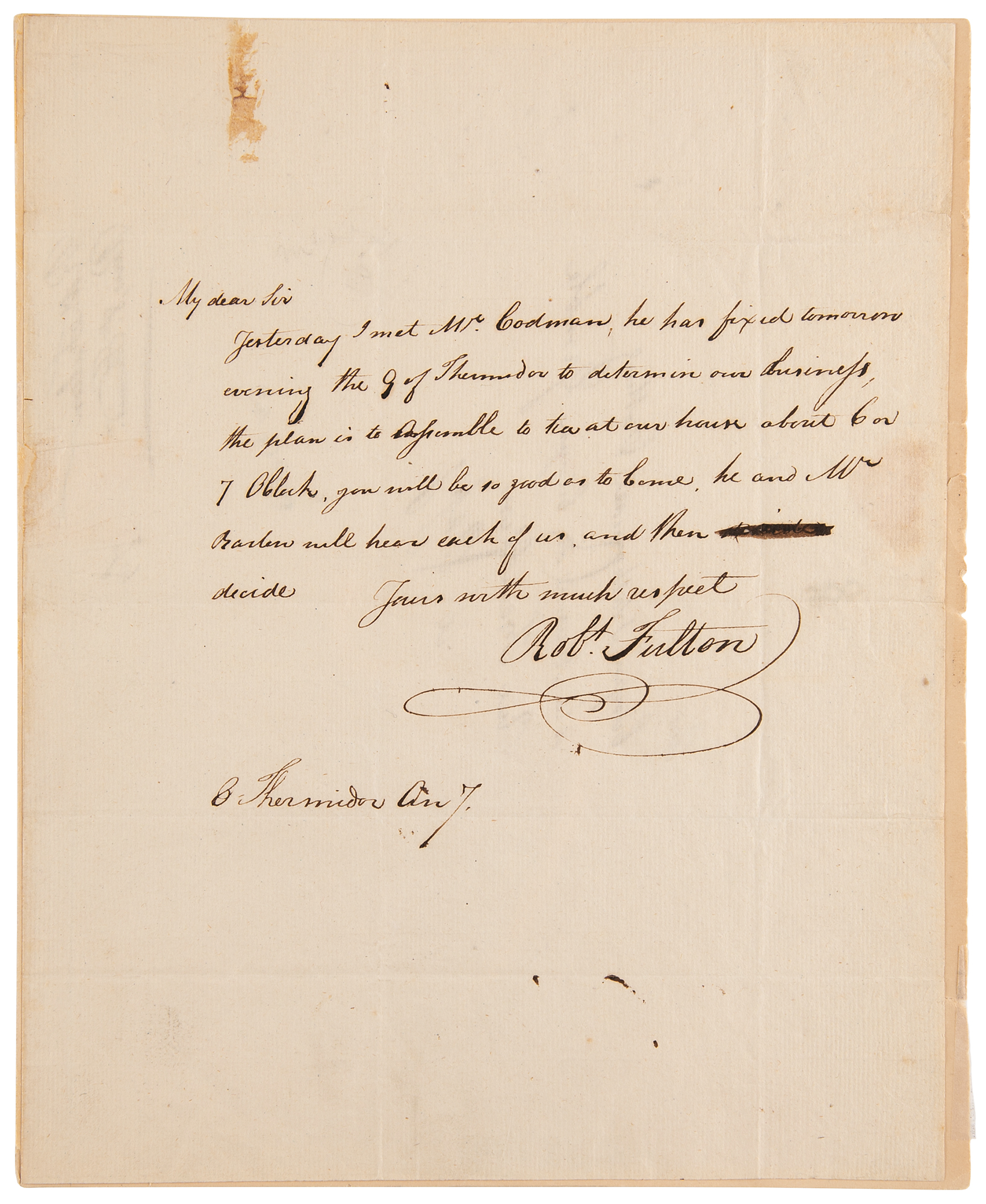
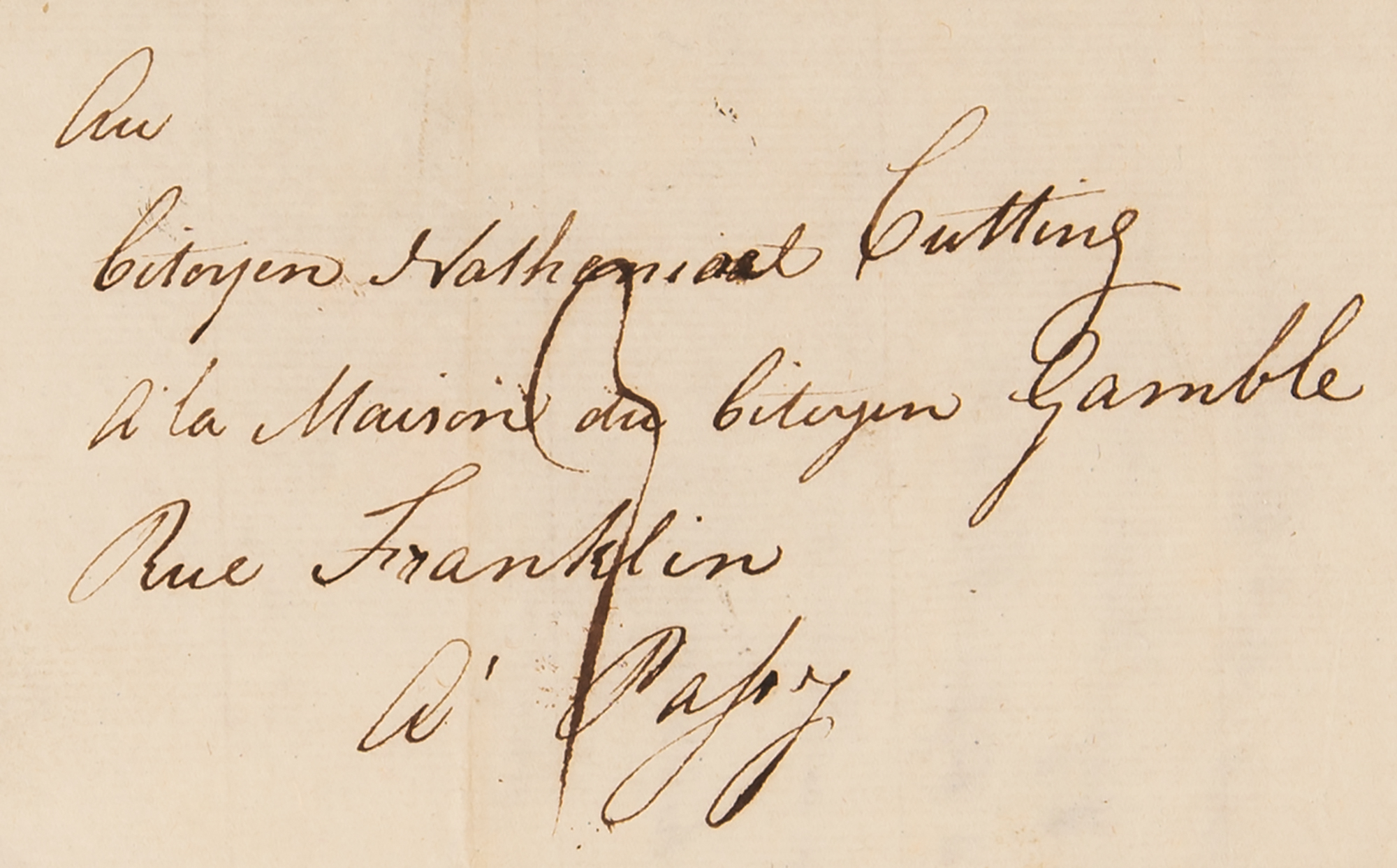
American inventor, engineer, and entrepreneur (1765–1815) best known for designing the first commercially successful steamboat. His other endeavors included a commission from Napoleon that resulted in the first practical submarine, the Nautilus. Rare ALS signed “Rob't Fulton,” one page, 7.75 x 9.75, 8 Thermidor an 7 [July 26, 1799]. Handwritten letter to Nathaniel Cutting in Paris, setting up a meeting with Joel Barlow and Richard Codman for the following day, presumably to discuss their rope cordage machinery. In full: “Yesterday I met Mr. Codman, he has fixed tomorrow evening the 9 of Thermidor to determine our business, the plan is to assemble to tea at our house about 6 or 7 o'clock, you will be so good as to come, he and Mr. Barlow will hear each of us and then decide.” The reverse of the second integral page is hand-addressed by Fulton. Affixed by its left edge to a slightly larger sheet and in fine condition, with a stain to the top blank area, and some seal-related paper loss to the integral address leaf.
Fulton had lived abroad in Europe since 1786, and in 1797, he went to Paris to study math, chemistry, and modern foreign languages. While in France, he presumably met Nathaniel Cutting, his soon-to-be business partner, and much later, his rival and nemesis. Cutting was a merchant from Cambridge, Massachusetts, who lived at Le Havre and was appointed U.S. Consul at Le Havre by George Washington in 1793. Cutting was also an investor and speculator with a particular interest in rope-making.
Robert Fulton delved into various areas of design and engineering besides steamships, including rope-making. The world's navies, merchants marine, and private merchants depended on untold miles of rope for ship's rigging, and in France, unlike in England, rope was laboriously hand-twisted. Seeing a business opportunity, Fulton and Cutting filed a 15-year-long joint patent in France on May 18, 1799, for ‘machines à fabriquer toutes espèces de cordes, cables et cordages en général’ [‘machines to make all types of cords, cables and rigging in general.’] Fulton later sold a share of his rope-making technology to Cutting, and the two co-patented a ‘mode of manufacturing cordage’ in the United States on March 4, 1808.
However, by 1815 the Fulton and Cutting rope-making partnership had deteriorated for reasons still unclear. Cutting evidently felt that he had been cheated in their business dealings, and thereafter, he began spreading rumors that Fulton's designs were poached from other successful inventors like John Fitch and Edmund Cartwright. In a letter to Cutting on January 28, 1815, Fulton passionately defended himself against the former's allegations of intellectual theft, declaring: ‘I accept the war. I defy you or any living being to stain my character with one unfair, ungenerous or illiberal act…and I will not lose an instant, in making you answerable for a libel on my character as a man of honor.' Fulton died from tuberculosis at the age of 49 less than one month later.

This item is Pre-Certified by PSA/DNA
Buy a third-party letter of authenticity for
$50.00
*This item has been pre-certified by a trusted third-party authentication service, and by placing a bid on this item, you agree to accept the opinion of this authentication service. If you wish to have an opinion rendered by a different authenticator of your choosing, you must do so prior to your placing of any bid. RR Auction is not responsible for differing opinions submitted 30 days after the date of the sale.
Third-party authentication service applies only to signatures and handwriting, and does not cover the addition of sketches, artwork, musical quotations, etc.

