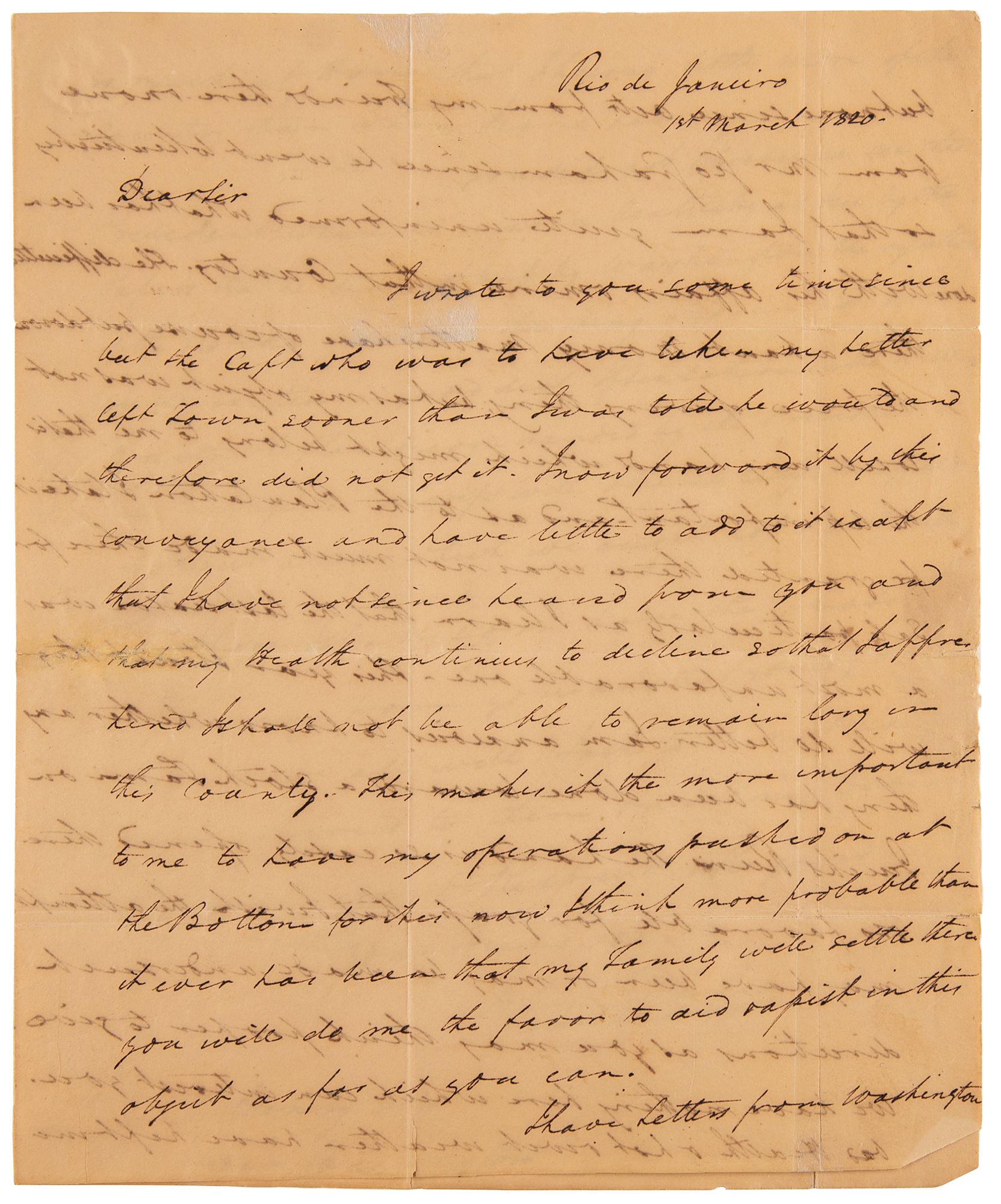
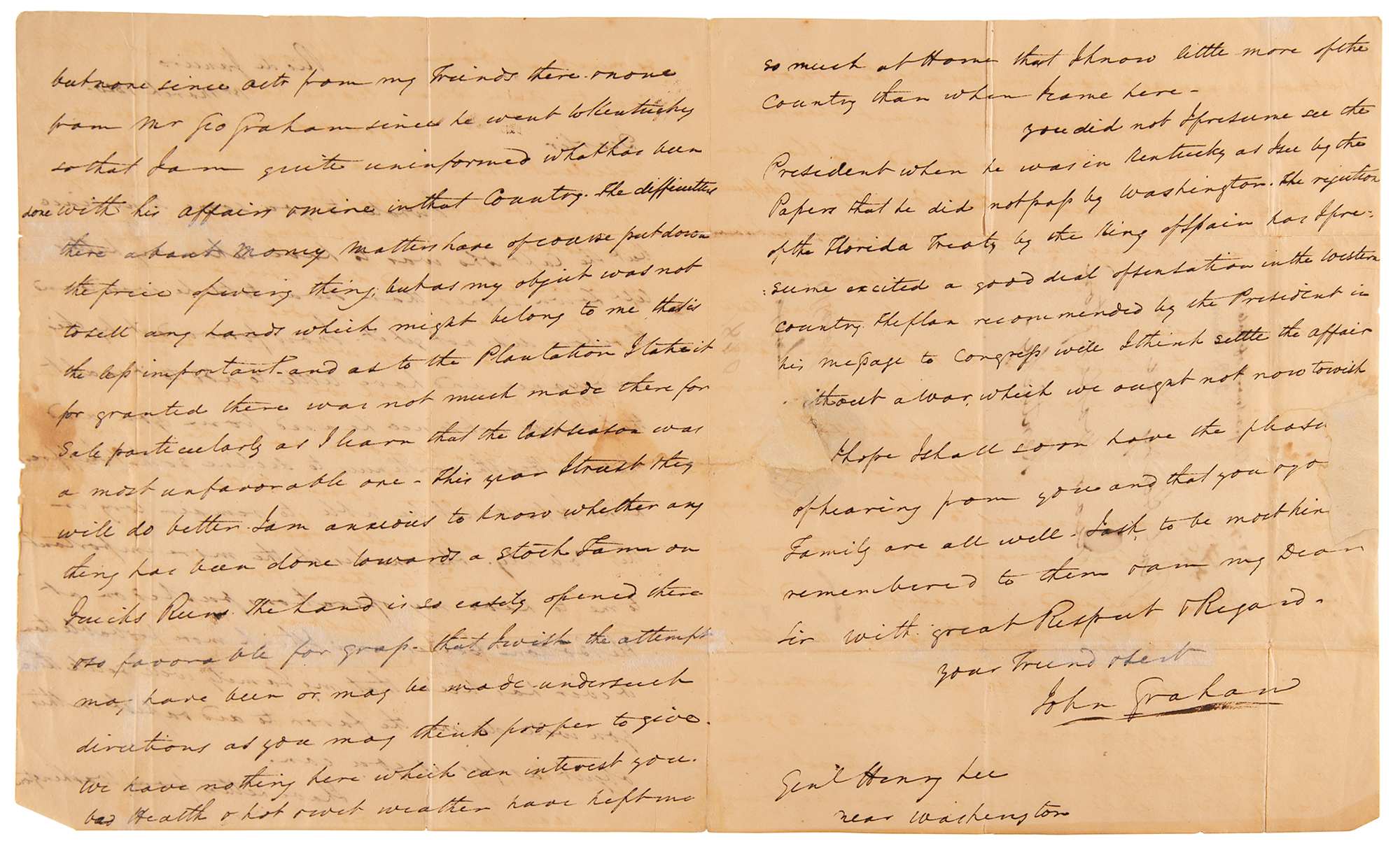
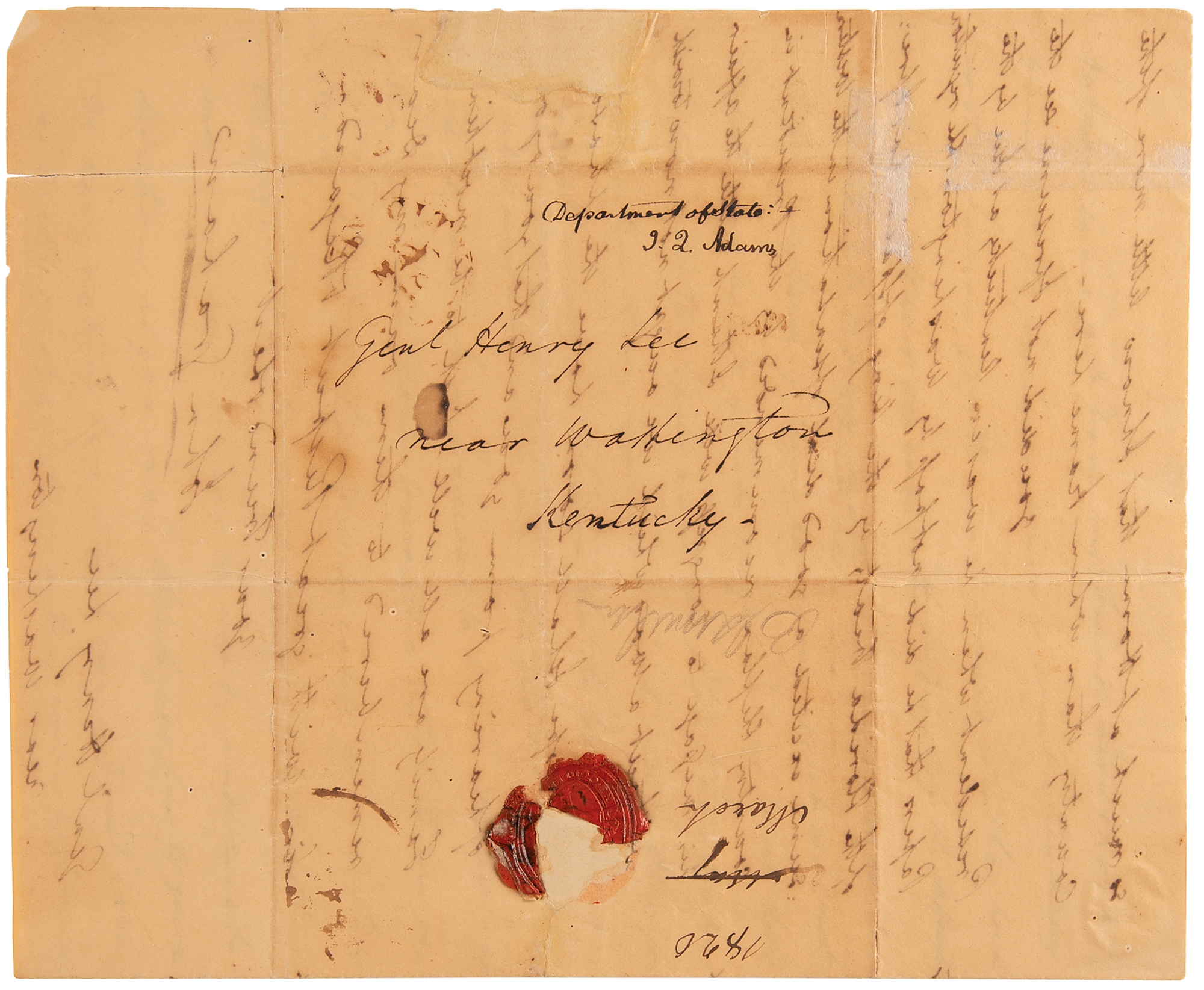
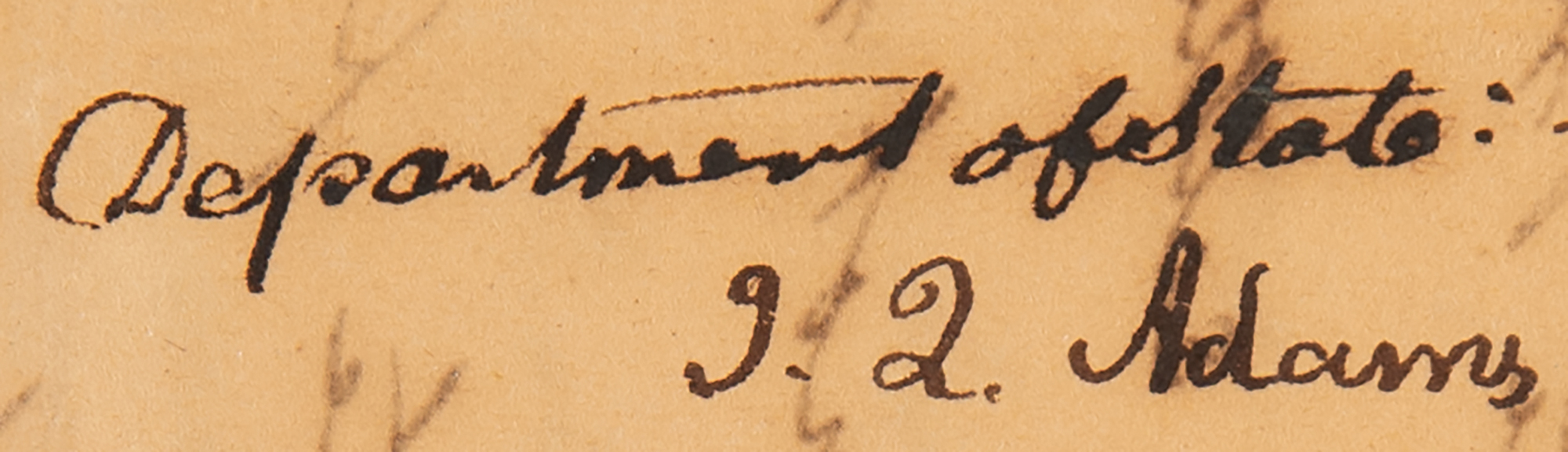
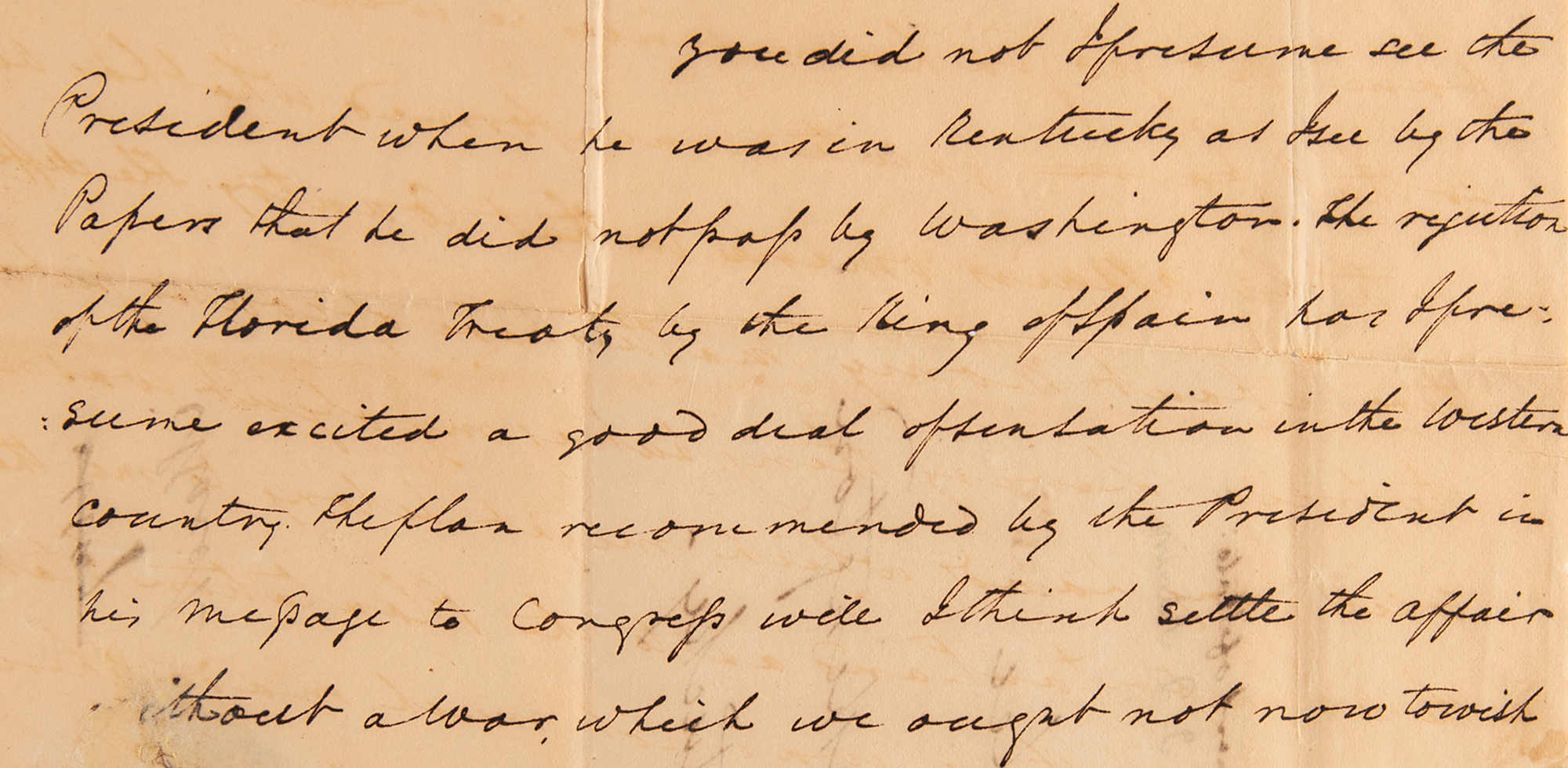
Franking signature, “Department of State, J. Q. Adams,” on the address panel inherent to the reverse of an ALS from American diplomat John Graham, the United States Minister to Portugal, three pages on two adjoining sheets, 8 x 9.5, March 1, 1820. Addressed from Rio de Janeiro, Graham’s handwritten letter was sent to General Henry Lee of Mason County, Kentucky, and discusses his poor health, his inability to get in touch with friends or his brother, George Graham, the former secretary of war under President Madison and Monroe, and King Ferdinand VII of Spain’s initial rejection of the Adams-Onís Treaty, which the Senate had ratified in February 1819. The letter, in part: “My Health continues to decline so that I apprehend I shall not be able to remain long in this Count’y…I have letters from Washington but none since Oct’r from my Friends there & none from Mr. Geo. Graham since he went to Kentucky so that I am quite uninformed what has been done with his affairs & mine in that Country…You did not I presume see the President when he was in Kentucky as I see by the Papers that he did not pass by Washington. The rejection of the Florida Treaty by the King of Spain has I presume excited a good deal of sensation in the Western country. The plan recommended by the President in his message to Congress will I think settle the affair without a war, which we ought not now to wish.” In very good to fine condition, with partial repairs to splitting along the folds.
Spain eventually ratified the treaty in October 1820, and the Senate again ratified the treaty in February 1821. Spain agreed to cede East and West Florida to the United States, and the United States agreed to pay the legal claims of American citizens against Spain up to $5 million. It clarified the boundaries of the Louisiana Purchase by making Texas part of New Spain, but when Spain finally recognized the independence of Mexico in August 1821, Texas became a part of Mexico, setting the stage for the Mexican War of the 1840s.
President James Monroe, traveling with General Andrew Jackson and several aides, visited Kentucky for almost a month in the summer of 1819, visiting at least 10 cities. Monroe went to Kentucky to inspect military posts and to strengthen his political network before the 1820 presidential election, though he won every state and had no major opponent. In his Annual Message to Congress of December 1819, President Monroe devoted much attention to the pending treaty with Spain, counseled patience, and suggested to Congress that the United States proceed to carry out the provisions of the treaty as if Spain had ratified it. He also reiterated American neutrality in the civil war between Spain and its American colonies.
John Graham (1774-1820) was born in Dumfries, Virginia, and graduated from Columbia University in 1790. He moved to Kentucky and served in the state legislature in 1800. He joined the State Department and held a variety of offices, including secretary and chargé d'affaires in the U.S. legation to Spain (1801-1803), secretary of Orleans Territory (1804-1806), investigator of the western conspiracy of Aaron Burr (1806), chief clerk of the State Department (1807-1817), member of the South American Commission (1817-1818), and U.S. minister to Portugal at Rio de Janeiro from June 1819 to June 1820. Shortly after his return to Washington, D.C., he died on August 6, 1820.

This item is Pre-Certified by PSA/DNA
Buy a third-party letter of authenticity for
$75.00
*This item has been pre-certified by a trusted third-party authentication service, and by placing a bid on this item, you agree to accept the opinion of this authentication service. If you wish to have an opinion rendered by a different authenticator of your choosing, you must do so prior to your placing of any bid. RR Auction is not responsible for differing opinions submitted 30 days after the date of the sale.
Third-party authentication service applies only to signatures and handwriting, and does not cover the addition of sketches, artwork, musical quotations, etc.

