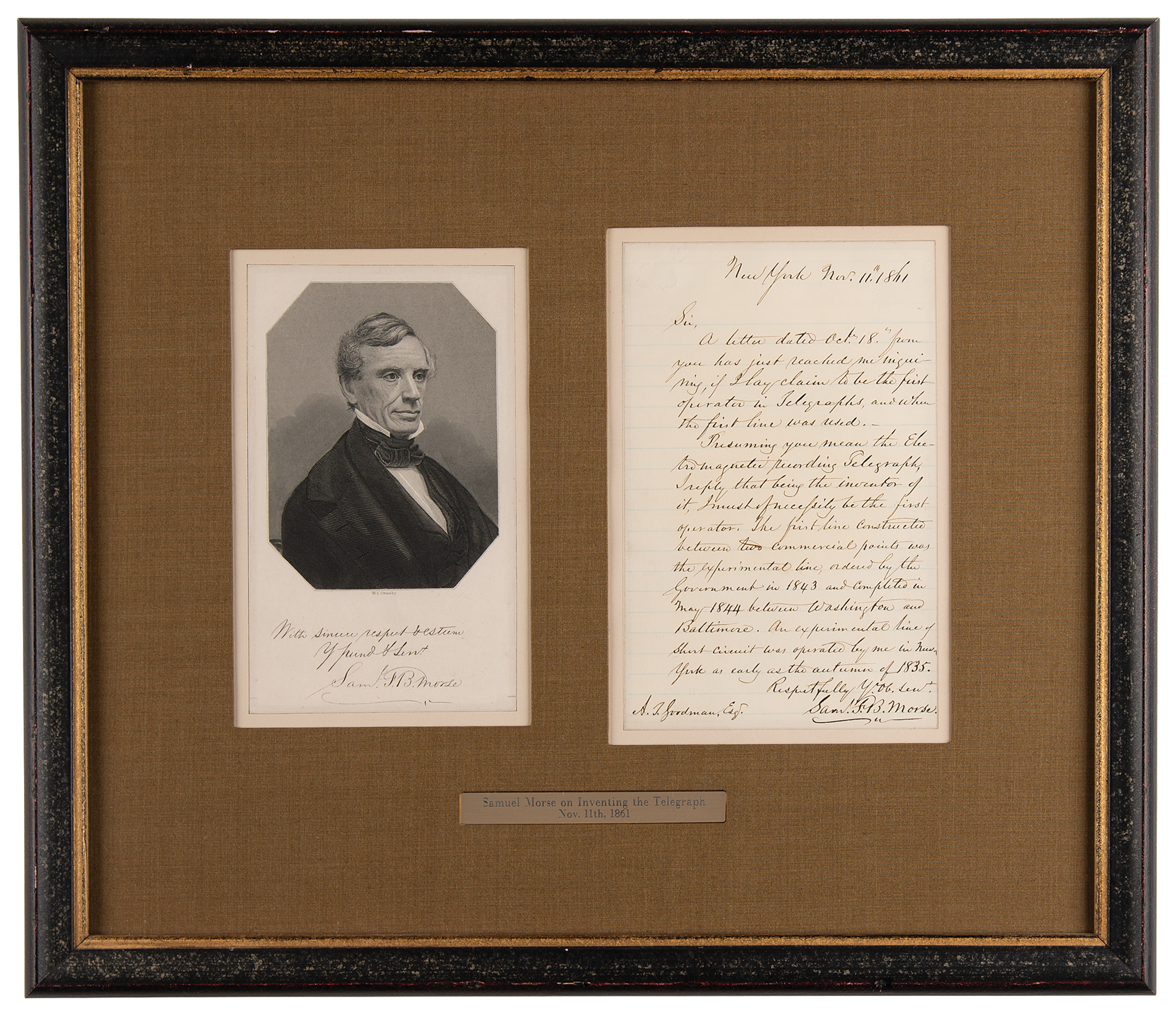
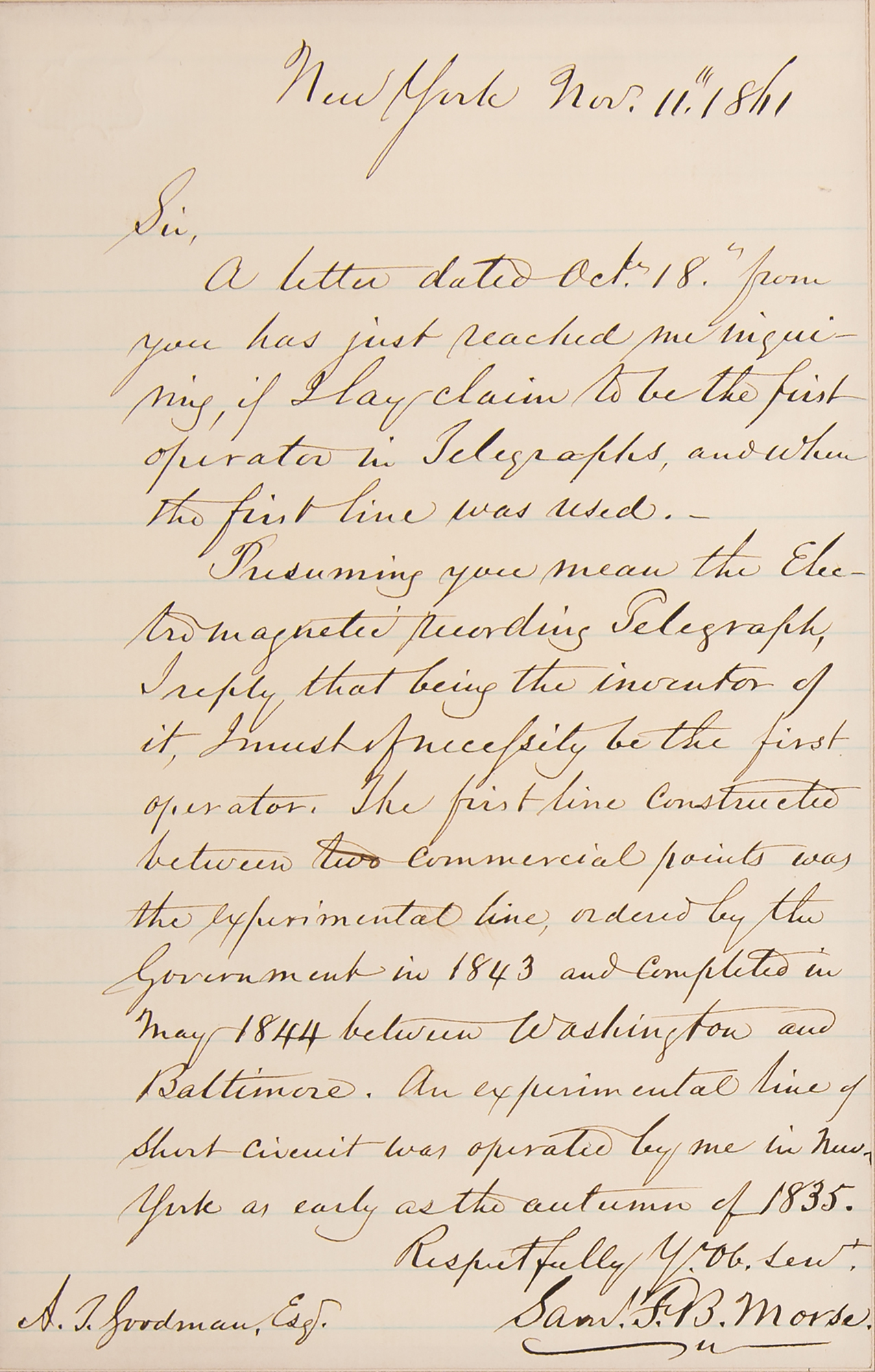
Civil War-dated ALS signed “Sam'l F. B. Morse,” one page, 5 x 7.75, November 11, 1861. Addressed from New York, a handwritten letter to A. T. Goodman, discussing his legal troubles in attempting to prove primacy in the invention of the telegraph, in full: “A letter dated Oct’r 18th from you has just reached me inquiring, if I lay claim to the first operator in Telegraphs, and when the first line was used. Presuming you mean the Electromagnetic recording Telegraph, I reply that being the inventor of it, I must of necessity be the first operator. The first line constructed between two commercial points was the experimental line, ordered by the Government in 1843 and completed in May 1844 between Washington and Baltimore. An experimental line of short circuit was operated by me in New York as early as the autumn of 1835.” The letter has been professionally inlaid into a slightly larger sheet. Framed under UV Plexiglas and matted with an engraved portrait bearing a facsimile signature to an overall size of 18 x 15.5. In fine condition.
The idea for the telegraph was born from a tragic moment in the life of Samuel Morse. While in Washington to paint a portrait of the Marquis de Lafayette, Morse received a letter from his father informing him that his wife, Lucretia, had fallen gravely ill after the birth of their third child. Morse immediately packed up his paint and headed home to New Haven. But by the time he arrived, he was too late; Lucretia had died and her body had already been buried for several days. After his wife's death, Morse vowed to find a way to expedite the delivery of life-or-death messages.
Goodman’s letter seems to reveal an ongoing source of frustration for the inventor, who often found himself, some 25 years after he developed the “Electromagnetic recording Telegraph,” queried on whether he was truly the machine’s inventor. Morse was, of course, the inventor, but there was a race between two sets of researchers to see who could design the system first: the English team of Sir William Cooke (1806-79) and Sir Charles Wheatstone (1802-75), and the American team of Morse, Leonard Gale (1800-83) and Alfred Vail (1807-59).
In the 1830s, British researchers Cooke and Wheatstone developed a telegraph system with five magnetic needles that could be pointed around a panel of letters and numbers by using an electric current (their system was soon being used for railroad signaling in Britain), while Yale-educated Morse worked to develop an electric telegraph of his own. In collaboration with Gale and Vail, Morse eventually produced a single-circuit telegraph. Notable moments came in 1842, when Morse strung ‘wires between two committee rooms in the Capitol and sent messages back and forth’ to demonstrate his telegraph system, and in 1844, when he telegraphed a Bible quote from Washington, D.C., to Baltimore: ‘What hath God wrought?’ This climatic moment was met with both great celebration and, unfortunately, nonstop lawsuits.
The first patent battle Morse was involved with revolved around whether or not he was the actual inventor of the telegraph. Morse swore to the originality of his invention, but the burden of proof fell on Morse as he did not apply for an American patent in a timely manner. Therefore he had to rely on the testimony of various colleagues and friends to determine when Morse had a working model of his telegraph (which was determined to be around 1835). The following series of lawsuits set the pace for Patent law which continues today. As a result, Samuel Morse is not just known for his invention of the telegraph but also known to have set the precedent for future patent litigation.

This item is Pre-Certified by PSA/DNA
Buy a third-party letter of authenticity for
$150.00
*This item has been pre-certified by a trusted third-party authentication service, and by placing a bid on this item, you agree to accept the opinion of this authentication service. If you wish to have an opinion rendered by a different authenticator of your choosing, you must do so prior to your placing of any bid. RR Auction is not responsible for differing opinions submitted 30 days after the date of the sale.
Third-party authentication service applies only to signatures and handwriting, and does not cover the addition of sketches, artwork, musical quotations, etc.

