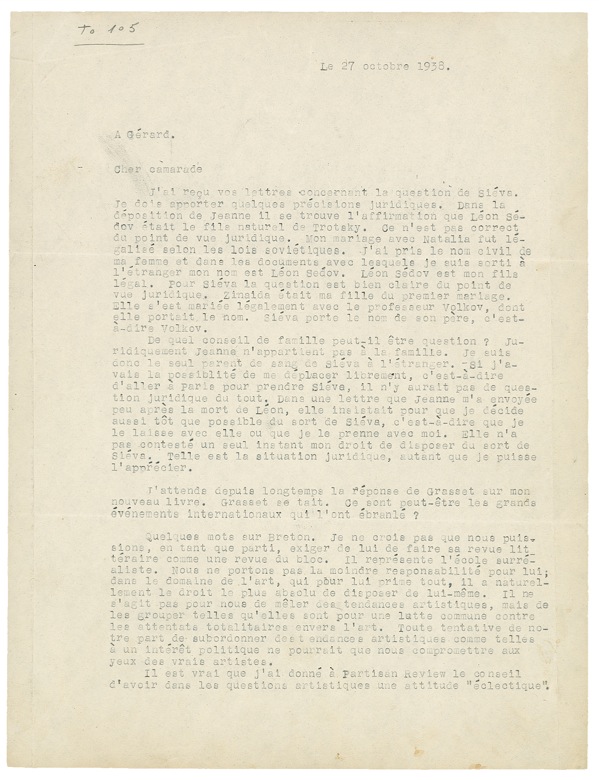
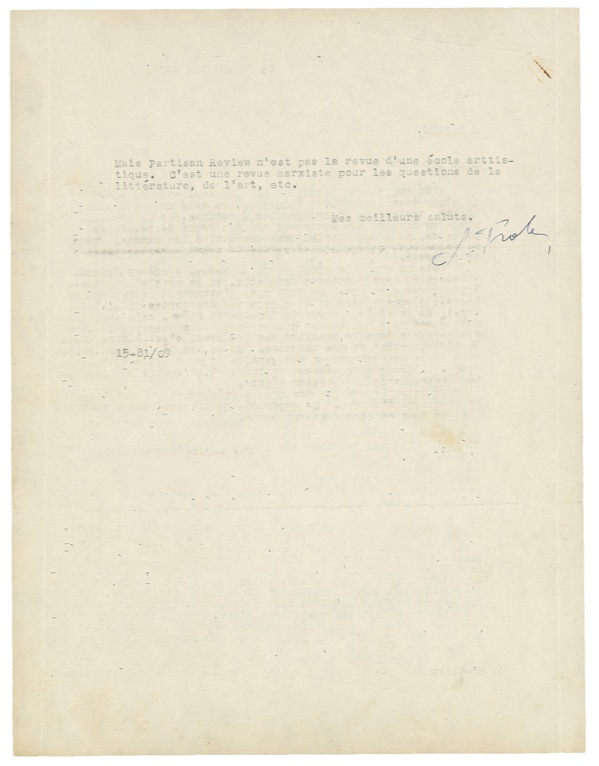
Russian Communist leader (1879–1940) who, with Lenin, organized the Bolshevik seizure of power during the October Revolution of 1917. In 1929, five years after Lenin’s death, Stalin defeated Trotsky for control of the Communist Party and banished him from Russia. Trotsky spent most of the remainder of his life in Mexico, where he was assassinated with a pickaxe by a Stalinist agent. Important TLS, in French, signed “L. Trotsky,” one page both sides, 8.5 x 11, October 27, 1938. Trotsky writes to Gérard. In part (translated): “I received your letters concerning the question of Siéva [Esteban “Siéva” Volkov, Trotsky’s grandson, born 1926].... In Jeanne’s deposition the assertion is found that Léon Sédov was Trotsky’s natural son. It is not correct from a legal standpoint. My marriage to Natalia was legalized according to the Soviet laws. I took my wife’s civil name and my name is Léon Sédov on the documents with which I went abroad.... Zinaida was my daughter from the first marriage. She legally married Professor Volkov, whose name she was bearing. Siéva bears his father’s name, which is Volkov.... I am Siéva’s sole blood relative abroad. If I could travel freely ... to take Siéva there would not be any legal question at all. In a letter that Jeanne sent to me shortly after Léon’s death, she insisted that I decide Sieva’s fate as soon as possible.... She did not deny for a instant my right to decide.... I have long been waiting for an answer from [French publisher] Grasset about my new book.... Maybe he was shaken by the great international events? A few words about Breton [distinguished French surrealist author André Breton, 1896–1966]. I don’t believe that as a party we can require of him to make his literary review one of the bloc. He represents the surrealistic school. We do not carry the weight for him in the domain of the art that prevails for him over everything; he as, of course, the absolute right of self-determination. It is not a matter for us to mix artistic tendencies but to group them as they are for a common struggle against the totalitarian attacks toward art. Any attempt on our part to subordinate the artistic tendency as such for a political interest could only discredit is in the eyes of true artists. It is true that I have the advice to have an “eclectic” attitude on artistic matters to the Partisan Review. But Partisan Review is not the review of an artistic school. It is a Marxist review when it comes to literature, art, etc.” Breton had joined the French Communist part in 1927 though was expelled in 1931. Trotsky met him a few months before writing the present letter, in June 1938, when Breton traveled to Mexico under the auspices of a French cultural commission. The two collaborated on a manifesto titled Pour un art révolutionnaire indépendent (published under the names of Breton and artist Diego Rivera), which called for the “complete freedom of art” at a time when ideological and political considerations were increasingly imperiling artists’ freedom of expression. In very good condition, with folds (horizontal mailing fold touching a few letters of signature; “extra” vertical fold to left and right margins), a touch of wrinkling, a few small spots, and slightly irregular ink flow (small “dropouts” to a few letters of signature, which remains fully legible). Auction LOA John Reznikoff/PSA/DNA and R&R COA.

