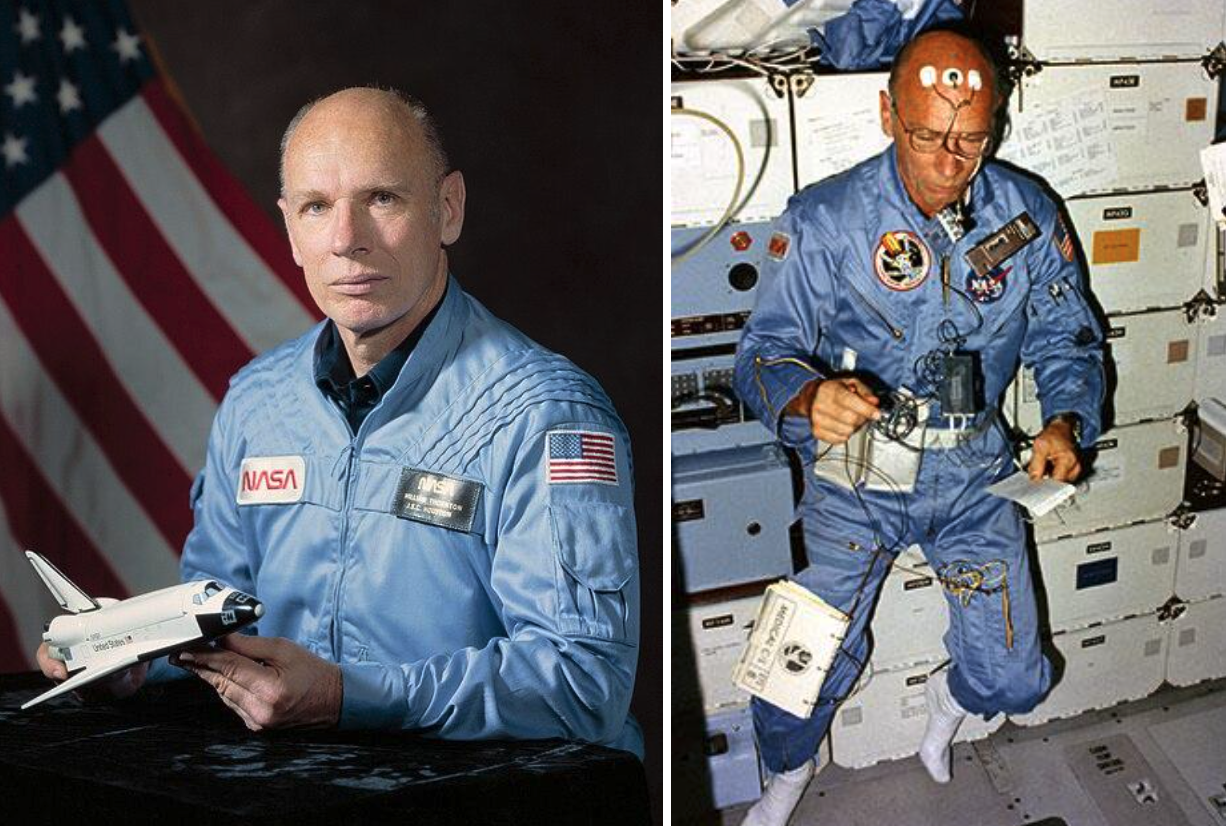
William Edgar Thornton, M.D., was an astronaut, medical professor, pilot and inventor. He was born on April 14, 1929, in Faison, NC, to the late William E. Thornton and Rosa B. Thornton.
While attending Faison High School, he opened a radio repair shop and used the profits to pay for college. He earned a Bachelor of Science Degree in Physics in 1952 from the University of North Carolina. Dr. Thornton enlisted in the United States Air Force where he served as the officer-in-charge of the USAF Instrumentation Laboratory at the Flight Test Air Proving Ground at Elgin Air Force Base, Florida. In working to improve air-to-air combat defenses, Thornton discovered that rockets could be tracked by radar. He developed the Radar Optic Firing Error Indicator (ROFEI), or Thornton Scorer, which was the first practical means of evaluating and maintaining the accuracy of interceptor aircraft. The Thornton Scorer was highly successful and Thornton, as a Second Lieutenant, was awarded the Legion of Merit in 1956.
After leaving the military in 1956, he worked as the Chief Engineer of the electronics division at Del Mar Engineering Labs in California. Thornton married the former Elizabeth Jennifer Fowler from Newgate Street, England, in 1958 and they had two sons, William Simon Thornton and James Fallon Thornton. In 1959, he enrolled in medical school at the University of North Carolina. After graduating in 1963, Dr. Thornton returned to active duty and was sent to the USAF Aerospace Medical Division at Brooks Air Force Base in San Antonio. Thornton invented a mass measuring device to determine the weight of items in space, which is still in use today.
Dr. Thornton was selected as a member of the second class of scientist-astronauts (XS-11) in 1967. In 1972, he participated in the Skylab Medical Experiment Altitude Test (SMEAT), a 56-day simulation of an American Skylab mission utilizing a sealed vacuum chamber at NASA's Manned Spacecraft Center in Houston, Texas. Dr. Thornton logged over 313 hours in space aboard two missions: STS-8 Challenger (August 30-September 5, 1983) and STS-51B Spacelab 3 Challenger (April 29-May 6, 1985). Of note, STS-8 was the first night launch and landing of a shuttle. During the STS-8 mission, he was responsible for making continuous measurements and investigations of the adaptation of the human body to weightlessness. These experiments included a number of first-time measurements on the human nervous system while in space. During the Spacelab 3 mission, Dr. Thornton's responsibilities included the management of the first animal payload in manned flight.
Dr. Thornton holds over 60 issued patents that cover a wide range of applications, from military weapons systems to the first real-time EKG computer analysis. His space-related patents include the Shuttle treadmill for in-flight exercise, shock and vibration isolation systems, and an improved waste collection system. “ I am still the only person that has run around the world on a treadmill that I designed,” Dr. Thornton related during a TV interview in 2010. Dr. Thornton was also a pilot with over 2500 hours in NASA T38s.
In May of 1994, Dr. Thornton retired from NASA and became a Clinical Professor of Cardiovascular Physical Diagnosis at UTMB. In an effort to improve learning, he developed a hybrid hardware/software system simulating the process of auscultation. With this invention, the ability of medical students to recognize anomalies in patients' hearts was greatly increased. While in his 80s, Dr. Thornton spent several years writing "The Human Body and Weightlessness,” a comprehensive textbook on the effects of spaceflight on the human body and solutions. For his service to the nation’s space program, Dr. Thornton was awarded the NASA Exceptional Service Medal, NASA Exceptional Scientific Achievement Medal, and two NASA Space Flight Medals, among many other honors.

