The 30 Minute Rule begins November 19 at 7:00 PM EST. An Initial Bid Must Be Placed By November 19 at 6:00 PM EST To Participate After 6:00 PM EST
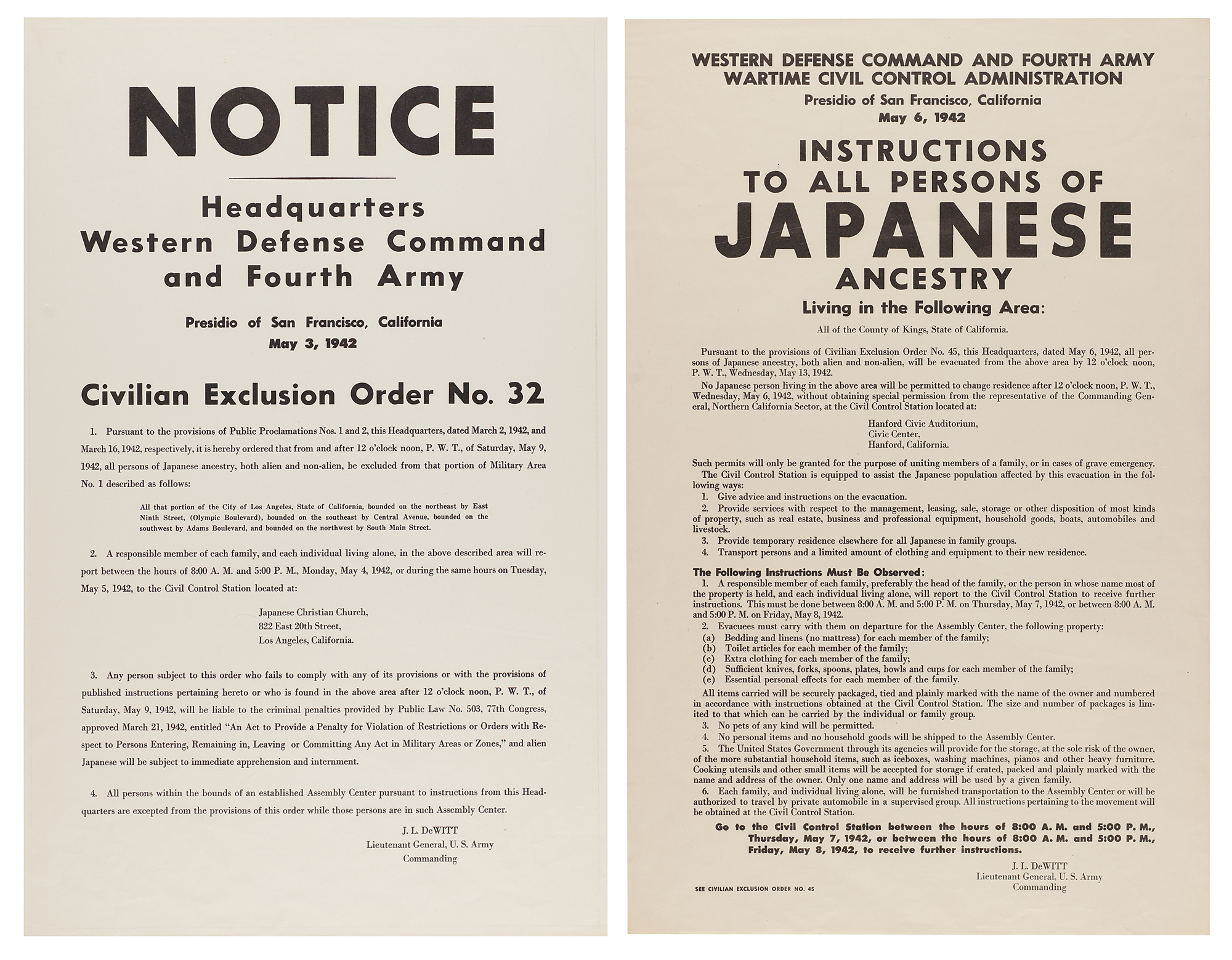
Two original World War II-dated broadsides, 14 x 22, issued by Lieutenant General J. L. DeWitt of the Western Defense Command and Fourth Army, Presidio of San Francisco, ordering the forced removal of Japanese Americans from two areas of California in May 1942. The first, dated May 3, 1942, announces "Civilian Exclusion Order No. 32," ordering that "all persons of Japanese ancestry, both alien and non-alien, be excluded" after "12 o'clock noon, P. W. T., of Saturday, May 9, 1942," from the portion of Los Angeles bounded by East Ninth Street (Olympic Boulevard), Central Avenue, Adams Boulevard, and South Main Street. A responsible member of each family is directed to report to the Civil Control Station at the "Japanese Christian Church, 822 East 20th Street," and those who fail to comply are warned that they "will be liable to the criminal penalties provided by Public Law No. 503" and that "alien Japanese will be subject to immediate apprehension and internment."
The second, dated May 6, 1942, and bearing the headings of the Western Defense Command and Fourth Army and the Wartime Civil Control Administration, is headed "Instructions to All Persons of Japanese Ancestry Living in the Following Area," covering "All of the County of Kings, State of California," under "Civilian Exclusion Order No. 45." It orders evacuation "by 12 o'clock noon, P. W. T., Wednesday, May 13, 1942," directs families to the Civil Control Station at the "Hanford Civic Auditorium," and lists what evacuees could bring to the Assembly Center (bedding and linens, toilet articles, extra clothing, eating utensils, and "essential personal effects"), with packages "limited to that which can be carried by the individual or family group." It adds: "No pets of any kind will be permitted." The second broadside is housed in a protective plastic sleeve. In overall fine condition, with slight edgewear, including a few short tears.
On February 19, 1942, ten weeks after Pearl Harbor, President Franklin D. Roosevelt signed Executive Order 9066, authorizing the military to designate areas from which ‘any or all persons may be excluded.’ Lieutenant General John L. DeWitt, commanding the Western Defense Command, used that authority to declare the western portions of Washington, Oregon, and California, along with southern Arizona, as Military Area No. 1. In March, Congress gave his orders the force of law through Public Law 503, which made violating them a federal crime.
Between late March and August 1942, DeWitt issued 108 Civilian Exclusion Orders, each covering a single district and each posted publicly as broadsides like these. The orders’ designation "non-alien" referred to American citizens of Japanese ancestry. Residents typically had only days to register, arrange their affairs, and sell, store, or entrust property to others before removal, and hurried sales often meant severe losses. Most evacuees were sent first to temporary assembly centers run by the Wartime Civil Control Administration before being transferred to one of ten inland relocation centers operated by the War Relocation Authority. Some were sent directly to relocation centers. In all, roughly 120,000 people of Japanese ancestry were removed from the West Coast, about two-thirds of them American citizens.
In Korematsu v. United States (1944), the Supreme Court upheld the military’s exclusion of Japanese Americans from designated areas. Decades later, the Commission on Wartime Relocation and Internment of Civilians concluded that the policy had been driven by ‘race prejudice, war hysteria and a failure of political leadership.’ In 1988, the Civil Liberties Act formally apologized on behalf of the nation and authorized $20,000 payments to eligible survivors.

