The 30 Minute Rule begins November 19 at 7:00 PM EST. An Initial Bid Must Be Placed By November 19 at 6:00 PM EST To Participate After 6:00 PM EST
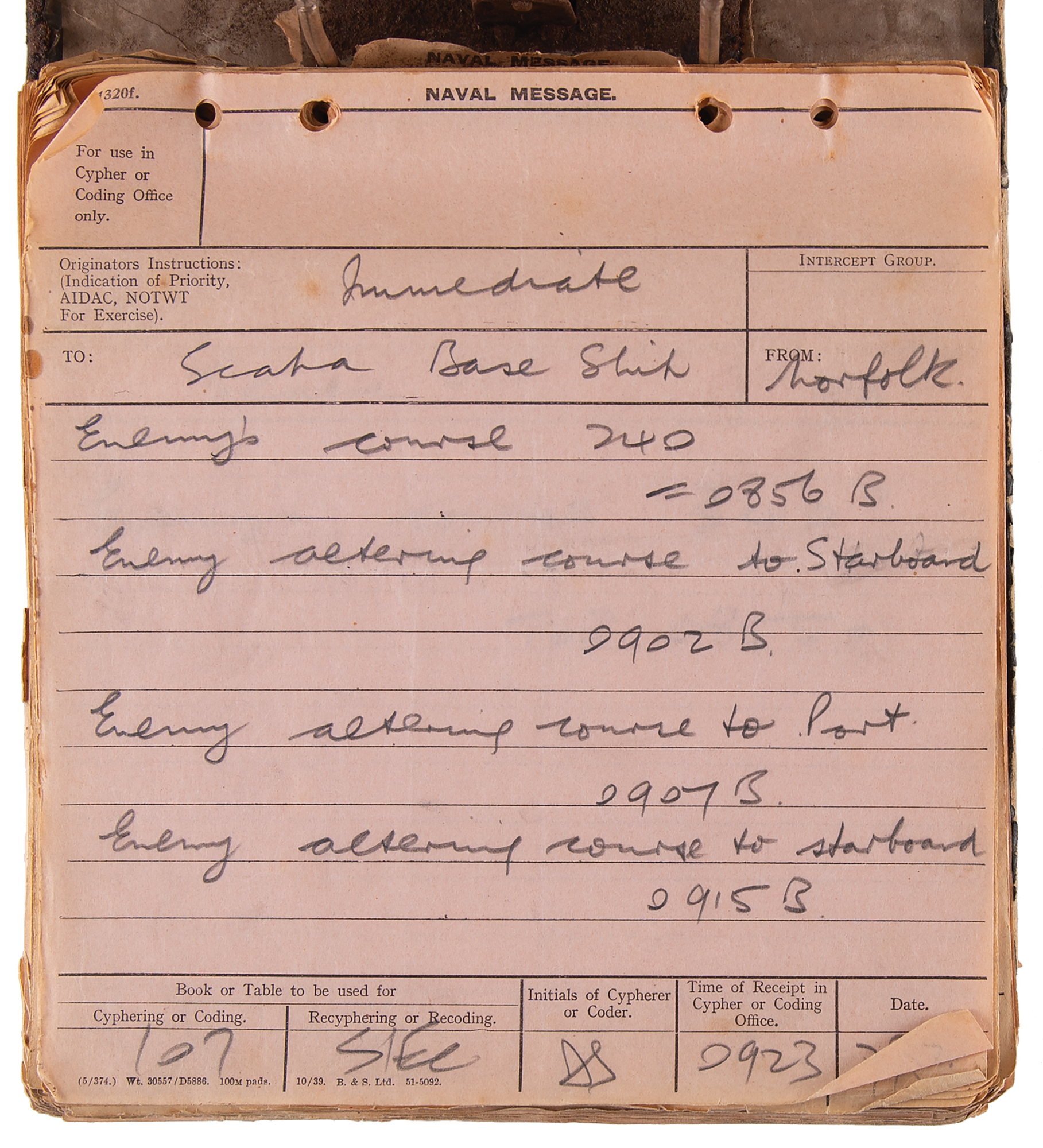
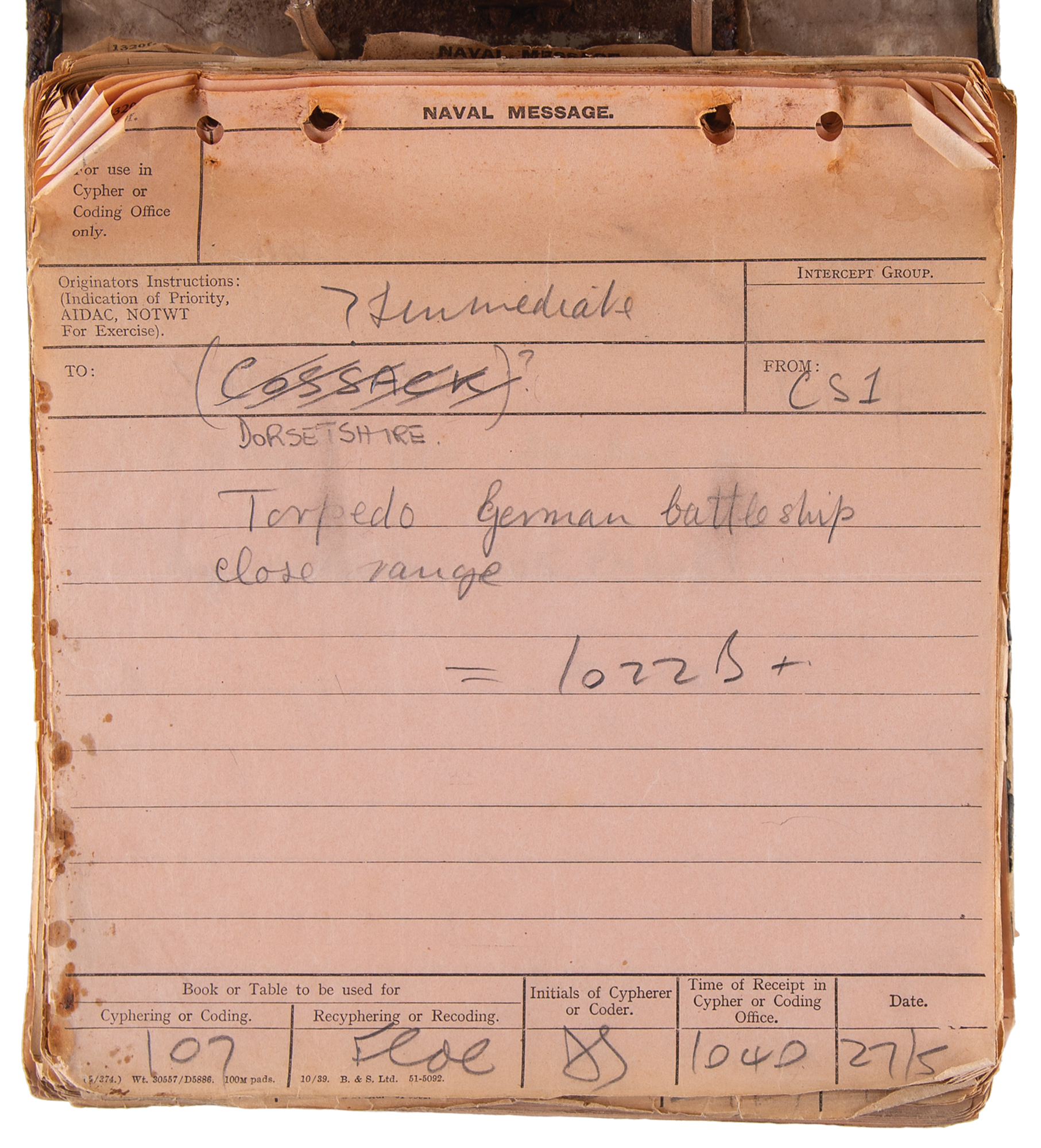
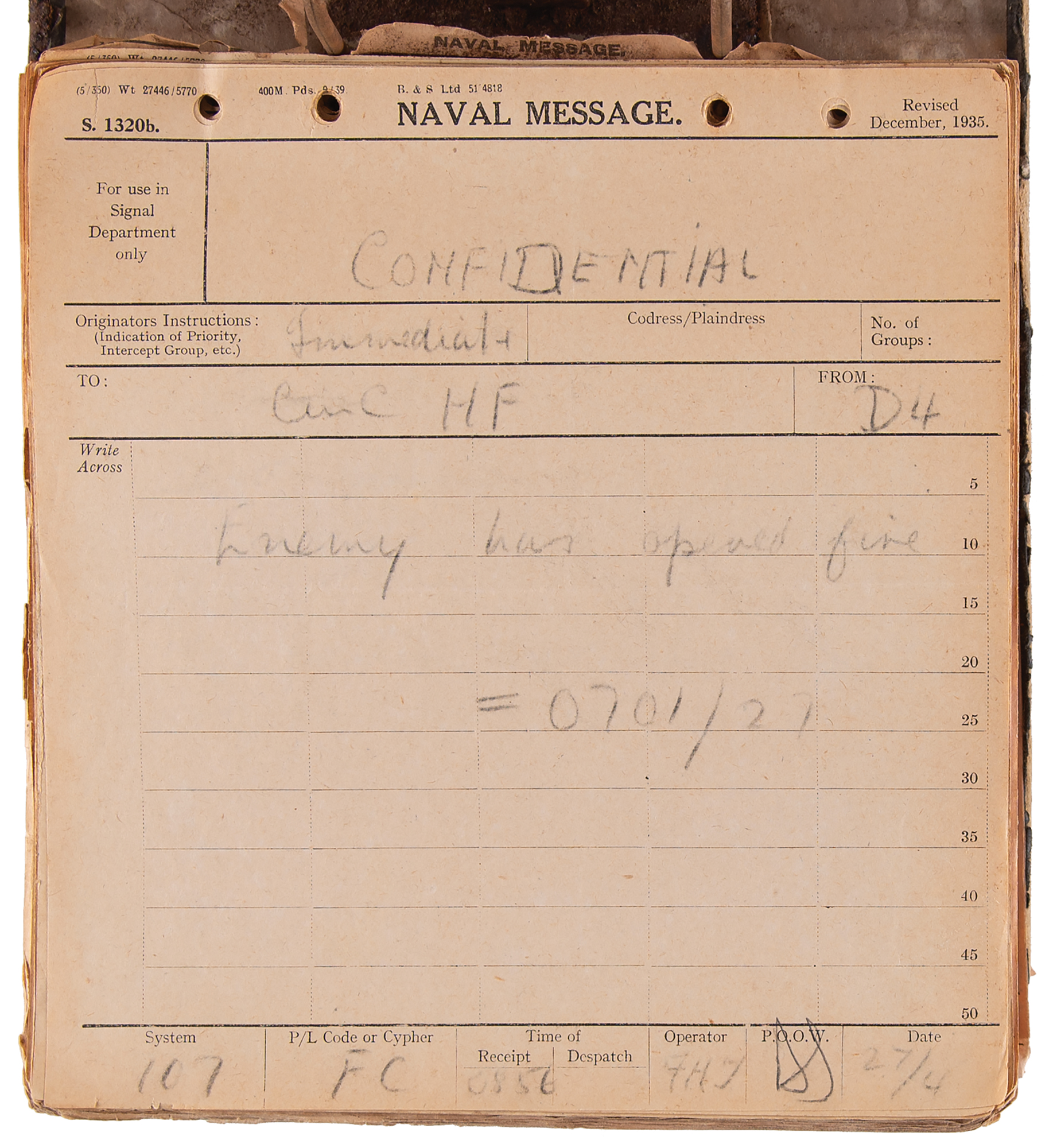
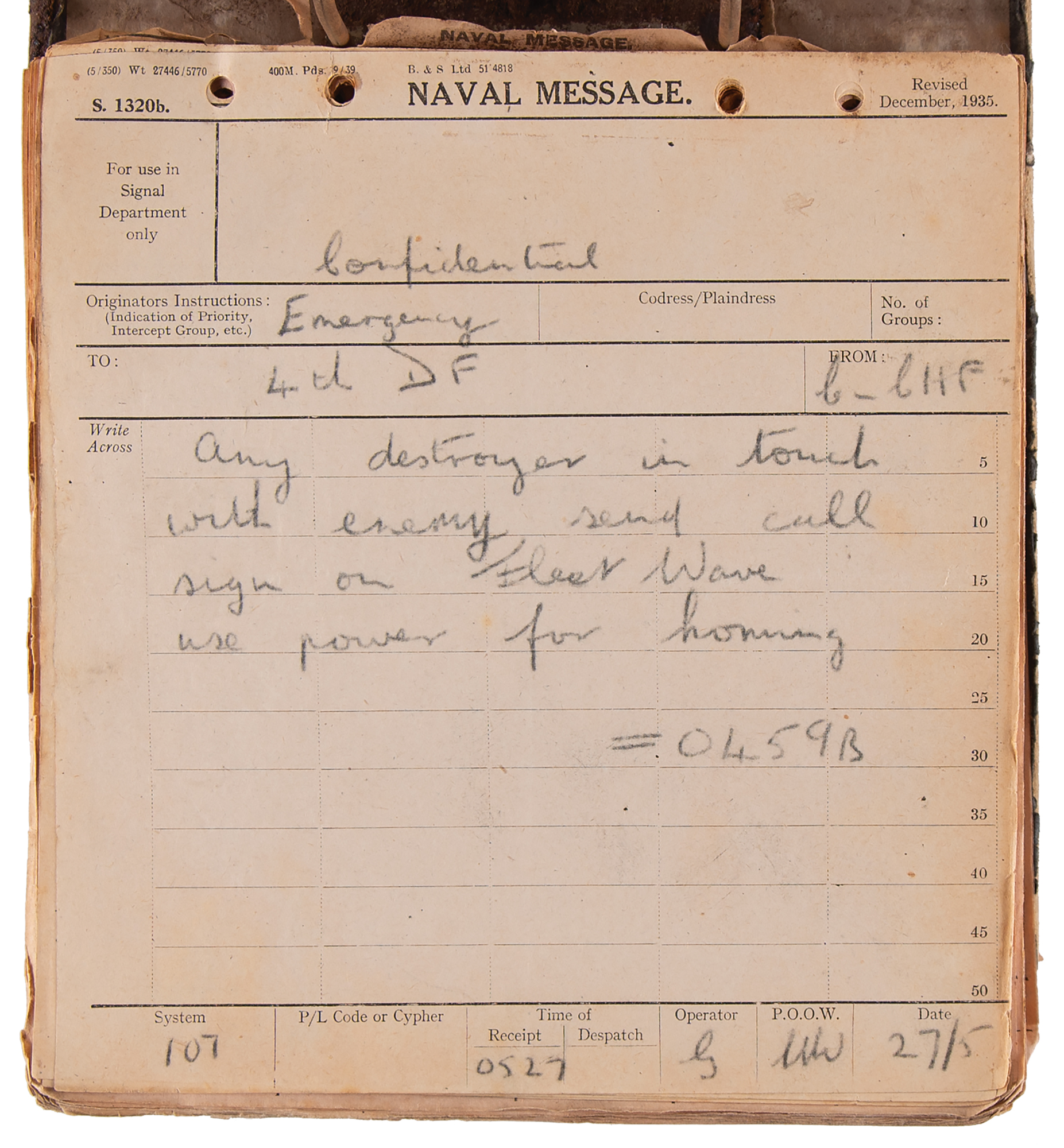
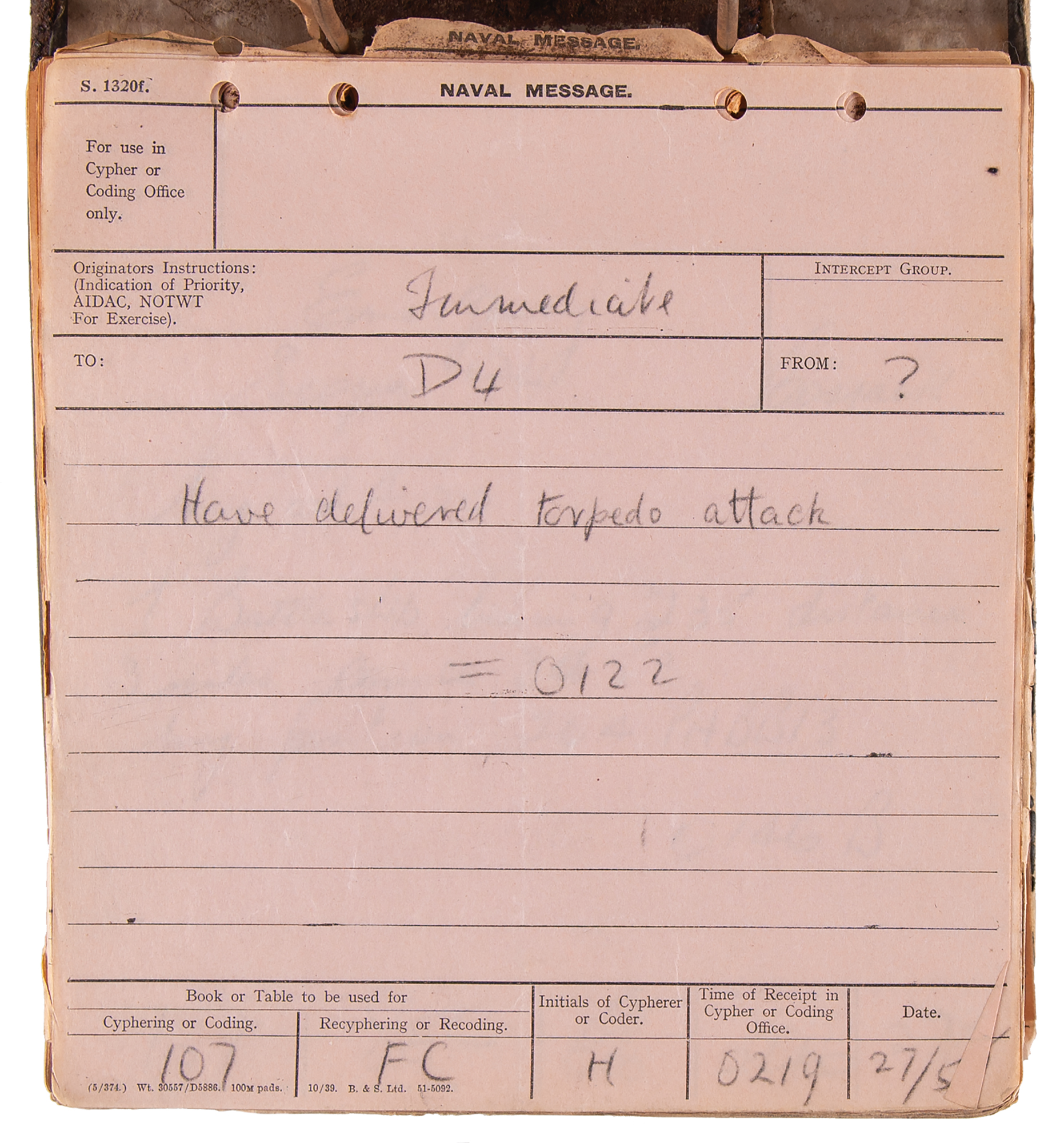
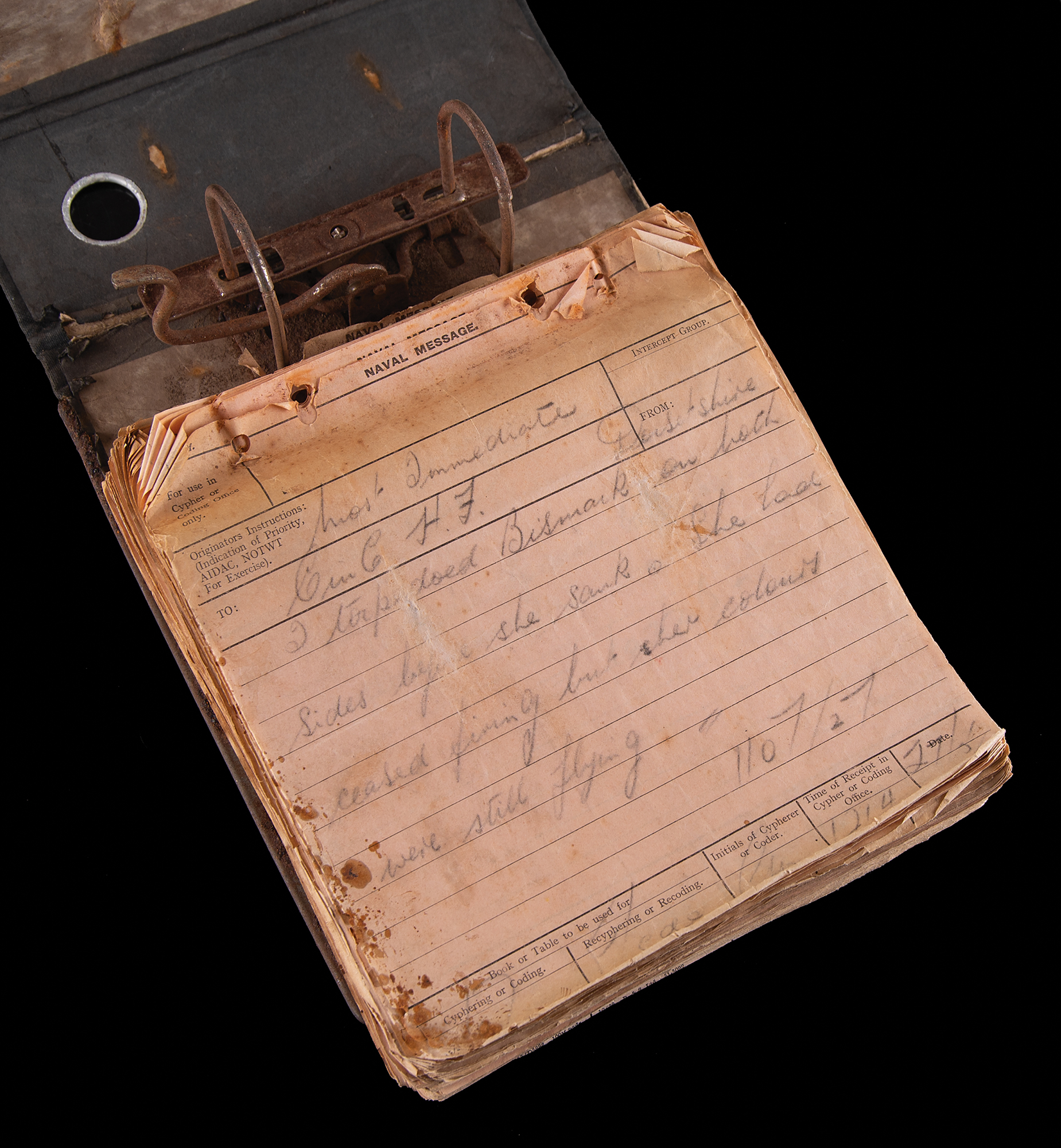
Original file of 258 decoded secret naval messages chronicling the pursuit and sinking of the German battleship Bismarck, dated May 23–27, 1941, contained in a file binder with labels to spine marked, “S-329a, Signal Log, Originals” and “No. 2 Log.” Comprising messages written in pencil and carbon copies on secret signal forms, the file records communications from the Admiralty, Home Fleet ships, the naval base at Scapa Flow, and supporting aircraft throughout the pursuit and final engagement.
The messages begin at 12:50 a.m. on May 23 with a communication from the Admiralty to British ships relaying a sighting of the approximately 45,000-ton Bismarck. During the initial encounters, one of the British warships made visual contact at the dangerously short range of six miles, and Bismarck fired the first shots. Around 5 a.m. on May 24, Prince of Wales signaled the Admiralty reporting a probable battleship at a range of 17 miles; at approximately the same time, Hood confirmed contact. Within the hour, Hood had been sunk with the loss of 1,415 lives, and Prince of Wales had been severely damaged, both events recorded in the messages. At 6:37 a.m.: “HOOD sunk… Proceed to search for survivors.” Forty-three minutes later: “Prince of Wales has a bridge out of action.” At 7:57 a.m., in a message classified “emergency,” Suffolk reported to Scapa that Prince of Wales had scored two hits on Bismarck and that her speed had been reduced. By 10:29 a.m., Norfolk radioed “enemy zigzagging,” and another message stated that she was leaving a “considerable wake of fuel oil.”
The Admiralty dispatched virtually every available ship, including aircraft carriers, for the pursuit, but Bismarck again could not be found. An air search was ordered to begin at dawn, and the search continued in vain throughout May 25. The Admiralty correctly surmised that Bismarck was heading toward western France, and at 10:30 a.m. the following morning, an aircraft sighted her. In an attempt to slow the damaged battleship’s flight and allow the main body of the fleet to close, Swordfish torpedo bombers from Ark Royal undertook an initial strike, associated in the supplied account with a 6:41 p.m. report: “striking force scored no hits.” A subsequent attack at 8:47 p.m. scored two hits from 13 torpedoes launched. One struck the armor belt and had no effect, but the other damaged the propellers, wrecked the steering gear, and jammed the rudders.
A later signal, at 12:46 a.m. on May 27, from the attacking force reported: “after being torpedoed German battleship Bismarck made complete circles and speed reduced.” The signals describe her erratic course during this final phase of the chase, veering from port to starboard and back again. During the night, several destroyers made torpedo attacks. At 2:12 a.m., one reported: “one-hit confirmed. Fire on forecastle.” At 2:34 a.m., the battleship was reported stopped, but a few minutes later she was underway again “and is still capable of heavy and accurate fire.” She continued to zigzag, and at 10:22 a.m. on May 27, Dorsetshire received the succinct order: “torpedo German battleship close range.” Forty-five minutes later, she signaled: “I torpedoed Bismarck on both sides before she sank. She had ceased firing but her colors were still flying.” In very good to fine condition, with edgewear and stains, heaviest to the opening and closing pages; the binder bears rusted parts and overall wear. Accompanied by a custom cloth-bound presentation case.
Launched in February 1939, the state-of-the-art battleship Bismarck embodied Adolf Hitler’s ambition to revive the German surface navy. The intention was that she would evade tracking while wreaking havoc on the Allied convoys supplying Britain. Her pursuit and sinking became one of the most famous and important naval engagements of World War II, with consequences for both Britain’s maritime security and Germany’s use of surface warships in the Atlantic.
Winston Churchill described the stakes in The Second World War: ‘Had she escaped the moral effects of her continuing existence as much as the material damage she might have inflicted on our shipping would have been calamitous. Many misgivings would have arisen regarding our capacity to control the oceans, and these would have been trumpeted round the world to our great detriment.’ It was a battle Britain had to win.
Admiral Karl Dönitz described its importance from the German perspective in his memoirs: ‘The sinking of the Bismarck had… Shown that the enemy had improved his system of patrolling the Atlantic to such a degree that our own surface vessels could obviously no longer operate in these sea areas.’

