The 30 Minute Rule begins December 9 at 7:00 PM EST. An Initial Bid Must Be Placed By December 9 at 6:00 PM EST To Participate After 6:00 PM EST
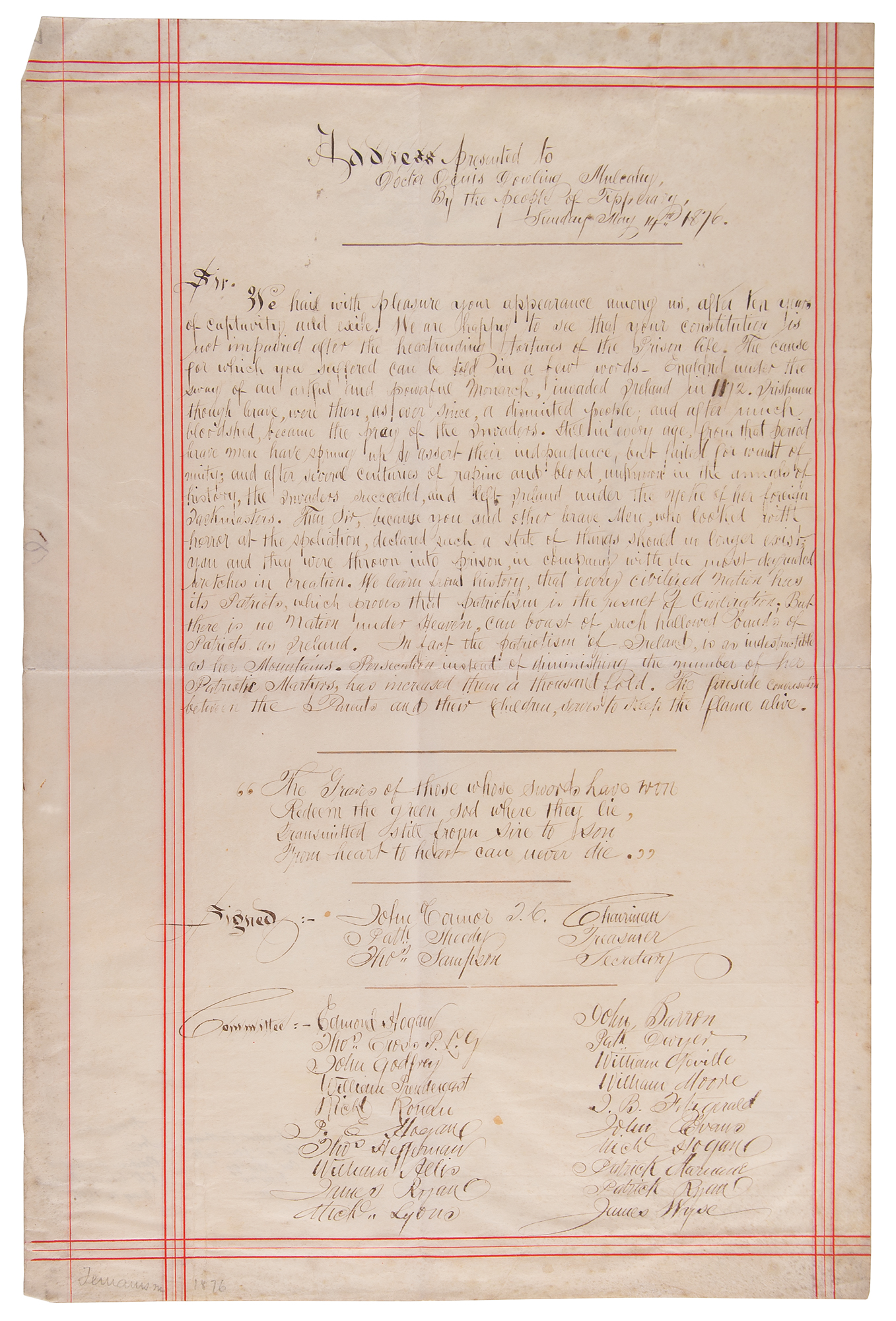
Vellum manuscript address, 13.75 x 20.5, May 14, 1876, document penned in an elegant calligraphic hand within a red-ruled border. Headed “Address Presented to Doctor Denis Dowling Mulcahy, By the People of Tipperary,” the address welcomes the Fenian veteran home, in part: “We hail with pleasure your appearance among us, after ten years of captivity and exile! We are happy to see that your constitution is not impaired after the heartrending tortures of the Prison life.” It recounts Ireland’s centuries of subjugation since the English invasion and the imprisonment of Mulcahy and “other brave Men” alongside “the most degraded wretches in creation,” declaring: “In fact the patriotism of Ireland is as indestructible as her Mountains. Persecution instead of diminishing the number of her Patriotic Martyrs, has increased them a thousand fold.”
The address closes with a stanza of patriotic verse beginning “The Graves of those whose swords have won / Redeem the green sod where they lie,” followed by the names of the committee’s chairman, John Connor, treasurer Patt. Sheedy, and secretary Thos. Sampson, along with 20 committee members. In fine condition.
Born around 1833 in Redmondstown, County Tipperary, Denis Dowling Mulcahy was a medical doctor and a member of the Irish Republican Brotherhood who joined the staff of the Fenian newspaper the Irish People. He was arrested in the paper’s offices in 1865 and sentenced to ten years’ penal servitude, then freed under Gladstone’s amnesty of 1870 on condition that he leave the United Kingdom for the remainder of his sentence. In January 1871 he sailed for New York aboard the SS Russia with eight other released Fenians. His ten-year sentence, handed down in January 1866, would have run its course by the time of this address in May 1876, freeing him to return. Tipperary greeted him as a returning hero. Though he visited Ireland over the years, Mulcahy remained active in the Fenian movement in America, settling in New Jersey, where he died in 1900.

