The 30 Minute Rule begins December 9 at 7:00 PM EST. An Initial Bid Must Be Placed By December 9 at 6:00 PM EST To Participate After 6:00 PM EST
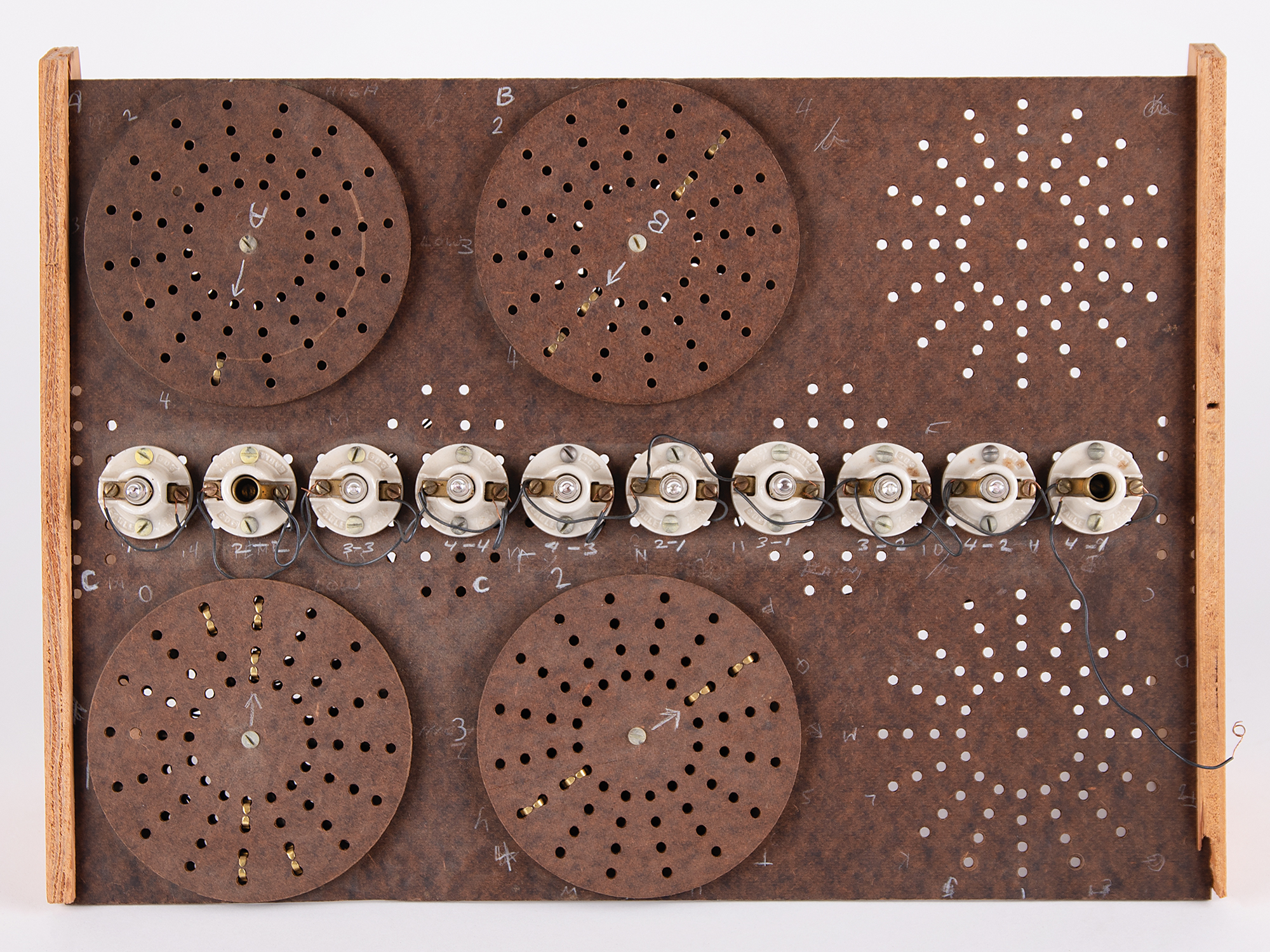
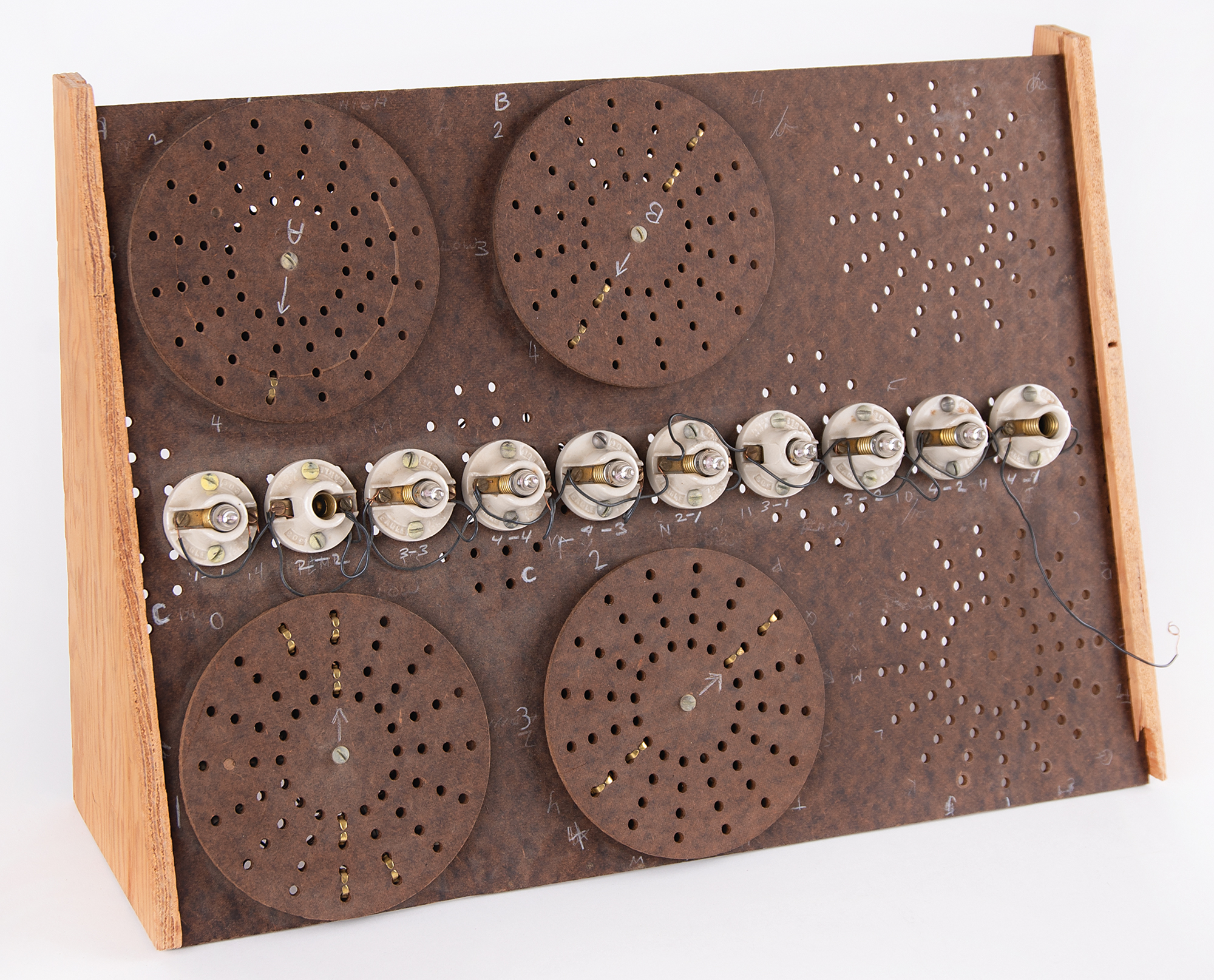
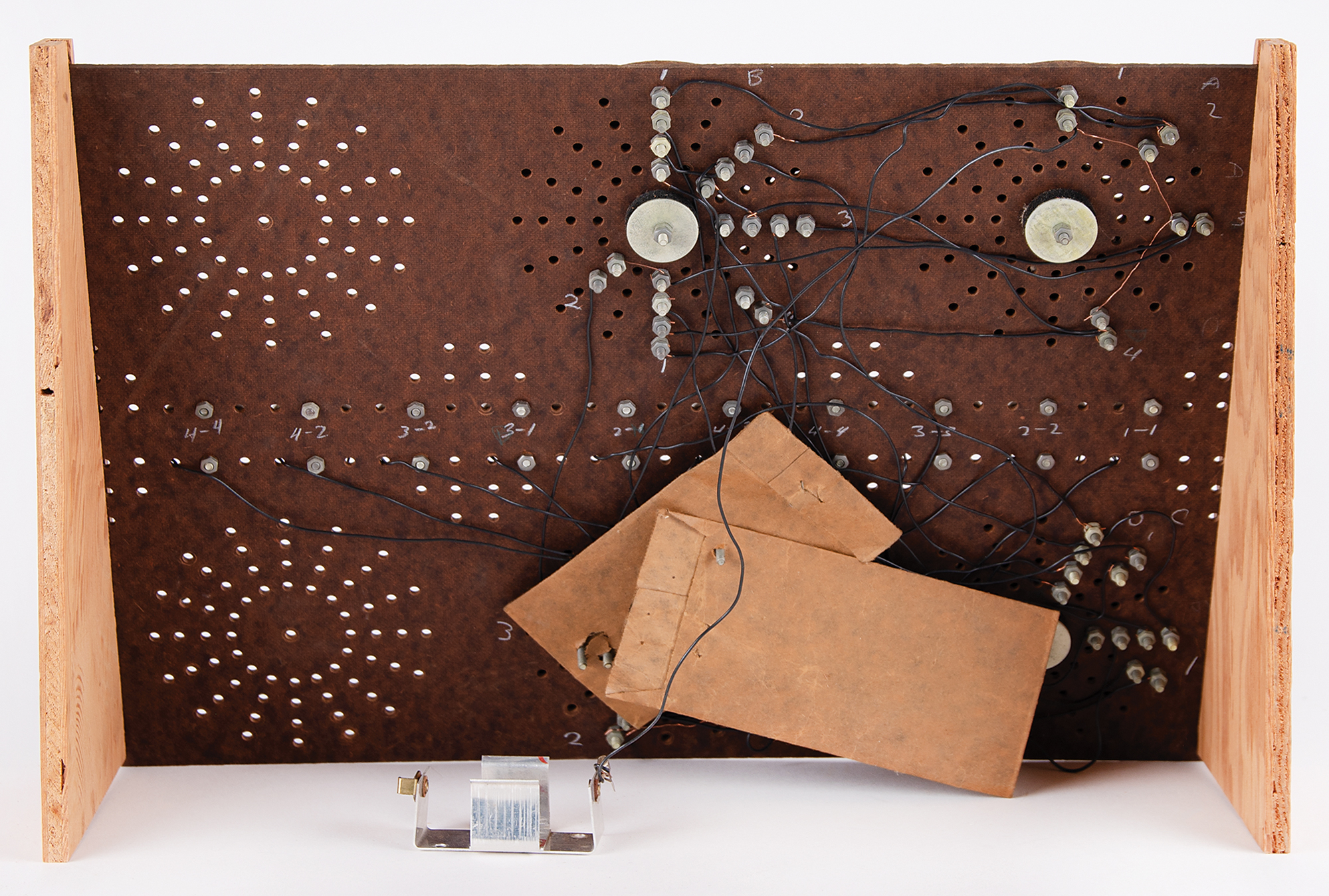
1957 Geniac No. 1 ‘Electric Brain’ mechanical computer construction kit, distributed by the Oliver Garfield Co., preserved with its period shipping box, construction components, instructional material, and Canadian customs documentation. The large perforated Masonite control board, 16.5 x 11.75, retains four of its six circular switching discs in place, 10 porcelain lamp sockets, extensive partial wiring, bolts, nuts, washers, and numerous handwritten working notations; the remaining two switching discs are also present, along with additional wire, hardware, battery/switch holder, insulating pieces, a parts container, two loose bulbs, and the wooden components used to assemble the machine's frame. The reverse of the board retains a complex network of wiring and fasteners corresponding to the experimentation visible on the front.
The original mailing material provides unusually specific contemporary provenance. The Oliver Garfield shipping label identifies the recipient as Robert Jenkins of North Vancouver, British Columbia, Canada, with a U.S. postal meter dated January 29, 1957. Accompanying Canadian customs paperwork includes an "Appraisal Note for Small Collections, Etc.," bearing National Revenue Canada postal markings and a 1957 "Duty Paid" stamp. One side of the box is boldly hand-marked "BOB'S CALCULATOR." The box and contents retain the character of a preserved time capsule, with partial wiring, handwritten working notations, and loose components capturing the kit in a partly assembled, experimental state.
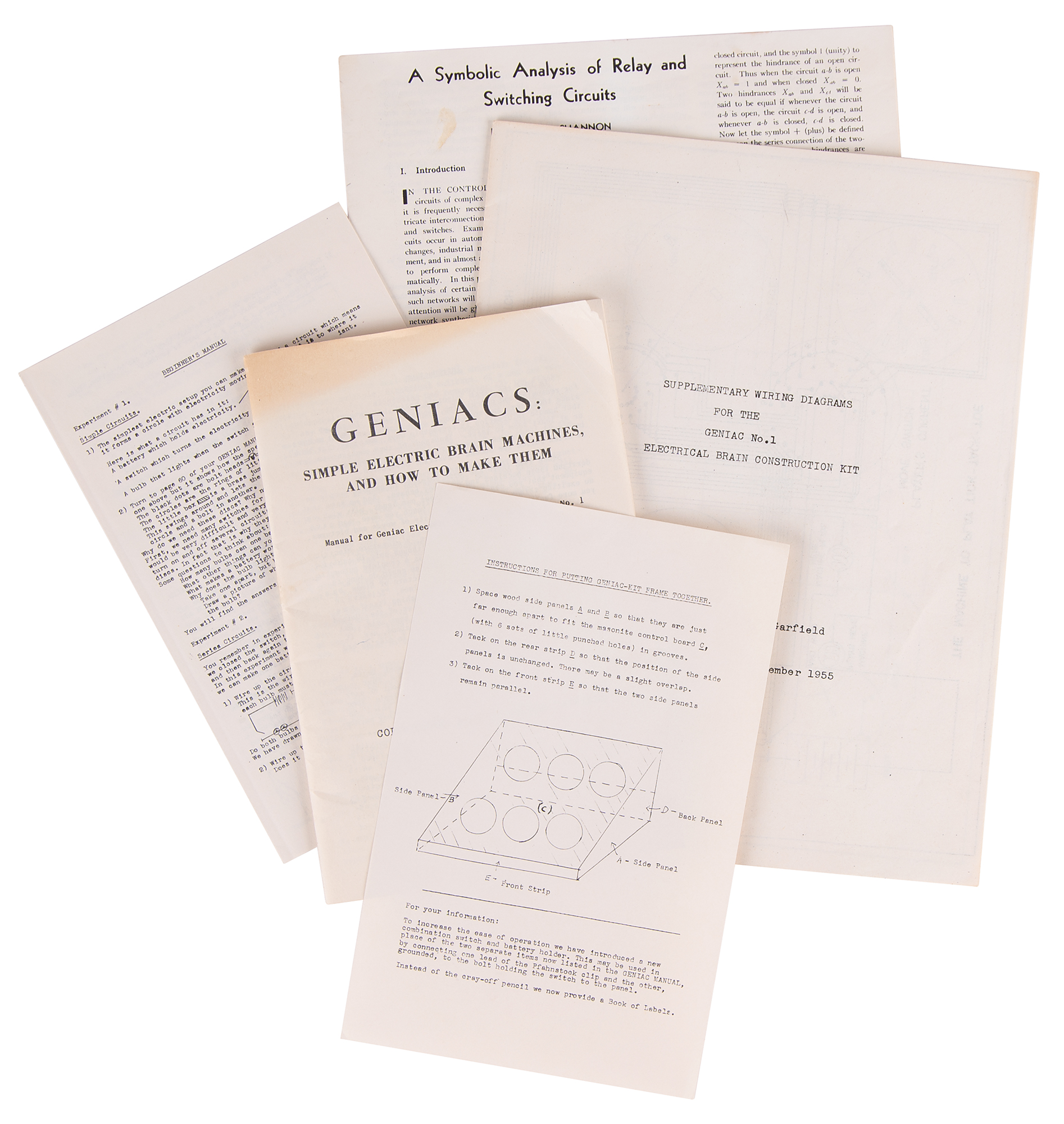
Accompanying instructional material includes the 63-page 1955 booklet GENIACS: Simple Electric Brain Machines, and How to Make Them, by Oliver Garfield, which also serves as the manual for GENIAC Electric Brain Construction Kit No. 1; an eight-page Beginner's Manual; a four-page GENIAC Study Guide; Instructions for Putting GENIAC-Kit Frame Together; Supplementary Wiring Diagrams for the GENIAC No. 1 Electrical Brain Construction Kit, containing 15 diagrams and marked "First Printing December 1955"; the four-page accordion-style pamphlet Labels for GENIAC; and a GENIAC parts price list and order form. Also included is an 11-page reproduction of Claude E. Shannon's landmark paper "A Symbolic Analysis of Relay and Switching Circuits," distributed as advanced instructional material with the GENIAC kit.
Developed by computing author and ACM co-founder Edmund C. Berkeley, GENIAC, short for ‘Genius Almost-Automatic Computer,’ was introduced in 1955 as an inexpensive mechanical computer and educational construction kit designed to bring the principles of computing and Boolean logic into the home. Berkeley conceived GENIAC as an affordable successor to his earlier educational computer Simon, which had cost more than $300 in materials to construct. By contrast, Berkeley's GENIAC manual states that the new construction kit cost less than $18 in January 1956 and could be configured to make more than 30 different "electric brain machines."
Rather than employing relays, vacuum tubes, or transistors, GENIAC functioned essentially as a configurable rotary-switch computer. Its six perforated Masonite discs could be fitted with brass jumpers that established electrical connections with contacts on the similarly perforated control panel, while wiring behind the panel connected the switches, battery, and indicator bulbs. By changing the jumpers and wiring and manually rotating the switches, the operator could configure different machines capable of performing arithmetic and logical operations, solving puzzles, playing games, operating combination locks, and encoding or decoding messages. GENIAC employed combinational logic rather than internal memory or sequential logic, with the user manually supplying the sequence of operations. The extensive surviving wiring and working notations on the present example therefore provide direct physical evidence of the hands-on experimentation central to the kit's purpose.
GENIAC's connection to Claude Shannon went beyond the inclusion of his influential 1938 paper, which demonstrated the application of Boolean algebra to relay and switching circuits and provided the theoretical foundation for the type of logic explored by the kit. Historian Mai Sugimoto documents Berkeley's consultation with Shannon and Bell Labs engineer David W. Hagelbarger during GENIAC's development, mainly on experimental design, materials, cost, and presentation. Sugimoto concludes that more than ten of GENIAC's 33 completed experiments were created as a direct result of this consulting work. GENIAC thus represents an early effort to place switching-logic concepts associated with academic and industrial computing directly into the hands of consumers, allowing users to physically construct and manipulate logical circuits themselves.
Also included is the eight-page pamphlet "A Machine to Compose Music," the prize-winning entry in the 1956 GENIAC contest by 16-year-old John F. Sowa of Pittsburgh. The pamphlet explains Sowa's use of statistical analysis, information theory, and transitional probabilities to construct a GENIAC circuit capable of producing simple melodies. Sowa later became an important computer scientist in artificial intelligence and knowledge representation, developing the theory of conceptual graphs and eventually being elected a Fellow of the Association for the Advancement of Artificial Intelligence.

