The 30 Minute Rule begins November 11 at 7:00 PM EST. An Initial Bid Must Be Placed By November 11 at 6:00 PM EST To Participate After 6:00 PM EST
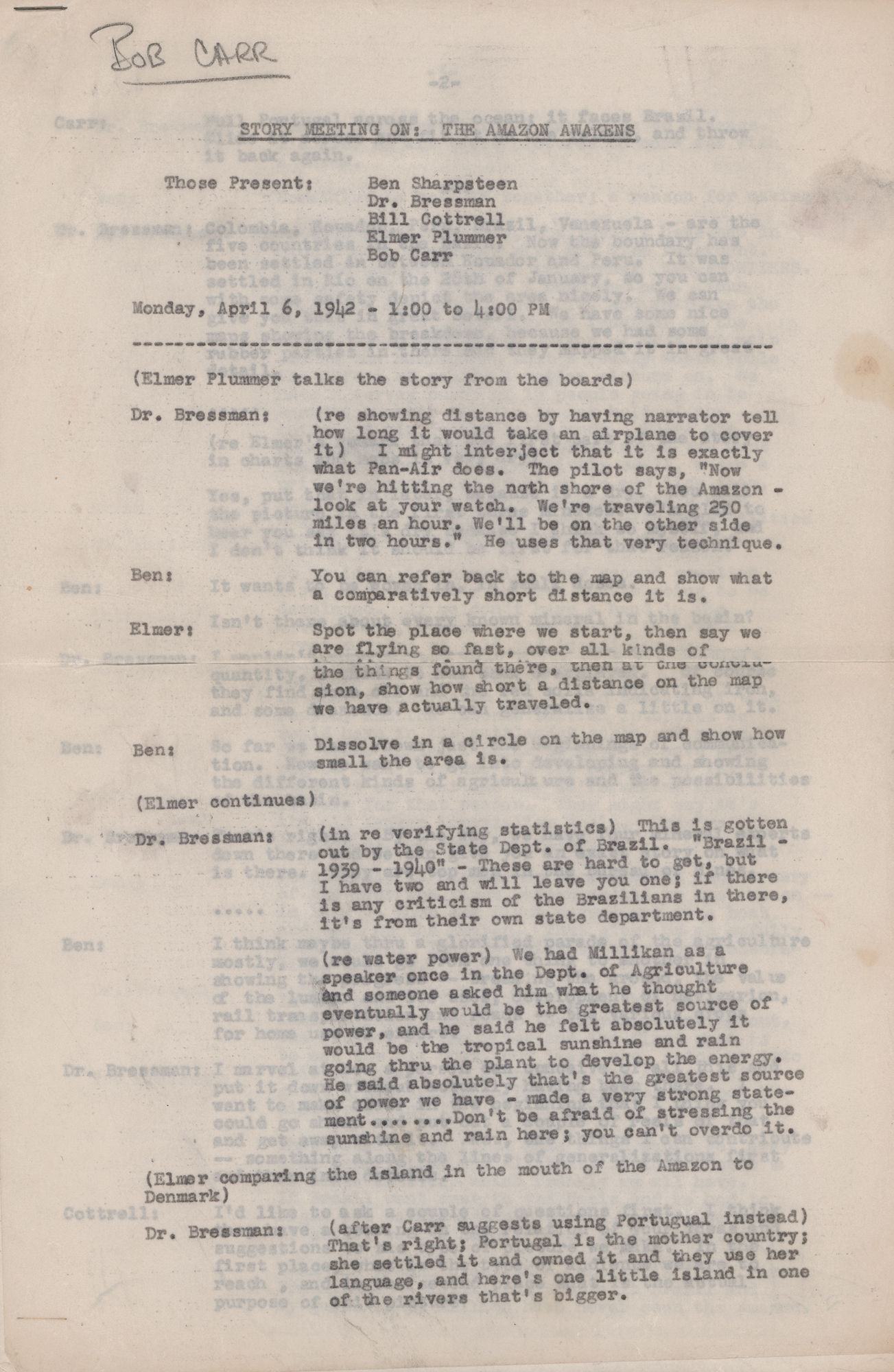
Original internal studio transcript documenting a three-hour creative story meeting at Walt Disney Productions on April 6, 1942, nine pages, 8.5 x 13, capturing the live, unedited dialogue of members of Walt Disney’s golden-age creative team—Ben Sharpsteen, Bill Cottrell, Elmer Plummer, and Bob Carr—as they developed The Amazon Awakens, a significant animated/live-action documentary produced under the U.S. government’s World War II 'Good Neighbor Policy' for the Office of the Coordinator of Inter-American Affairs (OCIAA).
In the dialogue, Dr. Earl N. Bressman, Chief of the Agricultural Section of the OCIAA, outlines his goals to the filmmakers: "I'd like on all these pictures to come out with a theme…On this particular one, the theme I have had in mind I have discussed with the Vice President. We have summed it up in two words: New Frontiers. He happened to publish a book on that. Your frontiers are gone in the U.S. and what are the near new areas? The biggest frontier in the whole hemisphere is the Amazon—it's the main one in the hemisphere that's really worth while the effort of making a motion picture on. We have a survey party of 15 people going in to spend a quarter million to get hold of the thing and tie up the loose ends. There are other spots—northwest Colombia and the west coast of Ecuador, comparatively small, where a private corporation could go in and lick them, but this thing is just something that's even bigger than governments almost. Its possibilities are so great you can't overplay them.
So my idea, in answering your second question first, is that it's an area that's going to be developed. If we don't have a hand in the development, somebody else will. We have a great surplus of gold and technicians and people who want an outlet for their energies, and here's a thing to let them work on… So that's the reason for it and because of that reason, and the intense selfish interests we would have in the settlement angle and maybe the trade angle, I think we have to have some peg to hook this on, and the reason for it. We can't come out and say we're making the picture for that reason. They might say it's the old Yankee imperialism again. They're looking at the selfish angle.
Fortunately it happens to be the 400th anniversary of the year the first person sailed up the Amazon in 1542—when the first person got in a boat and went up the Amazon. That gives us an awfully good reason. They're going to have some celebrations over it.
In the opening I'd like to see a little ship like Columbus going up the river, starting out. The subject is the river and the first shot is to see the old boat, 400 years ago, going up into this big area. It introduces the Amazon and gives a historical angle; it's a peg to hook the picture on and it's of interest.
That would be my first idea you would get away from imperialism and all that, if they accuse is of those motives, which frankly we all have. If Brasil went over to the Nazis and we had to fight the battle against them…we have so much at stake, we can hardly think about it….etc.
Then the second question—who is it for? First, Brazilians—40 million people in Brazil and my guess is 39 million have never seen the Amazon. Vargas was the first president in the history of the country who has ever seen it. They have the biggest river in the world there, and they don't know anything about it. It's like showing people in New York the dust bowl. I think every last person in Brazil and the U.S. and the other five countries in addition to Brazil would have an interest in the picture."
In very good to fine condition, with the last page detached.
From the collection of Gerda Robison, who worked as a story researcher and stenographer for Disney in the 1940s and 50s. She authored the book Dark Lady, and later served as Cecil Beaton's assistant on My Fair Lady.

