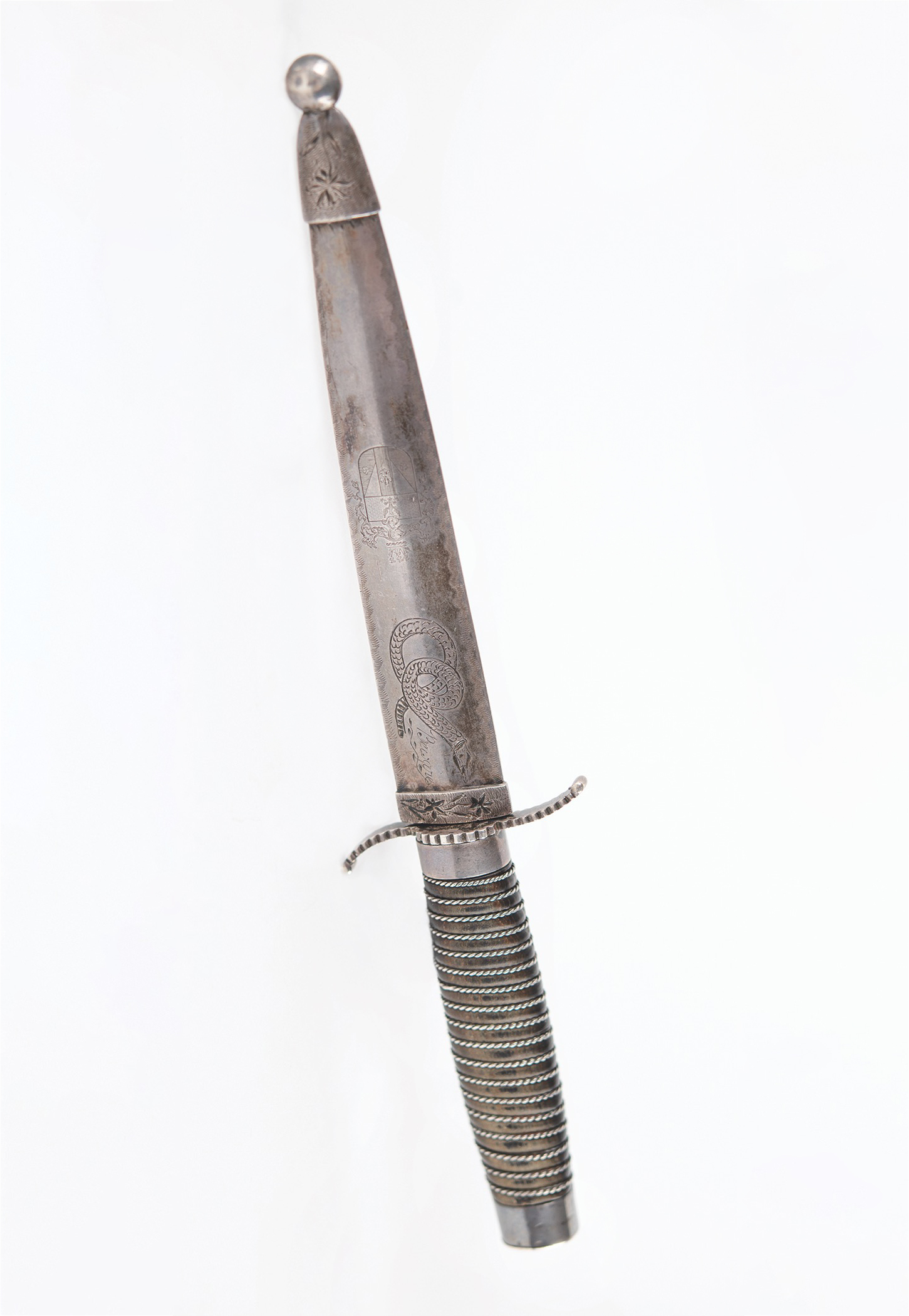
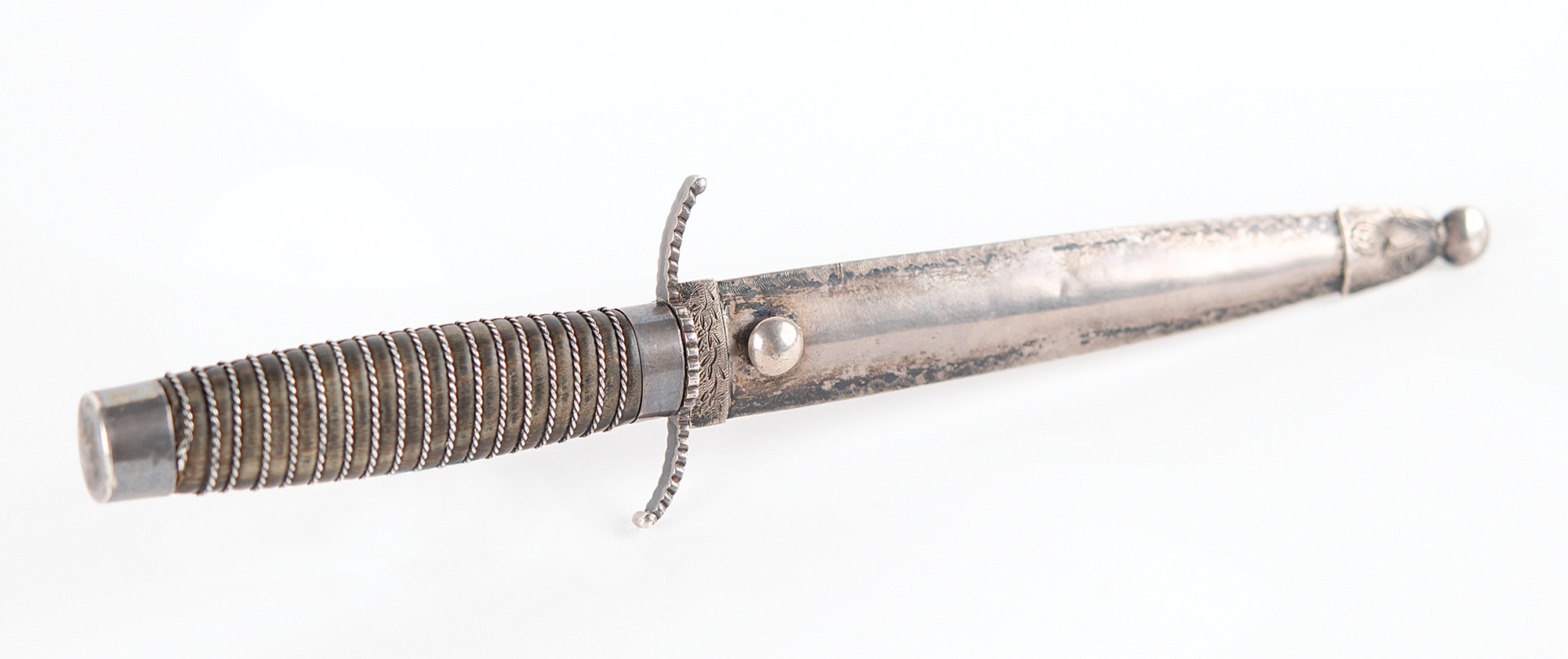
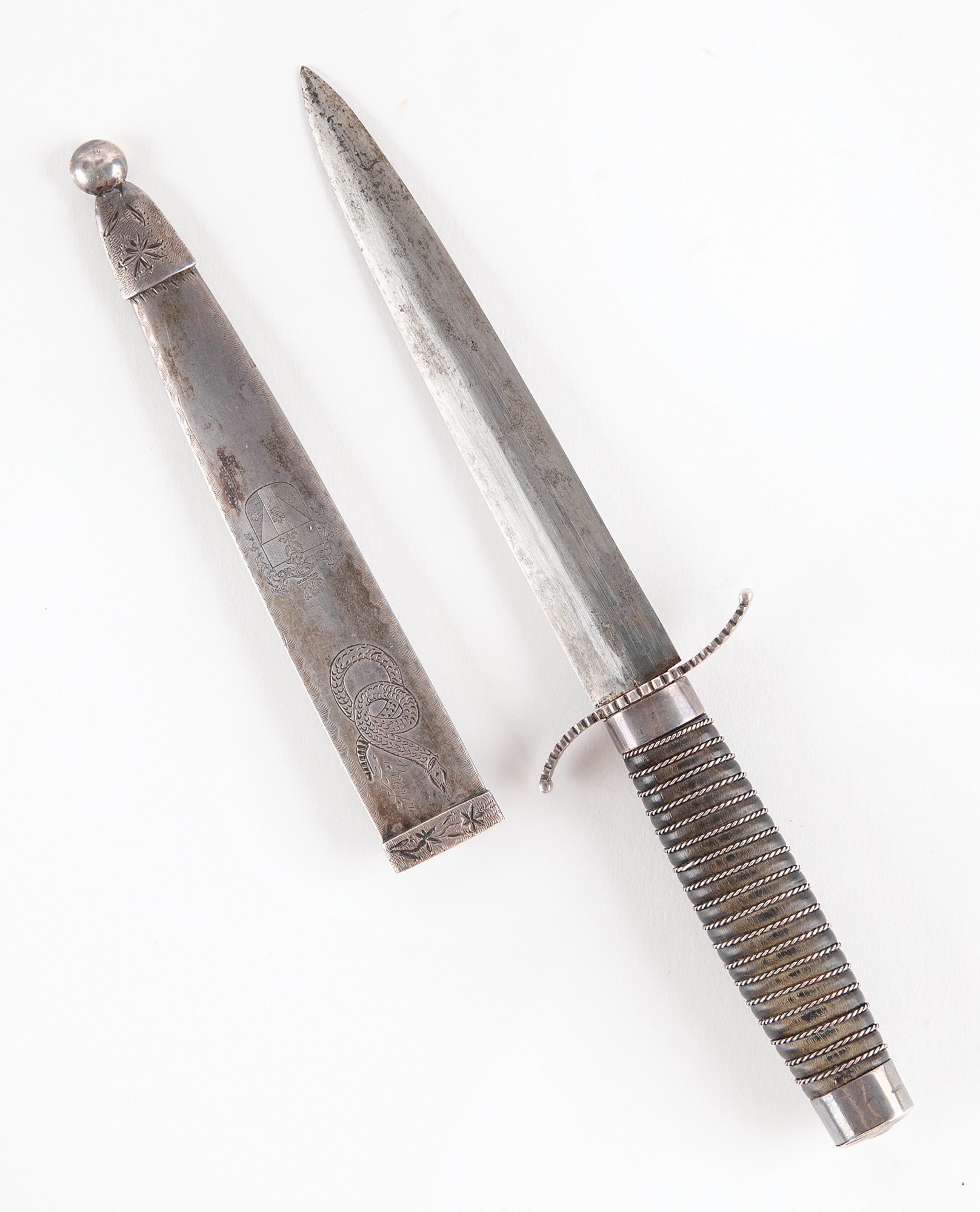
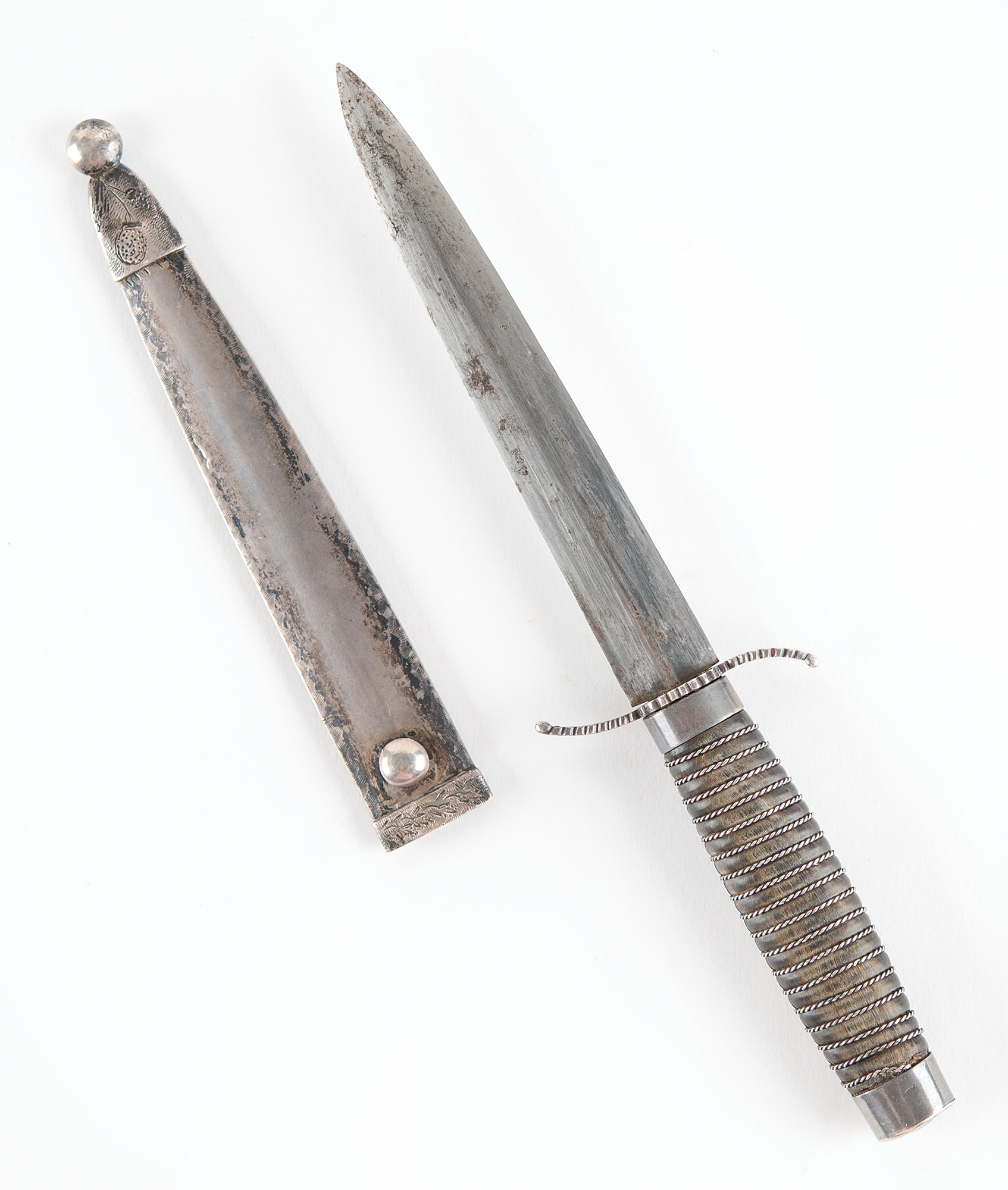
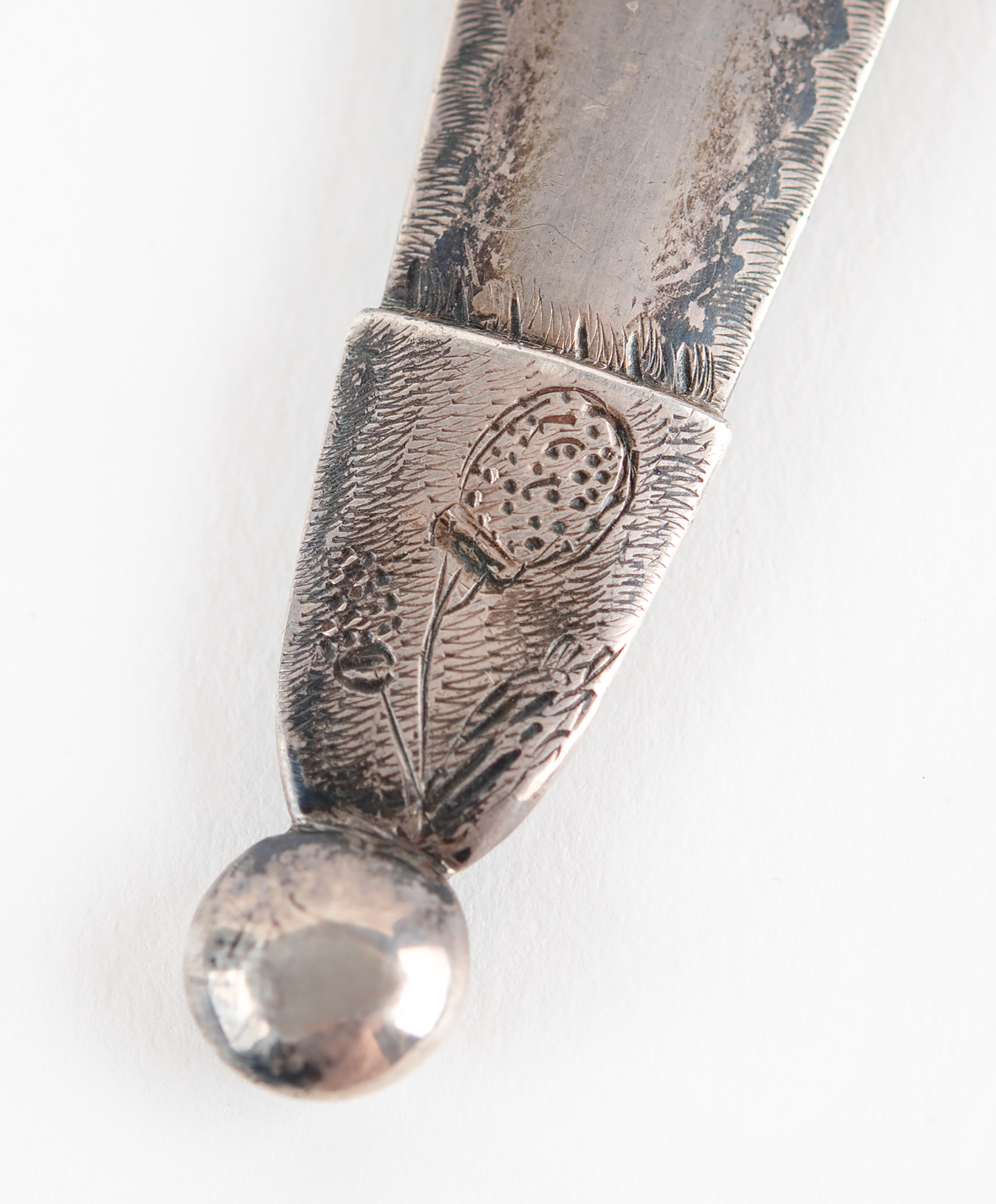
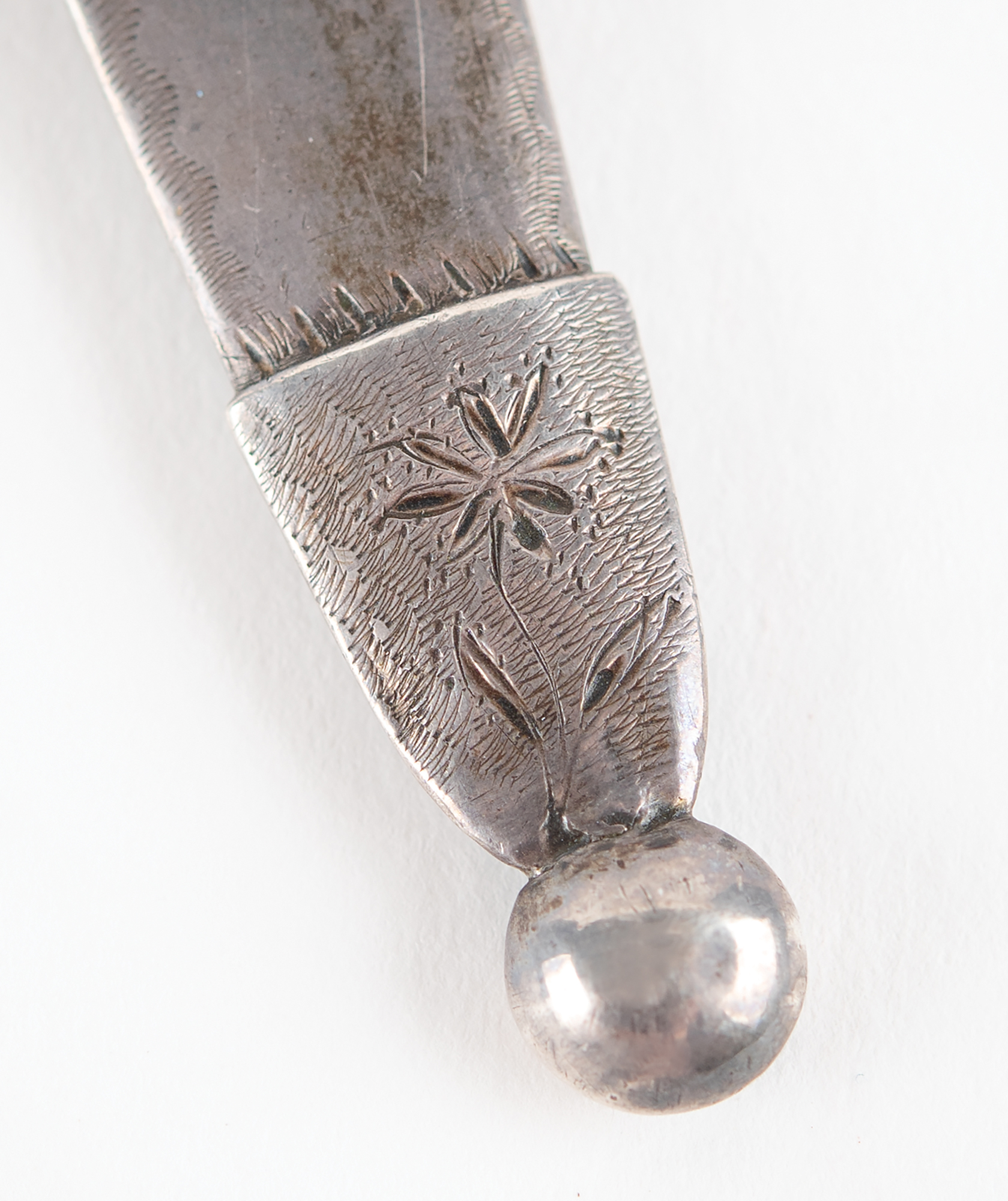
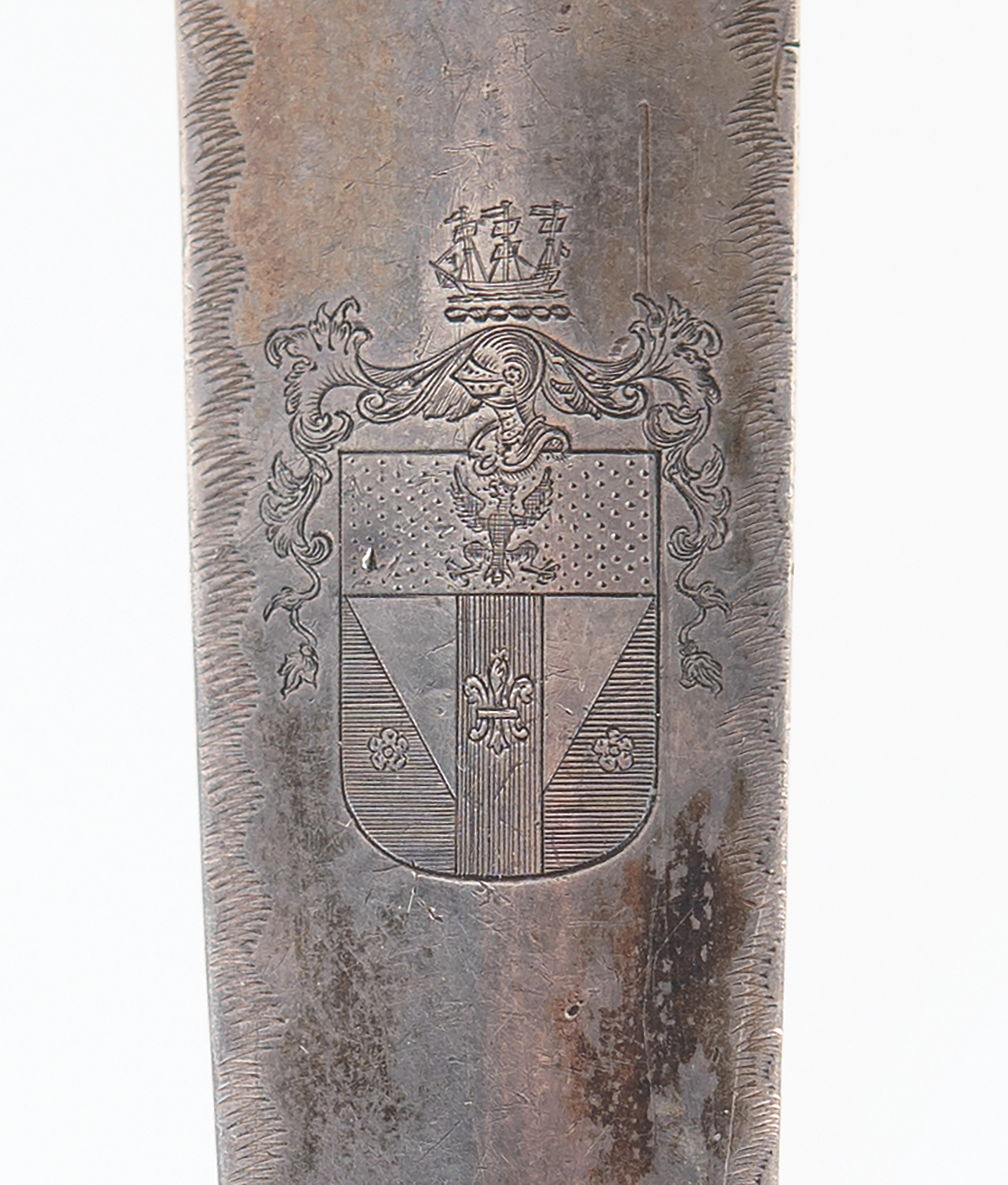
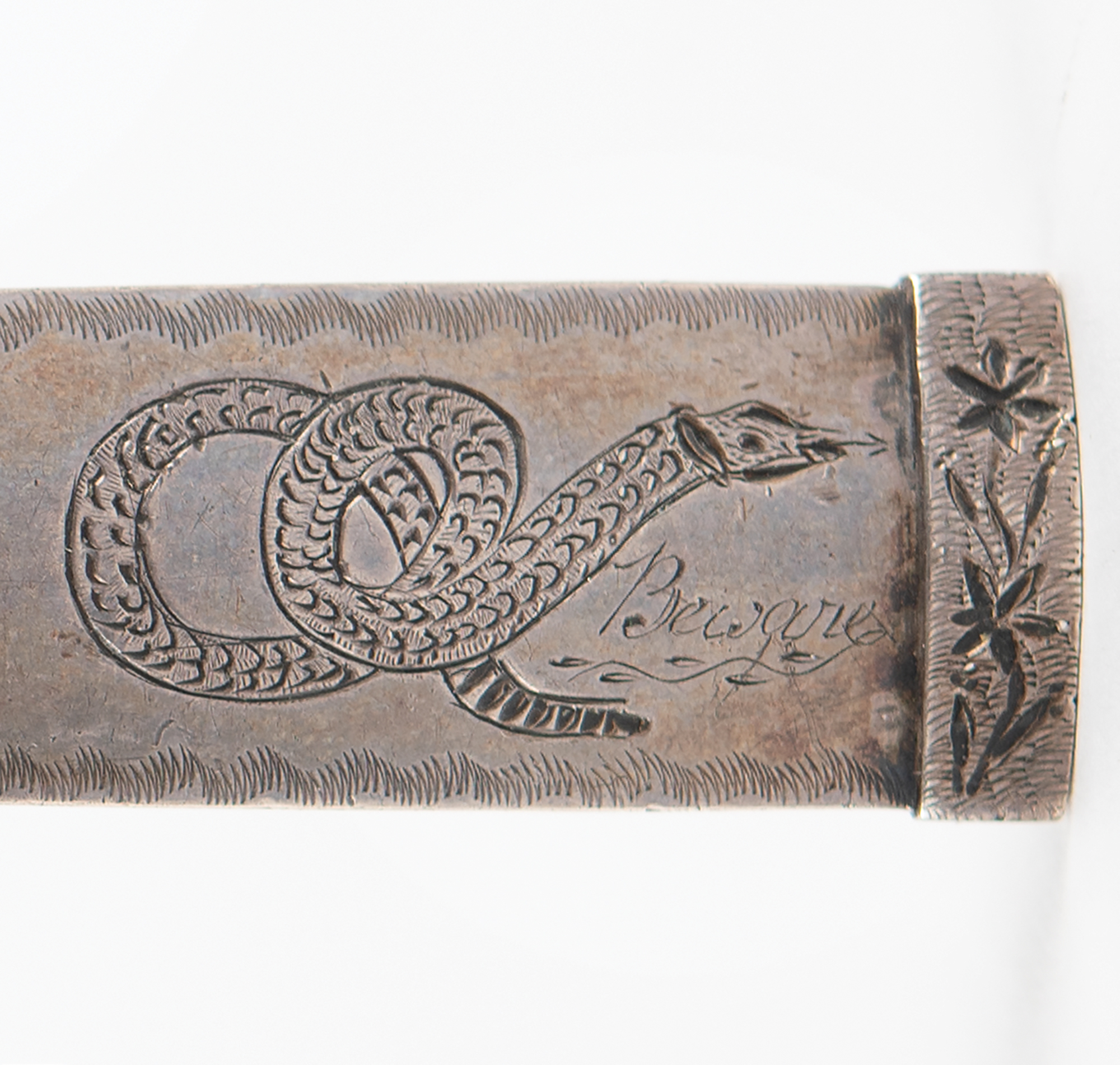
A beautifully made early 19th-century American dagger, 8 1/8" overall, with a 4 1/2" straight, double-edged blade lacking a ricasso. The steel has an overall bright gray patina with spots of thin freckling along its length that darken slightly towards the tip. The hilt has reversed, scalloped-edge quillons, a smooth silver ferrule, and silver wire-wrapped horn grip with smooth silver pommel. The design and quality of workmanship of the dagger is typical of the Federal Period, especially the years leading up to and just after the War of 1812. The silver sheath has an older, original engraved coat of arms of the distinguished and historic Pumpelly family of central New York (the arms: argent chaussé on a pale gules, accosted by two roses in base [on the azure]; a fleur-de-lis or; a chief of the last an eagle displayed sable; crest: on an esquire's helmet, ornamented with a wreath of colors and lambrequins of azure and argent, a ship on stormy waves) executed skillfully on the side opposite the frog stud. The scabbard has further engraving, added later and by a different hand, depicting floral vignettes at the tip and throat, as well as a double coiled rattlesnake with extended tongue next to the word "Beware" - the emblem found on the membership badges of Tammany Hall as approved by an order of January 11, 1790. On the handful of original Tammany badges of this design known to exist today, the central motif is further surrounded by the legend: 'Where Liberty dwells, there is my Country / Octr. 12th 1492.'
The Pumpellys were descended from Jean Pompili, a Franco-Italian Huguenot from Avignon who left France for New England some time in the early 18th century. His son, also named Jean, became a ship captain based in Plymouth, MA, and drowned by accident in 1727, shortly before the birth of his only son: John Pompilie (alternately spelled 'Pumpely,' then 'Pumpelly' as the name became anglicized). John did not have a happy home life after his mother remarried, and ran away from home at the age of fifteen to enlist in Capt. Loring's Company of His Majesty's Massachusetts Provincial Regiment of Foot as a drummer boy. He saw combat service in the French and Indian War where he distinguished himself for bravery; being promoted to Sergeant for carrying dispatches through hostile territory to and from the besieged and doomed garrison at Fort William Henry. Pumpelly re-enlisted several times during the course of the war, also taking part in the Crown Point Expedition and Battle of Lake George, the Siege of Louisbourg, and the Battle of the Plains of Abraham where both Montcalm and Wolfe were mortally wounded. Additionally, Pumpelly served as a member of Rogers' Rangers, and was both a messmate and friend to Ebenezer Webster, the father of famed NH congressman and statesman Daniel Webster. He settled in Salisbury, CT, after marrying Hannah Bushnell, daughter of Captain Samuel Bushnell of Salisbury, and during the ensuing Revolutionary War, John served as Commissary to General Israel Putnam, himself also a veteran of Rogers' Rangers and fellow Connecticut resident. John would also serve as the Superintendent of the Ironworks at Mount Riga in Salisbury, which produced cannons and assorted munitions throughout the Revolutionary War period. John would move to Boone County, NY, in 1803, where his son James had become a wealthy surveyor and land agent. John spent the remainder of his life as a gentleman farmer and passed away in 1819 at the incredible age of 92. John and Hannah would have seven children in all: James, Charles, Jerusha, Maria, Harriet, William, and Harmon. All of the Pumpelly sons became prominent men within central New York social and business circles, but William's youngest son Raphael is the most well-known today as a prominent American geologist and explorer of the mid-late 19th century who conducted geologic surveys in Japan, China, Mongolia, and Siberia, including the first extensive survey of the Gobi Desert. Raphael Pumpelly summered in Dublin, NH, and the trail leading from his old property near Dublin Lake to the summit of nearby Mt. Monadnock is still named the "Pumpelly Trail" in his honor.
Despite their prominence in both state and financial affairs, there is no known connection between the Pumpelly family and the Tammany Hall political machine except one of animosity towards the corruption and graft so prevalent in Tammany dealings after the rise of William 'Boss' Tweed to Tammany's overall leadership in the 1860s. It is easy to conclude, therefore, that the addition of Tammany Hall symbolism to the scabbard was instead commissioned by a subsequent unknown owner, unrelated to the family, and one who had much different political leanings. It is even possible that the dagger was used as a distinctive badge of membership for the owner in lieu of the metal badges worn by members as described above. Whatever the reason, the addition of the distinctive design adds an intriguing twist to what is already an exceptional example of an early Federal period American dagger. It would make a splendid addition to any fine collection of early American antiques or War of 1812-era American edged weapons.

